Learning Tree International devient partenaire de formation agréé ServiceNow et entend accompagner les entreprises dans l’adoption des plateformes numériques en entreprise

HERNDON, Virginie, 24 juill. 2026 (GLOBE NEWSWIRE) — Learning Tree International, acteur mondial de référence de la transformation des compétences professionnelles, annonce ce jour avoir décroché le statut de partenaire de formation agréé ServiceNow. Cette reconnaissance étend son offre d’accompagnement au développement des compétences en entreprise et des stratégies d’adoption nécessaires en vue d’optimiser la valeur maximale de leurs investissements ServiceNow.

À travers ce partenariat, les parcours agréés ServiceNow viennent enrichir le catalogue de formation de Learning Tree, qui intègre plus de 600 références animées par des instructeurs experts, mais aussi son cadre méthodologique axé sur l’adoption de l’intelligence artificielle. Cette méthodologie apporte une approche structurée aux entreprises, leur permettant de passer de la simple notion de sensibilisation à l’IA à la montée en compétences des équipes, à embrasser son usage et à obtenir des résultats mesurables. Elle contribue en outre à garantir que les investissements technologiques s’appuient sur les compétences professionnelles, les comportements et les pratiques de conduite du changement nécessaires à une réussite durable. Ensemble, ces critères aiguillent les clients vers une démarche concrète axée sur le développement des compétences de leurs équipes, l’accompagnement au changement et l’optimisation de la valeur dégagée par sa plateforme.

Faire de la formation ServiceNow un levier de transformation des compétences professionnelles

Si de nombreuses entreprises investissent dans des plateformes performantes, elles rencontrent encore des difficultés lorsqu’il s’agit de les faire converger vers une adoption effective par les utilisateurs. Learning Tree répond à cet enjeu en alliant formation technique et accompagnement de la montée en compétences, et vient apporter les connaissances, la confiance et les moyens concrets nécessaires pour aider les collaborateurs à profiter pleinement des fonctionnalités de ServiceNow.

À l’heure où l’intelligence artificielle s’intègre aux plateformes d’entreprise et aux modes opératoires, le cadre méthodologique axé sur son adoption développé par Learning Tree aide les entreprises à compléter la formation technique par des dispositifs de préparation, des parcours de formation adaptés aux différents métiers et des démarches de conduite du changement indispensables pour que les entreprises puissent capitaliser chaque jour sur ces nouvelles fonctionnalités et en faire une valeur concrète.

« ServiceNow aide les organisations à repenser leur manière de travailler. Cette vision fait directement écho à ce que nous observons chez nos clients, à savoir qu’une transformation ne produit des résultats durables que lorsque les collaborateurs disposent des compétences, de la confiance et de l’accompagnement nécessaires pour adopter de nouvelles façons de travailler », observe David Brown, PDG de Learning Tree International. « Partenaire agréé de ServiceNow, Learning Tree aide les entreprises à aligner la montée en compétences de leurs équipes sur leurs investissements technologiques dans le but d’en appuyer l’adoption, de renforcer la performance opérationnelle et de transformer les plateformes enrichies par l’intelligence artificielle en résultats métiers mesurables. »

Un accompagnement global au service des clients ServiceNow

Dans le cadre de ce partenariat, Learning Tree propose à ses clients :

  • des parcours agréés ServiceNow conçus pour renforcer la maîtrise de la plateforme par les utilisateurs et jouer en faveur du succès de son adoption ; et
  • des formations animées par des experts, alignées sur les modes opératoires, les priorités de l’entreprise et les besoins propres à chaque métier.

Une approche intégrée du développement des compétences professionnelles associant la maîtrise de la plateforme aux compétences en leadership, aux modes opératoires et à la préparation à l’IA nécessaires pour inscrire le changement dans la durée.

Déployer les compétences professionnelles à l’échelle mondiale grâce à un réseau de formation international

Forte de plus de 50 ans d’expérience et d’un modèle de formation déployé à l’échelle mondiale, Learning Tree met son expertise au service de l’environnement ServiceNow. Son empreinte internationale permet aux entreprises de proposer des parcours de formation cohérents sur tous leurs sites tout en adaptant les dispositifs d’accompagnement aux besoins des équipes en charge de la plateforme, des utilisateurs métiers et des responsables de la transformation. À l’appui de son cadre méthodologique axé sur l’adoption de l’intelligence artificielle, Learning Tree aide les entreprises à piloter une démarche d’adoption homogène entre leurs différentes régions, équipes et fonctions en adaptant les parcours de formation aux besoins spécifiques des utilisateurs de ServiceNow, des responsables métiers et des équipes en charge des programmes de transformation.

Ce partenariat institue également une collaboration durable entendant répondre à la demande croissante des entreprises pour les formations agréées ServiceNow, adaptées à différents métiers, et pour l’accompagnement de la transformation portée par l’intelligence artificielle. En associant les formations agréées à une démarche plus globale d’adoption, Learning Tree aide ses clients à passer du déploiement de la plateforme à une adoption durable par les utilisateurs.

Le partenariat plus large conclu entre Learning Tree et ServiceNow témoigne bien de l’engagement de Learning Tree à aider les entreprises à compléter leurs investissements technologiques par les compétences, les modes opératoires, les pratiques de conduite du changement et les démarches d’adoption de l’IA indispensables pour créer une valeur durable.

Favoriser une adoption mesurable de l’intelligence artificielle

En conjuguant les formations officielles ServiceNow, sa propre expertise en développement des compétences professionnelles et son cadre méthodologique axé sur l’adoption de l’IA, Learning Tree aide les entreprises à mieux préparer leurs équipes à :

  • asseoir la maîtrise de la plateforme et la confiance des utilisateurs ;
  • rendre les modes opératoires plus efficaces et relever la qualité des services ;
  • se préparer à suivre des modes de fonctionnement enrichis par l’intelligence artificielle ; et
  • pérenniser la valeur à long terme de la plateforme par le renforcement des compétences internes.

À propos de Learning Tree International

Learning Tree International est un acteur mondial de référence du développement des compétences professionnelles et de la formation technologique. Depuis plus de 50 ans, Learning Tree accompagne les entreprises et les professionnels du monde entier dans l’acquisition des compétences essentielles pour réussir dans un environnement en constante évolution. Dispensés en présentiel, à distance ou en mode hybride, ses parcours permettent aux individus comme aux entreprises d’appuyer leur transformation, d’améliorer leurs performances et d’obtenir des résultats durables. Son cadre méthodologique, axé sur l’adoption de l’intelligence artificielle, aide les entreprises à développer le niveau de préparation des équipes, les compétences adaptées à chaque métier et les pratiques d’adoption nécessaires pour transformer leurs investissements dans les technologies enrichies par l’intelligence artificielle en résultats concrets.
Pour en savoir plus, rendez-vous sur la page www.LearningTree.com.

ServiceNow, le logo ServiceNow et tous les autres noms de marques signés ServiceNow sont des marques commerciales ou des marques déposées de ServiceNow, Inc. aux États-Unis et/ou dans d’autres pays.

Demandes médias
Learning Tree International
E-mail : [email protected]
Site Internet : www.LearningTree.com


GLOBENEWSWIRE (Distribution ID 9767761)

Learning Tree International wird autorisierter Schulungspartner von ServiceNow, um die Einführung der Unternehmensplattform voranzutreiben

HERNDON, Virginia, July 24, 2026 (GLOBE NEWSWIRE) — Learning Tree International, ein weltweit führender Anbieter im Bereich der Personaltransformation, gab heute bekannt, dass das Unternehmen nun als ServiceNow Authorized Training Partner fungiert. Damit erweitert das Unternehmen seine Möglichkeiten, Unternehmen dabei zu unterstützen, die erforderlichen Kompetenzen und Einführungsstrategien aufzubauen, um den größtmöglichen Nutzen aus ihren ServiceNow-Investitionen zu ziehen.

Durch diese Partnerschaft werden die zertifizierten ServiceNow-Schulungen in das umfassende Lernökosystem von Learning Tree integriert, das mehr als 600 von Trainern geleitete Kurse sowie das AI Adoption Framework umfasst. Das Rahmenwerk bietet Unternehmen einen strukturierten Ansatz, um den Weg vom ersten Bewusstsein für KI hin zur Bereitschaft der Belegschaft, zur Einführung und zu messbaren Auswirkungen zu beschreiten – und trägt so dazu bei, dass Plattforminvestitionen durch die Kompetenzen, Verhaltensweisen und Veränderungsprozesse gestützt werden, die für langfristigen Erfolg erforderlich sind. Zusammen bieten diese Funktionen den Kunden einen praktischen Weg, um Teams auszurüsten, Veränderungen zu unterstützen und die Ergebnisse der Plattform zu verbessern.

ServiceNow-Schulungen mit der Transformation der Belegschaft verknüpfen

Viele Unternehmen investieren in leistungsstarke Plattformen, haben jedoch Schwierigkeiten, diese Investition in ihren Arbeitsalltag zu integrieren. Learning Tree trägt zur Bewältigung dieser Herausforderung bei, indem es technische Schulungen mit der Befähigung der Mitarbeitenden verbindet und den Teams so das Wissen, das Selbstvertrauen und die praktische Unterstützung vermittelt, die sie benötigen, um die Funktionen von ServiceNow erfolgreich einzusetzen.

Da KI zunehmend in Unternehmensplattformen und Arbeitsabläufe integriert wird, unterstützt das AI Adoption Framework von Learning Tree Unternehmen dabei, technische Schulungen mit den übergeordneten Aspekten der Bereitschaft, des rollenbasierten Lernens und der Veränderungsförderung zu verknüpfen, die erforderlich sind, um neue Funktionen in alltäglichen Geschäftsnutzen umzusetzen.

„ServiceNow hilft Unternehmen dabei, die Art und Weise, wie Arbeit erledigt wird, neu zu erwägen, und diese Botschaft steht in direktem Zusammenhang mit dem, was wir in der gesamten Belegschaft beobachten: Eine Transformation ist nur dann erfolgreich, wenn die Menschen über die Fähigkeiten, das Selbstvertrauen und die Unterstützung verfügen, um neue Arbeitsweisen anzunehmen“, sagte David Brown, Chief Executive Officer von Learning Tree International. „Als autorisierter Schulungspartner von ServiceNow unterstützt Learning Tree Unternehmen dabei, die Lücke zwischen Technologieinvestitionen und der Bereitschaft der Mitarbeitenden zu schließen – damit sie die Einführung beschleunigen, die betriebliche Leistung steigern und KI-gestützte Plattformen in messbare Geschäftsergebnisse umsetzen können.“

Ein integriertes Befähigungsmodell für ServiceNow-Kunden

Im Rahmen dieser Partnerschaft unterstützt Learning Tree seine Kunden in folgenden Bereichen:

  • Autorisierte ServiceNow-Schulungen sollen die Kenntnisse der Anwender vertiefen und die erfolgreiche Einführung der Plattform unterstützen.
  • Von Trainern geleitete Personalentwicklung, die auf praktische Arbeitsabläufe, geschäftliche Prioritäten und rollenspezifische Lernbedürfnisse abgestimmt ist.

Ein umfassenderer Ansatz zur Befähigung, der Plattformwissen mit den für einen nachhaltigen Wandel erforderlichen Kompetenzen in den Bereichen Führung, Prozesse und KI-Bereitschaft verbindet.

Erweiterung der Reichweite durch ein globales Lernnetzwerk

Mit mehr als 50 Jahren Erfahrung und einem globalen Bereitstellungsmodell bringt Learning Tree Schulungen im Unternehmensmaßstab in das ServiceNow-Ökosystem ein. Dank seiner Reichweite können Unternehmen regionenübergreifend einheitliche Schulungsangebote bereitstellen und gleichzeitig die Weiterbildungsmaßnahmen an die Bedürfnisse von Plattformteams, Geschäftsanwendern und Transformationsverantwortlichen anpassen. Mithilfe seines AI Adoption Framework kann Learning Tree Unternehmen dabei unterstützen, einen einheitlichen Ansatz zur Einführung von KI über Regionen, Teams und Funktionen hinweg anzuwenden und gleichzeitig die Lernpfade auf die Bedürfnisse der Nutzer der ServiceNow-Plattform, der Führungskräfte und der Transformationsteams abzustimmen.

Diese Partnerschaft schafft zudem eine Grundlage für die weitere Zusammenarbeit, da die Nachfrage der Kunden nach vertrauenswürdigen, rollenbasierten ServiceNow-Schulungen und KI-gestützter Transformationsunterstützung stetig wächst. Indem Learning Tree autorisierte Schulungen in einen umfassenderen Anwendungsrahmen einbindet, unterstützt das Unternehmen seine Kunden dabei, den Schritt von der Plattformimplementierung hin zu einer nachhaltigen Nutzung durch die Mitarbeitenden zu vollziehen.

Die erweiterte Partnerschaft von Learning Tree mit ServiceNow unterstreicht das Engagement des Unternehmens, Organisationen dabei zu unterstützen, ihre Technologieinvestitionen mit den Kompetenzen, Prozessen, Maßnahmen zur Veränderungsförderung und Vorgehensweisen zur Einführung von KI zu verbinden, die für die Schaffung nachhaltiger geschäftlicher Werte erforderlich sind.

Unterstützung messbarer Ergebnisse bei der Einführung von KI

Durch die Kombination von zertifizierten ServiceNow-Schulungen mit der Expertise von Learning Tree im Bereich der Personaltransformation und dem AI Adoption Framework können Unternehmen ihre Teams besser auf Folgendes vorbereiten:

  • Steigerung der Kompetenz und des Selbstvertrauens der Nutzer
  • Verbesserung der Effizienz der Arbeitsabläufe und der Servicebereitstellung
  • Schaffung der Bereitschaft für KI-gestützte Betriebsabläufe
  • Sicherung des langfristigen Werts der Plattform durch stärkere interne Kompetenzen

Über Learning Tree International

Learning Tree International ist ein weltweit führender Anbieter von Lösungen für die Personalentwicklung und Technologietrainings. Seit mehr als 50 Jahren unterstützt Learning Tree Unternehmen und Fachkräfte weltweit dabei, die entscheidenden Fähigkeiten zu entwickeln, die erforderlich sind, um in einem sich schnell verändernden Umfeld erfolgreich zu sein. Die von Lehrkräften geleiteten und hybriden Lernprogramme des Unternehmens befähigen Einzelpersonen und Organisationen, Veränderungen zu beschleunigen, die Leistung zu steigern und nachhaltige Ergebnisse zu erzielen. Das AI Adoption Framework des Unternehmens unterstützt Unternehmen dabei, die notwendigen Voraussetzungen, rollenbasierten Kompetenzen und Einführungsstrategien zu schaffen, um Investitionen in KI-gestützte Technologien in messbare Geschäftsergebnisse umzusetzen.
Besuchen Sie www.LearningTree.com, um weitere Informationen zu erhalten.

ServiceNow, das ServiceNow-Logo und andere ServiceNow-Marken sind Marken und/oder eingetragene Marken von ServiceNow, Inc. in den USA und/oder anderen Ländern.

Medienanfragen
Learning Tree International
E-Mail: [email protected]
Website: www.LearningTree.com


GLOBENEWSWIRE (Distribution ID 9767761)

EBC lance les graphiques TradingView destinés aux professionnels avec un accès gratuit aux indicateurs premium

LONDRES, 24 juill. 2026 (GLOBE NEWSWIRE) — EBC Financial Group (« EBC ») a équipé l’intégralité de son écosystème de trading des graphiques spécialisés TradingView permettant ainsi à ses clients d’accéder à l’une des plateformes de graphiques et d’analyse de marché les plus utilisées au monde.

« L’utilisation d’outils graphiques perfectionnés améliore considérablement l’approche suivie par les traders pour interpréter les conditions du marché et gérer les risques », a déclaré Lewis Tang, directeur de la marque chez EBC Financial Group.

Grâce aux graphiques professionnels TradingView, les traders ont accès à des indicateurs techniques avancés, une analyse multi-graphiques, des outils de dessin personnalisés et des analyses de marché en temps réel, le tout au sein d’un même outil. Ils peuvent ainsi anticiper plus efficacement les fluctuations du marché, identifier plus précisément les opportunités et prendre des décisions plus éclairées, quelles que soient les classes d’actifs et les conditions de marché. »

Alors que l’importance des données et la volatilité augmentent au sein des marchés financiers, les traders privilégient les outils qui leur permettent d’anticiper les fluctuations du marché, d’identifier les opportunités et d’optimiser la gestion de risques. En associant l’environnement graphique professionnel de TradingView à une infrastructure d’exécution de qualité institutionnelle, EBC s’emploie à rendre les outils d’analyse de marché innovants plus accessibles aux traders du monde entier.

Offrir aux traders amateurs un accès à des outils d’analyse professionnelle

Les stratégies de trading modernes misent aujourd’hui beaucoup sur une méthode d’analyse perfectionnée, mais l’accès à des outils graphiques innovants reste souvent limité par le coût des abonnements ou la complexité des plateformes.

Grâce à ce lancement, les clients éligibles d’EBC accèdent aux fonctionnalités graphiques premium et aux outils d’analyse avancée de TradingView, ce qui leur permet de suivre les marchés avec davantage de précision et d’efficacité.

Les traders ont ainsi accès à :

  • des présentations multi-graphiques permettant de suivre simultanément plusieurs marchés ;
  • des indicateurs spécialisés perfectionnés et des outils d’analyse personnalisés ;
  • des données de marché en temps réel et des fonctionnalités de création de graphiques ;
  • des outils de dessin et de visualisation complets pour l’analyse technique ;
  • un accès multi-appareils sur les postes de bureau et appareils mobiles ;
  • un meilleur suivi des marchés grâce à des alertes personnalisées et des listes de surveillance.

En accédant à toutes ces fonctionnalités regroupées au sein de l’écosystème EBC, les traders peuvent approfondir leurs analyses de marché sans avoir à recourir à plusieurs plateformes indépendantes.

Des graphiques perfectionnés associés à une exécution de qualité institutionnelle

Ce lancement ne se limite pas aux nouvelles fonctionnalités graphiques. En utilisant les graphiques professionnels TradingView, les traders ont accès à l’écosystème de trading élargi d’EBC et à son infrastructure conçue pour garantir rapidité, stabilité et efficacité tarifaire sur l’ensemble des marchés mondiaux.

Grâce à son moteur de routage intelligent des ordres, EBC favorise l’amélioration des prix sur l’ensemble des ordres de ses clients, avec plus de 87,6 % d’ordres exécutés à un prix plus avantageux que celui demandé. Son infrastructure est capable de traiter plus de 1 000 ordres par seconde, avec des vitesses d’exécution moyennes inférieures à 20 millisecondes et une stabilité de transmission des données allant jusqu’à 98,75 %.

Les clients bénéficient également de spreads ECN bruts à partir de 0,0 pip, d’une liquidité assurée par plus de 25 banques d’investissement et fonds spéculatifs de premier plan, et d’un service VIP multilingue disponible 24 h/24 et 7 j/7.

Cette intégration permet aux traders de combiner des outils avancés de création de graphiques et d’analyse de marché avec une qualité d’exécution de qualité institutionnelle, le tout au sein d’un écosystème de trading unique.

« Aujourd’hui, le trading moderne nécessite plus qu’un accès aux marchés. Il faut avoir accès à des outils professionnels, une exécution fiable et avoir la certitude que l’infrastructure utilisée est en mesure de s’adapter à des conditions de marché de plus en plus complexes », a déclaré Lewis.

« TradingView se place désormais comme l’une des plateformes graphiques les plus fiables du secteur. En intégrant ces nouvelles fonctionnalités à son écosystème, EBC facilite l’accès à une analyse perfectionnée des marchés et permet aux traders de gagner en efficacité, transparence et contrôle. »

Renforcer l’écosystème de trading mondial d’EBC

Avec ce lancement, EDC poursuit sa stratégie d’investissement continu dans les technologies de trading et l’expérience client, en proposant un écosystème plus vaste qui combine un accès aux marchés, une infrastructure d’exécution, des ressources analytiques, une offre de formation des traders et un service d’assistance à la clientèle.

EBC a été distinguée par World Finance trois années consécutives, remportant des prix dans des catégories telles que « Courtier le plus fiable », « Meilleure plateforme de trading », « Meilleur courtier CFD », « Meilleure plateforme de trading Forex » et « Meilleure exécution des ordres ».

L’intégration des graphiques professionnels de TradingView renforce encore davantage l’engagement d’EBC à fournir aux traders les outils, l’infrastructure et l’accès aux marchés nécessaires pour évoluer sur des marchés mondiaux de plus en plus dynamiques.

Pour en savoir plus les graphiques professionnels de TradingView et les conditions d’accès, rendez-vous sur www.ebc.com.

Avertissement : Ce document est proposé à titre d’information uniquement et ne constitue en aucun cas une recommandation ou un conseil de l’EBC Financial Group ni d’aucune de ses entités (ci-après « EBC »). La négociation de devises et de contrats sur différence (CFD) avec effet de levier présente un risque élevé et peut ne pas convenir à tous les investisseurs. Les pertes encourues peuvent dépasser les sommes investies. Avant de réaliser des opérations boursières, vous devez prendre en compte vos objectifs de trading, votre niveau d’expérience et votre appétence au risque, puis consulter un conseiller financier indépendant si nécessaire. Les statistiques ou les performances passées ne préjugent pas des performances à venir. EBC ne saurait être tenue responsable de tout dommage découlant de l’utilisation de ces informations.

À propos de EBC Financial Group
Fondée à Londres, EBC Financial Group (EBC) est une marque connue à l’échelle mondiale et réputée pour son expertise en matière de courtage financier et de gestion d’actifs. Grâce à ses entités réglementées réparties dans les principaux centres financiers du monde, comme le Royaume-Uni, l’Australie, les Îles Caïmans, l’Île Maurice, ou l’Afrique du Sud, entre autres, EBC permet aux investisseurs particuliers, professionnels et institutionnels d’accéder aux marchés mondiaux et aux opportunités de trading, notamment dans le domaine des devises, des matières premières, des CFD, etc.

EBC bénéficie de la confiance des investisseurs dans plus de 100 pays. Récompensée par de nombreux prix internationaux, dont une distinction pluriannuelle décernée par World Finance, EBC est largement reconnue comme l’un des meilleurs courtiers au monde avec des titres tels que Meilleure plateforme de trading et Courtier le plus fiable. Grâce à sa solide réputation réglementaire et à son engagement en faveur de la transparence, EBC figure régulièrement dans le classement des meilleurs courtiers du monde, reconnu pour sa capacité à proposer des solutions de trading sécurisées, innovantes et centrées sur le client sur des marchés internationaux compétitifs.

Les filiales d’EBC sont agréées et réglementées dans leurs juridictions respectives. EBC Financial Group (UK) Limited est réglementé par la Financial Conduct Authority (« FCA ») du Royaume-Uni, EBC Financial Group (Cayman) Limited est réglementé par la Monetary Authority (« CIMA ») des îles Caïmans, et EBC Financial Group (Australia) Pty Ltd, EBC Asset Management Pty Ltd sont réglementés par la Securities and Investments Commission australienne (« ASIC ») et EBC Financial (MU) Ltd est autorisée et réglementée par la Financial Services Commission de l’île Maurice (« FSC ») ; EBC Financial Group SA (Pty) Ltd est agréé et réglementé par la Financial Sector Conduct Authority (« FSCA »).

EBC tire sa force d’une équipe d’experts chevronnés du secteur, forts de plus de 40 années d’expérience au sein de grandes institutions financières. Ils ont traversé des cycles économiques clés, des Accords du Plaza à la crise du franc suisse de 2015, en passant par les bouleversements du marché liés à la pandémie de COVID-19. La culture d’entreprise d’EBC repose avant tout sur l’intégrité, le respect et la sécurité des actifs des clients et veille à ce que la relation avec chaque investisseur soit traitée avec le sérieux qu’elle mérite.

Fière d’être le partenaire officiel du FC Barcelone pour les opérations de change, EBC continue de développer des partenariats à fort impact pour soutenir les communautés, notamment à travers l’initiative « Unis pour vaincre le paludisme » de la Fondation des Nations Unies, le département d’économie de l’université d’Oxford et un large éventail de partenaires qui promeuvent des initiatives dans les domaines de la santé mondiale, de l’économie, de l’éducation et du développement durable.

https://www.ebc.com/


GLOBENEWSWIRE (Distribution ID 9767675)

EBC führt TradingView Professional Charts mit kostenlosem Zugang zu Premium-Indikatoren ein

LONDON, July 24, 2026 (GLOBE NEWSWIRE) — Die EBC Financial Group („EBC“) hat die TradingView Professional Charts in ihr gesamtes Handelsökosystem integriert. Damit erhalten Kunden Zugang zu einer der weltweit am häufigsten genutzten Plattformen für Charting und Marktanalyse.

„Der Zugang zu professionellen Charting-Tools kann wesentlich dazu beitragen, wie Händler Marktbedingungen interpretieren und Risiken steuern“, so Lewis Tang, Brand Director bei der EBC Financial Group.

„Mit den TradingView Professional Charts erhalten Händler in einer einzigen Umgebung Zugang zu fortschrittlichen technischen Indikatoren, Multi-Chart-Analysen, benutzerdefinierten Zeichen-Tools und Markteinblicken in Echtzeit. Diese Funktionen helfen ihnen, Marktbewegungen effizienter zu analysieren, Chancen präziser zu erkennen und über verschiedene Anlageklassen und Marktbedingungen hinweg fundiertere Entscheidungen zu treffen.“

Da die Finanzmärkte zunehmend datengesteuert und volatil sind, gewinnen Tools an Bedeutung, mit denen Händler Marktbewegungen analysieren, Chancen erkennen und Risiken wirksamer steuern können. Durch die Kombination der professionellen Charting-Umgebung von TradingView mit der institutionellen Ausführungsinfrastruktur der EBC möchte der Konzern fortgeschrittene Marktanalysen für Händler weltweit leichter zugänglich machen.

Professionelle Marktanalysen für den Handelsalltag

Die technische Analyse ist zu einem zentralen Bestandteil moderner Handelsstrategien geworden. Der Zugang zu fortschrittlichen Charting-Tools ist jedoch häufig durch Abonnementkosten oder die Komplexität der Plattformen eingeschränkt.

Mit der Einführung erhalten berechtigte EBC-Kunden Zugang zu den Premium-Charting-Funktionen und fortschrittlichen Analyse-Tools von TradingView. Damit können sie die Märkte präziser und effizienter beobachten.

Die Integration bietet Händlern:

  • Erweiterte Multi-Chart-Layouts zur gleichzeitigen Beobachtung mehrerer Märkte
  • Professionelle technische Indikatoren und benutzerdefinierte Analyse-Tools
  • Echtzeit-Marktdaten und Charting-Funktionen
  • Umfangreiche Zeichen- und Visualisierungs-Tools für die technische Analyse
  • Geräteübergreifenden Zugriff über Desktop- und Mobilgeräte
  • Eine verbesserte Marktbeobachtung durch benutzerdefinierte Benachrichtigungen und Beobachtungslisten

Durch die Bündelung dieser Funktionen innerhalb des EBC-Ökosystems können Händler umfassendere Marktanalysen durchführen, ohne auf mehrere voneinander getrennte Plattformen zurückgreifen zu müssen.

Professionelle Charting-Funktionen treffen auf Ausführung auf institutionellem Niveau

Die Einführung umfasst weit mehr als reine Charting-Funktionen. Händler, die die TradingView Professional Charts nutzen, erhalten zugleich Zugang zum umfassenden Handelsökosystem von EBC. Dieses wird von einer Infrastruktur unterstützt, die auf Geschwindigkeit, Stabilität und Preiseffizienz auf den globalen Märkten ausgelegt ist.

Mithilfe seiner proprietären „Smart Order Routing Engine“ erzielt die EBC bei Kundenaufträgen häufig bessere Ausführungspreise als ursprünglich angefragt. Mehr als 87,6 % der Trades werden zu einem günstigeren Preis ausgeführt. Gleichzeitig kann die Infrastruktur des Konzerns über 1.000 Aufträge pro Sekunde verarbeiten. Die durchschnittliche Ausführungszeit liegt dabei unter 20 Millisekunden, während die Stabilität der Datenübertragung bis zu 98,75 % erreicht.

Kunden profitieren außerdem von ECN-Spreads ab 0,0 Pips, Liquidität von mehr als 25 führenden Investmentbanken und Hedgefonds sowie einem mehrsprachigen VIP-Support rund um die Uhr.

Die Integration ermöglicht es Händlern, fortschrittliche Charting-Funktionen und Marktanalysen mit einer Ausführungsqualität auf institutionellem Niveau in einem einzigen Handelsökosystem zu verbinden.

„Der moderne Trader benötigt mehr als nur Zugang zu den Märkten. Er braucht professionelle Tools, eine zuverlässige Ausführung und die Gewissheit, dass seine Handelsinfrastruktur mit den zunehmend komplexen Marktbedingungen Schritt halten kann“, so Lewis.

„TradingView hat sich zu einer der vertrauenswürdigsten Charting-Plattformen der Branche entwickelt. Durch die Integration dieser Funktionen in das EBC-Ökosystem machen wir anspruchsvolle Marktanalysen leichter zugänglich und helfen Tradern zugleich, effizienter, transparenter und kontrollierter zu handeln.“

Stärkung des globalen Handelsökosystems der EBC

Die Einführung ist Teil der fortlaufenden Investitionen der EBC in Handelstechnologie und Kundenerlebnis. Zugleich unterstützt sie den Ausbau eines umfassenden Ökosystems, das Marktzugang, Ausführungsinfrastruktur, Analyse-Ressourcen, Schulungen für Händler und Kundenbetreuung miteinander verbindet.

Die EBC wurde drei Jahre in Folge von World Finance ausgezeichnet und erhielt Preise in mehreren Kategorien, darunter „Most Trusted Broker“, „Best Trading Platform“, „Best CFD Broker“, „Best FX Trading Platform“ und „Best Trade Execution“.

Die Einführung der „TradingView Professional Charts“ unterstreicht erneut das Engagement der EBC, Händlern die Tools, die Infrastruktur und den Marktzugang bereitzustellen, die sie benötigen, um sich auf zunehmend dynamischen globalen Märkten zurechtzufinden.

Weitere Informationen zu den „TradingView Professional Charts“ und den Teilnahmebedingungen finden Sie unter: www.ebc.com.

Haftungsausschluss: Dieses Material dient ausschließlich zu Informationszwecken und stellt keine Empfehlung oder Beratung seitens der EBC Financial Group und aller ihrer Unternehmen („EBC“) dar. Der Handel mit Devisen und Differenzkontrakten (CFDs) auf Margin birgt ein hohes Risiko und ist möglicherweise nicht für alle Anleger geeignet. Die Verluste können Ihre eingezahlten Mittel übersteigen. Bevor Sie mit dem Handel beginnen, sollten Sie Ihre Handelsziele, Ihre Erfahrung und Ihre Risikobereitschaft sorgfältig abwägen und gegebenenfalls einen unabhängigen Finanzberater konsultieren. Statistiken oder vergangene Investitionsergebnisse sind keine Garantie für zukünftige Ergebnisse. EBC übernimmt keine Haftung für Schäden, die durch das Vertrauen auf diese Informationen entstehen.

Über die EBC Financial Group
Die in London gegründete EBC Financial Group („EBC“) ist eine globale Marke, die für ihre Expertise in den Bereichen Finanzbrokerage und Vermögensverwaltung bekannt ist. Über ihre regulierten Unternehmen, die in wichtigen Finanzzentren wie Großbritannien, Australien, den Kaimaninseln, Mauritius und anderen Ländern tätig sind, ermöglicht EBC privaten, professionellen und institutionellen Anlegern den Zugang zu globalen Märkten und Trading-Möglichkeiten, darunter Devisen, Rohstoffe, CFDs und mehr.

Die EBC genießt das Vertrauen von Anlegern in über 100 Ländern und wurde mit globalen Auszeichnungen geehrt, darunter mehrfach von World Finance. Die EBC gilt weithin als einer der besten Broker der Welt und wurde unter anderem als Beste Trading-Plattform und Vertrauenswürdigster Broker ausgezeichnet. Mit seiner starken regulatorischen Stellung und seinem Bekenntnis zu Transparenz wird EBC auch regelmäßig unter den besten Brokern gelistet – vertrauenswürdig aufgrund seiner Fähigkeit, sichere, innovative und kundenorientierte Trading-Lösungen auf wettbewerbsintensiven internationalen Märkten anzubieten.

Die Tochtergesellschaften von EBC sind in ihren jeweiligen Rechtsgebieten zugelassen und reguliert. Die EBC Financial Group (UK) Limited wird von der britischen Financial Conduct Authority (FCA) reguliert; die EBC Financial Group (Cayman) Limited wird von der Cayman Islands Monetary Authority (CIMA) reguliert; die EBC Financial Group (Australia) Pty Ltd und die EBC Asset Management Pty Ltd werden von der australischen Securities and Investments Commission (ASIC) reguliert; die EBC Financial (MU) Ltd ist von der Financial Services Commission Mauritius (FSC) zugelassen und wird von dieser reguliert; die EBC Financial Group SA (Pty) Ltd ist von der Financial Sector Conduct Authority (FSCA) zugelassen und wird von dieser reguliert.

Den Kern der EBC bildet ein Team von Branchenveteranen mit über 40 Jahren Erfahrung in großen Finanzinstituten. Sie haben bedeutende Wirtschaftszyklen erfolgreich gemeistert – vom Plaza-Abkommen über die Schweizer-Franken-Krise im Jahr 2015 bis hin zu den Marktverwerfungen während der COVID-19-Pandemie. Wir pflegen eine Unternehmenskultur, in der Integrität, Respekt und die Sicherheit des Kundenvermögens oberste Priorität haben. Jede Geschäftsbeziehung mit einem Anleger wird mit der Ernsthaftigkeit behandelt, die sie verdient.

Die EBC ist stolzer offizieller FX-Partner des FC Barcelona und fördert weiterhin wirkungsvolle Partnerschaften zur Stärkung von Gemeinschaften – insbesondere durch die Initiative „United to Beat Malaria“ der UN-Stiftung, die Wirtschaftsfakultät der University of Oxford und eine Vielzahl von Partnern, die sich für Initiativen in den Bereichen globale Gesundheit, Wirtschaft, Bildung und Nachhaltigkeit einsetzen.

https://www.ebc.com/


GLOBENEWSWIRE (Distribution ID 9767675)

EBC Lança TradingView Professional Charts com Acesso Gratuito a Indicadores Premium

LONDRES, July 24, 2026 (GLOBE NEWSWIRE) — O EBC Financial Group (“EBC”) lançou o TradingView Professional Charts em todo o seu ecossistema de negociação, dando aos clientes acesso a uma das plataformas de gráficos e análise de mercado mais utilizadas do mundo.

“O acesso a ferramentas de gráficos profissionais pode melhorar significativamente a forma como os traders interpretam as condições do mercado e gerenciam o risco”, disse Lewis Tang, Diretor de Marca do EBC Financial Group.

“Com o TradingView Professional Charts, os traders têm acesso a indicadores técnicos avançados, análise de vários gráficos, ferramentas de desenho personalizadas e insights de mercado em tempo real em um único ambiente. Esses recursos ajudam os traders a analisar os movimentos do mercado com mais eficiência, identificar oportunidades com maior precisão e tomar decisões mais informadas em todas as classes de ativos e condições de mercado.”

Com os mercados financeiros cada vez mais orientados por dados e voláteis, os traders estão se concentrando mais nas ferramentas que viabilizam uma forma mais eficaz de analisar os movimentos do mercado, identificar as oportunidades e gerenciar o risco. Ao combinar o ambiente de gráficos profissionais do TradingView com a infraestrutura de execução institucional do EBC, o Grupo visa tornar a análise avançada de mercado mais acessível aos traders em todo o mundo.

Aproximando a Análise Profissional de Mercado dos Traders do Dia a Dia

A análise técnica tornou-se um componente central das estratégias de negociação modernas, mas o acesso a ferramentas avançadas de gráficos continua limitado pelos custos da assinatura ou pela complexidade da plataforma.

Com o lançamento, os clientes elegíveis do EBC podem acessar os recursos de gráficos premium e as ferramentas analíticas avançadas da TradingView que possibilitam o monitoramento mais preciso e eficiente dos mercados.

A integração fornece aos traders:

  • Layouts avançados de vários gráficos para o monitoramento simultâneo de vários mercados
  • Indicadores técnicos profissionais e ferramentas analíticas personalizadas
  • Dados de mercado em tempo real e funcionalidade de gráficos
  • Extensas ferramentas de desenho e visualização para análise técnica
  • Acesso entre dispositivos em ambientes de desktop e móveis
  • Monitoramento aprimorado do mercado por meio de alertas personalizados e listas de observação

Com esses recursos dentro do ecossistema do EBC, os traders podem realizar análises de mercado mais profundas sem depender de várias plataformas desconectadas.

Gráficos Profissionais com Execução Institucional

O lançamento se estende além da funcionalidade de gráficos. Os traders que usam o TradingView Professional Charts têm acesso ao ecossistema de negociação mais amplo do EBC, apoiado por uma infraestrutura desenvolvida para oferecer velocidade, estabilidade e eficiência de preços nos mercados globais.

O Smart Order Routing Engine proprietário do EBC dá suporte à melhoria de preços nos pedidos dos clientes, com mais de 87,6% de negociações executadas a um preço melhor do que o solicitado. A infraestrutura do Grupo pode processar mais de 1.000 pedidos por segundo, com velocidades médias de execução de menos de 20 milissegundos e estabilidade de transmissão de dados de até 98,75%.

Os clientes também se beneficiam de spreads ECN brutos de 0,0 pips, liquidez em mais de 25 principais bancos de investimento e fundos de hedge, e suporte VIP multilíngue 24 horas.

A integração viabiliza que os traders combinem gráficos avançados e análise de mercado com qualidade de execução em nível institucional por meio de um único ecossistema de negociação.

“O trader moderno precisa de mais do que acesso aos mercados. Ele precisa de acesso a ferramentas profissionais, execução confiável e a confiança de que sua infraestrutura de negociação pode acompanhar as condições do mercado cada vez mais complexas”, disse Lewis.

“A TradingView se tornou uma das plataformas de gráficos mais confiáveis do setor. Ao trazer esses recursos para o ecossistema do EBC, tornamos a análise de mercado sofisticada mais acessível e ainda ajudamos os traders a operar com maior eficiência, transparência e controle.”

Fortalecimento do Ecossistema de Negociação Global do EBC

O lançamento faz parte do investimento contínuo do EBC em tecnologia de negociação e experiência do cliente, expandindo um ecossistema mais amplo que combina acesso ao mercado, infraestrutura de execução, recursos analíticos, educação do trader e suporte ao cliente.

O EBC foi reconhecido pela World Finance durante três anos consecutivos em múltiplas categorias, incluindo Corretora Mais Confiável, Melhor Plataforma de Negociação, Melhor Corretora de CFD, Melhor Plataforma de Negociação de FX e Melhor Execução de Negociação.

A adição do TradingView Professional Charts solidifica ainda mais o compromisso do EBC em fornecer aos traders as ferramentas, a infraestrutura e o acesso ao mercado necessários para navegar em mercados globais cada vez mais dinâmicos.

Para mais informações sobre os TradingView Professional Charts e os requisitos de elegibilidade, visite: www.ebc.com.

Isenção de responsabilidade: Este material é para fins de informação e não é uma recomendação ou conselho do EBC Financial Group e de todas as suas entidades (“EBC”). Trading Forex and Contracts for Difference (CFDs) na margem acarreta um alto nível de risco e pode não ser adequado para todos os investidores. As perdas podem exceder seus depósitos. Antes de negociar, você deve analisar cuidadosamente seus objetivos de negociação, nível de experiência e apetite ao risco, e consultar um consultor financeiro independente, se necessário. Estatísticas ou desempenho de investimento passados não são uma garantia de desempenho futuro. O EBC não é responsável por quaisquer danos decorrentes da confiança nessas informações.

Sobre o EBC Financial Group
Fundado em Londres, o EBC Financial Group (EBC) é uma marca global conhecida por sua expertise em corretagem financeira e gestão de ativos. Por meio de suas entidades regulamentas localizadas em centros financeiros proeminentes, como Reino Unido, Ilhas Cayman, Mauritius, África do Sul e outros, o EBC viabiliza que investidores de varejo, profissionais e institucionais tenham acesso a oportunidades de mercados e de trading globais, inclusive de moedas, commodities, CFDs e mais.

Com a confiança de investidores de mais de 100 países e premiações globais, incluindo durante vários anos do World Finance, o EBC é amplamente considerado uma das melhores corretoras do mundo, com títulos que incluem Melhor Plataforma de Negociação e Corretora Mais Confiável. Com sua forte posição regulatória e compromisso com a transparência, o EBC também tem sido consistentemente classificado entre as principais corretoras – confiável por sua capacidade de fornecer soluções de negociação seguras, inovadoras e voltadas para o cliente em mercados internacionais competitivos.

As subsidiárias do EBC são licenciadas e regulamentadas nas suas respectivas jurisdições. O EBC Financial Group (UK) Limited é regulado pela Financial Conduct Authority (FCA) do Reino Unido, o EBC Financial Group (Cayman) Limited é regulado pela Cayman Islands Monetary Authority (CIMA), o EBC Financial Group (Australia) Pty Ltd e o EBC Asset Management Pty Ltd são regulados pela Australia’s Securities and Investments Commission (ASIC); o EBC Financial (MU) Ltd é autorizado e regulado pela Financial Services Commission Mauritius (FSC); EBC Financial Group SA (Pty) Ltd é autorizado e regulado pela Financial Sector Conduct Authority (FSCA).

O EBC conta com uma equipe de veteranos do setor com mais de 40 anos de experiência em grandes instituições financeiras. O grupo tem experiência com os principais ciclos econômicos, desde o Plaza Accord e a crise do franco suíço em 2015 até as convulsões do mercado da pandemia de COVID-19. O EBC defende uma cultura na qual a integridade, o respeito e a segurança dos ativos dos clientes são fundamentais, garantindo que todo o envolvimento dos investidores seja tratado com a máxima seriedade que merece.

O EBC tem orgulho de ser parceiro oficial de câmbio do FC Barcelona e continua a impulsionar parcerias impactantes para capacitar as comunidades – nomeadamente através da iniciativa Unidos para Combater a Malária da Fundação das Nações Unidas, do Departamento de Economia da University of Oxford, e de uma gama diversificada de parceiros que defendem iniciativas em saúde, economia, educação e sustentabilidade globais.

https://www.ebc.com/


GLOBENEWSWIRE (Distribution ID 9767675)

From Castel Gandolfo to Campidoglio: Call for Human Dignity to Be at the Heart of the AI Revolution

The Global Nobel Laureates Assembly on Artificial Intelligence and Nuclear War brought together more than 200 of the world’s most authoritative figures on peace and artificial intelligence. Here the 'The Rome Declaration for a Disarmed and Disarming Peace' was signed in the main council chamber in Rome's city hall Campidoglio. Credit: Katsuhiro Asagiri/INPS Japan

The Global Nobel Laureates Assembly on Artificial Intelligence and Nuclear War brought together more than 200 of the world’s most authoritative figures on peace and artificial intelligence. Here the ‘The Rome Declaration for a Disarmed and Disarming Peace’ was signed in the main council chamber in Rome’s city hall Campidoglio. Credit: Katsuhiro Asagiri/INPS Japan

By Ariel F. Dumont
ROME, Jul 24 2026 – After two days of debate at an international conference devoted to the challenges of artificial intelligence (AI), nuclear war and global security, Nobel laureates, former heads of state and government, scientists, human rights defenders, religious leaders and representatives of civil society adopted a joint declaration, calling for it to be based on human dignity.

Inspired by Pope Leo XIV’s encyclical Magnifica Humanitas and signed in the halls of the Capitol, Rome’s city hall, this text states that artificial intelligence cannot be left solely to military or commercial interests. It also calls for international cooperation based on human dignity, the development of global AI governance and the continuation of efforts towards nuclear disarmament.

As major powers are investing increasingly substantial sums in the development of AI, participants considered that humanity stands at a genuine crossroads. The choices that will be made will have a decisive impact not only on tomorrow’s geopolitical balances but also on the future and place of human beings in a world where decisions could increasingly be entrusted to artificial intelligence.

This point was highlighted by Rome’s mayor, Roberto Gualtieri, the master of ceremonies of this meeting, organised by the Global Nobel Laureates Assembly on Artificial Intelligence and Nuclear War, who described it as historic.

The declaration, named “The Rome Declaration for a Disarmed and Disarming Peace”, was signed on Thursday, July 16.

For Rome’s mayor, “the crucial issue, both at the global and local levels, is technological development, which must be inspired by fundamental ethical principles: respect for individuals, equality among human beings and democratic responsibility in the name of the common good.”

Gualtieri also stressed that today, more than ever, “the world needs an international coalition capable of promoting a new model of development combining economic growth, social justice, human rights and environmental protection”, thus echoing Pope Leo XIV’s call for “a disarmed and disarming peace”.

A few hours earlier, Agnès Callamard, secretary general of Amnesty International, had warned against the development of autonomous weapons.

“The idea that decisions to kill could be made by machines is repugnant to us.”

Delegates at the Global Nobel Laureates Assembly on Artificial Intelligence and Nuclear War pose during the assembly on artificial intelligence held at Borgo Laudato Si’. Credit: Katsuhiro Asagiri/INPS Japan

Delegates at the Global Nobel Laureates Assembly on Artificial Intelligence and Nuclear War pose during the conference on artificial intelligence held at Borgo Laudato Si’. Credit: Katsuhiro Asagiri/INPS Japan

According to Callamard, the danger does not lie in an artificial intelligence that would suddenly become conscious but rather in the decision to delegate to it responsibilities that belong exclusively to moral judgement.

“It is not that the machine decides that it will become the boss; it is we who programme these systems,” she explained.

For the head of Amnesty International, the growing integration of AI into military operations represents a major change. These systems can already analyse enormous quantities of data, identify targets and recommend strikes, while gradually reducing the need for human intervention.

Beyond autonomous weapons, the Callamard reminded the world that it must pay close attention to the implications of the progressive integration of AI into what the military calls, in its jargon, the “kill chain”, meaning the process from target identification to the conduct of an operation.

“Even when a human being officially retains the final decision, the growing dependence on automated systems profoundly changes the way military operations are prepared and conducted,” Callamard stated, adding that these technologies rely on immense volumes of data that may themselves be altered.

“Analyses and recommendations can be biased because they are based on data that themselves carry these biases. We must remain attentive to the risks arising from erroneous or discriminatory decisions in contexts where the consequences can be irreversible.”

Another danger: the multiplication of force. Thanks to artificial intelligence, a single operator could simultaneously supervise dozens, or even hundreds, of drones or other autonomous systems, considerably increasing military capabilities.

“These technological developments are taking place within a broader context of strategic competition between states. We are living in a period when many governments are seeking military hegemony,” Callamard concluded.

Beyond military issues, several speakers also insisted on the geopolitical consequences of this technological revolution. Romano Prodi, former president of the European Commission and former Italian prime minister, estimated that the growing rivalry between the United States and China considerably complicates the emergence of genuine international regulation.

In an increasingly fragmented world, Prodi warned, no nation will be able to address alone the challenges linked to artificial intelligence, global security or the control of ever more powerful technologies.

These words anticipated the essence of the final declaration, according to which international cooperation is now an indispensable condition for preventing artificial intelligence from fuelling a new arms race and widening geopolitical fractures.

The discussions also focused on the economic and social consequences of this technological revolution. In the world of work, the sudden arrival of AI is already raising many concerns, particularly regarding the professional future of younger generations and the profound transformation of several professions in the coming years.

The programme brought together a number of leading international figures, including Nobel Peace Prize laureate and former Chief Advisor to Bangladesh Muhammad Yunus; Yoshiyuki Nagaoka, Executive Director of the Office of Public Affairs at Soka Gakkai; Filipino journalist and Nobel Peace Prize laureate Maria RessaAmnesty International Secretary General Agnès Callamard; and several scientists and nuclear experts.

Research published by King’s College London shows that a study carried out on hundreds of millions of job advertisements across 39 countries reveals an average 6.1% decline in job offers in professions most exposed to automation, while the remaining positions require increasingly specialised skills.

Ultimately, what will remain of this conference and of the Rome Declaration? The main point to remember is that participants accept the development of artificial intelligence and do not believe it should frighten us. On the contrary, they consider that this technology can become a powerful driver of progress – provided, however, that it remains at the service of humanity. The ball is therefore in the court of states and their leaders, who must above all place human dignity at the forefront.

The real question is no longer only what artificial intelligence will make possible, but rather what limits societies and humanity as a whole will choose to set for it before the imperatives of power permanently override collective responsibility.

Note: This article is brought to you by IPS Noram in collaboration with INPS Japan and Soka Gakkai International in consultative status with ECOSOC.

IPS UN Bureau Report


!function(d,s,id){var js,fjs=d.getElementsByTagName(s)[0],p=/^http:/.test(d.location)?’http’:’https’;if(!d.getElementById(id)){js=d.createElement(s);js.id=id;js.src=p+’://platform.twitter.com/widgets.js’;fjs.parentNode.insertBefore(js,fjs);}}(document, ‘script’, ‘twitter-wjs’);


The Houthis Don’t Need to Close the Bab el-Mandeb Strait to Strangle the Suez Canal

The Houthis Don't Need to Close the Bab el-Mandeb Strait to Strangle the Suez Canal

Satellite image of the Red Sea, the Bab el-Mandeb strait being at the bottom right opening. Credit: Wikimedia/NASA

By Maximilian Malawista
UNITED NATIONS, Jul 24 2026 – With regional friction between Iran and the Gulf monarchies escalating, Houthi leadership in Yemen has proclaimed a total maritime blockade against all vessels linked to Saudi shipping. While this declaration does not constitute a verified military obstruction of the Bab el-Mandeb Strait, it significantly heightens the risk of volatility at the Red Sea’s southern gateway, potentially severing the primary arterial link to the Suez Canal.

The embargo is already being framed as more than a simple ban on Saudi-flagged vessels. In messages sent to shipping companies navigating the Strait, the Houthis warned against any activities at Saudi ports, including by non-Saudi-flagged ships, saying that vessels could be targeted “in any location.” This is significant as Saudi Arabia’s maritime infrastructure managed 331 million tonnes of freight in 2024—a volume roughly equal to 12 million fully laden 20-foot containers.

Within days of these threats being made, five ships have been recorded turning around after heading towards the Bab el-Mandeb passage. Among these ships, the Xin Long Yang, a VLCC loaded at Yanbu and bound for Qinzhou, China, carrying 2 million barrels of Saudi crude, initially reversed north towards the Suez Canal. The vessel later reversed course again, choosing to resume its original route heading south towards Bab el-Mandeb.

Additionally, Houthi military spokesperson Yahya Saree said that two Saudi oil tankers, named Encelia and Layla, were targeted for their “violation of the blockade decision issued by the armed forces.”

Jeddah Islamic Port, the Kingdom’s principal commercial gateway on the Red Sea, received 3,805 vessel calls in 2024, more than any other Saudi port. Yanbu has become Saudi Arabia’s critical Red Sea oil-export network, where crude is moved from eastern fields using the East–West pipeline before being loaded onto tankers. With the Strait of Hormuz severely disrupted, the Red Sea corridor is no longer simply an alternative route: it is Saudi Arabia’s critical remaining maritime outlet to Asian markets.

Saudi Arabia’s Yanbu port was loading approximately 4 million b/d in mid-July, close to 4 percent of daily global oil demand. Disruptions at Bab el-Mandeb would also affect the Suez Canal, which carried approximately 22 percent of global seaborne container trade in 2023 and acts as the link between European and Asian markets. Of the cargo which transits through Bab el-Mandeb, 3.97 million b/d of crude passed through its gates in March, according to Kpler.

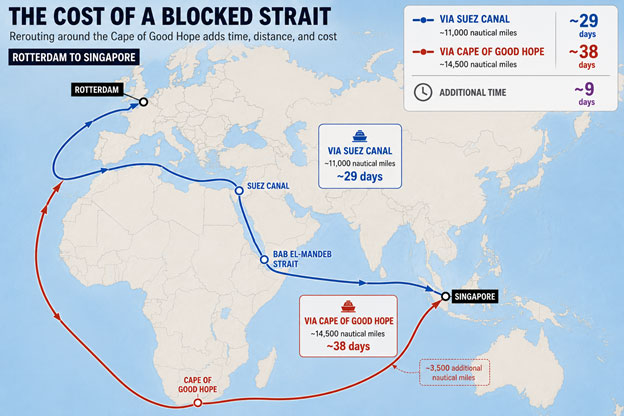
If the Houthis can continue to enforce their threat and create enough uncertainty, even selective attacks on some vessels can increase wartime insurance costs and undermine security guarantees, which could push carriers to reroute around the Cape of Good Hope at the southern tip of Africa.

Credit: Maximilian Malawista

For an Asia–Europe container voyage, rerouting around the Cape of Good Hope can add roughly 3,000 to 3,500 nautical miles and approximately seven to ten days of sailing time. This also increases the cost of the voyage, heightening fuel costs, requiring more vessel capacity to maintain scheduled services, and exposing cargo to higher insurance premiums. The World Bank has estimated that the additional fuel bill alone could reach USD 1 million for a round trip. Analysis by the OECD put the wider cost increase at USD 1.7 million for a medium-sized container ship on an Asia–Europe round trip—roughly an increase of USD 272, or 19 percent, for one standard 40-foot container.

In late 2023, similar Houthi threats, which led to selective attacks against commercial vessels, led major carriers to avoid the Red Sea passage and use the alternative route around the Cape of Good Hope. In just three months, by mid-February 2024, UNCTAD had recorded 586 container vessels taking the longer route around Africa, while container tonnage moving through the Suez Canal had simultaneously fallen 82 percent. Spot rates—the price of booking a container on short notice—also rose by 256 percent during the same period on voyages from Shanghai to Europe.

The Suez Canal in Egypt. Credit: Unsplash/Samuel Hanna

For Yemen, the consequences could be especially severe. The country relies on imports for more than 90 percent of its staple foods, including about 90 percent of its wheat and all of its rice requirements. Much of that supply enters through the ports of Aden and Hodeidah. The World Food Programme estimates that 18.2 million people in Yemen require humanitarian aid, being in dire need of humanitarian assistance and protection services.

Even considering that the Houthis formally exempt humanitarian cargo from the embargo, an escalation of insecurity can delay vessels and raise freight and insurance costs, deterring commercial shipping lines from calling at Yemeni ports. Humanitarian aid will not be nearly enough to replace the normal commercial flow of food and fuel, which affects Yemeni civilians first, who are already facing hunger and economic collapse.

The central question is not whether the Houthis can permanently seal Bab el-Mandeb. It is whether they can make the route risky enough that insurers, carriers, and oil traders abandon it themselves.

IPS UN Bureau Report


!function(d,s,id){var js,fjs=d.getElementsByTagName(s)[0],p=/^http:/.test(d.location)?’http’:’https’;if(!d.getElementById(id)){js=d.createElement(s);js.id=id;js.src=p+’://platform.twitter.com/widgets.js’;fjs.parentNode.insertBefore(js,fjs);}}(document, ‘script’, ‘twitter-wjs’);  


What Development Looks like in Myanmar Today

What Development Looks like in Myanmar Today

Investments in jobs, basic services and community infrastructure can reduce the pressures that drive displacement in Myanmar. Credit: UNDP Myanmar

By Norimasa Shimomura
YANGON, Myanmar, Jul 24 2026 – When asked what development looks like today, a community leader in Kalaw township points to these fields. Once destroyed by a typhoon, they are now productive again. What began as emergency food assistance in the first month was followed by UNDP support in the community—seeds, training, debris removal, support to microbusinesses and small infrastructure—backed by the Republic of Korea, Norway and Switzerland. One year on, the fields sustain three annual production cycles—rice and flowers—with more resilient practices and higher yields. “This is what development looks like to us,” he says.

Communities in Myanmar today are not facing a single crisis. They are facing many, and layered on top of one another, recurring over time. Conflict, insecurity, economic uncertainty, market volatility and climate- and disaster-related shocks do not occur in isolation. Global crises are placing added pressure on already-stretched humanitarian and development financing. Together, these dynamics reinforce one another, creating a cycle that is harder to break. These protracted, compounding crises are reshaping the country’s social and economic fabric and putting communities under enormous stress.

Myanmar shows why separating humanitarian action from development no longer fits reality. Relief keeps people alive, but it will not on its own restart livelihoods, steady local services, increase risk preparedness or reduce the pressures that drive displacement. The smarter play is to link emergency support to a continuum of recovery, stabilization and longer-term development, backing community systems and local markets so today’s spending also buys a more durable future.

A crisis that feeds on itself

Myanmar is fragmented: conflict in too many areas, economic freefall in others, and climate shocks across the country—from floods and droughts to rising temperatures and environmental loss. But these pressures are connected. When livelihoods collapse, people move. When insecurity rises, local economies contract. When disasters hit, already-fragile services give way. Families then face hard trade-offs; taking on high-interest debt, moving to precarious urban fringes, attempting risky migration, or turning to illicit markets.

For many, participation in informal, and sometimes criminal economies is less a choice than a last resort. Others flee, often towards cities such as Yangon. But urban areas are already under strain. In peri-urban Yangon, poverty rates are estimated to be around 50 percent, and new arrivals stretch housing, services and jobs further, deepening vulnerability and inequality. Women shoulder this burden most heavily, with women-headed households in peri-urban areas more likely to have lower incomes, depend on precarious and poorly paid employment, and facing heightened safety concerns.

This is how the crisis sustains itself. Conflict and violence breed insecurity; insecurity forces people from their homes and pushes some into illicit economies; displacement fractures livelihoods and the resulting economic hardship reinforces instability. And so the cycle continues.

The limits of a humanitarian-only response

Myanmar has received humanitarian aid for decades. It remains essential. People need immediate support for food, shelter and protection. But the challenges Myanmar faces today are not only humanitarian. They are structural and long-term. When support can only be planned and financed in short cycles, it can help people survive, but without enabling them to rebuild livelihoods, restore services or reduce future risk. This can create dependence on humanitarian aid without a clear exit.

The question is no longer whether humanitarian support is needed—it clearly is—but whether it is sufficient on its own, and how development can help build resilience. To break the cycle, investments must also focus on recovery, livelihoods, risk preparedness, access to finance and local systems. The bridge between humanitarian action and development must be deliberately built. UNDP in Myanmar has designed a new phase of its Community First Programme backing community-led solutions that can absorb shocks now while laying foundations for medium- and longer-term development.

Where the bridge matters most

There are three areas where this bridge is critical.

What Development Looks like in Myanmar Today

By combining community-based approaches with more targeted economic interventions, it is possible to offer a more comprehensive response in a protracted crisis. Credit: UNDP Myanmar

First, livelihoods and early recovery. Investments in jobs, basic services and community infrastructure can reduce the pressures that drive displacement. When people have viable ways to earn a living, they are less likely to move out of necessity. This also reduces the burden on humanitarian systems and can be an immediate stabilizing factor.

Second, local systems and community capacity. Even in constrained contexts, support to community-level structures can have a powerful effect. It enables people to manage their own recovery, strengthens local decision-making and builds a sense of ownership. It helps communities to think longer term and create some community wealth. These are the building blocks of future governance.

Third, economic alternatives to illicit activity. When large parts of local economies in some regions operate in grey or black markets, the implications go beyond livelihoods, they affect national and regional security. Creating alternatives—through job creation, support to small businesses and financing—gives people options. It reduces reliance on illicit networks, lowers risks of exploitation and opens pathways for more sustainable economic activity. These directly affect stability within Myanmar and across its borders.

Navigating a complex funding landscape

Despite the clear need to bridge humanitarian and development approaches, funding structures often work against it. In Myanmar, much of the available funding is still categorized as humanitarian. This creates challenges for organizations with strong development expertise, which must adapt their language and delivery models to fit short-term funding criteria.

At the same time, partner expectations are evolving, but not always consistently. Some continue to fund purely humanitarian outputs. Others expect development impact from humanitarian interventions. Still others fund development but want to demonstrate humanitarian impact.

This creates a fragmented landscape: humanitarian funding for humanitarian results, humanitarian funding seeking development impact, development funding framed as humanitarian and, more rarely, development funding investing directly in long-term results.

Navigating this requires flexibility and clarity of purpose. Development actors must be able to articulate the longer-term impact of their work, even when operating in a humanitarian context. The value lies precisely in that distinction: connecting immediate interventions to sustained recovery and future stability.

A window of opportunity

There are signs of change. Some partners are beginning to recognize that continued investment in short-term relief, without parallel investments in recovery and livelihoods, is not sustainable.

This creates an opportunity. By combining community-based approaches with more targeted economic interventions—jobs, enterprise development, access to finance, climate and energy solutions—it is possible to offer a more comprehensive response in a protracted crisis context, one that addresses both immediate needs and underlying drivers of crisis. But this window may not remain open indefinitely. As other actors reposition and global priorities shift, the space for shaping this agenda could narrow.

Looking ahead

Myanmar’s challenges are complex but the direction of response is clear. Humanitarian aid remains indispensable. But on its own, it cannot break cycles of crisis that are structural and self-reinforcing.

Bridging humanitarian action and development is how people regain agency. It is how communities stabilize. And ultimately, it is how countries begin to move beyond crisis—not just survive it.

Norimasa Shimomura is UNDP Resident Representative in Myanmar.
Source: UNDP

IPS UN Bureau


!function(d,s,id){var js,fjs=d.getElementsByTagName(s)[0],p=/^http:/.test(d.location)?’http’:’https’;if(!d.getElementById(id)){js=d.createElement(s);js.id=id;js.src=p+’://platform.twitter.com/widgets.js’;fjs.parentNode.insertBefore(js,fjs);}}(document, ‘script’, ‘twitter-wjs’);  


Bitget devient prestataire de services financiers en Nouvelle-Zélande

VICTORIA, Seychelles, 24 juill. 2026 (GLOBE NEWSWIRE) — Bitget, la plus grande bourse universelle (UEX) au monde, a annoncé son enregistrement en tant que prestataire de services financiers auprès du registre des prestataires de services financiers (FSPR) néo-zélandais.

Bitget étend ainsi son panel de service financiers en couvrant plusieurs catégories de services enregistrées, notamment l’échange de devises, les virements bancaires nationaux et transfrontaliers, la conservation des actifs des clients, la gestion de portefeuille et de fonds, ainsi que l’exécution de transactions financières ou d’opérations de change pour le compte des clients.

La société a également adhéré à l’Insurance and Financial Services Ombudsman (IFSO), le service néo-zélandais de règlement des litiges financiers. Ce dispositif indépendant met à disposition des clients éligibles une plateforme externe pour soumettre et résoudre des litiges impliquant les prestataires de services financiers participants.

Cet enregistrement suit la stratégie déployée par Bitget pour mettre en place l’infrastructure opérationnelle et réglementaire nécessaire à sa gamme de plus en plus étendue de produits financiers, notamment les instruments de marché traditionnels, les services de change et les actifs réels tokenisés.

« Les plateformes financières doivent reposer sur des structures réglementaires capables de prendre en charge un éventail plus large d’actifs et de services », a déclaré Gracy Chen, PDG de Bitget. « Cet enregistrement vient compléter notre gamme de services financiers internationaux, alors que la plateforme continue de permettre aux actifs numériques d’accéder aux marchés établis. »

La bourse universelle de Bitget rassemble les crypto-actifs, les actions tokenisées, les matières premières, les devises et d’autres produits financiers au sein d’une plateforme de négociation unique. La société continue d’étendre sa gamme de services par l’intermédiaire d’entités enregistrées et de partenaires agréés dans différentes juridictions.

Clause de non-responsabilité : la disponibilité des produits reste soumise aux lois en vigueur, aux exigences locales et aux conditions d’éligibilité régionales. L’immatriculation auprès du FSPR ne constitue en aucun cas une recommandation, une approbation ou une garantie de la part du gouvernement, de l’Autorité des marchés financiers ou du Registre des prestataires de services financiers de Nouvelle-Zélande.

À propos de Bitget

Bitget est la plus grande bourse universelle (UEX) au monde. Au service de plus de 125 millions d’utilisateurs, elle donne accès à plus de 2 millions de jetons crypto et à plus de 500 actions tokenisées, ETF, matières premières, devises et métaux précieux comme l’or. L’écosystème vise à aider les utilisateurs à faire du trading de manière plus avisée grâce à son agent IA qui accompagne l’exécution des ordres. Bitget entend promouvoir l’adoption des cryptomonnaies grâce à des partenariats stratégiques tels que MotoGP™. En accord avec sa stratégie d’impact mondial, Bitget s’est associée à l’UNICEF pour soutenir la formation à la blockchain auprès de 1,1 million de personnes d’ici à 2027. Actuellement leader sur le marché de la finance traditionnelle tokenisée, Bitget propose les frais les plus bas du secteur et la liquidité la plus élevée dans plus de 150 régions du monde.

Pour en savoir plus, veuillez consulter : Site Internet | X | Telegram | LinkedIn | Discord

Pour toute demande média, veuillez nous contacter à l’adresse suivante : [email protected] 

Mise en garde sur les risques : les cours des actifs numériques peuvent fluctuer et connaître une forte volatilité. Il est conseillé aux investisseurs de n’engager que les fonds qu’ils peuvent se permettre de perdre. La valeur de votre investissement peut être affectée et il est possible que vous n’atteigniez pas vos objectifs financiers ou que vous ne parveniez pas à récupérer votre investissement principal. Il est toujours recommandé de solliciter l’avis d’un spécialiste financier indépendant et de tenir compte de votre expérience et de votre situation financière personnelles. Les performances passées ne préjugent pas des résultats futurs. Bitget décline toute responsabilité en cas de pertes potentielles. Les informations figurant dans le présent communiqué ne constituent en aucun cas un conseil financier. Pour plus d’informations, veuillez consulter nos Conditions d’utilisation.

Une photo annexée au présent communiqué est disponible à l’adresse suivante : https://www.globenewswire.com/NewsRoom/AttachmentNg/67aee548-d01f-45db-a363-7151fcc71f12


GLOBENEWSWIRE (Distribution ID 1001214241)

Guatemala: A Narrow Opening in a Captured Justice System

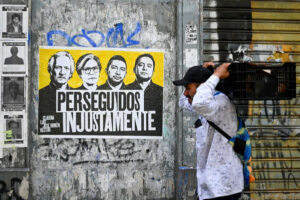
A man walks past a sign reading ‘unjustly persecuted’ featuring journalist José Rubén Zamora, former CICIG lawyer Claudia González and Maya leaders Luis Pacheco and Héctor Chaclan in a Guatemala City, 12 May 2026. Credit: Johan Ordóñez/AFP

By Inés M. Pousadela
MONTEVIDEO, Uruguay, Jul 24 2026 – José Rubén Zamora, founder of elPeriódico, Guatemala’s now-defunct leading investigative newspaper, spent 1,295 days in detention before a court granted him house arrest on 12 February. He endured long stretches of solitary confinement in a military jail, held in near-constant darkness and subjected to treatment that six UN experts warned could amount to torture. His offence was simply doing his job. For decades, he exposed the corrupt dealings of Guatemala’s economic and political elites. Prosecutors are still trying to send him back to prison.

Police arrested Zamora in July 2022 on a complaint brought by a former banker who was under investigation for financial crimes, following Zamora’s reporting on corruption under then President Alejandro Giammattei. Within months, elPeriódico had shut down following intimidation of its advertisers and criminalisation of its staff. A court convicted Zamora of money laundering in June 2023, and when an appeals court overturned the conviction, a second case kept him in jail anyway. Courts ordered his release several times, and each time appeals chambers reversed those decisions. The Supreme Court transferred a judge who ruled to free him to a court in another part of Guatemala. At least 10 lawyers who took up his defence were forced to abandon it under pressure. Some were prosecuted and jailed.

In May 2024, the UN Working Group on Arbitrary Detention declared Zamora’s detention arbitrary and retaliatory and recommended his immediate release. It took almost two more years for him to be allowed home. In March, the Supreme Court voided the rulings that had returned him to prison, finding they violated due process. The Constitutional Court heard the prosecution’s latest appeal to send him back to jail in June, but has yet to issue its ruling.

The machinery of impunity

Zamora’s ordeal is no aberration; it’s how captured institutions are designed to work. The Guatemalan state has long been in the hands of what Guatemalans call ‘the pact of the corrupt’, a coalition of business leaders, drug traffickers, military officers and politicians that has captured the justice system to guarantee their own impunity. Anyone who threatens that arrangement risks prosecution on fabricated charges, reinforced by coordinated smear campaign. This includes journalists who investigate corruption, judges and prosecutors who pursue it, and Indigenous, land rights and climate activists who mobilise against its consequences. The aim, as a Guatemalan civil society leader put it, is to instil fear so nobody dares question anything. Over 100 people, including around 50 judges and prosecutors, have fled into exile rather than face trumped-up charges.

Because the justice system serves the corrupt pact rather than the law, any serious attempt to dismantle corruption has required external support. In 2006, the UN and the Guatemalan government agreed to establish the International Commission against Impunity in Guatemala (CICIG). Over 12 years, CICIG and the Public Prosecutor’s Office investigated over 70 complex criminal structures and brought charges against more than 1,540 people, including former presidents, ministers, members of Congress and business figures. This challenged the perception that the powerful were untouchable.

But success sealed its fate. When CICIG investigated sitting president Jimmy Morales in 2017, he moved to destroy it, refusing to renew its mandate and appointing a compliant attorney general, Consuelo Porras. President Giammattei reappointed Porras, who prosecuted or forced out dozens of judges and prosecutors who had worked with CICIG. She turned the Public Prosecutor’s Office into an instrument of persecution while dismissing 74 per cent of the complaints filed with it without investigating them. By the time her term ended in May, over 40 states had sanctioned her and some associates. The institution built to prosecute crime had become the state’s key tool for committing it.

New president, same system

Guatemalans elected Bernardo Arévalo in 2023 with a mandate to dismantle this system, but the system has consistently tried to disable him. His unexpected win – he scraped into the runoff largely because the establishment had not seen him as a serious enough threat to block – triggered what civil society described as an attempted electoral coup, with spurious legal complaints, raids on his party’s headquarters and at least two credible assassination plots. It took 106 days of peaceful resistance led by Indigenous authorities to ensure he was sworn in.

But taking office was not the same as taking power. Arévalo’s party had only 23 of 160 congressional seats, and its legal status was subsequently cancelled by judicial order. Congress blocked the legislative change that would have allowed him to dismiss Porras, and the Supreme Court, 13 of whose judges were selected in 2024 through a process stacked with candidates tied to corruption networks, refused to lift her immunity. Throughout Arévalo’s term, the Public Prosecutor’s Office continued to criminalise dissent and repeatedly tried to strip Arévalo of immunity.

A narrow window

But Porras’s term eventually expired, and his successor, Gabriel García Luna, a career judge with no ties to corruption networks, has moved quickly, dismissing prosecutors linked to Porras and closing the special prosecutor’s office that fabricated cases against Zamora and many others. His arrival offers the first genuine opening in eight years. But it’s a narrow one. Congress remains in opposition hands, and the Constitutional Court, the Comptroller General’s Office and the electoral authority are all due for renewal this year. Corrupt interests are well placed to exploit these processes to entrench their grip.

Much now depends on whether Arévalo throws his political weight behind García Luna’s efforts to rebuild the institution Porras weaponised, and whether the bodies up for renewal can be kept out of the corrupt pact’s hands. The clearest sign of change will come if Zamora and the dozens of others criminalised for exposing corruption and defending rights no longer face prosecution, and instead their persecutors face justice.

Inés M. Pousadela is CIVICUS Head of Research and Analysis, co-director and writer for CIVICUS Lens and co-author of the State of Civil Society Report. She is also a Professor of Comparative Politics at Universidad ORT Uruguay.

For interviews or more information, please contact [email protected]


!function(d,s,id){var js,fjs=d.getElementsByTagName(s)[0],p=/^http:/.test(d.location)?’http’:’https’;if(!d.getElementById(id)){js=d.createElement(s);js.id=id;js.src=p+’://platform.twitter.com/widgets.js’;fjs.parentNode.insertBefore(js,fjs);}}(document, ‘script’, ‘twitter-wjs’);