Une étude de CryptoRank révèle que les rTokens de Bitget ont enregistré un glissement jusqu’à 58 % inférieur sur des ordres de 50 000 $ passés sur les principales plateformes d’actions tokenisées

VICTORIA, Seychelles, 27 juill. 2026 (GLOBE NEWSWIRE) — Bitget, la plus grande bourse d’échange universelle (UEX) au monde, s’est classée au premier rang pour l’exécution d’ordres importants dans une étude de CryptoRank évaluant la liquidité, la structure du marché et la qualité d’exécution pour les principaux produits d’actions tokenisées. L’étude a révélé que les « Reality rTokens » de Bitget affichaient le glissement simulé le plus faible parmi tous les actifs comparables testés, enregistrant un glissement jusqu’à 58 % inférieur pour des ordres de 50 000 $ par rapport aux produits d’actions tokenisées concurrents ; ce résultat souligne l’importance croissante de la qualité d’exécution avec l’arrivée à maturité du marché des actions tokenisées.

À la publication de ce rapport, le marché des actions tokenisées a atteint près de 2 milliards de dollars de valeur « on-chain » et compte plus de 471 000 détenteurs, reflétant l’intérêt croissant des investisseurs pour un accès aux actifs financiers traditionnels sur la blockchain. Avec la disponibilité croissante des actions tokenisées sur les plateformes d’échange de cryptomonnaies, CryptoRank a examiné l’impact des différences de structure des produits, de modèles de liquidité et d’infrastructures d’exécution sur l’expérience de trading, au-delà de la simple exposition au prix.

L’étude a comparé les offres d’actions tokenisées sur les principales plateformes d’échange et a révélé que les produits répliquant les mêmes actions sous-jacentes peuvent différer considérablement en termes de droits des investisseurs, de mécanismes de liquidité, de modèles de rachat et de qualité d’exécution. Le rapport a évalué NVIDIA, Microsoft, Meta et Tesla, les quatre seuls actifs ayant maintenu des carnets d’ordres bidirectionnels valides sur l’ensemble des plateformes testées. Au sein de cet échantillon comparable, les « Reality rTokens » de Bitget ont systématiquement généré les meilleurs résultats d’exécution pour les transactions de grande taille.

Le rapport a révélé que Bitget affichait le glissement simulé le plus faible pour les quatre actifs comparables, tant pour les ordres de 10 000 $ que pour ceux de 50 000 $, tandis que les Reality rTokens enregistraient la liquidité affichée équilibrée la plus élevée dans une fourchette de 50 points de base. CryptoRank a attribué ces résultats à l’architecture de liquidité de Bitget, qui associe la liquidité de la plateforme d’échange à celle des marchés sous-jacents liés au NYSE et au NASDAQ, permettant ainsi une liquidité plus profonde et une exécution plus efficace pour les transactions de grande envergure. CryptoRank a également examiné les structures juridiques et opérationnelles sous-tendant les produits de titres tokenisés, notant que des symboles boursiers similaires peuvent représenter différentes formes de droits pour les investisseurs, selon les modalités d’émission et de règlement de chaque produit.

« La tokenisation dépasse le stade de l’accès pour s’étendre à l’infrastructure », a déclaré Gracy Chen, PDG de Bitget. « Si ne serait-ce que 10 % des actifs financiers mondiaux sont tokenisés d’ici 2030, nous assisterons à l’une des transformations les plus marquantes des marchés de capitaux modernes. La prochaine phase de la tokenisation sera définie par la qualité de l’exécution, la liquidité et les infrastructures de marché soutenant ces actifs. Des études indépendantes comme celle-ci contribuent à établir les points de référence dont le secteur a besoin à mesure que les marchés tokenisés continuent de gagner en maturité. »

Ces résultats s’appuient sur l’expansion continue de l’écosystème Stock+ de Bitget, qui permet aux utilisateurs éligibles d’accéder à plus de 500 actions tokenisées, ETF, matières premières et autres actifs financiers traditionnels — en plus des cryptomonnaies — via un compte unique et unifié. En associant un accès au marché 24h/24 et 7j/7, l’investissement fractionné et une liquidité liée au NYSE et au NASDAQ, Bitget bâtit l’infrastructure nécessaire pour soutenir la prochaine génération de marchés de capitaux tokenisés.

Lisez le rapport CryptoRank ici.

À propos de Bitget

Bitget est la plus grande bourse universelle (UEX) au monde. Au service de plus de 125 millions d’utilisateurs, elle donne accès à plus de 2 millions de jetons crypto et à plus de 500 actions tokenisées, ETF, matières premières, devises et métaux précieux comme l’or. L’écosystème vise à aider les utilisateurs à faire du trading de manière plus avisée grâce à son agent IA qui accompagne l’exécution des ordres. Bitget entend promouvoir l’adoption des cryptomonnaies grâce à des partenariats stratégiques tels que MotoGP™. En accord avec sa stratégie d’impact mondial, Bitget s’est associée à l’UNICEF pour soutenir la formation à la blockchain auprès de 1,1 million de personnes d’ici à 2027. Actuellement leader sur le marché de la finance traditionnelle tokenisée, Bitget propose les frais les plus bas du secteur et la liquidité la plus élevée dans plus de 150 régions du monde.

Pour en savoir plus, veuillez consulter : Site Internet | X | Telegram | LinkedIn | Discord

Pour toute demande média, veuillez nous contacter à l’adresse suivante : [email protected]

Mise en garde sur les risques : les cours des actifs numériques peuvent fluctuer et connaître une forte volatilité. Il est conseillé aux investisseurs de n’engager que les fonds qu’ils peuvent se permettre de perdre. La valeur de votre investissement peut être affectée et il est possible que vous n’atteigniez pas vos objectifs financiers ou que vous ne parveniez pas à récupérer votre investissement principal. Il est toujours recommandé de solliciter l’avis d’un spécialiste financier indépendant et de tenir compte de votre expérience et de votre situation financière personnelles. Les performances passées ne préjugent pas des résultats futurs. Bitget décline toute responsabilité en cas de pertes potentielles. Les informations figurant dans le présent communiqué ne constituent en aucun cas un conseil financier. Pour tout complément d’information, veuillez consulter nos Conditions d’utilisation.

Les photos accompagnant le présent communiqué sont disponibles aux adresses suivantes :

http://www.globenewswire.com/NewsRoom/AttachmentNg/3c8f2a89-2b0b-465f-9fe6-d03b919d5754

http://www.globenewswire.com/NewsRoom/AttachmentNg/2fd67267-7705-42b5-82f2-dc4dbe7c590b


GLOBENEWSWIRE (Distribution ID 1001214250)

Dmitry Shubov Consulting Issues Strategic Analysis on Capital-Efficient Delaware Flip Models for Southeast Asian Scale-Ups

FREMONT, Calif., July 27, 2026 (GLOBE NEWSWIRE) — Corporate setup often dictates how fast a cross-border fundraising round moves. Drawing on established legal mechanics—including SPZ Legal’s analysis on Delaware flips—Dmitry Shubov Consulting today released a new executive briefing for Southeast Asian scale-ups entering the U.S. market. For founders across the region, structure dictates deal velocity. Most U.S. venture funds hesitate to invest directly into foreign holding entities, preferring standard legal frameworks they already know how to underwrite.

“For many Southeast Asian scale-ups, the challenge isn’t ambition — it’s making sure the structure supports the speed of the opportunity,” said Dmitry Shubov, Founder of Dmitry Shubov Consulting. “When a fundraising round moves across borders, founders need a setup that investors recognize, can underwrite quickly, and can scale without creating unnecessary drag on the business.”

Below are the four core priorities Dmitry Shubov Consulting recommends for expanding scale-ups:

  • Equity Mirroring & Cap Table Alignment: Structuring cross-border equity swaps that move existing shareholders into a U.S. parent entity without disrupting regional cap tables.
  • Intercompany IP Licensing: Establishing licensing structures that protect core IP while giving investors complete legal transparency.
  • Lean Dual-Jurisdiction Governance: Cutting administrative overlap between regional operating units and the U.S. entity to protect execution speed.
  • Investor-Ready Architecture: Setting up governance upfront against institutional due diligence standards to eliminate friction during active fundraising rounds.

Dmitry Shubov Consulting incorporates these structural frameworks directly into its executive advisory engagements for Southeast Asian leadership teams navigating cross-border capital strategies and U.S. market entry. For more information, reach out to Dmitry Shubov Consulting.

About Dmitry Shubov Consulting

At Dmitry Shubov Consulting, our mission is to connect accredited investors with groundbreaking legal technology startups, fostering innovation and growth across Southeast Asia and helping Asian businesses enter the U.S. market. For more information, please visit our website or contact us directly.

Media Contact:

[email protected]


GLOBENEWSWIRE (Distribution ID 9768055)

HKTB's Hong Kong Summer Fun Adds Ticket Spending Offers

HONG KONG, July 27, 2026 (GLOBE NEWSWIRE) — The Hong Kong Tourism Board (HKTB) announced today (27 July) that it is stepping up with an event ticket spending promotion (https://www.discoverhongkong.com/eng/events/summer-fun/event-ticket-spending-promotion.html) following the array of spending offers launched under its summer campaign “Hong Kong Summer Fun”. From 31 July to 31 August, visitors and locals presenting a valid ticket from designated mega events or activities can enjoy unlimited extra 5% discounts at over 100 hotels and tourist attractions across Hong Kong. The offers cover dining, attraction tickets and merchandise, encouraging everyone to immerse themselves in the city’s mega events and activities while enjoying a variety of spending experiences.

HKTB Executive Director Anthony Lau said: “Through HKTB’s ‘Hong Kong Summer Fun’, we are collaborating with the business community to present citywide spending privileges, the ‘Hong Kong Summer Deals’, which have been well received by visitors and locals since their launch in July. With a series of major sports, cultural and arts events underway, we have proactively joined forces with multiple industry partners to enhance these offers with an event ticket spending promotion, linking mega events and activities with spending experiences to encourage visitors and locals to spend, thereby supporting tourism-related sectors. I sincerely thank all partners for their active support in injecting further economic vitality into Hong Kong.”

A designated-event ticket is your pass to unlock multiple spending offers

The event ticket spending promotion covers the following events: “Hong Kong Football Festival (HKFF) 2026”, “Football Summit 2026 FC Bayern Munich vs Aston Villa”, “Ancient Egypt Unveiled: Treasures from Egyptian Museums”, “2026 TMElive International Music Awards (TIMA)” and “Silence Wang 2026 ‘Age of Romance’ World Tour”. During the promotional period, visitors and locals simply need to present a valid ticket from any of the above events (including physical tickets or e-tickets; screenshots, photos and photocopies are not accepted) to enjoy an extra 5% off at over 100 participating hotel dining outlets and tourist attractions across Hong Kong, with no limit on the number of redemptions. Offers include Michelin-starred restaurants at premium hotels, buffets, bars, attraction tickets, souvenirs and selected merchandise, allowing visitors and locals to easily enjoy a wide range of spending experiences with a single ticket.

For the list of participating merchants and offers, please visit:      https://www.discoverhongkong.com/eng/events/summer-fun/event-ticket-spending-promotion.html

Designated events and valid ticket dates for the promotion:

Designated Event Valid Ticket Dates
Hong Kong Football Festival (HKFF) 2026 31 Jul, 1, 4 and 5 Aug
Football Summit 2026 FC Bayern Munich vs Aston Villa 7 Aug
Ancient Egypt Unveiled: Treasures from Egyptian Museums 1 to 31 Aug
2026 TMElive International Music Awards (TIMA) 22 and 23 Aug
Silence Wang 2026 “Age of Romance” World Tour 5 and 6 September


Hong Kong Summer Fun Adds to Summer Excitement with Over 200,000 Offers

At the same time, visitors and locals can continue to enjoy “Hong Kong Summer Deals” — over 200,000 offers rolled out by HKTB in partnership with the business community across 9,000 outlets citywide, covering attractions, dining, transport and shopping. They can also take part in the rich and diverse mega events and activity featured under Hong Kong Summer Fun, immersing themselves in Hong Kong’s summer charm and enjoying spending to the fullest.

HKTB Discover Hong Kong “Hong Kong Summer Fun” information platform:
https://www.discoverhongkong.com/eng/events/summer-fun.html

Register as a user:
https://my.discoverhongkong.com/en/home

For media inquiries, please contact:

Mr Chokie Cheng Tel: 2807 6342                 Email: [email protected]


GLOBENEWSWIRE (Distribution ID 9798427)

Artel Lança Novo Switch PTP de Classe de Operadora Desenvolvido para as Demandas da Transmissão Moderna

GAITHERSBURG, Md., July 27, 2026 (GLOBE NEWSWIRE) — Novo Switch Ethernet PTP Quarra PTP-10GSE12SFP de 10 Gbps oferece sincronização precisa de nanosegundos, 20 portas de conectividade flexível e interoperabilidade SMPTE 2110 completa para redes Pro-AV, transmissão de mídia e industriais

Patton… Vamos nos conectar!

GAITHERSBURG, Md., 27 de julho de 2026 (GLOBE NEWSWIRE) — Artel Video Systems– uma empresa da Patton e fornecedora líder de soluções de transporte de mídia e rede de transmissão para os mercados profissionais de AV, defesa e industrial – anunciou hoje que o novo Quarra PTP-10GSE12SFP 10 Gbps PTP Ethernet Switch está disponível para pré-encomenda. 

O mais novo membro da família de switches Quarra foi desenvolvido especificamente para Pro-AV, transmissão de mídia, automação de fábrica e backhaul móvel 4G/5G. Ele fornece o tempo preciso de nanosegundos que as redes de missão crítica exigem.

Projetamos esse switch com a transmissão e o Pro AV em mente”, disse Tim Godby, Diretor de Sistemas de Transporte de Mídia da Artel Video Systems. “A opção para CC ou CA, fontes de alimentação simples ou duplas, Sync-E, portas de entrada/saída de 1PPS e 12 portas SFP+ fazem dele uma parte excepcionalmente potente e versátil para qualquer rede de transporte de mídia sensível ao tempo.”

Switch PTP Ethernet Artel™ Quarra PTP-10GSE12SFP 10 Gbps

“A opção para sistemas de fontes de alimentação CC ou CA, simples ou duplas… sendo uma parte excepcionalmente potente e versátil para qualquer rede de transporte de mídia sensível ao tempo.”

Tim Godby
Diretor, Sistemas de Transporte de Mídia
Artel Video Systems

Classe de Operadora. O Quarra é um switch Ethernet gerenciado de classe de operadora que combina doze (12) portas de fibra SFP+ de 10G com oito (8) portas de cobre Gigabit (RJ-45). Com um design flexível e pronto para o futuro, o dispositivo fornece funções Leaf Switch e Spine Switch em uma única unidade robusta.

O Timing é Fundamental. Na transmissão ao vivo, os erros de timing destroem o conteúdo. O Quarra PTP-10GSE12SFP elimina esse risco. Ele suporta IEEE 1588 PTPv2 com todos os modos de clock. Cada porta pode ser configurada individualmente para entrega de carimbo de data/hora SyncE ou PTP. Um conector SMA 1PPS embutido suporta fontes de relógio externas e medição de forma de onda.

Características Principais do Quarra PTP-10GSE12SFP:

  • 12 portas SFP+ de 10G mais 8 portas Gigabit de cobre (RJ-45)
  •  IEEE 1588 PTPv2 — timing preciso de nanossegundos, todos os modos de clock
  • SyncE (ITU-T G.8261/G.8262/G.8264) em todas as interfaces
  • Switch fabric de 256 Gbps, 8 filas de prioridade por porta
  • SMPTE 2110, ST-2022-7, SDVoE, AES67 e Dante — totalmente interoperável
  • Compatibilidade com Grandmaster Clock — Thales, Meinberg, Sonifex e muito mais
  •  Gerenciamento de GUI da Web, Telnet e SNMPv1/v2c/v3

Detalhes. Quatro modelos agora estão disponíveis para pré-encomenda com opções de fonte de alimentação CC e CA simples ou duplas. Para mais informações, visite patton.com/artel/quarra-ptp-10gse12sfp 

Notícias da semana passada, a Patton fechou um subcontrato para desenvolver módulos de fibra óptica seguros para fontes para aplicações do Departamento de Defesa dos EUA. 

Contato com a Mídia: Glendon Flowers | +1 301 975 1000 | [email protected]

Foto deste comunicado disponível em https://www.globenewswire.com/NewsRoom/AttachmentNg/6e94b258-eaee-4cbd-a4e3-d5354f6bd8ed


GLOBENEWSWIRE (Distribution ID 9768016)

Artel kündigt einen neuen PTP-Switch der Carrier-Klasse an, der speziell für die Anforderungen des modernen Rundfunks entwickelt wurde

Der neue Quarra PTP-10GSE12SFP 10-Gbit/s-PTP-Ethernet-Switch bietet nanosekundengenaue Zeitsteuerung, 20 Ports für flexible Anbindung und vollständige SMPTE-2110-Interoperabilität für Pro-AV-, Medien- und industrielle Netzwerke

Patton … Let's Connect!

GAITHERSBURG, Maryland, July 27, 2026 (GLOBE NEWSWIRE) — Artel Video Systems – ein Unternehmen der Patton-Gruppe und führender Anbieter von Lösungen für den Medientransport und Broadcast-Netzwerke für die Bereiche professionelle AV-Technik, Verteidigung und Industrie – hat heute bekannt gegeben, dass der neue Quarra PTP-10GSE12SFP 10-Gbit/s-PTP-Ethernet-Switch ab sofort vorbestellt werden kann. 

Das neueste Mitglied der Quarra-Switch-Familie wurde speziell für professionelle AV-Anwendungen, die Medienübertragung, die Fabrikautomatisierung sowie 4G- und 5G-Mobilfunk-Backhaul-Netzwerke entwickelt. Es bietet die nanosekundengenaue Zeitsynchronisation, die für geschäftskritische Netzwerke erforderlich ist.

Wir haben diesen Switch gezielt für den Einsatz im Rundfunk und im professionellen AV-Bereich entwickelt“, erklärt Tim Godby, Leiter des Bereichs Medienübertragungssysteme bei Artel Video Systems. „Die Auswahl zwischen Gleich- und Wechselstrom, einfacher und redundanter Stromversorgung sowie die Unterstützung von Sync-E, 1PPS-Ein- und -Ausgängen und zwölf SFP+-Anschlüssen machen diesen Switch zu einer außergewöhnlich leistungsfähigen und vielseitigen Komponente für jedes zeitkritische Medienübertragungsnetzwerk.“

Artel™ Quarra PTP-10GSE12SFP 10-Gbit/s-PTP-Ethernet-Switch

„Die Wahl zwischen Gleich- und Wechselstrom sowie zwischen Ein- und Zweikreis-Stromversorgungssystemen macht dieses Gerät zu einer einzigartig leistungsstarken und vielseitigen Komponente für jedes zeitkritische Medienübertragungsnetzwerk.“

Tim Godby
Leiter des Bereichs Medienübertragungssysteme
Artel Video Systems

Carrier-Klasse. Der Quarra ist ein Managed-Ethernet-Switch der Carrier-Klasse, der zwölf (12) 10G-SFP+-Glasfaseranschlüsse mit acht (8) Gigabit-Kupferanschlüssen im RJ-45-Format kombiniert. Dank seines flexiblen und zukunftssicheren Designs vereint das Gerät die Funktionen eines Leaf- und eines Spine-Switches in einem einzigen robusten System.

Auf den richtigen Zeitpunkt kommt es an. Bei Live-Übertragungen können bereits kleinste Timing-Fehler die Qualität der Inhalte beeinträchtigen. Der Quarra PTP-10GSE12SFP minimiert dieses Risiko. Er unterstützt IEEE 1588 PTPv2 in allen Taktmodi. Jeder Port lässt sich individuell für die Zeitsynchronisation über SyncE oder PTP konfigurieren. Ein integrierter 1PPS-SMA-Anschluss ermöglicht zudem die Anbindung externer Taktquellen sowie die Messung von Wellenformen.

Quarra PTP-10GSE12SFP – Wichtigste Merkmale:

  • 12x 10G-SFP+ sowie 8x Gigabit-Kupferanschlüsse (RJ-45)
  •  IEEE 1588 PTPv2 – nanosekundengenaue Zeitsteuerung, alle Taktmodi
  • SyncE (ITU-T G.8261/G.8262/G.8264) an jeder Schnittstelle
  • 256 Gbit/s Switch-Fabric, 8 Prioritätswarteschlangen pro Anschluss
  • SMPTE 2110, ST-2022-7, SDVoE, AES67 und Dante – vollständig kompatibel
  • Kompatibilität mit Grandmaster-Clocks – Thales, Meinberg, Sonifex und mehr
  •  Verwaltung über Web-GUI, Telnet und SNMPv1/v2c/v3

Details. Vier Modelle können ab sofort vorbestellt werden. Sie sind wahlweise mit einfacher oder redundanter Gleich- beziehungsweise Wechselstromversorgung erhältlich. Weitere Informationen finden Sie unter patton.com/artel/quarra-ptp-10gse12sfp 

In diesem Zusammenhang erhielt Patton letzte Woche einen Unterauftrag zur Entwicklung quellensicherer Glasfasermodule für Anwendungen des US-Verteidigungsministeriums. 

Medienkontakt: Glendon Flowers | +1 301 975 1000 | [email protected]

Ein Foto zu dieser Mitteilung finden Sie unter https://www.globenewswire.com/NewsRoom/AttachmentNg/6e94b258-eaee-4cbd-a4e3-d5354f6bd8ed


GLOBENEWSWIRE (Distribution ID 9768016)

Artel Announces New Carrier-Class PTP Switch Built for the Demands of Modern Broadcast

The new Quarra PTP-10GSE12SFP 10 Gbps PTP Ethernet Switch Delivers Nanosecond-Accurate Timing, 20 Ports of Flexible Connectivity, and Full SMPTE 2110 Interoperability for Pro-AV, Media Broadcast, and Industrial Networks

Patton… Let's Connect!

GAITHERSBURG, Md., July 27, 2026 (GLOBE NEWSWIRE) — Artel Video Systems—a Patton company, and leading provider of media transport and broadcast networking solutions for professional AV, defense, and industrial markets—today announced the new Quarra PTP-10GSE12SFP 10 Gbps PTP Ethernet Switch is now available for pre-order. 

The newest member of the Quarra switch family is purpose-built for Pro-AV, media broadcast, factory automation, and 4G/5G mobile backhaul. It delivers the nanosecond-accurate timing that mission-critical networks demand.

We designed this switch with broadcast and Pro AV in mind,” said Tim Godby, Director, Media Transport Systems, Artel Video Systems. “The option for DC or AC, single or dual power supplies, Sync-E, 1PPS input/output ports, and 12 SFP+ ports make this a uniquely powerful and versatile part of any timing-sensitive media transport network.”

Artel™ Quarra PTP-10GSE12SFP 10 Gbps PTP Ethernet Switch

“The option for DC or AC, single or dual power supplies systems… make this a uniquely powerful and versatile part of any timing-sensitive media transport network.”

Tim Godby
Director, Media Transport Systems
Artel Video Systems

Carrier Class. The Quarra is a carrier-class managed Ethernet switch combining twelve (12) 10G SFP+ fiber ports with eight (8) copper Gigabit (RJ-45) ports. Boasting a flexible, future-ready design, the device provides Leaf Switch and a Spine Switch functions in a single ruggedized unit.

Timing Matters. In live broadcast, timing errors destroy content. The Quarra PTP-10GSE12SFP eliminates that risk. It supports IEEE 1588 PTPv2 with all clocking modes. Every port can be individually configured for SyncE or PTP timestamp delivery. A built-in 1PPS SMA connector supports external clock sources and waveform measurement.

Quarra PTP-10GSE12SFP Key Features:

  • 12x 10G SFP+ plus 8x Gigabit copper (RJ-45) ports
  •  IEEE 1588 PTPv2 — nanosecond-accurate timing, all clocking modes
  • SyncE (ITU-T G.8261/G.8262/G.8264) on every interface
  • 256 Gbps switch fabric, 8 priority queues per port
  • SMPTE 2110, ST-2022-7, SDVoE, AES67, and Dante — fully interoperable
  • Grandmaster Clock compatibility — Thales, Meinberg, Sonifex, and more
  •  Web GUI, Telnet, and SNMPv1/v2c/v3 management

Details. Four models are now available for pre-order with single or dual DC and AC power supply options. For more information, visit patton.com/artel/quarra-ptp-10gse12sfp 

In related news, last week Patton was awarded a subcontract to develop source-secure fiber-optic modules for US DoD applications. 

Media Contact: Glendon Flowers | +1 301 975 1000 | [email protected]

A photo accompanying this announcement is available at https://www.globenewswire.com/NewsRoom/AttachmentNg/6e94b258-eaee-4cbd-a4e3-d5354f6bd8ed


GLOBENEWSWIRE (Distribution ID 9767499)

Artel annonce un nouveau commutateur PTP de classe opérateur conçu pour répondre aux exigences de la diffusion moderne

Le commutateur Ethernet PTP Quarra PTP-10GSE12SFP 10 Gbps offre une synchronisation à la nanoseconde, 20 ports de connectivité flexible et une interopérabilité totale avec la norme SMPTE 2110 pour les secteurs de l’audiovisuel et les réseaux industriels

Patton… Let’s Connect!

GAITHERSBURG, Maryland, 27 juill. 2026 (GLOBE NEWSWIRE) — Artel Video Systems, société du groupe Patton et fournisseur de premier plan de solutions de transport de médias et de réseaux de diffusion pour les marchés de l’audiovisuel professionnel, de la défense et de l’industrie, a annoncé ce jour que le nouveau commutateur Ethernet PTP Quarra PTP-10GSE12SFP 10 Gbps est désormais disponible en précommande. 

Le dernier-né de la famille des commutateurs Quarra est conçu pour les applications Pro-AV, la diffusion médiatique, l’automatisation industrielle et le backhaul 4G/5G mobile. Il garantit la précision de synchronisation à la nanoseconde exigée par les réseaux critiques.

« Nous avons conçu ce commutateur en pensant aux secteurs de la diffusion et de l’audiovisuel professionnel », a déclaré Tim Godby, directeur des systèmes de transport de médias chez Artel Video Systems. « Les options d’alimentation simple ou redondante, en CC ou CA, la prise en charge de Sync-E, les ports d’entrée/sortie 1PPS et les 12 ports SFP+ en font un élément d’une puissance et d’une polyvalence exceptionnelles pour tout réseau de transport de médias sensible à la synchronisation. »

Commutateur Ethernet PTP Quarra PTP-10GSE12SFP 10 Gbps d’Artel™

« La possibilité de choisir entre des alimentations simple ou redondante, en CC ou CA, en font un élément d’une puissance et d’une polyvalence exceptionnelles pour tout réseau de transport de médias sensible à la synchronisation. »

Tim Godby
, directeur des systèmes de transport de médias chez
Artel Video Systems

Classe opérateur. Le Quarra est un commutateur Ethernet de classe opérateur associant douze (12) ports SFP+ 10G fibre et huit (8) ports Gigabit cuivre (RJ-45). Grâce à son design flexible et évolutif, cet appareil offre les fonctions de commutateur Leaf et de commutateur Spine dans un seul et même boîtier robuste.

La synchronisation est primordiale. Lors d’une diffusion en direct, les erreurs de synchronisation compromettent la qualité du contenu. Le Quarra PTP-10GSE12SFP élimine ce risque. Il prend en charge la norme IEEE 1588 PTPv2 avec tous les modes de synchronisation d’horloge. Chaque port peut être configuré individuellement pour le SyncE ou la distribution d’horodatage PTP. Un connecteur SMA 1PPS intégré permet d’utiliser des sources d’horloge externes et de mesurer des formes d’onde.

Principales caractéristiques du Quarra PTP-10GSE12SFP :

  • 12 ports SFP+ 10G et 8 ports Gigabit cuivre (RJ-45)
  •  IEEE 1588 PTPv2 : synchronisation précise à la nanoseconde près, tous les modes d’horloge sont pris en charge
  • SyncE (ITU-T G.8261/G.8262/G.8264) sur toutes les interfaces
  • Capacité de commutation de 256 Gbit/s, 8 files d’attente de priorité par port
  • Interopérabilité totale avec SMPTE 2110, ST-2022-7, SDVoE, AES67 et Dante
  • Compatibilité avec les horloges Grandmaster (Thales, Meinberg, Sonifex, etc.)
  •  Gestion via interface Web (GUI), Telnet et SNMPv1/v2c/v3

Détails. Quatre modèles sont désormais disponibles en précommande, avec des options d’alimentation simple ou redondante en CC ou CA. Pour plus d’informations, rendez-vous sur patton.com/artel/quarra-ptp-10gse12sfp 

Par ailleurs, Patton a obtenu la semaine dernière un contrat de sous-traitance pour développer des modules de fibre optique sécurisés à la source destinés à des applications du département de la Défense des États-Unis. 

Contact presse : Glendon Flowers | +1 301 975 1000 | [email protected]

Une photo annexée au présent communiqué est disponible à l’adresse suivante : https://www.globenewswire.com/NewsRoom/AttachmentNg/6e94b258-eaee-4cbd-a4e3-d5354f6bd8ed


GLOBENEWSWIRE (Distribution ID 9768016)

Ongoing Need for Humanitarian Assistance in the Occupied Palestinian Territory

Ongoing Need for Humanitarian Assistance in the Occupied Palestinian Territory

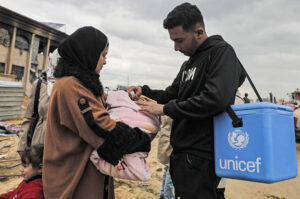
In Jabalia, north of the Gaza Strip, children received polio vaccines as part of the vaccination campaign conducted by UNICEF and its partners in 2025. Credit: UNICEF/Mohammed Nateel

By Shuli Wong
UNITED NATIONS, Jul 27 2026 – On Monday July 20, a team from the United Nations Office for the Coordination of Humanitarian Affairs (OCHA) visited two displacement sites in Gaza where they found two family tents decimated by domestic fires. This incident is indicative of the increasing frequency of domestic fires in Gaza.

Families are resorting to burning waste, cardboard, and trash to help prepare meals following the ban on gas cylinders and cooking stoves from entering Gaza since October 2023. While cooking gas is available, it is only offered in limited quantities and at extremely high prices.

The domestic fire risk in Gaza is situated within a larger, much more dire humanitarian access crisis, as documented in UNICEF’s Humanitarian Situation Update Mid-Year Review. Access restrictions and operational constraints continue to disrupt humanitarian delivery, with only 44 percent of aid trucks from Egypt able to offload between May and June. Severe restrictions remain in place for the entry of fuel, spare parts, and essential materials, which have driven system failures across health and water services. Across the Gaza Strip, an estimated 82 percent of families are water insecure, and nearly 90 percent of water and sanitation infrastructure has been damaged or destroyed.

Violence against civilians has also intensified across Gaza. The UN Human Rights Office reported that Israeli forces killed at least 57 people, including women and children, between July 13th and July 20th.

UN Spokesperson to the Secretary-General Stéphane Dujarric also detailed the aftermath of an Israeli drone strike on July 17th west of the Nuseirat refugee camp, in which seven people were reportedly killed and others injured as the strike coincided with mourners leaving a nearby funeral prayer.

On July 15th, a teacher was injured after being shot by Israeli forces while she was working at a temporary learning space west of Khan Younis. Since the start of 2026, OCHA has reported 26 education-related incidents. These findings echo their Humanitarian Situation Report from July 16th, in which 84 schools are under pending demolition or stop-work orders.

Despite operational constraints and security risks, humanitarian organizations have been working to restore and expand access to education after more than two years of disruption. At the beginning of 2026, UN partners helped 435,000 pre-primary and school-aged children, including 9,300 children with disabilities, access structured learning at 610 temporary learning spaces. Furthermore, 344,000 children received learning materials and 11,000 teachers were supported. UNICEF’s Mid-Year Review reported helping 266,000 children access formal and non-formal education opportunities, which has helped provide children with a sense of normalcy amid the ongoing upheaval and crisis.

Since the ceasefire was reached last October, there have been some improvements and gains in food security and nutrition levels, thanks to expanded humanitarian food, nutrition and agricultural assistance. But those gains are still fragile. UNICEF, the Food and Agricultural Organization (FAO) and the World Food Programme warned that families are struggling to meet basic needs, and these gains will be reversed without continuous humanitarian aid, funding and investment in recovery in the Gaza Strip. As of now, only one crossing, the Kerem Shalom/Abu Salem crossing in the south of Gaza, remains open for humanitarian assistance. The latest analysis on food security shows that an estimated 1.4 million people, or 67 percent of Gaza’s population, are experiencing crisis or worse levels of food insecurity.

Health and infrastructure remain heavily strained across the Gaza Strip. On July 20th, the Deputy Humanitarian Coordinator Susanne Tkalec met with leadership members of the Emirati Hospital in Rafah to determine solutions to strengthen the medical waste management systems in Gaza amid ongoing health and sanitation system stress.

Despite hospitals being explicitly protected under international humanitarian law, “healthcare workers, patients, ambulances, and hospitals have all been targeted,” said Dr. Javid Abdelmoneim, International President of Médecins Sans Frontières. Dr. Abdelmoneim went on to explain that “whether through direct violence, dismantling the healthcare system or obstructuring humanitarian assistance, inducing famine, weaponising water, causing higher levels of prematurity and mortality among infants and high levels of miscarriage, or denying care… it’s clear: the number one health issue in Palestine is Israel’s occupation.”

Shelter needs across Gaza remain outmatched by supply. In the first ten days of July, UN humanitarian partners provided 2,300 households with bedding items, tarpaulins and tents, and 13,000 families received kitchen sets. However, access to cooking fuel is still severely limited, as noted by the domestic fires. In addition, the supply stockpiles themselves are severely limited, with less than 1,000 tents currently available and only enough essential household supplies to support 7,000 families.

Across the occupied Palestinian territory, UN agencies continue to warn that violence, funding gaps, and access restrictions have created an unprecedented need that continues to outpace what can be delivered in terms of water, healthcare, education, and shelter.

IPS UN Bureau Report


!function(d,s,id){var js,fjs=d.getElementsByTagName(s)[0],p=/^http:/.test(d.location)?’http’:’https’;if(!d.getElementById(id)){js=d.createElement(s);js.id=id;js.src=p+’://platform.twitter.com/widgets.js’;fjs.parentNode.insertBefore(js,fjs);}}(document, ‘script’, ‘twitter-wjs’);  


U.S.-Saudi Nuclear Agreement Opens Door to Civilian Nuclear Cooperation, with One Major Caveat

A view of Riyadh, the capital of Saudi Arabia. Credit: Unsplash/Ekrem Osmanoglu

By Maximilian Malawista
UNITED NATIONS, Jul 27 2026 – On Wednesday, July 22, the U.S. Secretary of Energy, Chris Wright, and Saudi Arabia’s Minister of Energy, HRH Prince Abdulaziz bin Salman bin Abdulaziz signed a civilian nuclear cooperation agreement, best known as a 123 agreement, as well as an accompanying bilateral safeguards agreement, according to the U.S. Department of Energy and the Saudi Ministry of Energy.

While the agreement was expected to be submitted to Congress for review, President Donald Trump has conditioned U.S. nuclear cooperation on Riyadh, normalizing relations with Israel in order to receive U.S. nuclear technology. A condition that appears difficult to satisfy given the Kingdom’s hardline stance that it will not normalize relations with Israel until a Palestinian state is established with East Jerusalem as its capital, according to Crown Prince Mohammed bin Salman, Saudi Arabia’s de facto leader.

Washington mentions that these two agreements “lay the legal foundation for a decades-long, multi-billion-dollar partnership that advances several priority economic and strategic objectives, including nuclear nonproliferation.” The agreement has a 30-year term.

The 123 agreement, named after Section 123 of the Atomic Energy Act of 1954 – a U.S. federal law – provides the legal framework for long-term civilian nuclear cooperation between the United States and partner countries. The 123 agreement is mandatory before any significant exports of U.S.-origin nuclear material, such as nuclear reactors, nuclear fuel, and other major components can go to any partner.

Saudi Arabia’s nuclear agreement with the U.S. is more than an energy deal. It has the potential to reshape the Kingdom’s relationship with oil, and its geopolitical role in building the Middle East’s next-generation clean-energy infrastructure.

The advent of nuclear energy could also free up the amount of hydrocarbons Saudi Arabia can export. The Kingdom produced 22,744,529.0 TJ of oil and oil products in 2023, having consumed 6.4 million TJ domestically, equivalent to approximately 28 percent of its production. The Kingdom also produced 3,640,348.0 TJ of natural gas, having consumed all of its domestically produced natural gas that year. For reference, 3,600 TJ is equal to 1 TWh.

Expressed in barrels of oil equivalent (boe), Saudi Arabia produced the energy equivalent to 3.72 billion barrels of oil, in oil and oil products in 2023, consuming 1.05 billion barrels of that oil. This indicates that roughly 72 percent of the Kingdom’s oil and oil products, measured in energy terms, are not domestically consumed, leaving a substantial share available for exports and other uses. Saudi Arabia is the world’s second to third largest exporter of oil, producing 11 percent of global demand.

According to the International Energy Agency (IEA), transport accounts for roughly 30 percent of Saudi Arabia’s final energy consumption, followed by non-energy uses (29.7 percent), industry (19.9 percent), and commercial and public services (11 percent).

Although the pace at which Saudi Arabia can transition away from fossil fuels remains uncertain, nuclear power could gradually reduce domestic oil consumption, freeing up oil for export. According to the U.S. Energy Information Administration (EIA), a reactor can take about five or more years to be built after licensing and regulatory approvals are already completed.

Saudi Arabia’s first nuclear plant is expected to consist of two reactors, each producing around 1.4 GW, bringing the plant to a total capacity of 2.8 GW (2,800 MW). Assuming a 90 percent capacity factor, annual energy generation will be 22.1 TWh per year, nearly five percent of Saudi Arabia’s 431.9 TWh electricity generation.

Although Saudi Arabia’s first nuclear plant would account for only about 5 percent of the Kingdom’s current electricity generation, it would represent an important step toward reducing domestic hydrocarbon consumption in support of the country’s national strategy, Vision 2030.

IPS UN Bureau Report


!function(d,s,id){var js,fjs=d.getElementsByTagName(s)[0],p=/^http:/.test(d.location)?’http’:’https’;if(!d.getElementById(id)){js=d.createElement(s);js.id=id;js.src=p+’://platform.twitter.com/widgets.js’;fjs.parentNode.insertBefore(js,fjs);}}(document, ‘script’, ‘twitter-wjs’);  


Cockroach Protests: How India’s Youth Movement Led to Minister’s Resignation

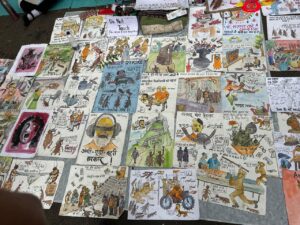
Student-made posters and artwork line the streets of Jantar Mantar, capturing messages of resistance and hope. Aishwarya Bajpai/IPS

Student-made posters and artwork line the streets of Jantar Mantar, capturing messages of resistance and hope.
Aishwarya Bajpai/IPS

By Aishwarya Bajpai
NEW DELHI, Jul 27 2026 – On July 25, after 50 days of protest at Delhi’s Jantar Mantar, Union Education Minister Dharmendra Pradhan resigned.

The movement had begun in May as a satirical social media page called the Cockroach Janta Party, founded by Abhijeet Dipke after the Chief Justice of India, Surya Kant, used the term “cockroaches” during a Supreme Court hearing, apparently referring to young people with fake law degrees, but his remark sparked a massive public backlash.

Weeks later, the NEET-UG paper (for admission into medical colleges) leaked, and alleged irregularities in the Central Board of Secondary Education on-screen marking process transformed satire into a nationwide campaign.

On June 6, Dipke called for a sit-in protest at Jantar Mantar, demanding Pradhan’s resignation. But by the time the protest entered its seventh week, the movement had outgrown its original demand – and many argue that replacing one minister will not restore faith in an education system battered by paper leaks, administrative failures and growing privatisation.

The crowd reflected that evolution.

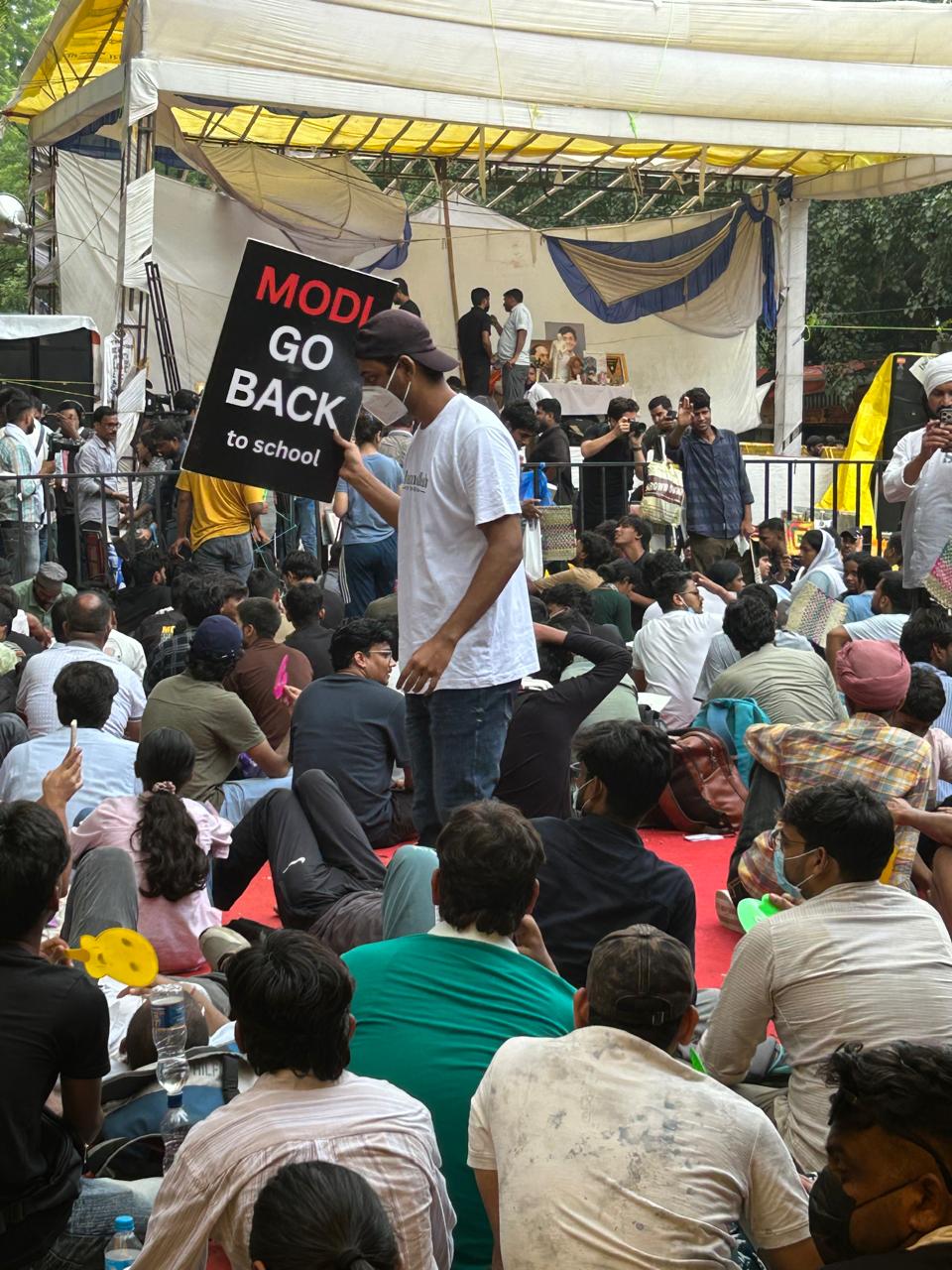
Protesters gather at the main stage at Jantar Mantar, where peaceful demonstrations and slogans continued throughout the sit-in. The stage later became the focal point of the movement as education reformer Sonam Wangchuk began his indefinite hunger strike. Aishwarya Bajpai/IPS

Protesters gather at the main stage at Jantar Mantar, where peaceful demonstrations and slogans continued throughout the sit-in. The stage later became the focal point of the movement as education reformer Sonam Wangchuk began his indefinite hunger strike. Credit: Aishwarya Bajpai/IPS

The seat of the protest, Jantar Mantar, had become far more than a student protest. Farmers stood beside parents, young professionals, senior citizens, queer activists and wage labourers. Volunteers distributed food, arranged train tickets for protesters travelling home and coordinated donations. People travelled from across India, while a handful of foreign nationals joined in solidarity. Despite their different backgrounds, they shared one belief — that the crisis threatened the future of public education itself.

Ashutosh Agarwal (centre), national vice-president of the Bharatiya Kisan Union, India's Youth Wing, stands with colleagues from Meerut in solidarity with the student-led movement. Credit: Aishwarya Bajpai/IPS

Ashutosh Agarwal (centre), national vice-president of the Bharatiya Kisan Union, India’s Youth Wing, stands with colleagues from Meerut in solidarity with the student-led movement. Credit: Aishwarya Bajpai/IPS

The seriousness and urgency are also reflected in the numbers. India has recorded 152 examination paper leaks in the past decade – roughly one every month. In 2026 alone, more than 20 million candidates appeared for NEET-UG, while reports of the leak were followed by the deaths of nearly 20 aspirants by suicide. Yet clearing these examinations offers no certainty. According to the State of Working India 2026 report by Azim Premji University, nearly 40% of graduates aged 15–25 remain unemployed, while unemployment among graduates aged 25–29 stands at 20%. Although the country produced 5 million graduates each year between 2004/05 and 2023, only 2.8 million found employment.

As the protests grew, they also drew support from opposition leaders, public figures and education reformers, expanding the movement beyond student circles.

The turning point came on June 28, when education reformer Sonam Wangchuk joined the sit-in with an indefinite hunger strike. CJP announced a march to Parliament on July 20, the opening day of the Monsoon Session. Later, on 18th July, Delhi Police removed Wangchuk from the protest site and admitted him to Safdarjung Hospital for medical observation, a move his family described as forced hospitalisation against his wishes.

What followed altered the course of the movement.

On July 20, police and the Rapid Action Force dispersed marchers using batons, tear gas, water cannons and pellet guns. Protesters alleged that some lathis were studded with nails, while the RAF’s own chief later admitted that “excessive force” had been used during the operation.

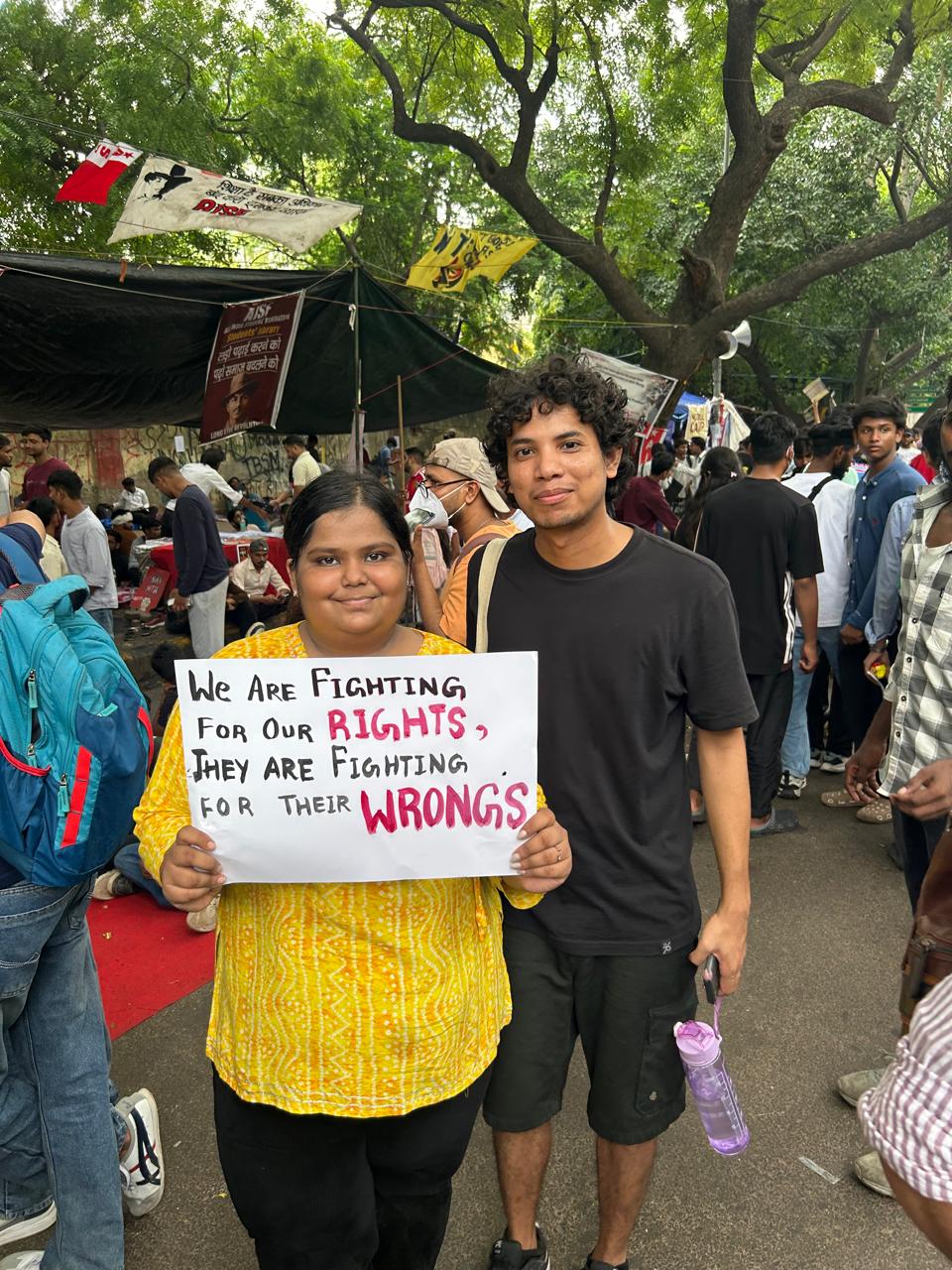
Nazia Khanam (left) and her friend travelled across Delhi to join the protest. Credit: Aishwarya Bajpai/IPS

Nazia Khanam (left) and her friend travelled across Delhi to join the protest. Credit: Aishwarya Bajpai/IPS

Instead of dispersing the protesters, however, the crackdown brought more people to Jantar Mantar.

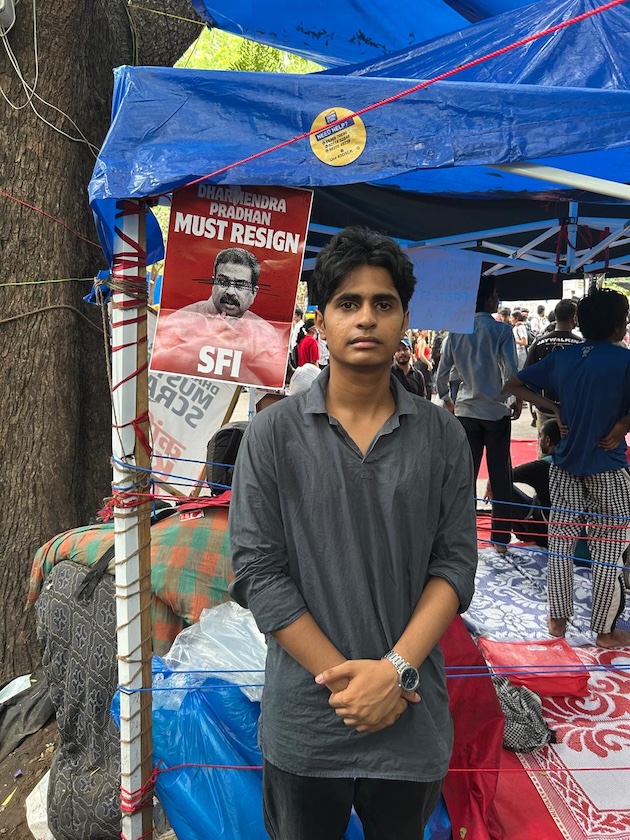
Nineteen-year-old Anshil Khan was among those who returned.

A first-year student at Delhi Skill and Entrepreneurship University, he had spent nearly three weeks at the protest. Four days earlier, he said, police had beaten him while demonstrators were trying to march towards Parliament Street. Even as he spoke, he carried hospital reports documenting his injuries.

“I got hit three times by the Delhi police,” he said. “I have been resting for four days, and today I have come back.”

He recalled crossing two barricades before police stopped the march at the third.

“We were peacefully protesting and only raising slogans of “Inquilab Zindabad” (Long Live Revolution). Nothing violent happened from our side.”

Delhi Police had issued a public advisory before the march stating that no permission had been granted for any procession beyond the designated protest site and later maintained that officers were enforcing prohibitory orders. Officials also said that both protesters and security personnel suffered injuries during the clashes.

For Anshil, however, the police action only strengthened public support.

“The students are coming along with their parents now,” he said, referring to the days following Wangchuk’s detention and the July 20 crackdown.

Anshil Khan, a member of the Students' Federation of India (SFI), joins fellow protesters at Jantar Mantar. Credit: Aishwarya Bajpai/IPS

Anshil Khan, a member of the Students’ Federation of India (SFI), joins fellow protesters at Jantar Mantar. Credit: Aishwarya Bajpai/IPS

His demands had also evolved.

“Dharmendra Pradhan’s resignation is the first step,” he said. “Education is our first priority.”

That sentiment surfaced repeatedly across conversations at Jantar Mantar. Protesters were no longer speaking only about accountability for one minister; they were debating how India’s education system itself should function.

Standing nearby with a placard reading “We are fighting for our rights,” Nazia Khanam had travelled across Delhi to join the demonstration, despite never having been directly affected by an examination scandal.

A law student from Jodhpur interning in the capital, Khanam had successfully cleared the Common Law Admission Test (CLAT). But with her younger sister now preparing for the same examination, she felt she could not remain on the sidelines.

“Being an elder sister of a student who is going to give a competitive exam, it becomes my responsibility,” she said. “Even though I’m not personally affected, I should still come here and raise my voice.”

Unlike many demonstrations driven solely by outrage, Khanam arrived with ideas for reform.

“There should be stricter checks and balances at every bureaucratic level,” she said, referring to agencies such as the National Testing Agency, examination centres and other bodies involved in conducting competitive exams.

She also questioned how education policy is made.

“There should be other stakeholders involved,” she said. “Educators who have done actual groundwork, who know the ground reality, should be part of consultations before policies are formulated like Sonam Wangchuk.”

That conversation had drawn unexpected allies.

Among those standing with the students was Ashutosh Agarwal, National Vice-President of the Bharatiya Kisan Union, India’s youth wing. Before arriving in Delhi, he said, the union had organised meetings across Meerut, Muzaffarnagar and other parts of western Uttar Pradesh to mobilise support for the students.

“We demand one nation, one education,” he said.

For Agarwal, the increasing commercialisation of essential public services was inseparable from the examination crisis.

“We demand the end of privatisation of both education and health,” he said. “Otherwise paper leaks won’t stop.”

He argued that growing corporate influence over private schools, colleges and hospitals had weakened public institutions, making quality education increasingly inaccessible.

Parents had reached a similar conclusion.

Alisha Siddique came to Jantar Mantar thinking about her three children, particularly her daughter pursuing a Bachelor of Science degree. Unlike many protesters, she did not begin with paper leaks. Instead, she pointed to the everyday rules that, in her view, unfairly punish students.

“If students reach one or two minutes late because of an accident or emergency, they are not allowed to sit for the exam,” she said. “Their entire year’s hard work goes to waste.”

For Siddique, the issue was larger than examinations.

“We want our children to become good citizens,” she said. “That starts with good education.”

The examination crisis merely provided the spark for Avinash Kumar, a human rights practitioner and activist who is the former Executive Director of Amnesty International India and the Director of Policy, Research and Campaigns at Oxfam India.

“The constant leaking cauldron of competitive exams provided that cause,” he said. “Yet everyone knows it’s now not just about that.”

According to Kumar, the protests became an outlet for frustrations that had accumulated over years — declining public services, rising costs, increasing privatisation, shrinking civic freedoms and a growing sense that institutions no longer worked for ordinary citizens.

“You need a cause which cuts across classes and masses, age and gender and religion,” he said. “Competitive exams became that cause.”

What struck Kumar most was not just the scale of the demonstrations in Delhi but also the emergence of protests in places that rarely make national headlines.

“My attention was particularly drawn towards mass-scale showings in small unknown towns like Begusarai, Narnaul and Aurangabad,” he said. “All were speaking in one language of years of frustration.”

To him, that distinguished this movement from many previous protests.

Rather than revolving around one organisation or one political leader, it drew strength from multiple voices – student leaders, education reformers, farmers, parents, opposition politicians and ordinary citizens – each contributing from their own experience.

“It is a movement with very different leaders at different points of time,” Kumar said.

Two days after resignation, the protest site is almost empty.

The questions raised over 50 days of protest — about accountability, privatisation, public education and the future promised to India’s youth — remain standing.

IPS UN Bureau Report


!function(d,s,id){var js,fjs=d.getElementsByTagName(s)[0],p=/^http:/.test(d.location)?’http’:’https’;if(!d.getElementById(id)){js=d.createElement(s);js.id=id;js.src=p+’://platform.twitter.com/widgets.js’;fjs.parentNode.insertBefore(js,fjs);}}(document, ‘script’, ‘twitter-wjs’);