اختتام تجربة القيادة للإعلاميين لسيارة LUXEED R7 في دبي بنجاح، تمهيدًا لتعزيز حضورها في سوق التنقل الفاخر في الشرق الأوسط

دبي، الإمارات العربية المتحدة, July 23, 2026 (GLOBE NEWSWIRE) —

استضافت شركة LUXEED فعالية لاختبار القيادة لممثلي وسائل الإعلام العالمية لسيارة LUXEED R7 في Dubai International Financial Centre (DIFC). وفي ظروف قيادة واقعية على الطرق الحضرية في دبي، خضعت السيارة LUXEED R7 لاختبارات دقيقة صارمة من قِبل الإعلاميين والمؤثرين (KOLs) من مختلف الدول، للتحقق من قدراتها الذكية المتطورة وراحة قيادتها الفائقة.

انطلاقًا واختتامًا من قرية البوابة في DIFC، امتد مسار الاختبار الحضري الموحّد على شكل حلقة مغلقة بطول 7.1 كيلومتر، شملت طريق E11 السريع. وغطّى المسار سيناريوهات القيادة النموذجية في الشرق الأوسط، بما في ذلك شوارع المدن منخفضة السرعة، والطرق الحضرية الرئيسية، وتقاطعات الطرق السريعة. وقد أتاحت التجربة للمشاركين التعرُّف بشكل مباشر على الأداء المتوازن للسيارة عبر مؤشرات متعددة، شملت التسارع، والتحكم في التوجيه، واستجابة المكابح، ونظام مساعدة القيادة على الطرق السريعة (HNOA)، والهدوء الشامل للمركبة من حيث مستويات الضوضاء والاهتزازات والخشونة (NVH)، فضلاً عن جودة الركوب المستقرة على مختلف أسطح الطرق.

تُعد أنظمة المساعدة الذكية المتقدمة ركيزةً أساسية cornerstone في المقومات والمزايا الفاخرة لسيارة LUXEED R7. وسلّطت الفعالية الضوء على تقنيات القيادة الذكية الرائدة في هذا الطراز، بما في ذلك نظام Super Intelligent Valet Parking (SIVP)، ونظام Automated Parking Assist (APA)، ونظام Exit Parking Assist (EPA)، ونظام Valet Parking Assistance (VPA). وبفضل خوارزميات ذكية متطورة، تتيح هذه الوظائف التحكم عن بُعد في السيارة عبر تطبيق على الهاتف المحمول. وبعد خروج السائق من السيارة، يستطيع النظام البحث بشكل مستقل عن أماكن لوقوف السيارات، وإتمام عملية الركن الآلي بالكامل، وتنفيذ استدعاء ذكي للسيارة من أماكن الوقوف إلى المواقع المحددة، مما يعزز سهولة التنقل بشكل كبير. واختبر الضيوف الإعلاميون المجموعة الكاملة من الميزات الذكية الأساسية في موقف السيارات الحصري لكبار الشخصيات في DIFC.

على امتداد الجزء المخصص من المسار على طريق E11 السريع، اختبر المشاركون أيضًا وظيفة HNOA في السيارة. وقدّم النظام متابعة ثابتة للسرعة التكيفية، وتمركزًا دقيقًا داخل المسار، وتحكمًا سلسًا في القيادة أثناء السير، مما ساعد على تقليل التعب خلال الرحلات الطويلة، مع تعزيز السلامة الشاملة أثناء القيادة لتوفير تجربة تنقل ذكية مريحة وممتعة وخالية من المتاعب.

عقب التقييمات العملية، أشاد ممثلو وسائل الإعلام العالمية والمؤثرون الإقليميون بالإجماع بنقاط القوة الشاملة التي تتمتع بها سيارة LUXEED R7 كمنتج متكامل. علّق أحد ممثلي وسائل الإعلام المقيمين في دولة الإمارات العربية المتحدة: “لقد تجاوزت وظيفة SIVP في سيارة LUXEED R7 جميع توقعاتي. فبعيدًا عن المواصفات التقنية، فإن التجربة الذكية البديهية التي تُعالج مشاكل القيادة اليومية الحقيقية تُجسّد الجوهر الحقيقي للتنقل الفاخر.”

أكد العديد من المؤثرين هذا الرأي قائلين: “بعد حضور عدد لا يُحصى من تجارب القيادة للمركبات الفاخرة في دبي، تقدم سيارة LUXEED R7 تجربة مميزة وفريدة من نوعها، إذ تتكامل ميزاتها الذكية بسلاسة مع كل جانب من جوانب راحة القيادة، لتُجسد معيارًا جديدًا للتنقل الحضري الفاخر المعاصر.”

عقب اختتام جلسات تجربة القيادة، اجتمع جميع الضيوف المميزين على مأدبة عشاء حصرية أقامتها LUXEED لإجراء مناقشات معمّقة. تركّزت المحادثات حول الأداء الذكي للسيارة، والحرفية الفاخرة للمقصورة الداخلية، وقابلية التكيف مع سوق الشرق الأوسط، مما عزّز بشكل أكبر السردية الخاصة بعلامة LUXEED التجارية القائمة على مفهوم أسلوب الحياة الراقي.

أبرزت تجربة القيادة الإعلامية العالمية نقاط القوة الرئيسية لسيارة LUXEED R7 من Chery Group في مجال التنقل الذكي الفاخر، وحظيت بإشادة واسعة من الصحافة العالمية والنخبة الإقليمية لأدائها المتميز على الطرق. وبالنظر إلى المرحلة المقبلة، ستواصل LUXEED تركيزها المكثف على حلول التنقل الفاخر. وستعمل العلامة التجارية باستمرار على تحسين تقنيات القيادة الذكية والارتقاء بتجارب السفر الفاخرة بما يتماشى بشكل وثيق مع متطلبات أسلوب الحياة عالي المعايير لدى المستهلكين في الشرق الأوسط. ومن خلال تطوير حلول تنقل مصممة خصيصًا لظروف الطرق المحلية ومتطلبات القيادة الفاخرة في مختلف أنحاء المنطقة، ستعمل LUXEED على ترسيخ مكانتها العالمية كعلامة تجارية متخصصة في تصنيع مركبات التنقل الذكية الفاخرة.

لمزيد من المعلومات:
إدارة العلامة التجارية الدولية لشركة LUXEED
السيد/ Qiao Jiantao
البريد الإلكتروني: [email protected]

الصور المصاحبة لهذا البيان الصحفي متاحة على:

https://www.globenewswire.com/NewsRoom/AttachmentNg/46de059b-a821-4c46-8edb-8cbaa1812786

https://www.globenewswire.com/NewsRoom/AttachmentNg/847f366e-f8d3-4eda-a41f-1dd9d6f967b1

https://www.globenewswire.com/NewsRoom/AttachmentNg/1cd4ab21-0b93-4647-9e84-3bf61b45e359

https://www.globenewswire.com/NewsRoom/AttachmentNg/532baa94-36c0-4a7a-a858-805c93ad4039

https://www.globenewswire.com/NewsRoom/AttachmentNg/d9cb3150-5203-4769-82fb-0344e606c37b

https://www.globenewswire.com/NewsRoom/AttachmentNg/eaf1fa33-6d07-4680-aeee-408f23123ffe

https://www.globenewswire.com/NewsRoom/AttachmentNg/55ab197d-433c-470f-850a-ea4f793d3bb0


GLOBENEWSWIRE (Distribution ID 9767181)

Bitget Registers as a New Zealand Financial Services Provider

VICTORIA, Seychelles, July 23, 2026 (GLOBE NEWSWIRE) — Bitget, the world's largest Universal Exchange (UEX), has been registered as a Financial Services Provider on New Zealand's Financial Service Providers Register (FSPR).

The registration supports Bitget's financial services framework and covers registered service categories including foreign currency exchange, domestic and cross-border money transfers, client asset custody, portfolio and money management, and the execution of financial product or foreign exchange transactions on behalf of clients.

Bitget has also joined the New Zealand Insurance and Financial Services Ombudsman (IFSO) Dispute Resolution Scheme. The independent scheme provides an external channel for eligible customers to raise and resolve disputes relating to participating financial service providers.

The registration forms part of Bitget's work to build the operational and compliance infrastructure required for its expanding range of financial products, including traditional market instruments, foreign exchange services and tokenized real-world assets.

“Financial platforms need compliance structures that can support a wider mix of assets and services,” said Gracy Chen, CEO at Bitget. “The registration adds another layer to our international financial services framework as the platform continues connecting digital assets with established markets.”

The Universal Exchange model brings crypto assets, tokenized stocks, commodities, foreign exchange and other financial products into a single trading platform. The company continues to develop its services through registered entities and qualified partners across different jurisdictions.

Disclaimer: Product availability remains subject to applicable laws, local requirements and regional eligibility. Registration on the FSPR does not constitute an endorsement, approval, or guarantee by the New Zealand Government, the Financial Markets Authority (FMA), or the Registrar of Financial Service Providers.

About Bitget

Bitget is the world's largest Universal Exchange (UEX), serving over 125 million users and offering access to over 2M crypto tokens, 500+ tokenized stocks, ETFs, commodities, FX, and precious metals such as gold. The ecosystem is committed to helping users trade smarter with its AI agent, which co-pilots trade execution. Bitget is driving crypto adoption through strategic partnerships such as MotoGP™. Aligned with its global impact strategy, Bitget has joined hands with UNICEF to support blockchain education for 1.1 million people by 2027. Bitget currently leads in the tokenized TradFi market, providing the industry's lowest fees and highest liquidity across 150 regions worldwide.

For more information, visit: Website | X | Telegram | LinkedIn | Discord

For media inquiries, please contact: [email protected] 

Risk Warning: Digital asset prices are subject to fluctuation and may experience significant volatility. Investors are advised to only allocate funds they can afford to lose. The value of any investment may be impacted, and there is a possibility that financial objectives may not be met, nor the principal investment recovered. Independent financial advice should always be sought, and personal financial experience and standing carefully considered. Past performance is not a reliable indicator of future results. Bitget accepts no liability for any potential losses incurred. Nothing contained herein should be construed as financial advice. For further information, please refer to our Terms of Use.

A photo accompanying this announcement is available at https://www.globenewswire.com/NewsRoom/AttachmentNg/67aee548-d01f-45db-a363-7151fcc71f12


GLOBENEWSWIRE (Distribution ID 1001214058)

From the Pitch to the Road – LEPAS L8 PHEV Redefines Elegant Mobility

WUHU, China, July 23, 2026 (GLOBE NEWSWIRE) — LEPAS, the mid-to-premium NEV brand under Chery Auto, has introduced the LEPAS L8 PHEV to global markets, bringing a new interpretation of elegant mobility through advanced hybrid technology, intelligent driving, and refined design. Inspired by the composure, precision, and resilience demonstrated by champions on the global football stage, the LEPAS L8 PHEV combines the brand’s signature “Leopard Aesthetics” design philosophy with the LEPAS Super Hybrid system, offering confident performance, extended range, and a sophisticated driving experience for consumers seeking intelligent and elegant mobility solutions worldwide.

Beyond victory and defeat, both teams embodied the champion's spirit – a fusion of composure and resilience. This resonates with the core values of the upcoming LEPAS L8 PHEV, a model poised to make its mark on the global NEV stage with all-around strength.

Leopard Aesthetics – Where Strength Meets Elegance

Throughout the final, Spain's fluid passing and movement, contrasted with Argentina's tenacious and resilient resistance, presented a compelling balance of power and elegance. This echoed perfectly with LEPAS's signature “Leopard Aesthetics” design philosophy. The LEPAS L8 PHEV draws inspiration from the leopard's stretched, agile stride, striking a balance between untamed power and understated sophistication. It mirrors the two finalists – one commanding the game with fluid rhythm, the other holding their ground with resilience. Leopard Aesthetics embodies the coexistence of strength and sophistication, creating a design language that is confident and elegant.

The Leopard Avant-Garde Front Face, paired with Leopard Dynamic Shoulder Line, conceals a sharp tension beneath its smooth contours. The Leopard Silhouette Through-Type LED Taillight, when illuminated, streaks across the night like a leopard's fleeting shadow, creating a interplay of motion and stillness. Customized paint finishes, such as Norwegian Forest Green and Provence Purple, are crafted through a seven-layer painting process to achieve a refined, understated texture with a recognizable visual identity. This design language – both fluid and powerful – ensures the vehicle stands out with an elegant character, whether navigating city streets or open roads.

The interior continues this philosophy of strength and elegance. A class-leading 2800mm wheelbase creates an airy, spacious, wraparound cabin, where flowing lines soften the cold precision of modern engineering. An active fragrance system, AQS air quality monitoring, UV-blocking and heat-insulating glass, cloud-comfort lounge seats, and a theater-class serene cabin work together to create a refined sanctuary from the outside world. Together, they bring the composed and relaxing travel experience, bringing the same sense of confidence and comfort found in championship performance to every journey.

LEPAS Super Hybrid – Confidence Across Every Journey

On the pitch, championship team proved that success comes not from a single style, but from the ability to adapt. Whether controlling the rhythm of the game or responding calmly under pressure, true champions remain composed in every situation. This is the philosophy behind the LEPAS L8 PHEV, delivering confident, well-balanced performance across every driving scenario.

The LEPAS L8 PHEV is powered by the LEPAS Super Hybrid system, featuring a dedicated hybrid engine with an industry-leading thermal efficiency of 45.79% and a dedicated hybrid transmission with 97.6% transmission efficiency. It achieves an ultra-low comprehensive fuel consumption of just 2.38L/100 km and a comprehensive range of up to 1,300 kilometers under NEDC conditions. Paired with 40kW DC fast charging, the battery can be replenished from 30% to 80% while you enjoy a cup of coffee. Whether navigating urban commutes, business trips, or long-distance journeys, it adapts seamlessly to every scenario, easing range anxiety and delivering a confident driving experience.

Comprehensive Safety and Intelligent Protection – A Solid Defense with Agile Response

“Attack wins you games, but defense wins you championships.” Throughout this tournament, Spain's defense was impregnable, conceding just one goal across the entire competition, while Argentina's multi-layered defensive network was equally among the strongest on display. Both teams fully demonstrated the art of defense – and this is precisely the philosophy behind how the LEPAS L8 PHEV safeguards its users' elegant journeys.

The LEPAS L8 PHEV features a cage-style body constructed with a high proportion of high-strength steel, equipped with up to 10 airbags to ensure the cabin integrity during a collision and provide comprehensive protection for every occupant.

The power battery incorporates triple battery safety protection with IP68/IPX9K ratings that effectively prevent water and dust ingress. This enables the vehicle to confidently handle complex road conditions such as flooded streets and unpaved surfaces, building a solid safety foundation for every journey.

On the intelligent front, the LEPAS L8 PHEV is equipped with a Level 2 ADAS (Intelligent Driving Assistance System), integrating a 540° panoramic transparent imaging, APA/RPA automatic parking, and over twenty functions including forward collision warning, lane keeping assist, and rear cross traffic braking. These technologies ensure driving safety and convenience, much like a steadfast defense on the pitch, guarding every journey from start to finish.

Every championship leaves behind more than a result. The young Spanish squad perfectly demonstrated how composure and teamwork can command the game, while the Argentine side showed unwavering determination, with Messi’s relentless drive under pressure standing as a testament to passion and resilience. As the final whistle fades, the journey continues. With the upcoming LEPAS L8 PHEV, LEPAS remains committed to bringing elegant mobility to every road ahead.

Media Contact

Company Name: LEPAS International

Contact Person: Vincy wang

E-mail: [email protected]

Company Official Website:https://lepasinternational.com/

Photos accompanying this announcement are available at:

https://www.globenewswire.com/NewsRoom/AttachmentNg/ffc894af-76ca-430e-bc81-57c3176de837

https://www.globenewswire.com/NewsRoom/AttachmentNg/7caefc54-5e3f-40af-92a4-548c28786d49

https://www.globenewswire.com/NewsRoom/AttachmentNg/5206c59d-8984-480f-8512-f98d636e594d


GLOBENEWSWIRE (Distribution ID 9767005)

EBC Launches TradingView Professional Charts with Free Access to Premium Indicators

LONDON, July 23, 2026 (GLOBE NEWSWIRE) — EBC Financial Group (“EBC”) has launched TradingView Professional Charts across its trading ecosystem, giving clients access to one of the world’s most widely used charting and market analysis platforms.

“Access to professional-grade charting tools can significantly improve how traders interpret market conditions and manage risk,” said Lewis Tang, Brand Director at EBC Financial Group.

“With TradingView Professional Charts, traders gain access to advanced technical indicators, multi-chart analysis, custom drawing tools, and real-time market insights within a single environment. These capabilities help traders analyse market movements more efficiently, identify opportunities with greater precision, and make more informed decisions across asset classes and market conditions.”

As financial markets become increasingly data-driven and volatile, traders are placing greater emphasis on tools that allow them to analyse market movements, identify opportunities, and manage risk more effectively. By combining TradingView’s professional charting environment with EBC’s institutional-grade execution infrastructure, the Group aims to make advanced market analysis more accessible to traders worldwide.

Bridging Professional Market Analysis Closer to Everyday Traders

Technical analysis has become a central component of modern trading strategies, yet access to advanced charting tools often remains limited by subscription costs or platform complexity.

Through the launch, eligible EBC clients can access TradingView premium charting features and advanced analytical tools, allowing them to monitor markets with greater precision and efficiency.

The integration provides traders with:

  • Advanced multi-chart layouts for monitoring multiple markets simultaneously
  • Professional technical indicators and custom analytical tools
  • Real-time market data and charting functionality
  • Extensive drawing and visualisation tools for technical analysis
  • Cross-device access across desktop and mobile environments
  • Enhanced market monitoring through custom alerts and watchlists

By bringing these capabilities together within the EBC ecosystem, traders can conduct deeper market analysis without relying on multiple disconnected platforms.

Professional Charting Meets Institutional-Grade Execution

The launch extends beyond charting functionality alone. Traders using TradingView Professional Charts gain access to EBC’s broader trading ecosystem, supported by infrastructure designed to deliver speed, stability, and pricing efficiency across global markets.

Through its proprietary Smart Order Routing Engine, EBC supports price improvement across client orders, with more than 87.6% of trades executed at a better price than requested. The Group’s infrastructure is capable of processing more than 1,000 orders per second, with average execution speeds below 20 milliseconds and data transmission stability of up to 98.75%.

Clients also benefit from raw ECN spreads from 0.0 pips, liquidity sourced from more than 25 leading investment banks and hedge funds, and 24/7 VIP multilingual support.

The integration enables traders to combine advanced charting and market analysis with institutional-level execution quality through a single trading ecosystem.

“The modern trader needs more than access to markets. They need access to professional tools, reliable execution, and the confidence that their trading infrastructure can keep pace with increasingly complex market conditions,” – said Lewis.

“TradingView has become one of the most trusted charting platforms in the industry. By bringing these capabilities into the EBC ecosystem, we are making sophisticated market analysis more accessible while helping traders operate with greater efficiency, transparency, and control.”

Strengthen EBC’s Global Trading Ecosystem

The launch forms part of EBC’s ongoing investment in trading technology and client experience, expanding a broader ecosystem that combines market access, execution infrastructure, analytical resources, trader education, and client support.

EBC has been recognised by World Finance for three consecutive years, receiving awards across multiple categories including Most Trusted Broker, Best Trading Platform, Best CFD Broker, Best FX Trading Platform, and Best Trade Execution.

The addition of TradingView Professional Charts further strengthens EBC’s commitment to providing traders with the tools, infrastructure, and market access needed to navigate increasingly dynamic global markets.

For more information about TradingView Professional Charts and eligibility requirements, visit: www.ebc.com.

Disclaimer: This material is for information only and does not constitute a recommendation or advice from EBC Financial Group and all its entities (“EBC”). Trading Forex and Contracts for Difference (CFDs) on margin carries a high level of risk and may not be suitable for all investors. Losses can exceed your deposits. Before trading, you should carefully consider your trading objectives, level of experience, and risk appetite, and consult an independent financial advisor if necessary. Statistics or past investment performance are not a guarantee of future performance. EBC is not liable for any damages arising from reliance on this information.

About EBC Financial Group 
Founded in London, EBC Financial Group (“EBC”) is a global brand known for its expertise in financial brokerage and asset management. Through its regulated entities operating across major financial jurisdictions—including the UK, Australia, the Cayman Islands, Mauritius, South Africa and others—EBC enables retail, professional, and institutional investors to access global markets and trading opportunities, including currencies, commodities, CFDs and more.

Trusted by investors in over 100 countries and honoured with global awards including multiple year recognition from World Finance, EBC is widely regarded as one of the world’s best brokers with titles including Best Trading Platform and Most Trusted Broker. With its strong regulatory standing and commitment to transparency, EBC has also been consistently ranked among the top brokers—trusted for its ability to deliver secure, innovative, and client-first trading solutions across competitive international markets.

EBC’s subsidiaries are licensed and regulated within their respective jurisdictions. EBC Financial Group (UK) Limited is regulated by the UK's Financial Conduct Authority (FCA); EBC Financial Group (Cayman) Limited is regulated by the Cayman Islands Monetary Authority (CIMA); EBC Financial Group (Australia) Pty Ltd, and EBC Asset Management Pty Ltd are regulated by Australia's Securities and Investments Commission (ASIC); EBC Financial (MU) Ltd is authorised and regulated by the Financial Services Commission Mauritius (FSC); EBC Financial Group SA (Pty) Ltd is authorised and regulated by the Financial Sector Conduct Authority (FSCA).

At the core of EBC are a team of industry veterans with over 40 years of experience in major financial institutions. Having navigated key economic cycles from the Plaza Accord and 2015 Swiss franc crisis to the market upheavals of the COVID-19 pandemic. We foster a culture where integrity, respect, and client asset security are paramount, ensuring that every investor relationship is handled with the utmost seriousness it deserves.

EBC is a proud official foreign exchange partner of FC Barcelona and continues to drive impactful partnerships to empower communities – namely through the UN Foundation’s United to Beat Malaria initiative, Department of Economics at the University of Oxford, and a diverse range of partners to champion initiatives in global health, economics, education, and sustainability.

https://www.ebc.com/


GLOBENEWSWIRE (Distribution ID 9766998)

Human-Caused Climate Change, Not El Niño, Drives Most Coral Bleaching Events – Research

The reef surrounding Namotu Island, Fiji, has experienced serious coral bleaching caused by increasing ocean temperatures. Credit: Beau Pilgrim / Climate Visuals

The reef surrounding Namotu Island, Fiji, has experienced serious coral bleaching caused by increasing ocean temperatures.
Credit: Beau Pilgrim / Climate Visuals

By Kizito Makoye
DAR ES SALAAM, Tanzania, Jul 23 2026 – Every morning, as the Indian Ocean retreats from the reef off Zanzibar’s Jambiani village, Chiku Chande steps into the knee-deep lagoon carrying bundles of seaweed seedlings. Years of farming these waters have taught her about every channel and coral outcrop. But lately, the corals that once glowed in brown and gold have become chalky white.

“You don’t need anyone to tell you these changes,” Chande tells IPS. “We see it with our own eyes. The coral has lost its colour.”

Like many families in Jambiani, the 48-year-old grandmother depends on the reef. It shelters her seaweed farm from crashing Indian Ocean waves, supports fish stocks and brings tourists to the village. As the corals bleach and slowly die, she worries about the future.

Chande has watched the reef change year after year. Scientists say her observations mirror what is happening across the world’s tropical oceans.

Scientists long regarded El Niño – the natural warming of parts of the Pacific Ocean that disrupts weather patterns globally – as the main driver of mass coral bleaching

A new study led by Climate Central and published in Oceanography concludes that human-induced climate change has driven every global coral bleaching event over the past four decades. The researchers found greenhouse gas emissions have warmed the oceans so much that El Niño now acts mainly as a trigger rather than the root cause.

“Our study shows that without climate change, coral bleaching would be a rare and isolated event, and global mass coral bleaching simply would not occur,” says Andrew Pershing, Climate Central’s chief programme officer and the study’s lead author.

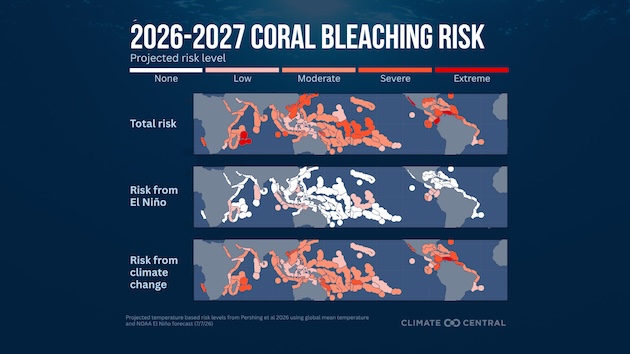
2026-2027 projected bleaching risk map. A report published in Oceanography argues that nearly every global coral bleaching event over the past 40 years would not have occurredwithout human-caused climate change. Credit: Oceanography

2026-2027 projected bleaching risk map. A report published in Oceanography argues that nearly every global coral bleaching event over the past 40 years would not have occurred
without human-caused climate change. Credit: Oceanography

Corals bleach when unusually warm water forces them to expel the microscopic algae that provide most of their food and give them their vibrant colours. If temperatures quickly return to normal, corals can recover. But prolonged heat starves them and can kill entire reef ecosystems.

To determine how much of that warming came from human activity, researchers compared today’s sea surface temperatures with computer simulations of a world unaffected by greenhouse gas emissions. They then assessed whether bleaching would still have occurred under those cooler conditions.

Their analysis showed that every global bleaching event since 1998 – including those in 1998, 2010, 2014-2017 and the ongoing event that began in 2023 – required human-caused warming to push ocean temperatures beyond bleaching thresholds. Although El Niño coincided with many of those events, the study found they would not have become global bleaching episodes without decades of warming driven by fossil fuel emissions.

Women seaweed farmers in Zanzibar's Jambiani village receive guidance while tending seaweed farms in the shallow lagoon, where warming seas have also left nearby coral reefs increasingly bleached. Scientists say human-caused climate change, rather than natural climate cycles, has driven every global mass coral bleaching event on record. Credit: Muhidin Michuzi

Women seaweed farmers in Zanzibar’s Jambiani village receive guidance while tending seaweed farms in the shallow lagoon, where warming seas have also left nearby coral reefs increasingly bleached. Scientists say human-caused climate change, rather than natural climate cycles, has driven every global mass coral bleaching event on record. Credit: Muhidin Michuzi

The findings have particular implications for Tanzania.

The country’s 1,400-kilometre coastline, which includes the reefs surrounding Zanzibar, Pemba and Mafia islands, supports fisheries, tourism and thousands of coastal livelihoods. Healthy reefs also protect beaches and coastal settlements by absorbing up to 97 percent of incoming wave energy, reducing erosion and storm damage.

As reefs deteriorate, fish populations decline, tourism suffers and coastlines become increasingly vulnerable to flooding and erosion.

Similar pressures are happening across tropical reefs worldwide. Although coral reefs cover less than one percent of the ocean floor, they support roughly a quarter of all marine species and generate an estimated US$2.7 trillion annually in ecosystem services through fisheries, tourism and coastal protection. The Global Coral Reef Monitoring Network estimates the world lost about 14 percent of its coral between 2009 and 2018 as repeated marine heatwaves left reefs too little time to recover.

Recent ocean temperature records suggest the pressure is intensifying.

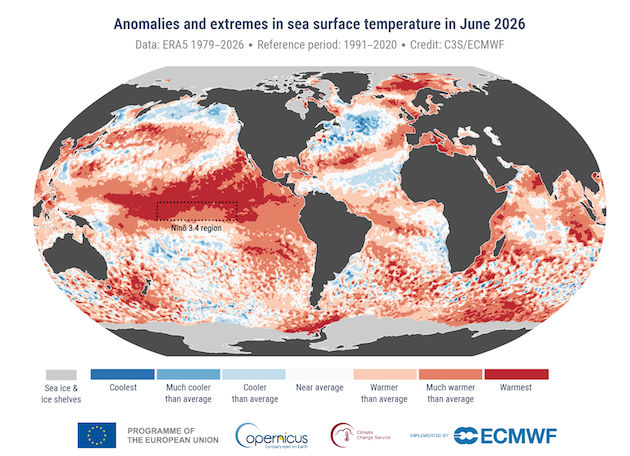
According to the Copernicus Marine Service, June 2026 was the warmest June on record for global sea surface temperatures, while marine heatwaves covered about 82 percent of the world’s oceans by the end of the month. Because the oceans absorb more than 90 percent of the excess heat trapped by greenhouse gases, marine heatwaves are becoming more frequent and severe, increasing the likelihood of coral bleaching.

The Climate Central researchers project that by 2028 human-caused warming will outweigh El Niño’s influence in every coral reef region worldwide. Bleaching, they say, will increasingly reflect persistently warmer oceans rather than unusually strong natural climate cycles.

Using the same attribution methods, the researchers also assessed bleaching risk during the developing 2026-2027 El Niño. They found that while the climate pattern could still trigger bleaching in some regions, human-caused warming would account for most of the risk, particularly in the southern Caribbean, the Pacific coasts of Central and South America, and parts of East and Southeast Asia.

Globally, the monthly average sea-surface temperature for the extra-polar ocean (60°S–60°N) was the highest for June, exceeding the previous record set in June 2024 by just 0.01ºC. This partly reflected the development of strong El Niño conditions in the equatorial Pacific, according to the Copernicus Climate Change Service. Credit: ECMWF/Copernicus Climate Change Service

Globally, the monthly average sea-surface temperature for the extra-polar ocean (60°S–60°N) was the highest for June, exceeding the previous record set in June 2024 by just 0.01ºC. This partly reflected the development of strong El Niño conditions in the equatorial Pacific, according to the Copernicus Climate Change Service. Credit: ECMWF/Copernicus Climate Change Service

The study challenges the long-held assumption that bleaching is mainly a response to natural climate cycles. Researchers say bleaching can no longer be viewed as an occasional event linked to natural climate cycles; scientists say it is increasingly becoming a recurring consequence of steadily warming oceans.

“By isolating the effect of climate change, our study shows that the fate of reefs is closely tied to how much carbon pollution goes into the atmosphere. Protecting reefs from overfishing and pollution is very important. We need as many thriving reef areas as possible. Even during severe events, there are often pockets of coral that persist. These areas can be the source for recovery in the short and long term,” Pershing tells IPS

The Intergovernmental Panel on Climate Change warns that even if global warming is limited to 1.5 degrees Celsius above pre-industrial levels, up to 90 percent of the world’s coral reefs could disappear by mid-century. At 2 degrees Celsius of warming, losses could reach 99 percent.

Chande does not speak in terms of climate attribution. She only knows the reef looks different from when she began farming seaweed. Researchers say the bleaching she has witnessed reflects a much deeper shift: oceans that have steadily warmed over decades because of greenhouse gas emissions.

“When I was younger, the corals were full of colour and fish,” she said. “Now everything looks white. I worry about what is happening to the sea,” she says.

IPS UN Bureau Report


!function(d,s,id){var js,fjs=d.getElementsByTagName(s)[0],p=/^http:/.test(d.location)?’http’:’https’;if(!d.getElementById(id)){js=d.createElement(s);js.id=id;js.src=p+’://platform.twitter.com/widgets.js’;fjs.parentNode.insertBefore(js,fjs);}}(document, ‘script’, ‘twitter-wjs’);


Hunger in Latin America Keeps Falling – Now Healthy Diets Must Become Affordable

Affordable healthy diets are Latin America's next food challenge as high costs keep nutritious food out of reach despite falling hunger

Latin America and the Caribbean has the world’s most expensive healthy diet. Credit: Max Valencia / FAO

By Máximo Torero
ROME, Jul 23 2026 – Hunger is falling across most of Latin America and the Caribbean. The region’s next challenge is harder: ensuring that everyone can afford a healthy diet, not merely enough calories to survive.

The regional hunger rate fell for a fifth consecutive year in 2025, reaching a record low of 4.8 percent, down from the pandemic peak of 6.1 percent in 2020. About 32 million people faced hunger, more than 1 million fewer than in 2024 and 7.5 million fewer than in 2020. Moderate or severe food insecurity, which includes people forced to skip meals or eat less, also fell to 22.9 percent, below its 2015 level of 23.4 percent. The region’s share of the world’s hungry has remained at about 5 percent for 15 years.

This progress was not accidental. It reflects sustained investment in agricultural productivity and stronger social protection, including the cash transfer and school feeding programs developed by Brazil and Mexico.

Poor roads, limited rail networks, inadequate cold storage, unreliable energy, inefficient markets and post harvest losses raise costs as nutritious food moves through storage, processing, transportation, wholesale and retail

The countries recording the largest gains differ greatly, but their policies reveal a consistent pattern. Brazil, Chile, Costa Rica, the Dominican Republic, Guyana and Uruguay have reduced hunger below 2.5 percent, the level below which the Food and Agriculture Organization of the United Nations reports the estimate simply as “less than 2.5 percent.” Since the mid 2000s, Peru has cut its rate from 17.9 to 5.7 percent; Bolivia, from 27.6 to 19.5 percent; Colombia, from 11.0 to 4.1 percent; and Panama, from 14.8 to 4.7 percent.

These findings, from the 2026 edition of The State of Food Security and Nutrition in the World, show that hunger falls when agricultural, economic and social policies reinforce one another. Social protection preserves purchasing power. Agricultural investment raises productivity. Rural infrastructure connects farmers to markets. School meals and cash transfers protect vulnerable families while creating demand for locally produced food.

The gains, however, remain fragile and uneven.

The 2026 Middle East crisis poses a less uniform threat here than in Africa or Asia. Latin America and the Caribbean produces more crude oil than it consumes, and some energy exporters could benefit from higher prices. But this regional average conceals the exposure of many Central American and Caribbean economies that depend heavily on imported fuels and remain vulnerable to rising energy, fertilizer, transportation and food import costs. The crisis will create winners and losers within the region, not leave it untouched.

The sharpest divide is in the Caribbean. Its hunger rate edged up to 16.6 percent in 2025, nearly five times the rate in South America, while moderate or severe food insecurity reached 52 percent, the highest of any subregion.

Haiti is the most extreme case. Its hunger rate rose from 47.7 to 51.4 percent, and more than half the population faces acute food insecurity. Haiti is the only country in the Americas, and one of five globally, where people face catastrophic levels of hunger. Armed violence, institutional breakdown, economic decline and climate shocks are erasing years of development, even without a formally declared war.

But hunger captures only one dimension of deprivation. The cost of a healthy diet reveals a larger structural problem.

Latin America and the Caribbean has the world’s most expensive healthy diet. In 2025, it cost an average of 4.91 purchasing power parity dollars per person per day, compared with 4.35 in Africa, 4.33 in Asia and 3.64 in Northern America and Europe. In the Caribbean, the cost reached 6.04 purchasing power parity dollars, the highest of any subregion, compared with 4.66 in Central America.

Because regional incomes are higher on average, the share of people unable to afford a healthy diet, 25.7 percent, remains far below Africa’s 66.1 percent and has been declining since 2021. But averages again conceal severe deprivation. In Haiti, 88.9 percent of people cannot afford a healthy diet.

Latin America and the Caribbean has therefore made genuine progress against calorie deprivation. But sufficient calories are no longer its only, or even its largest, food challenge. A diet that prevents hunger does not necessarily prevent anaemia, child stunting, obesity, diabetes and other forms of malnutrition. A healthy diet requires adequate fruits, vegetables and animal source foods, yet that diet costs more here than anywhere else.

The region’s high diet costs are driven particularly by vegetables and by what happens after food leaves the farm. Poor roads, limited rail networks, inadequate cold storage, unreliable energy, inefficient markets and post harvest losses raise costs as nutritious food moves through storage, processing, transportation, wholesale and retail. This is not simply a production problem. It is a midstream problem.

The policy response must therefore be more precise than simply spending more on agriculture. Broad farm subsidies will not repair broken supply chains. Governments should invest in horticultural productivity, rural roads, rail connections, cold chains, storage, packhouses, reliable energy, wholesale markets and competitive transportation. These investments would reduce losses, expand supply and lower the price of fruits, vegetables and other nutrient rich foods.

Sequencing also matters. Expanding school meals, cash transfers or food vouchers before supply can respond may raise local prices and exclude the consumers these programs are intended to support. Investment in production and supply chains must precede, or at least accompany, measures that stimulate demand.

A decade ago, Brazil, Peru, the Dominican Republic and Colombia might have appeared to be unrelated success stories. We now know that their gains came from deliberate investments in social protection and agricultural productivity.

Making healthy diets affordable will require the same determination, directed this time toward the infrastructure, logistics and markets that move nutritious food to consumers. The immediate priority is to extend the region’s progress to the Caribbean and, most urgently, to Haiti.

Latin America and the Caribbean has shown that hunger can fall. It must now prove that a healthy diet need not remain a privilege.

Excerpt:

Máximo Torero is the Chief Economist of the Food and Agriculture Organization of the United Nations

Trump’s Authoritarian Gambit to Muzzle the Foreign Press

Credit: Mauricio Morales Source UNESCO

By Alon Ben-Meir
NEW YORK, Jul 23 2026 – Under a new rule proposed by the Department of Homeland Security, the duration of “I visas” for foreign media will be slashed from renewable multi year periods—often up to five years—to a maximum of 240 days, and just 90 days for Chinese journalists. Renewals would no longer be a routine administrative step tied to continued employment and compliance with the law, but a discretionary privilege the government can grant or withhold at will.

Turning Journalist Visas into a Weapon

The Foreign Press Association and other media organizations have warned that such a regime will make it “impossible” for correspondents to do their jobs: they cannot build sources, understand the country’s complex politics, or maintain anything resembling a family life if their legal status expires every few months and is constantly subject to political whim. The Association of Foreign Press Correspondents in the United States rightly calls this a “flagrant attack on press freedom” designed to chill coverage by making unfavorable reporting a potential visa liability.

An Assault on the Spirit of the First Amendment

Formally, the First Amendment binds Congress, not consular officers or immigration regulators. But in substance, the proposed rule is a direct affront to the First Amendment’s core principle: that a free press must be able to scrutinize those in power without fear of retaliation.

By conditioning a journalist’s ability to live and work in the United States on repeated, discretionary renewals, the administration is creating precisely the climate of self censorship that the First Amendment was meant to prevent. If a reporter knows that a critical story about the president or his allies might translate into a denied extension, the line between immigration policy and political reprisal evaporates.

This is not a hypothetical danger. The rule expressly allows the government to scrutinize the “content” a journalist is covering when deciding whether to grant an extension, opening the door to ideological filtering of who gets to report from the United States. That logic is indistinguishable from the methods long used by authoritarian regimes that the United States has historically condemned.

A Tool for Selective Punishment

The proposal also creates a ready made instrument for selective punishment of journalists from countries with which the Trump administration has tense or adversarial relations. The singling out of Chinese journalists for especially harsh 90 day limits is an explicit signal that Washington is prepared to wield visa policy as a geopolitical stick, not a neutral administrative tool.

Once this precedent is established, nothing prevents the administration from tightening the screw further on reporters from other states whose governments it wishes to pressure—or punish. The result would be a two tiered press landscape in which journalists from favored countries enjoy relative stability, while those from disfavored states face constant uncertainty and the implicit demand to “behave.”

Collateral Damage to US Society and Industry

The damage, however, would not be confined to newsrooms. International coverage of the United States is a critical artery for sectors that depend on global visibility and confidence, including finance, higher education, entertainment, sports, tourism, and cultural institutions. If it becomes prohibitively expensive or logistically impossible for foreign outlets to station correspondents in the US for more than a few months, many will simply relocate their hubs elsewhere.

That relocation carries a cost: fewer nuanced stories about American democracy, markets, universities, and culture, and more reliance on second hand or adversarial narratives. For a country that still claims leadership of a “free world,” deliberately undermining the global visibility of its own society is more than self defeating; it is profoundly hypocritical.

Undermining Treaty Commitments and Global Standing

There is an additional, often overlooked dimension: these restrictions risk clashing with US obligations under the UN Headquarters Agreement and related arrangements governing access for foreign journalists covering the United Nations. New York is not only an American city; it is the seat of an international organization whose work depends on open media access from all member states.

For decades, Washington has rightly insisted that host states of international institutions must guarantee access to the press and avoid politicizing visas. If the United States itself begins to weaponize journalist visas, it hands every authoritarian government a ready made excuse to do the same, eroding what remains of an already fragile global norm.

What Must Be Done

This proposal is not inevitable. It is a regulatory measure that can be challenged, delayed, and ultimately defeated through a combination of legal action, congressional oversight, diplomatic pressure, and public mobilization. Media organizations, civil liberties groups, universities, and US industries that depend on international coverage should submit formal complaints, petition Congress to block implementation, and prepare litigation arguing that the rule is arbitrary, discriminatory, and incompatible with the constitutional protection of a free press.

Foreign governments and international bodies, including the UN, should make it clear that undermining foreign press access in the United States will invite reciprocal restrictions on American journalists abroad—further isolating US audiences from the world. And American citizens, who ultimately bear the cost of an information starved public sphere, must insist that their government not abuse immigration law as a backdoor censorship tool.

It is no accident that Trump, who is openly hostile to independent media, now seeks to transform visas into levers of control over who may report on it. If this rule stands, it will not only harm thousands of foreign journalists and their families; it will further entrench a creeping authoritarianism in America that fears scrutiny above all else, and that is precisely why it must be stopped.

Dr Alon Ben-Meir is President, Institute for Humanitarian Conflict Resolution

IPS UN Bureau


!function(d,s,id){var js,fjs=d.getElementsByTagName(s)[0],p=/^http:/.test(d.location)?’http’:’https’;if(!d.getElementById(id)){js=d.createElement(s);js.id=id;js.src=p+’://platform.twitter.com/widgets.js’;fjs.parentNode.insertBefore(js,fjs);}}(document, ‘script’, ‘twitter-wjs’);  


Excerpt:

For nearly a century, foreign correspondents have come to the United States precisely because this country prided itself on welcoming scrutiny. Now, the Trump administration proposes to turn that legacy on its head—by transforming visas for international journalists into instruments of control

Mavenir Classificada como Muito Forte na Avaliação do Cenário Competitivo do Núcleo de IMS e Voz da GlobalData em 2026

RICHARDSON, Texas, July 23, 2026 (GLOBE NEWSWIRE) — A Mavenir, empresa de software que desenvolve redes móveis nativas da nuvem, com foco em telecomunicações e IA integrada desde a concepção, anunciou hoje que a GlobalData classificou sua solução MAVcore (IMS e serviços de voz nativos da nuvem) como “Muito Forte” na sua avaliação de IMS and Voice Core: Competitive Landscape Assessment (junho de 2026), ranking a Mavenir entre os fornecedores de IMS e Voice Core mais bem avaliados do setor, ao lado de Nokia, ZTE e Ericsson.

O relatório avaliou fornecedores em cinco dimensões: arquitetura da solução, plataforma e desempenho, suporte a recursos e aplicativos, interoperabilidade e experiência de implantação. O MAVcore obteve uma classificação de Forte a Muito Forte em todos as cinco.

Fonte: GlobalData, IMS and Voice Core Competitive Landscape Assessment, June, 2026.

Arquitetura da solução: Muito Forte. O MAVcore foi projetado do zero como um IMS baseado em microsserviços e nativo da nuvem, criado especificamente para VoLTE e voz 5G, com uma única base de código unificada que facilita a migração de implantações baseadas em NFV para versões totalmente em contêiner.

Plataforma e desempenho: Muito Forte. A arquitetura altamente decomposta é dimensionada independentemente por função, viabilizando que as operadoras otimizem recursos por caso de uso e se adaptem aos padrões de tráfego em mudança sem degradar o desempenho.

Interoperabilidade: Muito Forte. O MAVcore oferece integração comprovada de vários fornecedores em ecossistemas de políticas, sinalização, mídia e dispositivos, uma exigência essencial para redes de vários fornecedores que a maioria das operadoras executa atualmente.

Suporte a recursos e aplicativos: Forte. O MAVcore oferece os principais recursos de IMS e os serviços suplementares que as operadoras exigem para implantações de voz VoLTE e 5G.

Experiência de implantação: Forte. A Mavenir expandiu sua empresa de voz para mais de 50 clientes em todo o mundo, incluindo implantações greenfield de alto perfil e projetos de transformação de voz com provedores de serviços de comunicações (CSPs) estabelecidos.

Além das cinco dimensões classificadas, a GlobalData destacou o roteiro de IA da Mavenir. A Mavenir está focada em serviços de IA em chamada, incluindo tradução simultânea, assistentes SMB agênticos e transcrição, visando o que a GlobalData identifica como a oportunidade de serviço de voz que mais cresce. Os recursos de segurança de sinalização, detecção de spam e gerenciamento de fraudes da Mavenir adicionam uma camada extra de diferenciação e uma base para serviços de valor agregado.

Com a evolução das chamadas de voz da interação entre humanos para a interação entre humanos e agentes, a Mavenir continuará a investir em arquitetura nativa da nuvem e serviços habilitados para IA que ajudam as operadoras a modernizar suas redes de voz e capturar novas fontes de receita.

“A nossa classificação de Muito Forte pela GlobalData valida o investimento que a Mavenir tem feito na arquitetura de voz nativa da nuvem”, disse Sachin Karkala, EVP e Gerente Geral, IMS & RAN, Mavenir. “Com as operadoras em todo o mundo desativando redes legadas e buscando monetizar a voz por meio de serviços habilitados para IA, a abordagem nativa em nuvem da Mavenir possibilita que nossos clientes se movam mais rapidamente e em escala com confiança.”

“A Mavenir projetou sua solução Cloud-Native IMS do zero para VoLTE e voz 5G”, disse Andy Hicks, Analista Principal Sênior da GlobalData. “Essa arquitetura e a base da empresa de mais de 50 clientes de voz em todo o mundo estão entre os fatores que deram à Mavenir uma classificação muito forte na avaliação deste ano.”

Sobre a Mavenir

A Mavenir habilita redes inteligentes, automatizadas e programáveis por meio do desenvolvimento de soluções de software de IA por design, nativas da nuvem, para operadoras de telefonia móvel. A profunda experiência com domínio de telecomunicações da empresa foi comprovada por meio de implantações em mais de 300 operadoras em todo o mundo em mais de 120 países, que juntas atendem mais de 50% dos assinantes de todo o mundo. A Mavenir combina sua profunda experiência em telecomunicações com a experiência em nuvem e TI, e conjuntos de habilidades em ciência de dados essenciais para resolver desafios reais dos clientes. Suas soluções de software comprovadas são IA por design, oferecendo o futuro nativo da IA e a evolução das operadoras para TechCos. Para mais informação, visite www.mavenir.com

Contato com a Mídia:

Emmanuela Spiteri
[email protected]

Foto deste comunicado disponível em https://www.globenewswire.com/NewsRoom/AttachmentNg/2e640084-bb33-4433-baf4-c7d47f00ac15


GLOBENEWSWIRE (Distribution ID 9766952)

Mavenir von GlobalData im Competitive Landscape Assessment 2026 für IMS- und Voice-Core-Lösungen mit „sehr gut“ bewertet

RICHARDSON, Texas, July 23, 2026 (GLOBE NEWSWIRE) — Mavenir, das Softwareunternehmen, das Telco-First-, cloud-native und AI-by-Design-Mobilfunknetze entwickelt, hat heute bekanntgegeben, dass GlobalData seine cloud-native IMS- und Voice-Services-Plattform MAVcore im Bericht IMS and Voice Core: Competitive Landscape Assessment (Juni 2026) mit „sehr gut“ bewertet hat. Damit zählt Mavenir gemeinsam mit Nokia, ZTE und Ericsson zu den am höchsten bewerteten Anbietern von IMS- und Voice-Core-Lösungen der Branche.

Der Bericht bewertete die Anbieter anhand von fünf Kriterien: Lösungsarchitektur, Plattform und Performance, Funktions- und Anwendungsunterstützung, Interoperabilität sowie Implementierungserfahrung. MAVcore erhielt in allen fünf Kategorien eine Bewertung von „gut“ bis „sehr gut“.

Quelle: GlobalData, IMS and Voice Core Competitive Landscape Assessment, Juni 2026.

Lösungsarchitektur: sehr gut. MAVcore wurde von Grund auf als cloud-native, auf Microservices basierende IMS-Lösung entwickelt, die speziell für VoLTE- und 5G-Sprachdienste konzipiert ist. Eine einheitliche Codebasis erleichtert die Migration von NFV-basierten Bereitstellungen zu vollständig containerisierten Versionen.

Plattform und Performance: sehr gut. Die hochgradig entkoppelte Architektur lässt sich für jede Funktion unabhängig skalieren. Dadurch können Netzbetreiber ihre Ressourcen je nach Anwendungsfall optimieren und sich an veränderte Datenverkehrsmuster anpassen, ohne Leistungseinbußen hinnehmen zu müssen.

Interoperabilität: sehr gut. MAVcore bietet bewährte Multi-Vendor-Integration über Richtlinien-, Signalisierungs-, Medien- und Geräteökosysteme hinweg – eine entscheidende Voraussetzung für die Multi-Vendor-Netze, die heute von den meisten Netzbetreibern eingesetzt werden.

Funktions- und Anwendungsunterstützung: gut. MAVcore bietet die zentralen IMS-Funktionen und Zusatzdienste, die Netzbetreiber für VoLTE- und 5G-Sprachdienste benötigen.

Implementierungserfahrung: gut. Mavenir hat sein Sprachgeschäft auf mehr als 50 Kunden weltweit ausgebaut, darunter bedeutende Greenfield-Implementierungen sowie Sprachtransformationsprojekte mit etablierten Kommunikationsdienstleistern (CSPs).

Neben den fünf bewerteten Kategorien hob GlobalData zudem die KI-Roadmap von Mavenir hervor. Im Fokus stehen KI-gestützte Dienste für Telefongespräche, darunter Simultanübersetzung, agentenbasierte Assistenten für kleine und mittlere Unternehmen (KMU) sowie Transkriptionsfunktionen. Damit adressiert Mavenir nach Einschätzung von GlobalData das derzeit am schnellsten wachsende Marktsegment im Bereich Sprachdienste. Darüber hinaus sorgen die Lösungen von Mavenir für Signalisierungssicherheit, Spam-Erkennung und Betrugsprävention für eine zusätzliche Differenzierung und schaffen die Grundlage für innovative Mehrwertdienste.

Da sich die Sprachkommunikation zunehmend von der Interaktion zwischen Menschen hin zur Interaktion zwischen Menschen und KI-Agenten entwickelt, wird Mavenir auch künftig in cloud-native Architekturen und KI-gestützte Dienste investieren. Damit unterstützt das Unternehmen Netzbetreiber dabei, ihre Sprachnetze zu modernisieren und neue Umsatzpotenziale zu erschließen.

„Die Auszeichnung mit der Bewertung ,sehr gut' durch GlobalData bestätigt unsere Investitionen in eine cloud-native Spracharchitektur“, so Sachin Karkala, EVP & General Manager, IMS & RAN bei Mavenir. „Während Netzbetreiber weltweit ihre veralteten Netze außer Betrieb nehmen und Sprachdienste mithilfe KI-gestützter Anwendungen monetarisieren möchten, schafft der konsequent cloud-native Ansatz von Mavenir die Voraussetzungen dafür, dass unsere Kunden Innovationen schneller umsetzen und ihre Netze zuverlässig skalieren können.“

„Mavenir hat seine cloud-native IMS-Lösung von Grund auf für VoLTE- und 5G-Sprachdienste entwickelt“, so Andy Hicks, Senior Principal Analyst bei GlobalData. „Diese Architektur sowie der Kundenstamm von inzwischen mehr als 50 Sprachkunden weltweit gehören zu den Faktoren, die Mavenir in der diesjährigen Bewertung die Einstufung ,sehr gut' eingebracht haben.“

Über Mavenir

Mavenir ermöglicht intelligente, automatisierte und programmierbare Netzwerke durch die Entwicklung von telekommunikationsorientierten, cloud-nativen und KI-basierten Softwarelösungen für Mobilfunkbetreiber. Die umfassende Expertise des Unternehmens im Telekommunikationsbereich zeigt sich in Implementierungen bei mehr als 300 Netzbetreibern in über 120 Ländern – gemeinsam versorgen sie über 50 % der weltweiten Mobilfunkteilnehmer. Mavenir vereint dabei seine umfassende Telekommunikationsexpertise mit tiefgehendem Cloud- und IT-Know-how sowie ausgeprägten Kompetenzen im Bereich Datenwissenschaft – Fähigkeiten, die entscheidend sind, um reale Herausforderungen der Kunden erfolgreich zu lösen. Die bewährten Softwarelösungen sind KI-basiert und ebnen den Weg für eine KI-native Zukunft sowie die Weiterentwicklung traditioneller Netzbetreiber zu Technologieunternehmen. Weitere Informationen finden Sie unter www.mavenir.com

Medienkontakt:

Emmanuela Spiteri
[email protected]

Ein Foto zu dieser Meldung ist verfügbar unter https://www.globenewswire.com/NewsRoom/AttachmentNg/2e640084-bb33-4433-baf4-c7d47f00ac15


GLOBENEWSWIRE (Distribution ID 9766952)

Mavenir obtient la mention très performant dans l’évaluation 2026 du paysage concurrentiel IMS et Voice Core de GlobalData

RICHARDSON, Texas, 23 juill. 2026 (GLOBE NEWSWIRE) — Mavenir, éditeur de logiciels développant des réseaux mobiles conçus prioritairement pour les télécoms, cloud natifs et intégrant l’intelligence artificielle dès leur conception, a annoncé aujourd’hui que GlobalData a attribué à sa solution MAVcore Cloud-Native IMS and Voice Services la mention très performant dans son rapport IMS and Voice Core: Competitive Landscape Assessment (juin 2026), plaçant Mavenir parmi les fournisseurs de solutions IMS et Voice Core les mieux notés du secteur aux côtés de Nokia, ZTE et Ericsson.

Le rapport a évalué les fournisseurs selon cinq critères : l’architecture de la solution, la plateforme et les performances, les fonctionnalités et le support applicatif, l’interopérabilité ainsi que l’expérience de déploiement. MAVcore a obtenu une note allant de performant à très performant dans chacune de ces cinq catégories.

Source : GlobalData, IMS and Voice Core Competitive Landscape Assessment, juin 2026.

Architecture de la solution : très performant. MAVcore a été conçu dès l’origine comme une solution IMS cloud native reposant sur une architecture de microservices, spécifiquement développée pour la VoLTE et la voix 5G. La plateforme s’appuie sur une base de code unifiée qui facilite la migration des déploiements basés sur la NFV vers des versions entièrement conteneurisées.

Plateforme et performances : très performant. Son architecture hautement décomposée permet une montée en charge indépendante de chaque fonction, offrant aux opérateurs la possibilité d’optimiser les ressources selon les cas d’usage et de s’adapter à l’évolution des schémas de trafic sans dégradation des performances.

Interopérabilité : très performant. MAVcore offre une intégration éprouvée dans des environnements multi-fournisseurs couvrant les politiques réseau, la signalisation, les médias et les écosystèmes d’appareils, une exigence essentielle dans les réseaux multi-constructeurs exploités aujourd’hui par la plupart des opérateurs.

Fonctionnalités et support applicatif : performant. MAVcore fournit les principales fonctionnalités IMS ainsi que les services complémentaires nécessaires aux déploiements VoLTE et voix 5G des opérateurs.

Expérience de déploiement : performant. Mavenir a développé son activité dans le domaine de la voix jusqu’à compter plus de 50 clients dans le monde, notamment à travers des déploiements « greenfield » de grande envergure et des projets de transformation des services vocaux réalisés avec des fournisseurs de services de communication (CSP) déjà établis.

Au-delà de ces cinq critères évalués, GlobalData a également mis en avant la feuille de route de Mavenir en matière d’intelligence artificielle. L’entreprise concentre ses efforts sur les services d’IA intégrés aux appels, notamment la traduction simultanée, les assistants autonomes destinés aux PME et les services de transcription, ciblant ainsi ce que GlobalData identifie comme l’opportunité de croissance la plus importante dans le domaine des services vocaux. Les capacités de Mavenir en matière de sécurité de la signalisation, de détection des appels indésirables et de gestion de la fraude constituent également un élément différenciateur supplémentaire et une base solide pour le développement de services à valeur ajoutée.

Alors que les communications vocales évoluent d’interactions entre personnes vers des interactions entre humains et agents intelligents, Mavenir indique qu’elle poursuivra ses investissements dans les architectures cloud natives et les services enrichis par l’intelligence artificielle afin d’aider les opérateurs à moderniser leurs réseaux vocaux et à générer de nouvelles sources de revenus.

« Être reconnu comme étant très performant par GlobalData valide les investissements réalisés par Mavenir dans les architectures vocales cloud natives », a déclaré Sachin Karkala, vice-président exécutif et directeur général IMS & RAN chez Mavenir. « Alors que les opérateurs du monde entier mettent progressivement hors service leurs réseaux historiques et cherchent à monétiser les services vocaux grâce à l’intelligence artificielle, l’approche cloud native de Mavenir, conçue dès l’origine selon ce modèle, permet à nos clients d’accélérer leur transformation et de se développer en toute confiance. »

« Mavenir a conçu sa solution IMS cloud native dès le départ pour la VoLTE et la voix 5G », a expliqué Andy Hicks, analyste principal senior chez GlobalData. « Cette architecture, associée à une base de plus de 50 clients dans le domaine des services vocaux à travers le monde, fait partie des éléments qui ont permis à Mavenir d’obtenir la mention très performant dans l’évaluation de cette année. »

À propos de Mavenir

Mavenir développe des réseaux intelligents, automatisés et programmables grâce à des solutions logicielles cloud native, conçues avec l’IA dès la conception et destinées aux opérateurs mobiles. L’expertise approfondie de l’entreprise dans le domaine des télécoms a été démontrée par des déploiements auprès de plus de 300 opérateurs dans plus de 120 pays, qui desservent ensemble plus de 50 % des abonnés dans le monde. Mavenir allie une expertise approfondie des télécommunications à des compétences en informatique, en cloud et en science des données, des atouts essentiels pour relever les défis concrets de ses clients. Ses solutions logicielles éprouvées sont conçues avec l’IA dès la conception, offrant aux entreprises technologiques un avenir basé sur l’IA et l’évolution des opérateurs. Pour en savoir plus, consultez le site www.mavenir.com

Contact presse :

Emmanuela Spiteri
[email protected]

Une photo annexée au présent communiqué est disponible à l’adresse suivante : https://www.globenewswire.com/NewsRoom/AttachmentNg/2e640084-bb33-4433-baf4-c7d47f00ac15


GLOBENEWSWIRE (Distribution ID 9766952)