Against the backdrop of an Ebola disease outbreak, the new Africa Health Security (AHS) Index, released today, reveals significant gaps in critical health infrastructure despite important progress in health security capacity in recent years.
Keeping Middle East Owners Cool and Confident: KAIYI Launches Dedicated Summer Service Campaign
YIBIN, China, July 22, 2026 (GLOBE NEWSWIRE) — As the Middle East enters its peak summer season, extreme heat, strong sunlight and dry conditions place higher demands on vehicle A/C systems, energy systems and daily cabin comfort. Whether commuting in the city, travelling with family or driving between cities, a stable vehicle condition is essential to a more confident journey. In response to local summer driving needs, KAIYI is bringing its Summer Service Campaign to real customer usage scenarios across the region.
Dedicated Service for Summer Driving Needs
From July to September 2026, KAIYI will launch the campaign in the UAE, providing local owners with targeted vehicle inspections and maintenance support. The campaign will subsequently be rolled out in Bahrain, Qatar and Saudi Arabia (Refer to the release time of local service centers). The checks will focus on A/C performance, components that may be affected by extreme heat, and the charging and discharging status of the battery systems.
Care Services That Go Beyond Inspection
In addition to the inspection, owners may choose one of four services based on their vehicle condition: A/C system cleaning, A/C refrigerant top-up, A/C odour treatment, or coolant and brake fluid top-up. KAIYI will also prepare appreciation gifts for participating customers, turning the campaign into a cooler service experience beyond a routine check.
From Heat Testing to Daily Customer Care
The initiative reflects KAIYI's user-centred approach to both product development and aftersales service. Every KAIYI model is validated across high-temperature, high-altitude and extremely cold environments before reaching global users. KAIYI conducted an intensive 50,000-kilometer high-temperature durability test for its X7, X3, X3 Pro and E5 models across the Middle East region during the peak heat season, covering coastal, desert and mountain terrains. Under 240 minutes of direct sunlight, with cabin temperature above 75°C and humidity at 42%, the A/C outlet temperature dropped to 19°C after three minutes of operation.
A Commitment Beyond One Campaign
For KAIYI, globalization is not only about entering more markets. It is about bringing care and commitment into real driving scenarios. From extreme-heat validation to summer service in the Middle East, KAIYI continues to take local customers’ needs as the starting point of product development and service improvement, making support more timely, detailed and relevant to every journey.
Contact for media enquiries:
Wang Hanlu, Senior Brand Manager
Email: [email protected]

GLOBENEWSWIRE (Distribution ID 9766233)
US Plans to Restrict Visas to Foreign Journalists Come Under Fire

By Thalif Deen
UNITED NATIONS, Jul 22 2026 – A proposal to restrict US visas to foreign journalists assigned to cover the US has triggered a strong protest from the New York-based Foreign Press Association (FPA).
The FPA says it is dismayed by the US administration’s proposals for restricting international press visas. The shortened duration of the press “I” visa would make it impossible for overseas press to maintain consistent coverage of the US, let alone staff a bureau.
The likely administrative backlogs and possible politically motivated visa denials fly in the face of the First Amendment in the US and challenge international media standards.
“The demand for frequent visa renewal obviates any chance that correspondents could maintain any kind of family life, let alone to develop the network of sources and resources essential for professional journalism.”
“The benefits of free press coverage stand in their own right. However, we should also point out that many essential US industries depend on international media coverage.”
Markets, education, entertainment, STEM, sports, and culture are just some examples of industries where companies and institutions could decide to relocate to more cosmopolitan and accessible countries, the FPA said.
The administration rule changes reducing the length of stay for foreign journalist (I) visas to 240 days and 90 days for Chinese journalists harm the international media’s ability to cover the United States. Journalists, who have spent years building relationships and developing a deep understanding of the U.S. economy, people, culture, and politics, would join the millions whose ability to travel to and work in the U.S. is challenged by the administration’s policies.
According to the US State Department, media (I) visas are for representatives of the foreign media, including members of the press, radio, film, and print industries. The media representative must be traveling temporarily to the United States to work in their profession. The individual may only participate in informational or educational activities, essential to the foreign media function.
Activities in the United States while on a media (I) visa must be for a media organization with a home office outside of the United States. Activities in the United States must be informational in nature and generally associated with the newsgathering process and reporting on current events.
Since at least the Second World War, the FPA pointed out, the State Department has set an example for other countries with its untrammelled welcome for the foreign press and its consistent defense of First Amendment rights. The flurry of reflexive xenophobia represented by these proposals reverses all those decades in a way that clearly does not take account of the needs of the press, nor indeed of the USA.
“Many of us can testify to the professional development of journalists from more restrictive countries like China when exposed to a more open press here, which makes it even more illogical that the proposals impose additional restrictions on Chinese media”.
“We recall that the Headquarters Treaty with the United Nations and other international bodies commits the host country, the US, to facilitate entry to press from member countries to cover the work, and cannot see any provisions to ensure that this international treaty obligation is fulfilled. Once again this suggests that these proposals were rushed through without consideration of the realities, and we can testify, with no consultation with the media affected”.
Ian Williams, President, Foreign Press Association of the USA, told Inter Press Service (IPS), “It’s worse than a crime; it’s a screw-up (mistake), as Napoleon’s general didn’t say… They have lumped journalists in with the overall category of foreigners and acted with reflexive xenophobia—perhaps exacerbated because if there’s any group they hate more than foreigners, it’s journalists.”
The proposals, he said, show no sign of intelligent appreciation of the role of journalism or journalists, and they have produced no statistics for journalists and the alleged threat to security or immigration. Their arguments and proposals are an exercise in knee-jerk prejudice, a reflex that operates without the intervention of the intellect.
“One also wonders whether they have given any thought to American interests. Whatever you think of their social utility, NYSE and NASDAQ depend on global media for international investors,” he said
Similarly, as one would expect from a bunch of Philistines with no professional experience, by bundling the media, along with educational visas, they may have muddied the waters. Higher education has a heavy dependence on foreign tuition income, and they will fight back politically and in the courts, maybe joined by the Murdoch Press, which has regularly imported reactionary talent from abroad.
“Ironically one thinks of the foreign press personalities who have come into the USA—people like Rupert Murdoch, Andrew Neill, Douglas Murray, Conrad Black, Andrew Sullivan, and Stuart Varney—and furthered the conservative cause here, but that is not who they are thinking about,” declared Williams, a former President of the UN Correspondents’ Association (UNCA).
Dr. Alon Ben-Meir, President, Institute for Humanitarian Conflict Resolution, told IPS that by conditioning a journalist’s ability to live and work in the United States on repeated, discretionary renewals, the administration is creating precisely the climate of self-censorship that the First Amendment was meant to prevent.
If a reporter knows that a critical story about the president or his allies might translate into a denied extension, the line between immigration policy and political reprisal evaporates, he said.
“This is not a hypothetical danger. The rule expressly allows the government to scrutinize the “content” a journalist is covering when deciding whether to grant an extension, opening the door to ideological filtering of who gets to report from the United States. That logic is indistinguishable from the methods long used by authoritarian regimes that the United States has historically condemned,” said Dr Ben-Meir
The proposal also creates a ready-made instrument for selective punishment of journalists from countries with which the Trump administration has tense or adversarial relations. The singling out of Chinese journalists for especially harsh 90-day limits is an explicit signal that Washington is prepared to wield visa policy as a geopolitical stick, not a neutral administrative tool, he pointed out.
Once this precedent is established, nothing prevents the administration from tightening the screw further on reporters from other states whose governments it wishes to pressure—or punish.
The result would be a two-tiered press landscape in which journalists from favored countries enjoy relative stability, while those from disfavored states face constant uncertainty and the implicit demand to “behave,” he declared.
Dr. Ben-Meir said foreign governments and international bodies, including the UN, should make it clear that undermining foreign press access in the United States will invite reciprocal restrictions on American journalists abroad—further isolating US audiences from the world.
And American citizens, who ultimately bear the cost of an information-starved public sphere, must insist that their government not abuse immigration law as a backdoor censorship tool.
IPS UN Bureau Report
Follow @IPSNewsUNBureau
!function(d,s,id){var js,fjs=d.getElementsByTagName(s)[0],p=/^http:/.test(d.location)?’http’:’https’;if(!d.getElementById(id)){js=d.createElement(s);js.id=id;js.src=p+’://platform.twitter.com/widgets.js’;fjs.parentNode.insertBefore(js,fjs);}}(document, ‘script’, ‘twitter-wjs’);
!function(d,s,id){var js,fjs=d.getElementsByTagName(s)[0],p=/^http:/.test(d.location)?’http’:’https’;if(!d.getElementById(id)){js=d.createElement(s);js.id=id;js.src=p+’://platform.twitter.com/widgets.js’;fjs.parentNode.insertBefore(js,fjs);}}(document, ‘script’, ‘twitter-wjs’);

Africa Can Grow Faster With AI—If It Moves Now
Credit: Luke Dray/Stringer via Getty Images. Source IMF
By Martin Schindler, Nikola Spatafora and Andrew Tiffin
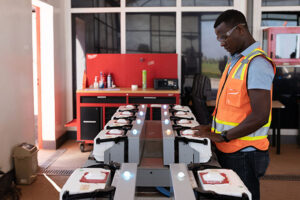
WASHINGTON DC, Jul 22 2026 – A farmer in Kenya gets weather and planting advice on a basic phone. A teacher in Nigeria uses a chatbot to help students catch up in math. South Africa’s revenue authority uses data analytics to better target tax audits. These are not futuristic examples from Silicon Valley. They are early signs of the broader transformation that artificial intelligence (AI) could bring to sub-Saharan Africa.
AI will reshape the global economy. The question for Africa is whether it rides the wave or gets left behind.
Transformative potential
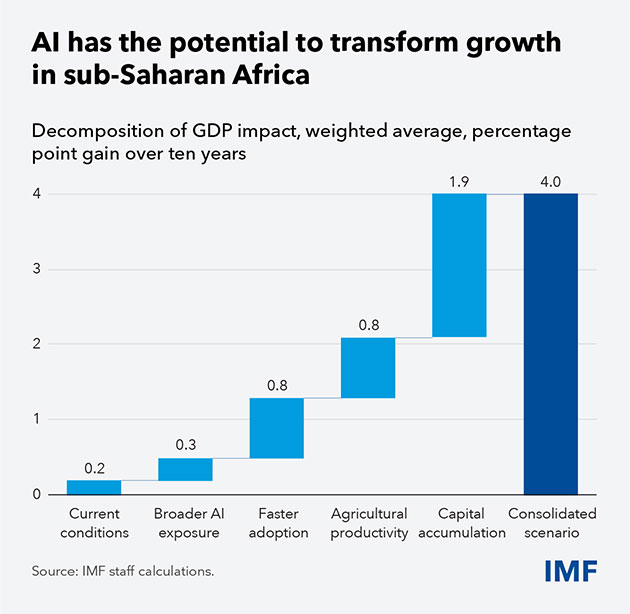
Our research shows AI’s promise, but it also points to significant risks and challenges. At current levels of preparedness, we estimate that AI will add just 0.2 percent to the region’s GDP over the next decade—little more than a rounding error. However, if countries can put the right foundations in place to accelerate adoption and extend the impact of AI beyond today’s digitally connected firms, the gains could rise to about 4 percent over the decade—nearly half a percentage point of additional growth a year.
That extra growth is critical given Africa’s vast jobs challenge. By 2030, sub-Saharan Africa will account for roughly half of new entrants into the global labor force. But the issue is not only the number of jobs needed—it is also their quality. Most workers are still in informal microenterprises or smallholder agriculture, where productivity is far below that of formal firms.
For the region, AI’s main promise is not about replacing office workers, but boosting productivity across the economy—helping informal firms manage inventory, enabling farmers to increase yields, and supporting mid-sized firms to transition to formality and export readiness.
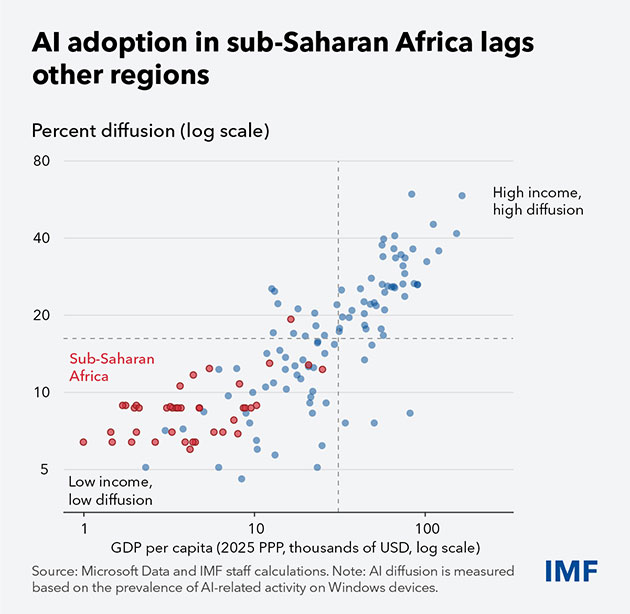
The risk is that the opposite happens. AI adoption in sub-Saharan Africa currently lags well behind every other region. If richer economies race ahead while African firms and governments lag, the productivity gap between the region and the rest of the world will only widen.
A different reality
Aid flows have always fluctuated. But this episode stands apart.
The recent cuts are large and broadly simultaneous across countries. They are driven by donor decisions rather than changes in recipient economies. And they come at a time when traditional buffers are weaker: multilateral institutions and NGOs, which have often cushioned past declines, are themselves facing funding constraints. While non-traditional donors, such as China and the Gulf States, have grown their aid presence in the region, the magnitudes are not able to cover the reduction in traditional donors.
The cuts are also difficult to manage because they follow six years of successive shocks—including the pandemic, tighter global financial conditions, and food and energy crises—that have already eroded fiscal space.
Delivering on AI’s promise
Two priorities for AI adoption stand out.
First, countries must build the foundations for broad adoption.
AI depends on reliable electricity, affordable broadband and data infrastructure, and workers with digital skills. That means investing in power and connectivity, supporting regional data infrastructure where viable, and strengthening digital and AI literacy through education and training. Countries in Africa do not need to develop the world’s most powerful AI models. But they do need the capacity to adopt, adapt, and scale AI quickly.
Second, build trust—and scale.
AI can widen inequality if its benefits are concentrated among large firms, skilled workers, and urban hubs. It also creates risks around privacy, cybersecurity, misinformation, and dependence on foreign providers. Governments need clear and practical rules on data, competition, consumer protection, cybersecurity, and the public sector’s use of AI. Regional cooperation will also be essential. Many African economies are too small to build AI ecosystems alone. But together they can create the scale needed for infrastructure, data standards, regulation, and markets.
AI in Africa is not just a technology policy issue—it is central to the region’s growth strategy. Africa does not need to win the race to build cutting-edge AI models, but it must find ways to use AI widely, cheaply, and safely. The window is narrow. Over the next debate, Africa’s young and growing workforce will either find more productive jobs, or watch the global productivity gap widen further. The outcome will not be shaped in Silicon Valley, but in the choices made across governments, schools, farms, and firms from Dakar to Dar es Salaam.
Martin Schindler is an advisor, Nikola Spatafora is a senior economist, and Andrew Tiffin is a deputy division chief, all in the IMF’s African Department.
IPS UN Bureau
Follow @IPSNewsUNBureau
!function(d,s,id){var js,fjs=d.getElementsByTagName(s)[0],p=/^http:/.test(d.location)?’http’:’https’;if(!d.getElementById(id)){js=d.createElement(s);js.id=id;js.src=p+’://platform.twitter.com/widgets.js’;fjs.parentNode.insertBefore(js,fjs);}}(document, ‘script’, ‘twitter-wjs’);
!function(d,s,id){var js,fjs=d.getElementsByTagName(s)[0],p=/^http:/.test(d.location)?’http’:’https’;if(!d.getElementById(id)){js=d.createElement(s);js.id=id;js.src=p+’://platform.twitter.com/widgets.js’;fjs.parentNode.insertBefore(js,fjs);}}(document, ‘script’, ‘twitter-wjs’);
Children in Conflict Zones and Remote Areas Bear the Brunt of Global Immunization Gaps
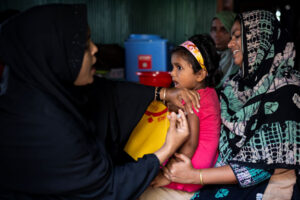
In 2025, 13.5 million ‘zero-dose’ children did not receive vaccinations in their first year. More than half of these children live in fragile, conflict-affected or vulnerable countries, where immunization may be disrupted due to a number of factors. Credit: UNICEF
By Shuli Wong
UNITED NATIONS, Jul 22 2026 – Despite growing up and working in vastly different geographic regions and environments — one shaped by decades of armed conflict and political instability, and the other by remote, hard-to-reach areas — both Sagal and Johao encounter children daily who have never been vaccinated. Sagal and Johao are members of UNICEF’s Global Youth Health Advisory Group, where they advance children’s health by shaping UNICEF’s strategies, policies, and campaigns, while working directly in their own countries to connect community realities to global conversations about children’s health.
Sagal, 23, lives in the Darul-Salam district in Mogadishu, Somalia, where she works as a junior doctor in maternal and child health. Sagal’s passion lies in promoting vaccine confidence, addressing health misinformation, and empowering the youth to become advocates for healthier communities, she told Inter Press Service. While global vaccine coverage is improving, Sagal describes Somalia’s situation as “still very difficult.” Somalia has one of the lowest vaccination rates due to years of conflict, and while coverage is improving, “not all children are reached equally and a child’s chance to get vaccines depends on where they live, especially in unsafe or hard-to-reach places.”
Johao, 14, lives in Ecuador’s Amazon region, where he has seen firsthand the realities of why children in rural, remote, and isolated areas struggle to get vaccinated. Johao has hands-on volunteer experience in infectious disease research and community health projects and is also a part of U-Report, GeneraciónMÁS, and FixMyFood networks in Ecuador. The biggest challenges Johao encounters when it comes to childhood vaccination campaigns, he told Inter Press Service, are “reaching communities with limited infrastructure, overcoming transportation difficulties, and ensuring that accurate information reaches families before misinformation does.” Both conflict-affected and hard-to-reach areas face their own challenges, but what is particularly difficult in remote communities is “isolation and limited access to essential services.”
The World Health Organization (WHO) defines “zero-dose” children as those who lack access to or are never reached by routine immunization services, which is measured as children who have never received their first dose of diphtheria-tetanus-pertussis (DTP). According to the annual WHO-UNICEF Estimates of National Immunization Coverage (WUENIC), 90 percent of infants globally received at least one dose of a DTP vaccine and 85 percent completed the three-dose series in 2025. However, in 2025, an estimated 13.5 million zero-dose children did not receive a single vaccine in their first year of life, and an estimated 7.3 million infants received their first DTP vaccine but dropped out before receiving their first measles dose. Globally, more than half of all zero-dose children live in fragile, conflict-affected or vulnerable countries (FCV) where immunization programs are affected by political instability, insecurity, and underfunding.
The Immunization Agenda 2030 (IA2030) Mid-Term Review, identified FCVs as “one of the greatest challenges to achieving global immunization goals.” In Somalia, Sagal explained how “most zero dose and dropout children live in places that are unsafe, far away, or completely unreachable. These children face many problems at the same time, including, no vaccines, poor nutrition, very few health services, and almost no social support.”
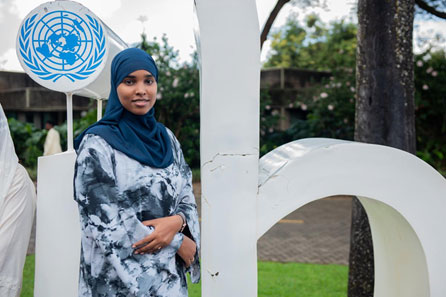
Sagal, 23, a Somalian junior doctor and member of the UNICEF Global Youth Health Advisory Group. Credit: UNICEF
The situation is similar in Ecuador, where Johao explained, “children who have never received vaccines often live in remote rural or Indigenous communities, where transportation is limited and access to health services can be difficult.”
UNICEF Executive Director Catherine Russell emphasized that while vaccination rates have bounced back since dropping during the COVID-19 pandemic, millions of children are still left vulnerable due to displacement, poverty and war.
“We must reach every child, and we must rebuild trust where it is fraying. No child should suffer from a disease that a simple vaccine can prevent,” said Russell.
WHO and UNICEF have identified the urgent need to counter the spread of misleading information and erosion of trust, which has led to a surge in vaccine hesitancy and anti-science sentiment. In particular, IA2030 called for tailored support in FCV settings to “promote nuanced and context-specific advocacy messaging and approaches, and foster trust through sustained community engagement.”
Aside from logistical access, there are other factors that determine people’s decisions to get vaccinations. Sagal shared that in Somalia people forgo vaccinations for a variety of reasons, including fear of vaccine side effects or rumors that vaccines cause infertility. In Ecuador, Johao detailed how some families lack clear information regarding vaccination schedules and have vaccine concerns influenced by misinformation, with these “barriers affecting their trust in and ability to access health services.”
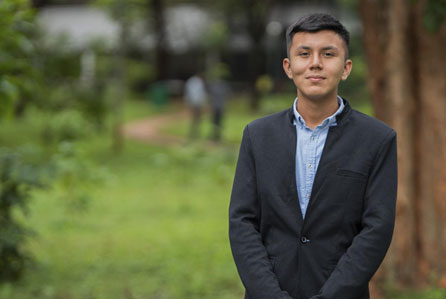
As a member of the UNICEF Global Youth Health Advisory Group, Johao, 14, speaks to the experiences of children in Amazon communities in Ecuador. Credit: UNICEF
In FCV and hard-to-reach settings, mistrust surrounding vaccines is driven by multiple complex and multifaceted aspects, including misinformation campaigns, conspiracy theories, religious opposition, low health literacy, sociodemographic factors, and the politicization of vaccines that undermines science.
Both Sagal and Johao’s work sits at the intersection of access and trust. As members of the UNICEF Global Youth Health Advisory Group, Sagal and Johao are not only bringing vaccines to children who would otherwise be missed, but doing so in contexts where the social and political conditions that make vaccination difficult are the same conditions their communities live with every day.
When it comes to rebuilding trust and reaching children in FCV settings, youth advocates’ “presence and credibility help [them] enter spaces where formal systems cannot,” Sagal said. “Youth advocates speak the same language and come from the same communities, [so] families trust us more than big institutions.” In Somalia, she explained, youth advocates help to rebuild trust in fragile areas by “reaching other young people quickly, communicating in a natural and friendly way, fighting misinformation fast, and mobilizing communities faster than traditional actors.”
Across settings, culture, language, and traditions strongly influence health decisions. Johao noted how “vaccination messages are more effective when they are communicated respectfully and acknowledge local knowledge and beliefs.”
In order to reach the IA2030 goal and ensure vaccines reach everyone, everywhere, at every age, WHO and UNICEF have put forth four concrete actions. These actions include strengthening immunization programs in FCV settings, countering false and misleading health information to support vaccine uptake, increasing and sustaining global funding for immunization programs, and investing in stronger data and disease surveillance systems.
Sagal and Johao’s lived experiences highlight the dire need for these actions. From Sagal’s experiences, zero-dose children “need health and nutrition support delivered in ways that work in fragile and dangerous environments.” As members of the UNICEF Global Youth Health Advisory Group, Johao explained that to effectively help their communities, “we need access to reliable information, training, resources, and opportunities to work closely with health professionals and community leaders.”
IPS UN Bureau Report
Follow @IPSNewsUNBureau
!function(d,s,id){var js,fjs=d.getElementsByTagName(s)[0],p=/^http:/.test(d.location)?’http’:’https’;if(!d.getElementById(id)){js=d.createElement(s);js.id=id;js.src=p+’://platform.twitter.com/widgets.js’;fjs.parentNode.insertBefore(js,fjs);}}(document, ‘script’, ‘twitter-wjs’);
!function(d,s,id){var js,fjs=d.getElementsByTagName(s)[0],p=/^http:/.test(d.location)?’http’:’https’;if(!d.getElementById(id)){js=d.createElement(s);js.id=id;js.src=p+’://platform.twitter.com/widgets.js’;fjs.parentNode.insertBefore(js,fjs);}}(document, ‘script’, ‘twitter-wjs’);
Children in Conflict Zones, Remote Areas Fall Short of Vaccination Goals
In 2025, 13.5 million ‘zero-dose’ children did not receive vaccinations in their first year. More than half of these children live in fragile, conflict-affected or vulnerable countries, where immunization may be disrupted due to a number of factors. Credit: UNICEF
By Shuli Wong
UNITED NATIONS, Jul 22 2026 – Despite growing up and working in vastly different geographic regions and environments — one shaped by decades of armed conflict and political instability, and the other by remote, hard-to-reach areas — both Sagal and Johao encounter children daily who have never been vaccinated. Sagal and Johao are members of UNICEF’s Global Youth Health Advisory Group, where they advance children’s health by shaping UNICEF’s strategies, policies, and campaigns, while working directly in their own countries to connect community realities to global conversations about children’s health.
Sagal, 23, lives in the Darul-Salam district in Mogadishu, Somalia, where she works as a junior doctor in maternal and child health. Sagal’s passion lies in promoting vaccine confidence, addressing health misinformation, and empowering the youth to become advocates for healthier communities, she told Inter Press Service. While global vaccine coverage is improving, Sagal describes Somalia’s situation as “still very difficult.” Somalia has one of the lowest vaccination rates due to years of conflict, and while coverage is improving, “not all children are reached equally and a child’s chance to get vaccines depends on where they live, especially in unsafe or hard-to-reach places.”
Johao, 14, lives in Ecuador’s Amazon region, where he has seen firsthand the realities of why children in rural, remote, and isolated areas struggle to get vaccinated. Johao has hands-on volunteer experience in infectious disease research and community health projects and is also a part of U-Report, GeneraciónMÁS, and FixMyFood networks in Ecuador. The biggest challenges Johao encounters when it comes to childhood vaccination campaigns, he told Inter Press Service, are “reaching communities with limited infrastructure, overcoming transportation difficulties, and ensuring that accurate information reaches families before misinformation does.” Both conflict-affected and hard-to-reach areas face their own challenges, but what is particularly difficult in remote communities is “isolation and limited access to essential services.”
The World Health Organization (WHO) defines “zero-dose” children as those who lack access to or are never reached by routine immunization services, which is measured as children who have never received their first dose of diphtheria-tetanus-pertussis (DTP). According to the annual WHO-UNICEF Estimates of National Immunization Coverage (WUENIC), 90 percent of infants globally received at least one dose of a DTP vaccine and 85 percent completed the three-dose series in 2025. However, in 2025, an estimated 13.5 million zero-dose children did not receive a single vaccine in their first year of life, and an estimated 7.3 million infants received their first DTP vaccine but dropped out before receiving their first measles dose. Globally, more than half of all zero-dose children live in fragile, conflict-affected or vulnerable countries (FCV) where immunization programs are affected by political instability, insecurity, and underfunding.
The Immunization Agenda 2030 (IA2030) Mid-Term Review, identified FCVs as “one of the greatest challenges to achieving global immunization goals.” In Somalia, Sagal explained how “most zero dose and dropout children live in places that are unsafe, far away, or completely unreachable. These children face many problems at the same time, including, no vaccines, poor nutrition, very few health services, and almost no social support.”
Sagal, 23, a Somalian junior doctor and member of the UNICEF Global Youth Health Advisory Group. Credit: UNICEF
The situation is similar in Ecuador, where Johao explained, “children who have never received vaccines often live in remote rural or Indigenous communities, where transportation is limited and access to health services can be difficult.”
UNICEF Executive Director Catherine Russell emphasized that while vaccination rates have bounced back since dropping during the COVID-19 pandemic, millions of children are still left vulnerable due to displacement, poverty and war.
“We must reach every child, and we must rebuild trust where it is fraying. No child should suffer from a disease that a simple vaccine can prevent,” said Russell.
WHO and UNICEF have identified the urgent need to counter the spread of misleading information and erosion of trust, which has led to a surge in vaccine hesitancy and anti-science sentiment. In particular, IA2030 called for tailored support in FCV settings to “promote nuanced and context-specific advocacy messaging and approaches, and foster trust through sustained community engagement.”
Aside from logistical access, there are other factors that determine people’s decisions to get vaccinations. Sagal shared that in Somalia people forgo vaccinations for a variety of reasons, including fear of vaccine side effects or rumors that vaccines cause infertility. In Ecuador, Johao detailed how some families lack clear information regarding vaccination schedules and have vaccine concerns influenced by misinformation, with these “barriers affecting their trust in and ability to access health services.”
As a member of the UNICEF Global Youth Health Advisory Group, Johao, 14, speaks to the experiences of children in Amazon communities in Ecuador. Credit: UNICEF
In FCV and hard-to-reach settings, mistrust surrounding vaccines is driven by multiple complex and multifaceted aspects, including misinformation campaigns, conspiracy theories, religious opposition, low health literacy, sociodemographic factors, and the politicization of vaccines that undermines science.
Both Sagal and Johao’s work sits at the intersection of access and trust. As members of the UNICEF Global Youth Health Advisory Group, Sagal and Johao are not only bringing vaccines to children who would otherwise be missed, but doing so in contexts where the social and political conditions that make vaccination difficult are the same conditions their communities live with every day.
When it comes to rebuilding trust and reaching children in FCV settings, youth advocates’ “presence and credibility help [them] enter spaces where formal systems cannot,” Sagal said. “Youth advocates speak the same language and come from the same communities, [so] families trust us more than big institutions.” In Somalia, she explained, youth advocates help to rebuild trust in fragile areas by “reaching other young people quickly, communicating in a natural and friendly way, fighting misinformation fast, and mobilizing communities faster than traditional actors.”
Across settings, culture, language, and traditions strongly influence health decisions. Johao noted how “vaccination messages are more effective when they are communicated respectfully and acknowledge local knowledge and beliefs.”
In order to reach the IA2030 goal and ensure vaccines reach everyone, everywhere, at every age, WHO and UNICEF have put forth four concrete actions. These actions include strengthening immunization programs in FCV settings, countering false and misleading health information to support vaccine uptake, increasing and sustaining global funding for immunization programs, and investing in stronger data and disease surveillance systems.
Sagal and Johao’s lived experiences highlight the dire need for these actions. From Sagal’s experiences, zero-dose children “need health and nutrition support delivered in ways that work in fragile and dangerous environments.” As members of the UNICEF Global Youth Health Advisory Group, Johao explained that to effectively help their communities, “we need access to reliable information, training, resources, and opportunities to work closely with health professionals and community leaders.”
IPS UN Bureau Report
Follow @IPSNewsUNBureau
!function(d,s,id){var js,fjs=d.getElementsByTagName(s)[0],p=/^http:/.test(d.location)?’http’:’https’;if(!d.getElementById(id)){js=d.createElement(s);js.id=id;js.src=p+’://platform.twitter.com/widgets.js’;fjs.parentNode.insertBefore(js,fjs);}}(document, ‘script’, ‘twitter-wjs’);
!function(d,s,id){var js,fjs=d.getElementsByTagName(s)[0],p=/^http:/.test(d.location)?’http’:’https’;if(!d.getElementById(id)){js=d.createElement(s);js.id=id;js.src=p+’://platform.twitter.com/widgets.js’;fjs.parentNode.insertBefore(js,fjs);}}(document, ‘script’, ‘twitter-wjs’);
ALBANIA: ‘The Public Only Learns about These Development Megaprojects Once Construction Machinery Arrives’
By CIVICUS
Jul 22 2026 –
CIVICUS discusses land grabs and environmental damage linked to a luxury coastal resort project with Eva Kushova, Director of Destination Management Organisation Albania, a civil society organisation that supports sustainable tourism in Albanian destinations, seeking to preserve culture and nature while maximising benefits for communities.
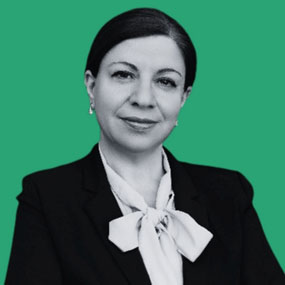
Eva Kushova
Since May, protests have rocked Albania over a luxury coastal resort project linked to US President Donald Trump’s family, to be built on protected land near Vlorë. Protests, now dubbed the ‘Flamingo Revolution’, have spread nationwide and won diaspora support, broadening into an anti-corruption movement.
What are the impacts of Albania’s foreign investment laws?
The Law on Strategic Investments was passed in 2015 to attract foreign investment and boost Albania’s economy. Its deadline has since been extended several times, most recently to 2027. In practice, it has become a vehicle for serious abuses. Unlike ordinary investment laws, it gives the state the power to expropriate private property on investors’ behalf, often at compensation well below market value. Some residents say they were forced off their land after refusing this compensation.
Despite the law’s stated purpose, only two of around 44 projects approved so far are genuinely foreign investments. Most are owned by domestic investors with close connections to the government. The system gives selected companies access to public land, beaches, forests and national assets, and grants them tax exemptions for up to 10 years. The state also pays for all the necessary infrastructure, including electricity, roads, telecommunications and water, effectively subsidising private profit. In some cases, water meant for villages has been diverted to supply resort swimming pools. Meanwhile, local communities lose beach access and remain economically marginalised.
What does the Zvërnec case reveal about how these deals are made?
The Zvërnec project, a luxury resort planned on the coast near Vlorë, in southern Albania, comprising around 10,000 accommodation units, drew international attention because of its Trump family ties, but it exposed broader governance failures. It includes a large property allegedly acquired by an internationally wanted drug trafficker under highly questionable circumstances, and there are also allegations that officials manipulated property records at the regional land registry. Many local residents claim ownership of the property, yet it was suddenly recognised as belonging to the trafficker, who then sold it to Arab investors.
This fits a wider pattern in Albania’s land governance. After communism collapsed in 1991, the law mandated redistribution of agricultural land to rural families in small parcels. Thirty-five years on, most Albanians own only limited land, while strategic investors obtain vast coastal properties through questionable transactions, controversial expropriations and alleged manipulation of property records. Property rights have remained unresolved for over 30 years, forcing people into costly court proceedings.
The secrecy around the Zvërnec deal is typical too. The public only learns about the projects once construction machinery arrives on site. News of Zvërnec, and of Sazan Island, an island off Albania’s Adriatic coast earmarked for luxury development, broke via international media in March 2024. Even now, the identity and ownership of the investors behind several of these projects remain unclear, and sites are fenced off with barbed wire. Authorities say this is in preparation for infrastructure works, fuelling further distrust.
What environmental damage have these developments caused?
The Zvërnec coastline is home to the Narta Lagoon, one of Albania’s most biodiverse areas and a critical stopover for thousands of migratory birds travelling between Africa and Europe. It was first threatened by the construction of Vlora International Airport and now by the Zvërnec resort.
The legal groundwork was laid in 2022, when the government removed thousands of hectares from protected areas, cutting total coverage by 20 per cent. In 2024, another law opened the door to construction inside protected areas, allowing for the transformation of one of Albania’s last wild coastal lagoons into a heavily urbanised area. A further law passed in 2025 extended the threat to forests and pastures elsewhere in the country.
This runs counter to Albania’s European Union (EU) membership bid, targeted for 2030. All candidate states must align their laws with EU standards across 33 negotiating chapters before joining, and chapter 27 covers environmental protection. The European Commission’s 2025 Enlargement Report raised serious concerns on this front, criticising recent legal changes for weakening environmental standards. The Bern Convention’s Standing Committee, an international body that protects European wildlife and habitats, has repeatedly asked Albania to suspend construction of Vlora International Airport inside the Pishë Poro–Narta Protected Area, which includes the lagoon, pending proper environmental assessment. So far these requests have gone unheeded. But sustained EU pressure could still force a repeal of regressive laws and the introduction of stronger protection for natural areas.
What has driven recent protests, and how has the government responded?
Protests began on 23 May in Zvërnec after the developer fenced off part of the beach with barbed wire. They intensified after footage emerged on 30 May showing private security guards beating a protester while police stood by without intervening. The movement spread to the capital, Tirana, the next day, then to other Albanian cities, Kosovo and diaspora communities abroad, becoming known as the ‘Flamingo Revolution’. Protesters have marched nightly since under the slogan ‘Albania is not for sale’, demanding the project’s cancellation and Prime Minister Edi Rama’s resignation.
What began as opposition to a single resort has broadened into a wider anti-corruption movement, with protesters citing grievances such as poor public healthcare. A nationwide protest on 10 June deliberately coincided with a national historic commemoration, joined by Albanians from the diaspora on five continents. Yet Rama has stayed defiant, arguing that the backlash has more to do with the Trump links than with the project itself.
There are encouraging signs of accountability, though. The Special Structure against Corruption and Organised Crime, an independent judicial body created in 2016, has opened an investigation into the 2024 legal changes that enabled the Zvërnec deal. Arrest warrants have been issued against around 20 businesspeople suspected of illegally obtaining land or permits linked to various projects. People hope public pressure will keep judicial investigations alive, ensuring accountability for abuses of power, environmental damage and property rights violations.
CIVICUS interviews a wide range of civil society activists, experts and leaders to gather diverse perspectives on civil society action and current issues for publication on its CIVICUS Lens platform. The views expressed in interviews are the interviewees’ and do not necessarily reflect those of CIVICUS. Publication does not imply endorsement of interviewees or the organisations they represent.
GET IN TOUCH
Website
Facebook
Instagram
LinkedIn
Twitter
SEE ALSO
Albania: protesters and police clash at anti-corruption demonstrations; amendments partially decriminalising defamation criticised CIVICUS Monitor 22.Apr.2026
Albania: ‘Corruption is a serious problem, but no political force commands enough public trust to unite demands’ CIVICUS Lens | Interview with Gresa Hasa 13.Feb.2026
Albania: ‘Diaspora voting ensured every citizen, regardless of location, could exercise their right to vote’ CIVICUS Lens | Interview with Erida Skëndaj 01.Jun.2025
Follow @IPSNewsUNBureau
!function(d,s,id){var js,fjs=d.getElementsByTagName(s)[0],p=/^http:/.test(d.location)?’http’:’https’;if(!d.getElementById(id)){js=d.createElement(s);js.id=id;js.src=p+’://platform.twitter.com/widgets.js’;fjs.parentNode.insertBefore(js,fjs);}}(document, ‘script’, ‘twitter-wjs’);
!function(d,s,id){var js,fjs=d.getElementsByTagName(s)[0],p=/^http:/.test(d.location)?’http’:’https’;if(!d.getElementById(id)){js=d.createElement(s);js.id=id;js.src=p+’://platform.twitter.com/widgets.js’;fjs.parentNode.insertBefore(js,fjs);}}(document, ‘script’, ‘twitter-wjs’);
Jackaroo King Teams Up With UAE Animated IP Freej for a Middle East-Themed Social Adventure
DUBAI, United Arab Emirates, July 21, 2026 (GLOBE NEWSWIRE) — Jackaroo King has created a Middle East-themed collaboration with Freej, the UAE animated IP, bringing the show's neighborhood stories and character humor into Jackaroo King's social board game experience built around classic Jackaroo rules.
Freej is a UAE CGI animated series centered on four older women living in a modern Dubai neighborhood. Its name comes from an Emirati Arabic word meaning “neighborhood” or “community,” and the series uses humor to portray city change, family life, and community relationships. In the collaboration, Jackaroo King draws on Freej's character dynamics and neighborhood storytelling to create an in-game adventure shaped by local culture, friendship, and online interaction.
The themed experience pairs Jack with four classic Freej characters as an adventure team moving through scenes inspired by old Dubai, moonlit ruins, islands, desert landscapes, and seafaring imagery. Players can collect symbols, uncover clues, and unlock themed profile effects, titles, frames, and other visual items. Rather than framing the collaboration around rewards alone, the experience emphasizes character companionship, shared exploration, and social play. The collaboration is designed to make a familiar regional IP feel playable inside everyday friend groups, rather than exist only as decorative branding.
Jackaroo King also connects the collaboration with its real-time four-player battles, private rooms, and voice-room features. Players can progress through the adventure while chatting with friends, sharing themed moments, and seeing room-based progress and effects together.
For Jackaroo King, the Freej collaboration is both a content partnership and a localized expression for Middle East players. Freej's neighborhood relationships, humor, and cross-generational memories align naturally with Jackaroo King's goal of bringing friends and communities together through classic Jackaroo gameplay and online social interaction.
About Jackaroo King
Operated by WEJOY PTE. LTD., Jackaroo King is a social board game built around classic Jackaroo rules, supporting real-time four-player online matches, private rooms, and voice interaction. Players can enjoy an authentic Jackaroo experience through strategy, teamwork, and play-while-chatting social moments. Guided by its mission, “Bring joy and friends to young people around the world,” Jackaroo King continues to explore more participatory online social entertainment experiences.
Media Contact
Company: WEJOY PTE. LTD.
Contact: Bryant
Email: [email protected]
Official Website: https://www.jackarooapp.com/
A photo accompanying this announcement is available at https://www.globenewswire.com/NewsRoom/AttachmentNg/c3ed95dd-0c9f-4634-bdec-ca952dbca213

GLOBENEWSWIRE (Distribution ID 9763289)
Jackaroo King Teams Up With UAE Animated IP Freej for a Middle East-Themed Social Adventure
DUBAI, United Arab Emirates, July 21, 2026 (GLOBE NEWSWIRE) — Jackaroo King has created a Middle East-themed collaboration with Freej, the UAE animated IP, bringing the show's neighborhood stories and character humor into Jackaroo King's social board game experience built around classic Jackaroo rules.
Freej is a UAE CGI animated series centered on four older women living in a modern Dubai neighborhood. Its name comes from an Emirati Arabic word meaning “neighborhood” or “community,” and the series uses humor to portray city change, family life, and community relationships. In the collaboration, Jackaroo King draws on Freej's character dynamics and neighborhood storytelling to create an in-game adventure shaped by local culture, friendship, and online interaction.
The themed experience pairs Jack with four classic Freej characters as an adventure team moving through scenes inspired by old Dubai, moonlit ruins, islands, desert landscapes, and seafaring imagery. Players can collect symbols, uncover clues, and unlock themed profile effects, titles, frames, and other visual items. Rather than framing the collaboration around rewards alone, the experience emphasizes character companionship, shared exploration, and social play. The collaboration is designed to make a familiar regional IP feel playable inside everyday friend groups, rather than exist only as decorative branding.
Jackaroo King also connects the collaboration with its real-time four-player battles, private rooms, and voice-room features. Players can progress through the adventure while chatting with friends, sharing themed moments, and seeing room-based progress and effects together.
For Jackaroo King, the Freej collaboration is both a content partnership and a localized expression for Middle East players. Freej's neighborhood relationships, humor, and cross-generational memories align naturally with Jackaroo King's goal of bringing friends and communities together through classic Jackaroo gameplay and online social interaction.
About Jackaroo King
Operated by WEJOY PTE. LTD., Jackaroo King is a social board game built around classic Jackaroo rules, supporting real-time four-player online matches, private rooms, and voice interaction. Players can enjoy an authentic Jackaroo experience through strategy, teamwork, and play-while-chatting social moments. Guided by its mission, “Bring joy and friends to young people around the world,” Jackaroo King continues to explore more participatory online social entertainment experiences.
Media Contact
Company: WEJOY PTE. LTD.
Contact: Bryant
Email: [email protected]
Official Website: https://www.jackarooapp.com/
A photo accompanying this announcement is available at https://www.globenewswire.com/NewsRoom/AttachmentNg/c3ed95dd-0c9f-4634-bdec-ca952dbca213
GLOBENEWSWIRE (Distribution ID 9763289)
Jackaroo King تعاونت مع العلامة الكرتونية الإماراتية الشهيرة «فريج» لتطلق مغامرة اجتماعية مستوحاة من ثقافة الشرق الأوسط
دبي، الإمارات العربية المتحدة, July 21, 2026 (GLOBE NEWSWIRE) —
أطلقت Jackaroo King فعاليةً خاصة بالتعاون مع العلامة الكرتونية الإماراتية العريقة «فريج»، تمزج بين قصص الحي وشخصياته المرحة وبين تجربة اللعبة الاجتماعية المستوحاة من قواعد الجاكارو الكلاسيكية، لتقدم للاعبين مغامرة «تحت ضوء القمر» تجمع بين أصالة الثقافة المحلية ومتعة التفاعل عبر الإنترنت.
تُعد «فريج» من أبرز أعمال الرسوم المتحركة الإماراتية بتقنية CGI، وتدور أحداثها حول أربع سيدات مسنّات يعشن في أحد أحياء دبي الحديثة. ويعني اسمها في اللهجة الإماراتية «الحي» أو «المجتمع»، وقد اشتهرت السلسلة بتناولها بأسلوب فكاهي للتحولات التي شهدتها دبي، وتفاصيل الحياة الأسرية وروابط الجيرة. وفي هذا التعاون، استلهمت Jackaroo King ديناميكيات الشخصيات وروح الحي التي تجسدها «فريج» لتدمج ملامح المدينة الشرق أوسطية وروح المغامرة والتفاعل بين الأصدقاء في تجربة اللعب، مانحة اللاعبين أجواءً محلية مألوفة ودافئة.
وفي إطار الحدث، ينضم جاك إلى الشخصيات الأربع الشهيرة من «فريج» لتشكيل «فريق المغامرة»، الذي ينطلق من أجواء دبي القديمة تحت ضوء القمر ليجوب مواقع فريدة مثل أطلال القمر، وجزيرة الأسرار، وصحراء الرمال الذهبية، وبحر الألف شراع. وخلال الرحلة، يجمع اللاعبون رموز القمر ويكشفون شظايا الأدلة ويفتحون الكنوز، ويحصلون على ألقاب وإطارات صور شخصية وأوسمة ومؤثرات خاصة للملف الشخصي. ويضع التصميم العام مفهومَي «رفقة الشخصيات» و«الاستكشاف المشترك» في صميم التجربة، بما يضيف بُعدًا إنسانيًا يتجاوز متعة المنافسة الاستراتيجية.
وانطلاقًا من مزايا Jackaroo King المتمثلة في المباريات الفورية الرباعية والغرف الخاصة والغرف الصوتية، تتضمن الفعالية أيضًا رسائل تهنئة متحركة ومشاركة للمحتوى وعرضًا لتقدم المغامرة ومؤثرات بصرية خاصة. وهكذا لا يقتصر دور اللاعبين على خوض المغامرة داخل اللعبة، بل يشاركون أصدقاءهم لحظات الاكتشاف والتفاعل في أجواء من الحوار والمرح، في امتداد واضح لرؤية Jackaroo King التي تجمع بين اللعب والتواصل الاجتماعي وروح التنافس.
وبالنسبة إلى Jackaroo King، لا تمثل الشراكة مع «فريج» مجرد تعاون محتوى، بل تعبيرًا محليًا أكثر قربًا من الثقافة الشرق أوسطية. فالعلاقات الإنسانية وروح الدعابة والذكريات المشتركة التي تجسدها «فريج» تنسجم بصورة طبيعية مع رسالة اللعبة في ربط الأصدقاء والمجتمعات من خلال الجاكارو الكلاسيكية والتخطيط الجماعي والتفاعل الصوتي. ومن خلال إدماج هذا الرمز الثقافي المحلي في لوحات اللعب والأنشطة التفاعلية، تواصل Jackaroo King توسيع آفاق ألعاب الطاولة الاجتماعية الرقمية وتقديم تجارب ترفيهية جديدة تنبض بالألفة الثقافية.
واختتامًا، تؤكد Jackaroo King التزامها بمواصلة استكشاف المزيد من مبادرات التعاون مع الملكيات الفكرية والأنشطة التفاعلية، سواء عبر الإنترنت أو على أرض الواقع، بما يعزز ارتباط اللاعبين بثقافتهم ويمنحهم تجارب اجتماعية أكثر ثراءً وقربًا من اهتماماتهم.
عن Jackaroo King
تُشغَّل Jackaroo King بواسطة شركة WEJOY PTE. LTD.، وهي لعبة لوحية اجتماعية تستند إلى قواعد جاكارو الكلاسيكية، وتدعم مباريات فورية عبر الإنترنت لأربعة لاعبين، وغرفًا خاصة، والتواصل الصوتي. ويمكن للاعبين الاستمتاع بتجربة جاكارو أصيلة تجمع بين الاستراتيجية والعمل الجماعي والتواصل الاجتماعي أثناء اللعب والدردشة. وانطلاقًا من رسالتها المتمثلة في «نشر الفرح والصداقة بين الشباب حول العالم»، تواصل Jackaroo King استكشاف تجارب ترفيه اجتماعي أكثر تفاعلية عبر الإنترنت.
للاستفسارات الإعلامية
اسم الشركة: WEJOY PTE. LTD.
جهة الاتصال: براينت (Bryant)
البريد الإلكتروني: [email protected]
الموقع الرسمي لـجاكارو كنغ: https://www.jackarooapp.com/
الصورة المصاحبة لهذا الإعلان متاحة على
https://www.globenewswire.com/NewsRoom/AttachmentNg/c3ed95dd-0c9f-4634-bdec-ca952dbca213/ar

GLOBENEWSWIRE (Distribution ID 9763289)