CGTN: Por que a China se tornou um destino procurado do verão

PEQUIM, July 28, 2026 (GLOBE NEWSWIRE) — A CGTN publicou um artigo sobre o aumento das viagens para a China (China Travel). Com um crescente número de viajantes de todo o mundo indo à China em busca de destinos menos quentes, o artigo fala sobre o boom do país no turismo neste verão e destaca como as políticas de facilitação de vistos em expansão da China e os serviços favoráveis ao estrangeiro estão impulsionando essa tendência de viagens.

Com o calor extremo atingindo grande parte da Europa, uma nova tendência de viagens está surgindo. Cada vez mais, os viajantes querem sair dos seus países em busca de destinos de verão com temperaturas menos quentes, e a China está emergindo como uma das principais opções.

Com seu clima ameno e paisagens pitorescas de colinas verdes e águas cristalinas, a cidade de Liupanshui, conhecida como a “cidade fresca” da China situada na província de Guizhou, no sudoeste do país, tornou-se um destino preferido para viajantes de outros países que tentam escapar do calor. Durante as férias de verão, mais de 20 eventos temáticos, incluindo festivais de música e feiras de jardins rurais, estão ocorrendo em toda a cidade, atraindo visitantes de todo o mundo.

Passeando pela cidade neste verão, Max Slonim, um turista americano, ficou impressionado com o clima fresco e confortável. “Sempre que você vai a lugares cênicos e bonitos, é possível realmente sentir a natureza e a atmosfera pacífica sem grandes multidões e longas filas”, disse ele.

A tendência por trás da “China Travel” continua a crescer. Durante o primeiro semestre de 2026, a China registrou mais de 22,91 milhões de visitas recebidas, um aumento de 20,4% em relação ao ano anterior. Os destinos tradicionais de verão, como as províncias de Yunnan, Guizhou e Hunan, estão no topo das listas de destinos de verão dos viajantes do exterior.

O Boom da China Travel

Em Zhangjiajie, uma cidade turística na província de Hunan, no centro da China, conhecida mundialmente por sua paisagem onírica, esta é a alta temporada para os visitantes. Turistas da Europa, Sudeste Asiático e outros lugares se aventuram pelas suas montanhas de arenito listadas pela UNESCO, onde brisas frescas e florestas exuberantes oferecem um refúgio natural.

Beneficiando-se da política de trânsito sem visto da China de 240 horas, a cidade abriu mais de 10 rotas aéreas para oito países e regiões. Os procedimentos acelerados de imigração e entrada nas principais atrações com apenas um passaporte tornaram as viagens na cidade mais fáceis do que nunca para os visitantes de outros países.

Desde o início de julho, as viagens de verão em família para a Área Cênica do Grand Canyon de Zhangjiajie aumentaram, com quase 10.000 visitantes diários, com turistas representando mais de 50% do total.

Os destinos costeiros com temperaturas mais amenas da China também estão tendo uma popularidade crescente. Qinhuangdao, uma cidade litorânea na província de Hebei, no norte da China, introduziu uma linha diversificada de atividades de verão, incluindo vela, passeios de lancha, apresentações de patrimônio cultural intangível e experiências imersivas de realidade virtual no Museu da Grande Muralha.

A cidade recebeu 43.000 visitas durante o primeiro semestre deste ano, um aumento de 50% em relação ao ano anterior, enquanto a estadia média dos turistas estrangeiros dobrou de sete para quinze dias.

A tendência é especialmente perceptível entre os viajantes europeus. Os países europeus representam quase 30% dos 20 principais mercados de origem de visitas à China neste verão. As reservas de viagens aumentaram 275% ano a ano, enquanto os pedidos de ingressos para atrações aumentaram 20 vezes. Somente os visitantes da Grã-Bretanha, França e Alemanha representam quase 42% de todas as chegadas europeias.

Por que a China?

Por trás do boom do turismo está a política de facilitação de vistos em constante expansão da China. A China oferece atualmente a entrada unilateral sem visto para cidadãos de 50 países, além de acordos de isenção mútua de vistos com 29 países. Enquanto isso, cidadãos de 55 países agora podem utilizar o programa de trânsito sem visto de 240 horas para entrar na China através de 65 portos.

A acessibilidade internacional também aumentou significativamente. Os voos diretos agora conectam destinos do exterior com 160 cidades chinesas, e mais de três quartos dos viajantes que chegam agora entram no país sem visto.

Enquanto isso, os serviços de viagens tornaram-se cada vez mais amigáveis ao estrangeiro. Máquinas de emissão de bilhetes multilíngues, dispositivos de tradução alimentados por IA e suporte ao cliente em inglês, francês, espanhol e outros idiomas agora estão amplamente disponíveis em atrações turísticas e nas principais plataformas de viagens.

No entanto, um detalhe repetidamente pelos visitantes do exterior é surpreendentemente simples: o ar-condicionado. De aeroportos e estações de metrô a shoppings, hotéis e atrações turísticas, o ar-condicionado confiável tornou-se uma parte essencial da experiência da viagem de verão na China, apoiado por um dos maiores e mais confiáveis sistemas de energia do mundo.

Nas redes sociais, vídeos de viajantes de outros países compartilhando suas aventuras de verão na China se tornaram janelas através das quais o público global está redescobrindo o país. Cada vez mais, os visitantes estão se aventurando além de Pequim, Xangai, Guangzhou e Shenzhen para explorar cidades antigas, aldeias montanhosas e cidades menos conhecidas. O que eles estão encontrando mais do que simplesmente um lugar legal para escapar do calor do verão, e sim descobrindo uma China cada vez mais acessível, acolhedora e vibrante.

https://news.cgtn.com/news/2026-07-26/What-makes-China-such-an-appealing-summer-gateway-for-global-tourists–1P5OL710a4M/p.html 


GLOBENEWSWIRE (Distribution ID 9799374)

Chemical Marketing & Economics honors LyondellBasell CEO Peter Vanacker with STEM Leadership Award for Corporate Reinvention

HOUSTON and MORRISTOWN, N.J., July 28, 2026 (GLOBE NEWSWIRE) — LyondellBasell (NYSE: LYB) and Chemical Marketing & Economics, Inc. (CME) today announced that Peter Vanacker, LYB CEO, will receive the CME STEM Leadership Award™ for Corporate Reinvention on Dec. 11, 2026 in New York City. The other honorees will be Omar Yaghi, 2025 Nobel Laureate in Chemistry (Extraordinary Fundamental Research) and Ann Ziff, Chairman of the Metropolitan Opera Board (Lifetime Achievement).

LYB is a leader in the global chemical industry, guided by its purpose of creating solutions for everyday sustainable living. The company is one of the world's largest producers of polymers and a leader in polyolefin technologies.

“Peter Vanacker exemplifies corporate reinvention at the highest level, demonstrating how disciplined strategy and visionary leadership can reshape an entire enterprise,” said CME Co-Chair Shah Karim. “Through initiatives focused on value enhancement, portfolio optimization and bold expansion of circular solutions, he has positioned the company for enduring value creation and industry leadership,” added CME Co-Chair and Legal Counsel Ksenia Takhistova. “He champions the essential connection between science, engineering, and sustainable growth – recognizing that transformative leaders accelerate the breakthroughs our world depends on,” said STEM Leadership Awards founder and ACS Fellow George Rodriguez.

“Reinvention is about building a company that can create value through change,” said LYB CEO Peter Vanacker. “At LYB, we continue to strengthen our portfolio, advance circular and low-carbon solutions at the right pace, and develop the capabilities and STEM talent pipeline needed to shape the future of our industry. I am honored by this recognition from CME and grateful to the LYB teams whose resilience and commitment make our progress possible.”

Under Vanacker’s leadership as LYB CEO, the company has remained anchored in its long-term strategy through a volatile market cycle, balancing disciplined near-term actions with a clear focus on long-term value creation. By upgrading its core businesses, taking decisive portfolio actions and preserving flexibility for future growth, LYB continues to position the business for enduring performance and industry leadership.

About Peter Vanacker
Peter Vanacker is chief executive officer of LyondellBasell, a global leader in the chemical industry delivering solutions for everyday sustainable living. Before joining LYB, he served as president, CEO and chair of the executive committee at Neste Corporation, and previously as CEO of both CABB Group GmbH and Treofan Group. Earlier in his career, he held senior leadership roles at Bayer AG, including executive vice president of the global polyurethanes business and member of the executive committee of Bayer Material Science (now Covestro). An international executive, Vanacker has worked across Belgium, Brazil, China, Finland, Germany and the United States. He earned his master’s degree in chemical engineering, specializing in polymers, from the University of Ghent. He serves on the supervisory board of Symrise AG, a leading global flavor, nutrition, scent and care company recognized with top CDP sustainability ratings. He also chairs the board of directors and serves on the executive committee of the American Chemistry Council, contributing to its energy, climate, environment, sustainability, finance, audit and plastics committees. In addition, he is a member of the board of the International Consortium of Chemical Associations.

About CME STEM Leadership Awards™
Established in 2012, the CME STEM Leadership Awards™ honor exceptional leaders who harness chemistry’s transformative power to solve global challenges. Past honorees span industry, finance, philanthropy, and academia, including Roy Vagelos, Seifi Ghasemi, Len Blavatnik, Albert Bourla, Martin Brudermüller, Jim Fitterling, Henry Kravis, Daniel D'Aniello, Craig Venter, and seven Nobel Laureates such as Frances Arnold and Barry Sharpless. Proceeds support transformative STEM programs, including unique student and mentor awards—the fundamental unit of innovation—alongside chemistry festivals and symposia advancing sustainability. To support or sponsor programs that empower future STEM pioneers in the Quantum AI and Space Age, reach us at [email protected] and visit www.cme-stem.org.

About Chemical Marketing & Economics
With roots dating back to 1954, Chemical Marketing & Economics, Inc. (CME) is an independent 501(c)(3) non-profit dedicated to inspiring STEM leaders and advancing sustainable breakthroughs in energy, materials, and life sciences. In collaboration with NASA, ACS, ACC, and the U.S. DOE, CME connects Nobel Laureates, industry leaders, and the public through initiatives such as the CME STEM Leadership Awards™, CME NASA Symposia, Earth & Space Sustainability Summits, STEM Festivals, and CME Student & Mentor Awards. Help spark innovation and collaboration shaping STEM in the Quantum AI and Space Age. Join us at www.cme-stem.org, LinkedIn, and Facebook.

About LyondellBasell
We are LyondellBasell (NYSE: LYB) ― a leader in the global chemical industry creating solutions for everyday sustainable living. Through advanced technology and focused investments, we are enabling a circular and low carbon economy. Across all we do, we aim to unlock value for our customers, investors and society. As one of the world's largest producers of polymers and a leader in polyolefin technologies, we develop, manufacture and market high-quality and innovative products for applications ranging from sustainable transportation and food safety to clean water and quality healthcare. For more information, please visit www.lyondellbasell.com or follow @LyondellBasell on LinkedIn.

Contact
CME Marketing Communications & Administration / [email protected]
Barrie Lee / [email protected]

A photo accompanying this announcement is available at https://www.globenewswire.com/NewsRoom/AttachmentNg/d33cf584-1303-4c6e-8e97-7e2e2b8e4ce0


GLOBENEWSWIRE (Distribution ID 9798625)

Beyond the Final Whistle: LEPAS Drives Elegant Mobility Forward with Its Global Lineup

WUHU, China, July 28, 2026 (GLOBE NEWSWIRE) — LEPAS, Chery Auto’s mid-to-premium NEV brand, is advancing its global market expansion with a comprehensive NEV lineup featuring the LEPAS L4 EV, LEPAS L6 EV, and LEPAS L8 PHEV. The new lineup showcases LEPAS’ commitment to elegant mobility through a combination of elegant design, intelligent technologies, and exquisite space, addressing diverse mobility needs across global markets.

The recently concluded tournament highlighted qualities such as composure, resilience, and adaptability — values that align with LEPAS’ approach to mobility. Through the integration of design, technology, and user-focused innovation, LEPAS continues to deliver elegant and confident mobility experiences for customers worldwide.

LEPAS L4 EV: Confident Range for Effortless Urban Mobility

On the pitch, steady performance and the ability to adapt to changing situations are the keys to victory. This same philosophy is reflected in the LEPAS L4 EV, which is designed for urban drivers seeking a more effortless and intelligent NEV experience. Combining extended range capability, efficient performance, and convenient charging solutions, the LEPAS L4 EV delivers confident mobility for both daily commuting and longer journeys.

The LEPAS L4 EV is powered by a highly integrated 12-in-1 electric drive system, delivering smooth, quiet, and efficient power output. With a maximum fast-charging power of over 120kW, it can charge from 30% to 80% in just 20 minutes when connected to a 200kW charging pile, supporting both daily commuting and long-distance travel.

The LEPAS L4 EV also features a Level 2 ADAS and a 540° HD Panoramic View, providing enhanced support for scenarios such as narrow-road driving and parking, while creating a more relaxed and confident urban driving experience.

LEPAS L6 EV: Intelligent Refinement for Quality Living

Beyond the intensity of competition, the pitch also reflects precision, composure, and refined performance. This balance of capability and style comes to life in the LEPAS L6 EV, an Intelligent & Exquisite Life SUV designed for those who seek a more refined and sophisticated mobility experience.

Featuring LEPAS's signature “Leopard Aesthetics”, the LEPAS L6 EV showcases an elegant and dynamic exterior, complemented by a minimalist, refined design that seamlessly adapts to a wide range of lifestyles—from daily commuting and family travel to leisure outings and social occasions.

For daily commuting, intelligent technologies and driving assistance features help reduce driving stress during busy urban traffic. During family trips, the cabin transforms into a mobile living space equipped with entertainment and lifestyle functions, complemented by the V2L external power supply function for greater convenience.

When taking a break on the road, the quiet and refined cabin provides a private and comfortable environment, offering enhanced privacy, a serene atmosphere, and temperature-controlled comfort. For outdoor activities and travel photography, the LEPAS L6 EV’s distinctive design creates a stylish presence wherever it goes, adding confidence and character to every journey.

LEPAS L8 PHEV: The Elegant Versatility for Confident Journeys

The strongest performers in top-level competitions are defined not by a single advantage, but by comprehensive capability across every aspect. This philosophy is reflected in the LEPAS L8 PHEV, which embodies a balance of spacious comfort, intelligent technology, safety, and long driving range capability, delivering a confident and refined mobility experience for global consumers.

Built on a 2800mm wheelbase, the LEPAS L8 PHEV offers a spacious and comfortable cabin environment. The wrap-around cabin design balances driving visibility with a sophisticated technological atmosphere, while versatile space configurations and 47 storage spaces to accommodate diverse travel needs. The cabin is also equipped with AQS Air Quality Monitoring System, an active fragrance system, and UV-blocking and heat-insulating glass, while the 8155 chip and 13.2-inch Waterfall-Style Touchscreen support responsive interaction and smartphone remote control functions, including temperature adjustment, vehicle unlocking, and air conditioning activation.

For intelligent driving, The LEPAS L8 PHEV features a Level 2 Advanced Driver Assistance Systems (ADAS) 540° panoramic camera, and APA/RPA parking system, enhancing driving convenience and confidence across diverse scenarios.

Under NEDC conditions, the LEPAS L8 PHEV delivers a comprehensive range of over 1,300 kilometers and supports three charging methods — DC fast charging, home charging, and portable charging, providing flexible energy solutions for commuting, long-distance travel, and different charging scenarios.

As the global football tournament concludes, LEPAS continues to bring the spirit of composure and confidence from the pitch to everyday mobility. Currently, the LEPAS L4 EV, LEPAS L6 EV, and LEPAS L8 PHEV have entered the global launch phase and will gradually roll out across markets worldwide.

About LEPAS

LEPAS is Chery Auto’s mid-to-premium NEV brand, dedicated to creating elegant mobility experiences for users worldwide. Committed to becoming the Preferred Brand for Elegant Mobility Life, LEPAS brings together Leopard Aesthetics, Elegant Technology, and Exquisite Space – transforming elegance into a driving experience you can see, feel, and trust. Supported by a growing global dealer network of more than 500 sales and service outlets, LEPAS is expanding its international footprint through localized operations, delivering products and experiences tailored to users across global markets.

About Chery Auto

Founded in 1997, Chery Auto is a global automotive manufacturer specializing in vehicle development, intelligent technologies, and new energy solutions. The company operates in more than 130 countries and regions, supported by a strong international network of research, production, and strategic partnerships. Chery Auto has remained China’s No. 1 passenger vehicle exporter among Chinese brands for 23 consecutive years. Guided by its global philosophy of “In somewhere, For somewhere, Be somewhere,” Chery Auto is committed to advancing sustainable mobility through continuous innovation and global collaboration.

Media Contact
Company Name: LEPAS International
Contact Person: Vincy Wang
E-mail: [email protected]
Company Official Website: https://lepasinternational.com/

Photos accompanying this announcement are available at:
https://www.globenewswire.com/NewsRoom/AttachmentNg/5e941da6-7104-4c1d-88cf-bf1efea5b3f9
https://www.globenewswire.com/NewsRoom/AttachmentNg/24504b4c-cd8a-4854-b508-464780dbda43
https://www.globenewswire.com/NewsRoom/AttachmentNg/f61cc398-a0c1-48b3-8673-008849024ed5


GLOBENEWSWIRE (Distribution ID 9799245)

Tellus Power Launches Tellus Energy AI, a Vertical Large Model for Green AI Computing

  • New vertical AI model combines electricity-price intelligence, load forecasting, computing scheduling and V2G resources to help lower power costs and unlock flexible grid capacity

IRVINE, Calif., July 28, 2026 (GLOBE NEWSWIRE) — Tellus Power Global Holding Limited (“Tellus Power” or the “Company”), a deep technology company building bi-directional energy transfer systems to power the physical AI economy, today announced Tellus Energy AI, a purpose-built (“vertical”) AI model for the energy and computing sectors. The model is designed to coordinate energy and compute in multiple directions, matching AI compute workloads to real-time power availability and price, while turning distributed charging and storage assets into grid-responsive resources. Tellus Power believes it is among the first providers to bring multiple-way energy-compute scheduling to market in a single professional model.

Tellus Energy AI provides five core capabilities:

  • Real-time price tracking – ingests and analyzes wholesale electricity prices in near real time to support power-trading decisions.
  • Power-load forecasting – multi-dimensional load prediction to inform energy dispatch, consumption and trading decisions.
  • Energy decision supportrecommends actions based on live prices and load to help customers reduce electricity costs.
  • Grid coordination, energy arbitrage and value-added services – responds to grid signals for resilience, peak demand and other ancillary-service signals, converting idle charging capacity into additional revenue.
  • Open agent platform – customers can build custom AI agents on TPResearch, Tellus Power’s agent framework, via its published APIs.

The Tellus Power Mission Control platform – fleet health, uptime and live diagnostics at a glance (representative view).

Alongside the model, Tellus Power is building an integrated energy-AI computing capability on four foundations including a vehicle-to-grid (V2G) based virtual power plant, a wide-area charging network, liquid-cooled high-density compute clusters, and an advanced EMS (energy-management platform).

Together these support four applied models – compute-power coordinated dispatch, V2G site operation, power-trading decisioning, and green-compute traceability, intended to address high energy costs, grid constraints, bring in capacity for micro data centers, green-power certification and low asset utilization.

In early deployments, Tellus Power is targeting electricity-cost reductions of 20%-40% vs. unoptimized operation, data-center PUE below 1.1 and additional ancillary-service revenue of up to 40%, with full green-power traceability to support ESG reporting.

Near-real-time electricity-price tracking and price-forecast scenario comparison.

Tellus Power is opening three commercial offerings, Energy Intelligence Agent, private deployment and an EMS smart toolkit, to AI operators, data centers and new-energy operators for partnership and integration along with its state-of-the-art infrastructure.

Tellus Energy AI, reachable on any channel – operators query the fleet in plain language from tablet or phone.

Over the next three to five years, Tellus Power aims to build a distributed green-compute network exceeding 1 GW, developing an integrated “energy + compute + AI” offering as a second growth curve and contributing to a low-carbon compute infrastructure ecosystem.

“The race for all types of AI including generative, inference and physical AI is really a race for immediate energy. The compute exists, but the power to run it affordably and cleanly is the real constraint on AI's growth. We built Tellus Energy AI to help lift that constraint, turning energy from AI's largest cost and time resource into a source of efficiency, resilience and immediate availability,” said Mike Calise, Chief Executive Officer of Tellus Power.

About Tellus Power
Tellus Power is a deep technology company building bi-directional energy transfer systems to power the physical AI economy. Our products unify fleet and passenger vehicle charging, battery storage, and vehicle-to-grid capabilities. This infrastructure enables two-way control of high flow-rate electrons through a grid-edge energy system. Deployed globally, Tellus Power is enabling the convergence of electrification, robotics, autonomy, and distributed energy resources.

Find out more at https://telluspowergroup.com

Media Contact
Jessica Starman, MBA
[email protected]

Company Contact
Caitlin McCann
[email protected]

Forward-looking statements
This release contains forward-looking statements about Tellus Power’s products, targets, and plans, including performance figures and future network capacity. These reflect current expectations and are subject to risks and uncertainties; actual results may differ materially. Tellus Power undertakes no obligation to update these statements.

Photos accompanying this announcement are available at:

https://www.globenewswire.com/NewsRoom/AttachmentNg/808768fa-df18-4f9b-b7cb-a8ab9a5958b0

https://www.globenewswire.com/NewsRoom/AttachmentNg/6d596f15-4cc5-4762-a2d1-41383ee33358

https://www.globenewswire.com/NewsRoom/AttachmentNg/19177ea3-5342-43b3-9eab-8ef7eda227b5


GLOBENEWSWIRE (Distribution ID 9799125)

Extreme Heatwave Escalates Urgency of Climate Adaptation in Europe

A person uses an umbrella to keep cool during a heatwave in London, England, in June 2026. Credit: Alastair Johnstone-Hack / Climate Visuals

A person uses an umbrella to keep cool during a heatwave in London, England, in June 2026. Credit: Alastair Johnstone-Hack / Climate Visuals

By Catherine Wilson
SYDNEY, Australia, Jul 28 2026 – As Western Europe endured its worst-ever June heatwave in recorded history, the imperative for climate adaptation is now urgent as the continent accelerates beyond others to become the fastest-warming region in the world.

In May temperatures began increasing to levels previously not experienced until mid-summer in July, and the impacts on human health and social inequalities are now evident. Experts emphasise that the warnings are clear about the future under worsening climate extremes.

“The heatwaves that affected western Europe in May and June were unusual because of their intensity and their early timing,” Julien Nicolas, senior scientist at Europe’s Copernicus Climate Change Service, told IPS.

Yet “the weather patterns behind the recent heatwaves, characterised by persistent high pressure over the region and hot air drawn from North Africa into western Europe, have been observed in many previous European heatwaves. Studies have also shown that the number of summer heatwaves has risen particularly sharply in Europe compared with other continental regions.”

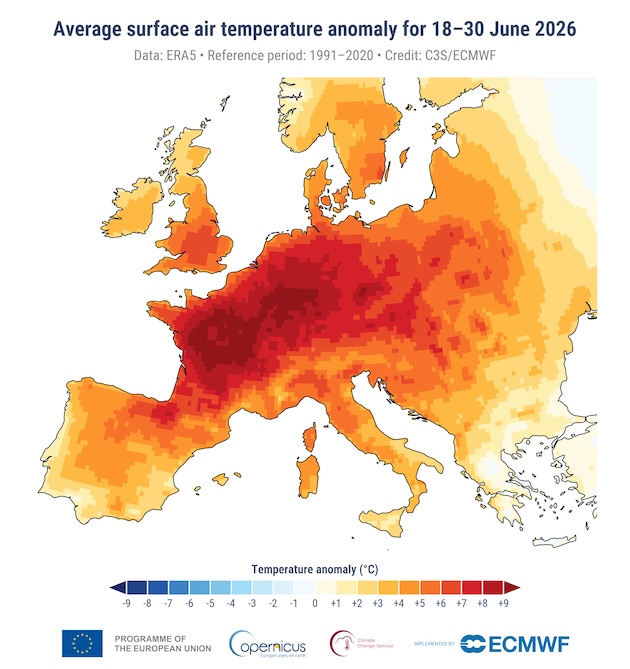
Europe's Copernicus Climate Change Service reports the average anomalies in air temperatures in Europe during this year's heatwave from 18-30 June 2026 relative to the average temperature for the 1991-2020 reference period. Cedit: C3S/ECMWF

Europe’s Copernicus Climate Change Service reports the average anomalies in air temperatures in Europe during this year’s heatwave from 18-30 June 2026 relative to the average temperature for the 1991-2020 reference period. Cedit: C3S/ECMWF

By late June, the record temperature of 41.7 degrees Celsius was reached in eastern Germany, 40 degrees in Vienna, Austria, and 43.8 degrees in western France, reports the World Meteorological Organization (WMO). While western Europe has borne the worst so far, heatwave conditions now extend across central and eastern Europe. In Romania, located south of Ukraine and west of Hungary, temperatures rose dramatically in early July to exceed 35 to 40 degrees Celsius, Daniel Modoacă, Head of Emergency and Disaster Response at the Romanian Red Cross in Bucharest, told IPS.

France and Spain are also at the centre of a wildfire crisis, fuelled by successive heatwaves that have forced the evacuation of more than 300,000 people. The current emergency has been described by French President Emmanuel Macron as the country’s worst fire-related crisis since World War II.

The record-breaking European summer is consistent with the region warming at twice the global average since the 1980s. The continent’s worst heatwaves have all occurred since 2020, and now one consequence is that ‘Europe faces a growing risk of megadroughts that span large regions and last for several years,’ reports the European Environment Agency (EEA).

Following a red alert issued for extreme temperatures, Romanian Red Cross volunteers in Bucharest's Sector 4 distributed drinking water and supported the health and safety of local communities. Bucharest, Romania. Credit: Romanian Red Cross-Bucharest Sector 4

Following a red alert issued for extreme temperatures, Romanian Red Cross volunteers in Bucharest’s Sector 4 distributed drinking water and supported the health and safety of local communities. Bucharest, Romania. Credit: Romanian Red Cross-Bucharest Sector 4

Yet it is not just heatwaves. Europe has also endured excessive rainfall in recent years. Life-threatening floods following major storms occurred in Valencia, Spain, in late 2024. They caused more than 200 deaths, and the devastation ranged from landslides to damage to housing, power, transportation and road infrastructure. In the same year, severe floods also affected Austria, Poland, Czechia and Romania.

But as Europe approaches midsummer, people are facing immediate shocks to their health and wellbeing.

“In Bucharest, the combination of extreme temperatures, dense urban infrastructure and limited nighttime cooling has intensified the impact on vulnerable groups, particularly the elderly, people with chronic illnesses and households facing financial hardship,” Modoacă said, with the interior cooling of homes a major challenge for 17.7 percent of Romanian households already struggling to pay electricity bills.

But the Romanian Red Cross is striving to meet people’s needs by providing drinking water, basic health monitoring, including blood pressure checks, and assistance for those living with medical conditions likely to be worsened by extreme heat. As well as “support for the homeless, who are among the most exposed during prolonged heatwaves, and assistance for rural households, where access to cooling systems and medical services are limited”, Modoacă added.

When high air temperatures are relentless for long periods, and higher than average night temperatures don’t offer relief, the human body is subjected to stress that can diminish its ability to function, leading to heightened risks of heat exhaustion, heat stroke, the worsening of existing illnesses, such as cardiovascular disease, and, in the worst scenario, loss of life.

This year more than 150 million people in European countries have suffered from the heatwave, with 10,000 extra related deaths in late June, according to health authorities. Meanwhile, the WHO reports that heat-related mortality in Europe has risen by 30 percent during the past 20 years, with an estimated 175,000 related fatalities per year. While the same mortality rate for people over the age of 65 years increased by 85 percent from 2000 to 2004 to 2017 to 2021.

In cities, where the built environment has retained the heat to intense levels, health and humanitarian services have been stretched and overwhelmed. In Paris, hospital and ambulance services have been under severe strain, while the French Red Cross has extended its humanitarian outreach to the public with emergency round-the-clock cooling shelters where people can access food, drinking water, sleeping facilities and social support.

However, the longer-term repercussions of climate warming were revealed in new research published in the Global Environmental Change journal. Scientists in Germany claim that severe heatwaves in Europe have widened the inequality gap, significantly impacting lower-income households the greatest and pushing an extra 5.6 million people into risk of poverty on average from 2004 to 2022.

Last month, Mary Friel, the Climate Policy Senior Officer at the International Federation of the Red Cross (IFRC), declared that ‘extreme heat is now one of the defining humanitarian challenges of our time, a major public health risk that demands action from people, institutions and governments alike.’

It was a message reinforced In July by WHO Regional Director for Europe, Hans Kluge, who told the media that most European countries were not prepared for the health repercussions of future heatwaves, including the heatproofing of health infrastructure. ‘Heatwaves can overwhelm hospitals that may not be designed to cope with higher temperatures, especially as admissions rise. Hospital buildings can overheat, causing power supplies and cooling systems, as well as computers and tech services, to fail,’ warns the WHO. Some of the challenges to implementing climate adaptation in the region include limited resources, insufficient dedicated finance and lack of private sector and citizen engagement, claims the IPCC.

Yet the European Union (EU) has demonstrated a commitment to climate action with an ambitious goal of achieving net zero greenhouse gas emissions by 2050. Meanwhile, the European Green Deal, which was launched in 2019, sets out a plan to accelerate the region’s transition to clean infrastructure, energy, transport and industries. And last year Copernicus reported that 46.4 percent of all electricity produced in Europe derived from renewables.

At the same time, the current crisis in Europe has worldwide implications, as the global temperature rise is now estimated to be 1.4 degrees Celsius above pre-industrial levels. And, with current trends, the safety threshold of 1.5 degrees Celsius could be reached by the end of the decade. Nicolas told IPS that every additional fraction of a degree above 1.5 degrees Celsius would increase climate threats to ecosystems, water and food security, infrastructure and the economy and “the possibility of parts of the climate system reaching tipping points”.

IPS UN Bureau Report


!function(d,s,id){var js,fjs=d.getElementsByTagName(s)[0],p=/^http:/.test(d.location)?’http’:’https’;if(!d.getElementById(id)){js=d.createElement(s);js.id=id;js.src=p+’://platform.twitter.com/widgets.js’;fjs.parentNode.insertBefore(js,fjs);}}(document, ‘script’, ‘twitter-wjs’);


Atea Pharmaceuticals Meets Both Its Primary and Secondary Endpoints in the Phase 3 C-BEYOND North America Trial Evaluating Bemnifosbuvir/Ruzasvir for Hepatitis C Virus

Bemnifosbuvir/Ruzasvir (BEM/RZR) Achieved its Primary Endpoint of Statistical Non-inferiority Compared to Sofosbuvir/Velpatasvir (SOF/VEL; Epclusa®), a Standard-of-Care, in First-Ever Successful Head-to-Head Trial in a Global Phase 3 Program of Hepatitis C Virus (HCV) Treatments

Results Reinforce Potential Best-in-Class Profile of BEM/RZR as a Short 8-Week Treatment for Patients Without Cirrhosis

Up to 4 Million People in the US Living with HCV, Which Can Progress to Cirrhosis, End-Stage Liver Disease and Liver Cancer if Left Untreated

BOSTON, July 28, 2026 (GLOBE NEWSWIRE) — Atea Pharmaceuticals, Inc. (Nasdaq: AVIR) (Atea or Company), a late-stage clinical biopharmaceutical company developing oral antiviral therapeutics for serious viral diseases, today announced positive topline results from C-BEYOND, its pivotal Phase 3 trial conducted in North America evaluating the once-daily fixed-dose combination of bemnifosbuvir and ruzasvir (BEM/RZR) for the treatment of chronic hepatitis C virus (HCV) infection. BEM/RZR demonstrated statistical non-inferiority compared to the fixed-dose combination of sofosbuvir and velpatasvir (SOF/VEL) in the modified intent-to-treat (mITT) population, achieving the trial’s primary endpoint. C-BEYOND enrolled patients reflective of the current real-world population living with HCV in the US and Canada.

In the mITT analysis (n=905, cirrhotic and non-cirrhotic), BEM/RZR achieved a 93.9% sustained virologic response (SVR) rate vs. 94.8% for SOF/VEL (Epclusa) at Week 24, encompassing SVR at 12 weeks post-treatment (accepted definition of cure for HCV) in both arms. These results achieved the primary endpoint of statistical non-inferiority, with a 95% confidence interval for difference in SVR rates within the prespecified 5% margin. The mITT analysis in patients without cirrhosis (n=721) showed BEM/RZR (8 weeks of treatment) achieved a 93.5% SVR rate vs. 94.6% for SOF/VEL (12 weeks of treatment). In patients with cirrhosis (12 weeks treatment in both arms) (n=184), BEM/RZR achieved a 95.4% SVR rate vs. 95.4% for SOF/VEL. In C-BEYOND, rates of virologic failure across all populations were low and comparable between treatment arms. Statistical non-inferiority was also met in secondary endpoints, including the per-protocol analysis.

“We are pleased to announce these positive results from C-BEYOND showing our regimen of BEM/RZR achieved high cure rates across all populations and genotypes,” said Jean-Pierre Sommadossi, PhD, Founder and Chief Executive Officer of Atea Pharmaceuticals. “As today is World Hepatitis Day, it underscores that HCV presents complex public health challenges. We believe the profile of our regimen will substantially contribute to the World Health Organization’s goal of HCV eradication. We look forward to sharing results from C-FORWARD, Atea’s second Phase 3 trial of BEM/RZR outside North America, in early 2027, and to bringing BEM/RZR to patients as soon as possible.”

“Achieving these high cure rates with just 8 weeks of BEM/RZR in patients without cirrhosis, alongside a favorable drug-drug interaction profile and the flexibility to be taken with or without food, is a meaningful step forward for HCV care. A shorter, simpler regimen has the potential to streamline prescribing decisions and accelerate the test-and-treat strategies that are essential to HCV elimination,” said Eric Lawitz, MD, Clinical Professor of Medicine at UT Health San Antonio and the Texas Liver Institute. “Many of the patients I see in my practice are managing multiple chronic conditions, taking several concomitant medications, and navigating real barriers to consistent follow-up. Those realities are exactly why we need HCV regimens that are highly effective, convenient to administer and compatible with the medications patients are already taking every day.”

BEM/RZR was administered as an 8-week regimen to patients without cirrhosis compared with the 12-week regimen of SOF/VEL, highlighting the potential of BEM/RZR to deliver robust antiviral efficacy with a shorter treatment duration. In the US, approximately 80-90% of people living with HCV do not have cirrhosis. Together with its potential advantages of a shorter treatment duration for most patients, low risk of drug-drug interactions and no food effect, the results from C-BEYOND further reinforce BEM/RZR’s potential as a differentiated, best-in-class treatment option for people with HCV.

Chronic HCV infection remains an ongoing public health crisis. If left untreated, HCV can progress to cirrhosis, end-stage liver disease and liver cancer, and it remains one of the leading causes of liver cancer in the US, Europe and Japan. Approximately 50 million people worldwide are living with HCV, including up to 4 million people in the US, while new diagnoses continue to outpace annual cures. Additionally, many people living with HCV are also managing other chronic conditions, and roughly 80% take multiple concomitant medications for common comorbidities such as heartburn, heart arrhythmia, high blood pressure and gastroesophageal reflux disease (GERD), which may increase the potential for drug-drug interactions with currently approved therapies.

In C-BEYOND, BEM/RZR demonstrated robust SVR rates across HCV genotypes that predominate in North America. C-FORWARD, which is being conducted outside North America, includes a broader range of HCV genotypes and is expected to provide additional efficacy data in genotypes more frequently found outside the US and Canada. In C-BEYOND, BEM/RZR was generally safe and well tolerated with no drug-related serious adverse events or drug related early treatment discontinuations. Safety was comparable between treatment arms.  

“We are grateful to the patients and clinicians who participated in the C-BEYOND study, whose engagement and support made this important progress possible in the first-ever successful head-to-head trial in a global Phase 3 HCV program,” said Janet Hammond, MD, PhD, Chief Development Officer of Atea Pharmaceuticals. “These strong results underscore the promise of BEM/RZR for the treatment of patients infected with HCV. Looking ahead, we believe C-FORWARD will provide important additional insight into the regimen’s efficacy across HCV genotypes which are less common in the US and Canada, and further our goal of bringing a simplified, effective HCV treatment option to patients worldwide.”

C-BEYOND was conducted at approximately 120 sites in the US and Canada. C-FORWARD, which is fully enrolled with more than 880 patients, is being conducted at approximately 120 sites in 17 countries outside North America and is on track to report topline results in early 2027. Atea plans to present the detailed results of its global Phase 3 program in HCV at future medical conferences and submit to peer-reviewed medical journals for publication.

About the C-BEYOND and C-FORWARD Phase 3 Trials in Adults with Chronic HCV

The global Phase 3 program is evaluating the fixed-dose combination (FDC) of BEM/RZR for the treatment of chronic HCV in patients with and without compensated cirrhosis. The program consists of two open-label controlled trials: C-BEYOND in North America and C-FORWARD outside North America. C-BEYOND (NCT06868264) enrolled 905 (mITT population) treatment-naïve patients, while C-FORWARD (NCT07037277) has enrolled more than 880 treatment-naïve patients. The trials compare the FDC regimen of BEM, a nucleotide analog polymerase inhibitor, and RZR, an NS5A inhibitor, to the FDC regimen of SOF/VEL. The regimen of BEM/RZR is administered orally once daily for eight weeks (in patients without cirrhosis) or 12 weeks (in patients with compensated cirrhosis), while the regimen of SOF/VEL is administered orally once daily for 12 weeks to all patients, with or without compensated cirrhosis.

The primary endpoint for each trial is HCV RNA below the lower limit of quantitation (LLOQ) at 24 weeks from the start of treatment and encompasses sustained virologic response 12 weeks post-treatment (SVR12) in each arm. SVR12 is the accepted definition of cure for HCV. Measurement at 24 weeks from the start of treatment is to ensure the primary endpoint measurement occurs at the same relative timepoint from the start of treatment in all patients. The primary endpoint was assessed in the mITT population in C-BEYOND, which is comprised of all patients who received at least one dose of the regimen and includes patients who discontinued early, were not compliant or were lost to follow-up. The mITT analysis is the agreed upon primary endpoint with the United States Food and Drug Administration (FDA).

About Bemnifosbuvir and Ruzasvir for Hepatitis C Virus (HCV)

BEM has been shown in in vitro studies to be approximately 10-fold more active than SOF against a panel of laboratory strains and clinical isolates of HCV GT 1–5. In vitro studies have also demonstrated BEM remained fully active against SOF resistance-associated substitutions (S282T), with up to 58-fold more potency than SOF. The pharmacokinetic (PK) profile of BEM supports once-daily dosing for the treatment of HCV. BEM has been shown to have a low risk for drug-drug interactions. BEM has been administered to over 3,200 subjects and has been well-tolerated at doses up to 550 mg for durations up to 12 weeks in healthy subjects and patients.

RZR has demonstrated highly potent and pan-genotypic antiviral activity in preclinical (picomolar range) and clinical studies. RZR has been administered to over 3,100 HCV-infected patients at daily doses of up to 180 mg for 12 weeks and has demonstrated a favorable safety profile. The PK profile of RZR supports once-daily dosing.

About HCV

HCV is a blood-borne, single-stranded (ss) RNA virus that primarily infects liver cells. HCV is a leading cause of chronic liver disease and liver transplants and can be spread through blood transfusion, hemodialysis and needle sticks, with approximately 240,000 deaths occurring each year. Despite the availability of direct-acting antivirals, HCV continues to be a significant global healthcare issue. An estimated 50 million people worldwide are chronically infected with HCV and there are approximately one million new infections each year. In the US, approximately four million people are estimated to have HCV with annual new infections outpacing treatment rates. HCV infections in the US predominate among patients between 20 and 49 years old, and it is estimated that approximately 80-90% of people living with HCV in the US do not have cirrhosis. Chronic HCV infection is the leading cause of liver cancer in the US, Europe and Japan.

About Atea Pharmaceuticals

Atea is a late-stage clinical biopharmaceutical company focused on discovering, developing and commercializing oral antiviral therapies to address the unmet medical needs of patients with serious viral infections. Leveraging Atea’s deep understanding of antiviral drug development, nucleos(t)ide chemistry, biology, biochemistry and virology, Atea has built a proprietary nucleos(t)ide prodrug platform to develop novel product candidates to treat single-stranded ribonucleic acid, or ssRNA, viruses, which are a prevalent cause of serious viral diseases. Atea plans to continue to build its pipeline of antiviral product candidates by augmenting its nucleos(t)ide platform with other classes of antivirals that may be used in combination with its nucleos(t)ide product candidates. Atea’s Phase 3 program is evaluating the FDC regimen of BEM, a nucleotide analog polymerase inhibitor, and RZR, an NS5A inhibitor, to treat HCV. Atea is also currently conducting a Phase 1 clinical study of AT-587, a nucleotide analog, for the treatment of HEV. For more information, please visit www.ateapharma.com

Forward-Looking Statements

This press release includes “forward-looking statements” within the meaning of the Private Securities Litigation Reform Act of 1995. Forward-looking statements in this press release include but are not limited to, statements regarding the potential best-in-class profile of the regimen of BEM/RZR for the treatment of HCV and anticipated milestone events including the timeline for readout of the C-FORWARD Phase 3 clinical trials results. When used herein, words including “potential,” “expected,” “should,” “anticipated,” “believe,” “will,” “plans,” and similar expressions are intended to identify forward-looking statements. In addition, any statements or information that refer to expectations, beliefs, plans, projections, objectives, performance or other characterizations of future events or circumstances, including any underlying assumptions, are forward-looking. All forward-looking statements are based upon Atea’s current expectations and various assumptions. Atea believes there is a reasonable basis for its expectations and beliefs, but they are inherently uncertain. Atea may not realize its expectations, and its beliefs may not prove correct. Actual results could differ materially from those described or implied by such forward-looking statements as a result of various important factors, including, without limitation, uncertainties inherent in the drug development process and the regulatory submission or approval process, unexpected or unfavorable safety or efficacy data or results observed during clinical trials or in data readouts; delays in or disruptions to clinical trials or our business; our reliance on third parties over which we may not always have full control; our ability to manufacture sufficient commercial product; competition from approved treatments for HCV; dependence on the success of Atea’s most advanced product candidates, in particular the BEM/RZR regimen for the treatment of HCV; as well as the other important factors discussed under the caption “Risk Factors” in Atea’s Quarterly Report on Form 10-Q for the quarter ended March 31, 2026 as such factors may be updated from time to time in its other filings with the SEC, which are accessible on the SEC’s website at www.sec.gov. These and other important factors could cause actual results to differ materially from those indicated by the forward-looking statements made in this press release. Any such forward-looking statements represent management’s estimates as of the date of this press release. While Atea may elect to update such forward-looking statements at some point in the future, except as required by law, it disclaims any obligation to do so, even if subsequent events cause our views to change. These forward-looking statements should not be relied upon as representing Atea’s views as of any date subsequent to the date of this press release.

Contacts

Jonae Barnes
SVP, Investor Relations and Corporate Communications
617-818-2985
[email protected]

Joyce Allaire
LifeSci Advisors
[email protected]


GLOBENEWSWIRE (Distribution ID 9798809)

CSL célèbre la livraison du premier navire d'une flotte de transbordement de classe mondiale destinée au projet Simandou

MONTRÉAL, 28 juill. 2026 (GLOBE NEWSWIRE) — Le Groupe CSL (« CSL »), un chef de file mondial en matière de transport maritime responsable, annonce la livraison du MV Wontanara, le premier des cinq navires de transbordement (TSV) de pointe conçus pour soutenir le projet de minerai de fer de Simandou, en Guinée, l’un des plus vastes projets miniers et d’infrastructure au monde.

Conçue par CSL et construite au chantier naval CSSC Chengxi, cette flotte révolutionnaire de TSV allie une capacité de port en lourd de 41 800 tonnes à un système d'autodéchargement à double flèche capable de transférer jusqu’à 12 000 tonnes de minerai de fer par heure, ce qui en fait la flotte de TSV la plus rapide et la plus efficace au monde.

Spécialement conçue pour acheminer efficacement de grands volumes de minerai de fer entre les terminaux fluviaux et les vraquiers au large, cette flotte de TSV se caractérise par une coque à faible tirant d’eau optimisée pour la navigation fluviale, cinq propulseurs azimutaux offrant une maniabilité et une précision exceptionnelles, ainsi qu’une capacité de navigation bidirectionnelle qui renforce à la fois la sécurité et l’efficacité opérationnelle.

« La conception de pointe et les capacités de manutention de cette flotte reflètent l’expertise de CSL dans la transformation de défis logistiques complexes en solutions maritimes concrètes et hautement performantes », a déclaré Louis Martel, président et chef de la direction de CSL. « En étroite collaboration avec notre client, nous avons conçu un système de transbordement intégré qui permet des exportations de grands volumes sécuritaires, efficaces et continues dans des environnements aux eaux peu profondes. »

CSL a dirigé le développement de cette solution de transbordement, de la conception initiale à l’ingénierie, à la construction et à la livraison. S’appuyant sur sa solide expérience dans la conception de navires autodéchargeants et les opérations de transbordement, CSL a défini les exigences techniques de la flotte, dirigé les phases d’ingénierie et de conception, et assuré la supervision tout au long de la construction.

Le MV Wontanara est le premier des cinq TSV qui entreront en service pour soutenir le projet Simandou, la livraison du reste de la flotte étant prévue au cours des prochains mois.

Groupe CSL est un fournisseur de classe mondiale de solutions maritimes complexes et le plus important propriétaire et exploitant de navires autodéchargeants au monde. Son siège social est situé à Montréal et l’entreprise compte des divisions aux Amériques, en Australie, en Europe et en Afrique. CSL offre une vaste gamme de services d'expédition et de manutention et transporte annuellement des millions de tonnes de marchandises pour des clients des secteurs de la construction, de l'acier, de l'énergie et de l'agroalimentaire.

Contacts médias :
Brigitte Hébert, directrice, Communications
514-653-8854 | [email protected]

Une photo accompagnant ce communiqué est disponible au : https://www.globenewswire.com/NewsRoom/AttachmentNg/db0a41e3-3773-4796-a0cd-2a7eff80cf78/fr


GLOBENEWSWIRE (Distribution ID 9799083)

CSL Marks the Completion of the First Vessel in World-Leading Transhipment Fleet for Simandou Project

MONTREAL, July 28, 2026 (GLOBE NEWSWIRE) — The CSL Group (“CSL”), a global leader in responsible marine transportation services, announces the delivery of MV Wontanara, the first of five state-of-the-art transhipment shuttle vessels (TSVs) commissioned to service the Simandou iron ore project in Guinea, one of the world's largest mining and infrastructure developments.

Designed by CSL and built at CSSC Chengxi Shipyard, this groundbreaking fleet of TSVs combines a 41,800-tonne deadweight capacity with a dual-boom self-unloading system that can transfer up to 12,000 tonnes of iron ore per hour, making it the fastest and most efficient TSV fleet in the world.

Purpose-built to move large volumes of iron ore efficiently between river terminals and offshore bulk carriers, the TSV design features a shallow-draft hull optimized for river navigation, five azimuth thrusters that deliver exceptional manoeuvrability and precision, and bi-directional navigation capability that enhances both safety and operational efficiency.

“The advanced design and cargo-handling capabilities of this fleet reflect CSL’s expertise in transforming complex logistics challenges into practical, high-performance maritime solutions,” said Louis Martel, CSL President and CEO. “Working closely with our customer, we designed an integrated transhipment system that enables safe, efficient and continuous high-volume exports in shallow-water environments.”

CSL led the development of this transhipment solution from concept design through to engineering, construction and delivery. Leveraging its strong track record in self-unloading vessel design and transhipment operations, CSL established the fleet's technical requirements, led the engineering and design phases, and provided oversight throughout construction.

MV Wontanara is the first of five TSVs that will enter service in support of the Simandou project, with the balance of the fleet scheduled for delivery over the coming months.

The CSL Group is a world class provider of complex marine solutions and the largest owner and operator of self-unloading ships in the world. Headquartered in Montreal with operations throughout the Americas, Australia, Europe and Africa, CSL delivers millions of tonnes of cargo annually for customers in the construction, steel, energy and agri-food sectors.

MEDIA CONTACT
Brigitte Hébert, Director, Communications
514-653-8854 │[email protected]

A photo accompanying this announcement is available at https://www.globenewswire.com/NewsRoom/AttachmentNg/db0a41e3-3773-4796-a0cd-2a7eff80cf78


GLOBENEWSWIRE (Distribution ID 9799083)

McVitie's owner sets 2030 target to double sales of products with a better nutritional balance

LONDON, July 28, 2026 (GLOBE NEWSWIRE) — The company behind McVitie’s, GODIVA and Ülker has pledged to double the volume of products it sells with lower levels of sugar, salt and saturated fat, and higher levels of nutrients such as fibre and protein, by 2030.

Snacking giant, pladis, said it would achieve the target by improving existing recipes without compromising taste, launching new products and expanding successful ranges into more markets.

The move comes as consumers increasingly seek snacks that fit their lifestyle and wellbeing goals without sacrificing taste and enjoyment. pladis believes the move will provide greater choice across its portfolio in response to those changing expectations.

Dr Jennifer Moss, Chief R&D Officer at pladis, said:

“People don't buy biscuits and chocolate because they're looking for a lecture on nutrition – they buy them because they enjoy them. Great taste will always come first.

“What is changing is that consumers increasingly want more choice. They want products that fit their lifestyles and wellbeing goals, but they still expect the same great taste.

“We believe the brands that succeed in the future will be the ones that can deliver both. That's why we're committed to giving consumers more options while continuing to provide the enjoyment that has always been at the heart of our brands.”

To support the target, pladis has developed a new global nutrition framework that will guide how products are developed, reformulated and marketed across its portfolio.

Built by the company's scientists, the framework draws on internationally recognised nutrition systems, including France's Nutri-Score, Australia’s Health Star Rating and the UK's Nutrient Profile Model (HFSS).

The framework is applied across all pladis products and takes a balanced view of nutrition. It assesses both nutrients consumers are encouraged to have more of, such as fibre and protein, and nutrients many are looking to reduce, including salt, sugar and saturated fat.

Today, products identified by the framework as offering a better nutritional balance account for around 10 per cent of pladis' sales volume. The company has set an ambition to double that volume by 2030.

This move comes on the back of long-standing work by pladis to evolve its portfolio. The company has already removed 676 tonnes of sugar from recipes in the UK – the equivalent of around 169 million teaspoons. In the Netherlands, it has revamped its Sultana fruit biscuits by reducing sugar and salt and increasing fibre. Reformulation efforts over the past decade have also seen Ülker remove 549 tonnes of fat from its products alongside reducing sugar and salt.

This pledge forms part of Happy People, Happy Planet, pladis' newly launched global sustainability strategy.

pladis employs around 16,000 people and sells products in more than 110 countries.

For any press queries, please contact the pladis press office on 44 151 230 4899 / [email protected]

Notes to editors:

  • All targets based on a 2023 data baseline.
  • Teaspoons of sugar calculation based on 4g in each teaspoon.

A photo accompanying this announcement is available at https://www.globenewswire.com/NewsRoom/AttachmentNg/74a1d9ee-5411-4b4d-b749-c46ea30b6299


GLOBENEWSWIRE (Distribution ID 9799153)

Le propriétaire de McVitie’s fixe pour 2030 l’objectif de doubler les ventes de produits présentant un meilleur équilibre nutritionnel

LONDRES, 28 juill. 2026 (GLOBE NEWSWIRE) — L’entreprise à l’origine de McVitie’s, GODIVA et Ülker s’est engagée à doubler, d’ici 2030, le volume de produits qu’elle commercialise contenant moins de sucre, de sel et de graisses saturées, et davantage de nutriments tels que les fibres et les protéines.

Le géant du snacking, pladis, a indiqué qu’il atteindrait cet objectif en améliorant les recettes existantes sans compromettre le goût, en lançant de nouveaux produits et en étendant les gammes à succès à de nouveaux marchés.

Cette initiative intervient alors que les consommateurs recherchent de plus en plus des snacks adaptés à leur mode de vie et à leurs objectifs de bien-être, sans renoncer au goût ni au plaisir. pladis estime que cette démarche offrira un plus grand choix au sein de son portefeuille de produits afin de répondre à l’évolution de ces attentes.

Le Dr Jennifer Moss, directrice de la R&D de pladis, a déclaré :

« Les consommateurs n’achètent pas des biscuits ou du chocolat parce qu’ils recherchent un cours de nutrition : ils les achètent parce qu’ils les apprécient. Le goût restera toujours la priorité.

« Ce qui change, c’est que les consommateurs veulent de plus en plus de choix. Ils recherchent des produits qui s’intègrent à leur mode de vie et à leurs objectifs de bien-être tout en gardant la même saveur.

« Nous pensons que les marques qui réussiront à l’avenir seront celles capables d’offrir les deux. C’est pourquoi nous nous engageons à proposer davantage d’options aux consommateurs tout en continuant à leur offrir le plaisir qui a toujours été au cœur de nos marques. »

Pour soutenir cet objectif, pladis a élaboré un nouveau cadre nutritionnel mondial qui orientera le développement, la reformulation et la commercialisation des produits au sein de son portefeuille.

Conçu par les scientifiques de l’entreprise, ce cadre s’appuie sur des systèmes nutritionnels reconnus à l’échelle internationale, notamment le Nutri-Score français, le Health Star Rating australien et le Nutrient Profile Model (HFSS) du Royaume-Uni.

Ce cadre est appliqué à l’ensemble des produits pladis et adopte une approche équilibrée de la nutrition. Il évalue à la fois les nutriments dont les consommateurs sont encouragés à augmenter l’apport, comme les fibres et les protéines, et ceux que beaucoup cherchent à réduire, notamment le sel, le sucre et les graisses saturées.

Aujourd’hui, les produits identifiés par ce cadre comme offrant un meilleur équilibre nutritionnel représentent environ 10 % du volume des ventes de pladis. L’entreprise s’est fixé l’ambition de doubler ce volume d’ici 2030.

Cette initiative s’inscrit dans la continuité du travail mené depuis de nombreuses années par pladis pour faire évoluer son portefeuille de produits. L’entreprise a déjà retiré 676 tonnes de sucre de ses recettes au Royaume-Uni, soit l’équivalent d’environ 169 millions de cuillères à café de sucre. Aux Pays-Bas, elle a repensé ses biscuits aux fruits Sultana en réduisant leur teneur en sucre et en sel tout en augmentant leur teneur en fibres. Les efforts de reformulation menés au cours de la dernière décennie ont également permis à Ülker de retirer 549 tonnes de matières grasses de ses produits tout en réduisant les quantités de sucre et de sel.

Cet engagement s’inscrit dans le cadre de Happy People, Happy Planet, la nouvelle stratégie mondiale de développement durable récemment lancée par pladis.

pladis emploie environ 16 000 personnes et commercialise ses produits dans plus de 110 pays.

Pour toute demande presse, veuillez contacter le service de presse de pladis au +44 151 230 4899 ou à l’adresse [email protected]

Notes à l’attention des rédacteurs :

  • Tous les objectifs sont fondés sur les données de référence de 2023.
  • Le calcul du nombre de cuillères à café de sucre est basé sur 4 g de sucre par cuillère à café.

Une photo annexée au présent communiqué est disponible à l’adresse suivante : https://www.globenewswire.com/NewsRoom/AttachmentNg/74a1d9ee-5411-4b4d-b749-c46ea30b6299


GLOBENEWSWIRE (Distribution ID 9799153)