Sindbad Mentoring da Áustria Vence o F1® Allwyn Global Community Award – Com um Prêmio de € 100.000 para Combater a Desigualdade Educacional

SPIELBERG, Áustria, June 26, 2026 (GLOBE NEWSWIRE) — Sindbad Mentoring venceu hoje o F1® Allwyn Global Community Award no FORMULA 1® LENOVO AUSTRIAN GRAND PRIX 2026. A organização sem fins lucrativos, que capacita os jovens por meio de mentoria individual, recebeu uma doação transformadora de € 100.000 da Allwyn, a empresa de entretenimento liderada pela loteria. Essa doação dará um grande impulso à missão do Sindbad de promover a igualdade de oportunidades, estimular a mobilidade social e inspirar os jovens a seguir as carreiras com que sonham, especialmente nas áreas de STEM.

Muitos jovens de meios desfavorecidos ainda carecem de acesso a redes profissionais, modelos de referência e orientação de carreira, criando barreiras para a mobilidade social. Isso significa que um enorme grupo de talentos em potencial está sendo negligenciado – onde muitas mentes jovens brilhantes nunca têm a oportunidade de entrar em setores como STEM, manufatura e tecnologia verde.

Com operações em toda a Áustria e recentemente estabelecido na Alemanha, o Sindbad Mentoring conecta adolescentes de 13 a 19 anos de meios sub-representados com mentoria pessoal de longo prazo. Desde 2019, 8.400 jovens em toda a Áustria já participam do programa. Ao romper as barreiras sociais e estabelecer relacionamentos de mentoria para pessoas de meios diversificados, a organização sem fins lucrativos ajuda os adolescentes a desenvolver um verdadeiro senso de confiança e pertencimento, e a obter informações valiosas sobre suas futuras carreiras, especialmente nas áreas STEM.

A doação da Allwyn irá apoiar a expansão do Sindbad, ao ajudar a eliminar a lacuna de oportunidades, e aumentar o acesso à educação, treinamento, redes profissionais e emprego. Com o apoio da Allwyn, o Sindbad poderá proporcionar orientação a 35 jovens adicionais em Graz, com um foco mais forte nos caminhos de carreira relacionados a STEM e automobilismo.

O painel de jurados do Prêmio reconheceu a capacidade do beneficiário de criar duradouros impacto e benefícios sociais com o desenvolvimento sustentado dos jovens. A mentoria fortalece a autoestima e o caráter dos jovens que mais precisam dela, oferecendo uma rede de apoio fundamental para a tomada de decisões importantes sobre educação e carreira que, de outra forma, talvez eles não recebessem da família ou da comunidade.

O Sindbad Mentoring é a segunda organização sem fins lucrativos a ser reconhecida pelo F1® Allwyn Global Community Award em 2026. Após o grande sucesso do primeiro ano em 2025, o programa deste ano foi lançado no mês passado, com a instituição de caridade canadense La Tablée des Chefs recebendo o primeiro prêmio no FORMULA 1® LENOVO GRAND PRIX DU CANADA pelo seu trabalho vital no combate à insegurança alimentar, por meio da recuperação e redistribuição de refeições para famílias vulneráveis.

Mais ONGs serão reconhecidas em todos os locais de corrida do Grand Prix nesta temporada, incluindo no Formula 1 Pirelli British Grand Prix 2026 na próxima semana. No final da temporada, os fãs da Formula 1® terão a oportunidade de votar nas suas iniciativas favoritas, como parte do plano da Allwyn para aproximar esses fãs do programa.

Erwin van Lambaart, CEO e Diretor Geral da Casinos Austria AG e Österreichische Lotterien, e jurado do F1® Allwyn Global Community Award, disse: “É com muito orgulho que entregamos o F1® Allwyn Global Community Award ao Sindbad Mentoring. Seu compromisso de orientar os jovens nos anos críticos do desenvolvimento deles gera um impacto humano profundo que se estende muito além da própria pessoa. A Allwyn acredita que o verdadeiro poder do esporte está na sua capacidade de unir e elevar as comunidades que nos recebem nos Grands Prix. Com a promoção da autoestima e da educação durante os anos de formação, além de transformar a vida dos jovens hoje, o Sindbad Mentoring cria um efeito cascata de oportunidades para a vida toda.”

Ellen Jones, Dirigente de ESG da Formula 1® e jurada do F1® Allwyn Global Community Award, disse: “Além de oferecer ajuda imediata, o modelo do Sindbad Mentoring desenvolve confiança e oportunidades duradouras, uma missão que reflete o próprio compromisso da Fórmula 1 de garantir que o nosso esporte atue como um potente catalisador de crescimento e inclusão em todo o mundo. É com prazer que anunciamos o Sindbad Mentoring como o vencedor da primeira edição do prêmio austríaco Formula 1® Allwyn Global Community Award, e estamos prontos para ver o impacto fantástico que essa iniciativa irá gerar nos próximos anos.”

A vencedora do F1® Allwyn Global Community Award e Co-Dirigente do Sindbad Mentoring, Barbara Krainer, disse: “Estamos incrivelmente orgulhosos e gratos por receber esse reconhecimento. Acima de tudo, este prêmio pertence aos nossos mentores voluntários e a toda a comunidade do Sindbad, cujo compromisso faz uma diferença duradoura na vida dos jovens todos os dias. O nosso programa de mentoria individual de longo prazo, apoia os jovens durante a transição crítica da escola para a formação ou emprego, ajudando-os a criar confiança, a descobrir os seus pontos fortes e a conectar-se com novas ideias e oportunidades.”

A vencedora do F1® Allwyn Global Community Award e Co-Dirigente do Sindbad Mentoring, Julia Unterberger, acrescentou: “Com o generoso apoio da Allwyn poderemos aumentar o nosso impacto e orientar mais 35 jovens em Graz. Além disso, estamos particularmente empolgados em expandir nosso foco nos caminhos de carreira relacionados a STEM e automobilismo, ajudando os jovens a explorar novas possibilidades e moldar ativamente o seu futuro. Juntamente com nossos parceiros de escolas, empresas e sociedade civil, estamos fortalecendo o acesso a oportunidades e reduzindo a desigualdade educacional.”

Notas aos Editores

Sobre a Allwyn
A Allwyn é uma empresa multinacional de entretenimento de jogos com foco em loterias líder no mercado e com marcas confiáveis na Europa e na América do Norte, listadas na Euronext Athens. Seu objetivo é aprimorar a experiência de jogo para todos, com foco na inovação, tecnologia, segurança dos jogadores e direcionamento de mais recursos a causas sociais, por meio de um portfólio crescente de entretenimento em jogos casuais.

Sobre a parceria da Allwyn com a Formula 1®
A parceria de vários anos com a Formula 1® é um incentivo ao aumento da conscientização global da Allwyn, com suas 24 corridas do esporte em todo o mundo, 750 milhões de fãs e 96 milhões de seguidores nas redes sociais, bem como seu alcance em canais de transmissão e estabelecimentos de entretenimento.

A parceria irá destacar a posição da Allwyn como uma marca internacional que impulsiona o impacto na comunidade em todo o mundo, em apoio aos seus planos de crescimento global.

A parceria está focada no desenvolvimento de iniciativas que apoiem a ambição da empresa de contribuir positivamente para a sociedade em todo o mundo. Com a Allwyn e a Formula 1® igualmente comprometidas em capacitar os fãs e as comunidades locais, a parceria dará à Allwyn a oportunidade de utilizar a crescente base internacional de fãs do esporte para homenagear quem faz mudanças positivas, compartilhando essas histórias inspiradoras em todo o mundo.

Sobre a Formula 1®
As corridas de Formula 1® tiveram início em 1950 e passaram a ser a competição de automobilismo anual mais prestigiada e mais popular do mundo. A Formula One World Championship Limited faz parte da Formula 1® e detém os direitos comerciais exclusivos do FIA Formula One World Championship™. Formula 1® é uma subsidiária da Liberty Media Corporation (NASDAQ: FWONA, FWONK, LLYVA, LLYVK) atribuída à ação de rastreamento do Formula One Group. O logotipo F1, F1 Formula 1®, Formula 1®, F1, FIA FORMULA ONE WORLD CHAMPIONSHIP, GRAND PRIX, PADDOCK CLUB e marcas relacionadas são marcas comerciais da Formula One Licensing BV, uma empresa da Formula 1®. Todos os direitos reservados.

Para mais informações sobre o F1® Allwyn Global Community Award, incluindo os critérios de elegibilidade e o processo de seleção, visite o nosso site: https://www.allwyn.com/responsibility/community-award.

Foto deste comunicado disponível em https://www.globenewswire.com/NewsRoom/AttachmentNg/8d2988ac-96c9-4885-b105-ef655678a8b3


GLOBENEWSWIRE (Distribution ID 1001209861)

Le programme autrichien de mentorat Sindbad remporte le prix F1® Allwyn Global Community Award et décroche un financement de 100 000 euros qui servira la lutte contre les inégalités des chances face à l’éducation

SPIELBERG, Autriche, 26 juin 2026 (GLOBE NEWSWIRE) — Le programme de mentorat Sindbad a été nommé ce jour lauréat du prix F1® Allwyn Global Community Award à l’occasion du GRAND PRIX D’AUTRICHE DE FORMULE 1® LENOVO 2026. Cette organisation à but non lucratif qui accompagne les jeunes en proposant des programmes de mentorat individuels, reçoit un don de 100 000 euros de la part d’Allwyn, groupe international de divertissement spécialisé dans les jeux de loterie. Cet appui financier majeur permettra à Sindbad de donner un coup d’accélérateur à sa mission qui consiste à renforcer les chances de réussite des jeunes, favoriser leur mobilité sociale et les encourager à embrasser les carrières auxquelles ils aspirent, notamment dans les disciplines dites STEM (sciences, technologies, ingénierie et mathématiques).

De nombreux jeunes issus de milieux défavorisés sont toujours sans accès aux réseaux professionnels et restent privés de modèles inspirants ou d’accompagnement dans leurs choix d’orientation, autant de freins à leur mobilité sociale. Il en ressort un important vivier de talents inexploité, au sein duquel de nombreux jeunes prometteurs peinent à s’engager dans les filières STEM, l’industrie ou encore les technologies vertes.

Fort d’une présence dans toute l’Autriche et tout récemment introduit en Allemagne, le programme Sindbad Mentoring met en relation des adolescents âgés de 13 à 19 ans issus de milieux sous-représentés avec des mentors qui les accompagnent durablement dans le cadre d’une approche individuelle. En Autriche, plus de 8 400 jeunes ont bénéficié de ce programme depuis 2019. En levant les barrières sociales et en proposant des parcours de mentorat entre des personnes d’horizons différents, l’association aide les adolescents à développer leur confiance en eux et leur sentiment d’appartenance, tout en les aidant à mieux connaître les perspectives de carrière qui s’offrent à eux, notamment dans les disciplines STEM.

Les fonds consentis par Allwyn permettront à Sindbad de pérenniser son développement et de participer à la réduction des inégalités des chances en renforçant l’accès à l’éducation, à la formation, aux réseaux professionnels et à l’emploi. Grâce à cet appui, Sindbad pourra accompagner 35 jeunes supplémentaires à Graz, en mettant davantage l’accent sur les carrières liées aux disciplines STEM et au sport automobile.

Le jury a salué la faculté de l’organisation à créer un impact vecteur d’un mieux sociétal durable via un accompagnement continu des jeunes générations. Le programme de mentorat aide à renforcer l’estime de soi et le développement personnel des jeunes qui en ont le plus besoin, en leur ouvrant un réseau essentiel voué à les aider à prendre des décisions importantes concernant leurs études et leur avenir professionnel, un accompagnement dont ils ne bénéficient pas toujours au sein de leur environnement familial ou de leur entourage.

Sindbad Mentoring est la deuxième organisation à but non lucratif distinguée par le prix F1® Allwyn Global Community Award en 2026. Après une première édition couronnée de succès en 2025, le programme de cette année a été lancé le mois dernier et a remis un premier prix à l’association canadienne La Tablée des Chefs lors du GRAND PRIX DU CANADA DE FORMULE 1® LENOVO, qui vient récompenser son engagement dans la lutte contre l’insécurité alimentaire grâce à la récupération et à la redistribution de repas destinés aux familles les plus vulnérables.

D’autres ONG seront récompensées au cours de la saison lors de différentes étapes du championnat, notamment dès la semaine prochaine à l’occasion du Grand Prix Pirelli de Formule 1 de Grande-Bretagne 2026. Plus tard dans l’année, les supporters de Formule 1® seront appelés à voter en faveur de leur initiative favorite, une opportunité qui répond à la volonté d’Allwyn de rapprocher les fans de ce programme.

Erwin van Lambaart, directeur général et PDG de Casinos Austria AG et d’Österreichische Lotterien, et membre du jury du prix F1® Allwyn Global Community Award, s’exprime en ces termes : « Nous sommes fiers de remettre le prix F1® Allwyn Global Community Award à Sindbad Mentoring. Son engagement auprès des jeunes à un moment clé de leur développement délivre un impact humain marqué qui dépasse largement le cadre individuel. Chez Allwyn, nous sommes convaincus que la véritable force du sport réside dans sa faculté à rassembler et à développer les collectifs qui nous accueillent lors des Grands Prix. En jouant d’influence sur l’estime de soi et l’accès à l’éducation durant ces années déterminantes, Sindbad Mentoring transforme la vie de ces jeunes aujourd’hui et produit parallèlement un effet durable en leur faveur personnelle mais aussi à l’endroit de toutes leurs communautés tout au long de leur vie. »

Ellen Jones, responsable ESG de Formula 1 et membre du jury du prix F1® Allwyn Global Community Award, ajoute les observations suivantes : « Le modèle développé par Sindbad Mentoring ne se contente pas de répondre à des besoins immédiats. Il renforce durablement la confiance en soi et ouvre de nouvelles perspectives. Cette mission reflète pleinement l’engagement de Formula 1 à faire de notre sport un véritable moteur de développement et d’inclusion à l’échelle mondiale. Nous sommes enchantés de choisir Sindbad Mentoring au titre de tout premier lauréat autrichien du prix Formula 1® Allwyn Global Community Award et nous avons hâte de mesurer les retombées positives de cette initiative au cours des prochaines années. »

De son côté, Barbara Krainer, co-responsable du programme Sindbad Mentoring et lauréate du prix F1® Allwyn Global Community Award, tient les propos suivants : « Nous sommes à la fois extrêmement fiers et reconnaissants de décrocher ce prix, qui revient en premier lieu à nos mentors bénévoles et se partage avec tout le collectif Sindbad, dont l’engagement transforme chaque jour durablement la vie de nombreux jeunes. Grâce à notre programme de mentorat individuel à long terme, nous accompagnons les jeunes dans la période charnière située entre la fin de leur scolarité et leur poursuite d’études, leur formation ou leur entrée dans la vie active. Nous les aidons à prendre confiance en eux, à identifier leurs forces et à découvrir de nouvelles idées et opportunités. »

Et Julia Unterberger, co-responsable du programme Sindbad Mentoring et elle-même également lauréate du prix F1® Allwyn Global Community Award, de conclure : « La générosité du don consenti par Allwyn nous permettra d’accentuer notre impact et d’accompagner 35 jeunes supplémentaires à Graz. Par ailleurs, nous sommes particulièrement enthousiastes à l’idée de développer encore davantage notre action autour des carrières liées aux disciplines STEM et au sport automobile, en vue d’aider les jeunes à s’ouvrir à de nouvelles perspectives et à construire activement leur avenir. Aux côtés de nos partenaires professionnels des établissements scolaires, des entreprises et de la société civile, nous renforçons l’accès aux opportunités et contribuons à réduire les inégalités des chances face à l’éducation. »

Notes à l’attention de la rédaction

À propos d’Allwyn
Allwyn est un groupe international spécialisé dans le divertissement et les jeux, dont l’activité est principalement axée sur les loteries. Coté sur Euronext Athènes, il se positionne comme acteur majeur sur plusieurs marchés d’Europe et d’Amérique du Nord, où il exploite des marques reconnues. Sa mission consiste à rendre l’expérience de jeu meilleure pour tous en misant sur l’innovation, la technologie, la sécurité des joueurs et en reversant davantage de fonds à des causes caritatives grâce à portefeuille de jeux et divertissements en constante expansion.

À propos du partenariat entre Allwyn et Formula 1®
Le partenariat pluriannuel conclu avec Formula 1® témoigne d’une volonté de renforcer la notoriété mondiale d’Allwyn en s’appuyant sur ses 24 courses organisées chaque année dans le monde, ses 750 millions de fans, ses 96 millions d’abonnés sur les réseaux sociaux, et une large diffusion sur les chaînes de télévision et les plateformes de divertissement.

Ce partenariat permettra de renforcer la position d’Allwyn comme une marque internationale engagée en faveur des communautés à travers le monde, en cohérence avec ses ambitions de développement mondial.

Le développement d’initiatives qui serviront l’ambition de l’entreprise, à savoir contribuer positivement à la société à l’échelle internationale, se trouve au cœur de ce partenariat. Allwyn et Formula 1® partageant la volonté d’accompagner leurs fans et communautés locales, ce partenariat permettra au groupe de mobiliser l’audience internationale toujours plus importante de ce sport à l’échelle internationale et de mettre en lumière celles et ceux qui œuvrent pour un changement positif, en faisant connaître leurs histoires inspirantes à travers le monde.

À propos de Formula 1®
Le championnat Formula 1® a vu le jour en 1950. Il s’agit de la compétition automobile la plus prestigieuse et de la série sportive annuelle la plus populaire du monde. Formula One World Championship Limited fait partie de Formula 1® et détient les droits commerciaux exclusifs du Championnat du monde de Formule 1 de la FIA™. Formula 1® est une filiale de Liberty Media Corporation (NASDAQ : FWONA, FWONK, LLYVA, LLYVK) rattachée à l’action de suivi Formula One Group. Les logos F1, F1 Formula 1®, Formula 1®, F1, FIA FORMULA ONE WORLD CHAMPIONSHIP, GRAND PRIX, PADDOCK CLUB et les autres marques associées sont des marques déposées de Formula One Licensing BV, une société de Formula 1. Tous droits réservés.

Pour en savoir plus sur le prix F1® Allwyn Global Community Award, notamment sur les critères d’éligibilité et les modalités de sélection, rendez-vous sur le site : https://www.allwyn.com/responsibility/community-award.

Une photo annexée au présent communiqué est disponible à l’adresse suivante : https://www.globenewswire.com/NewsRoom/AttachmentNg/8d2988ac-96c9-4885-b105-ef655678a8b3


GLOBENEWSWIRE (Distribution ID 1001209861)

Le Guide MICHELIN 2026 récompense 74 restaurants en Slovénie et décerne à nouveau trois étoiles à l’établissement Hiša Franko

LJUBLJANA, Slovénie, 26 juin 2026 (GLOBE NEWSWIRE) — Le restaurant Hiša Franko, dirigé par Ana Roš, conserve la plus haute distinction du Guide en renouvelant ses trois étoiles MICHELIN. De son côté, le Restaurant Milka, sous la houlette de David Žefran, se voit à nouveau récompensé par deux étoiles MICHELIN. Huit établissements décrochent une étoile MICHELIN, parmi lesquels Galerija okusov qui fait son entrée dans cette catégorie cette année. 12 restaurants reçoivent la distinction Bib Gourmand et la sélection MICHELIN liste maintenant 52 restaurants, dont six nouveaux venus.

Cette nouvelle édition s’ouvre également sur l’introduction en Slovénie du prix MICHELIN de l’Ouverture de l’année. Le guide recense d’autres distinctions spéciales, à savoir le prix du Jeune Chef, décerné à Marko Magajne (Galerija okusov), le prix du Sommelier, attribué à Nejc Farčnik (Grič) et le prix du Service, remporté par Peter Patajc (Gostilnica Ruj). Le prix de l’Ouverture de l’année revient à l’établissement Gostilna Francl, dirigé par Sebastijan Kovačič.

Pour Maja Pak Olaj, directrice de l’Office du tourisme slovène : « L’édition 2026 du Guide MICHELIN Slovénie confirme à nouveau la position renforcée de notre pays au rang des destinations gastronomiques les plus reconnues d’Europe. Les 74 restaurants référencés sur l’ensemble du territoire démontrent bien que la gastronomie de haut niveau occupe une place de plus en plus importante dans l’offre touristique slovène et constitue un moteur essentiel du développement d’un tourisme à forte valeur ajoutée. Notre partenariat avec MICHELIN appuie la visibilité internationale de la Slovénie, relève les standards de qualité et assoie la réputation de ses chefs et restaurants. Nous nous réjouissons tout particulièrement que la Slovénie ait reçu cette année, pour la toute première fois, le prix de l’Ouverture de l’année, sans oublier les prix du Jeune Chef, du Sommelier et du Service, récompenses qui mettent en lumière l’excellence de différents métiers de la gastronomie. Rapporté au nombre d’habitants, le nombre d’établissements distingués par le Guide MICHELIN place la Slovénie dans la moyenne européenne des pays couverts par le guide, ce qui témoigne de l’exceptionnelle qualité de sa gastronomie et de son ambition. Félicitations à tous les lauréats. L’Office du tourisme slovène poursuivra son engagement en faveur du développement et de la promotion internationale de la Slovénie au titre de destination de référence pour les expériences gastronomiques d’exception. »

Consulter le communiqué de presse

Le Guide MICHELIN fête cette année son septième anniversaire en Slovénie

De plus amples informations sont disponibles sur les portails Taste Slovenia et Slovenia.info. Les photos et déclarations filmées lors de la cérémonie de remise des prix sont également accessibles en ligne en suivant ce lien.

Une photo annexée au présent communiqué est disponible à l’adresse suivante : http://www.globenewswire.com/NewsRoom/AttachmentNg/f30fbbc3-b02d-4386-9e2e-b472a374bde4


GLOBENEWSWIRE (Distribution ID 1001209847)

Slowenien feiert 2026 insgesamt 74 MICHELIN-prämierte Restaurants – „Hiša Franko“ verteidigt drei Sterne

LJUBLJANA, Slovenia, June 26, 2026 (GLOBE NEWSWIRE) — Das von Ana Roš geführte Hiša Franko hat erneut die höchste Auszeichnung von drei MICHELIN-Sternen erhalten. Das Restaurant Milka unter der Leitung von David Žefran wurde erneut mit zwei MICHELIN-Sternen ausgezeichnet. Acht Restaurants erhielten einen MICHELIN-Stern. Neu in dieser Kategorie ist in diesem Jahr die Galerija okusov. Die Auszeichnung „Bib Gourmand“ wurde an zwölf Restaurants vergeben. Die Kategorie „Selected“ umfasst 52 Restaurants, darunter sechs Neuzugänge.

Erstmals wurde in Slowenien außerdem der MICHELIN-Sonderpreis „Opening of the Year Award“ verliehen. Weitere Sonderauszeichnungen gingen an Marko Magajne von Galerija okusov, der den „Young Chef Award“ erhielt, an Nejc Farčnik von Grič, der mit dem „Sommelier Award“ ausgezeichnet wurde, sowie an Peter Patajc von Gostilnica Ruj, der den „Service Award“ erhielt. Der erste „Opening of the Year Award“ ging an das von Sebastijan Kovačič geführte Restaurant Gostilna Francl.

MSc Maja Pak Olaj, Direktorin des Slowenischen Fremdenverkehrsamts, betont: „Die Bewertungen des Guide MICHELIN Slowenien 2026 unterstreichen erneut die Position Sloweniens als eines der führenden gastronomischen Reiseziele Europas. Dass 74 Restaurants aus allen Regionen des Landes in den Guide aufgenommen wurden, zeigt, welchen Stellenwert Spitzenküche inzwischen innerhalb des slowenischen Tourismus einnimmt. Sie ist ein wichtiger Bestandteil unseres Angebots und ein bedeutender Treiber für die qualitative Weiterentwicklung der Destination. Unsere Partnerschaft mit MICHELIN stärkt die internationale Sichtbarkeit Sloweniens, setzt Impulse für höchste Qualitätsstandards und festigt den hervorragenden Ruf unserer Köchinnen, Köche und Restaurants. Besonders erfreulich ist die erstmalige Vergabe des „Opening of the Year Award“ in Slowenien. Zusammen mit den „Young Chef Award“, „Sommelier Award“ und „Service Award“ würdigt er Exzellenz in den unterschiedlichsten Bereichen der Gastronomie. Gemessen an der Zahl der vom Guide MICHELIN ausgezeichneten Restaurants pro Kopf bewegt sich Slowenien im europäischen Vergleich der vertretenen Länder im Mittelfeld – ein weiterer Beweis für die außergewöhnliche Qualität und das hohe Niveau der slowenischen Gastronomieszene. Wir gratulieren allen ausgezeichneten Restaurants und Preisträgern herzlich zu diesem Erfolg. Das Slowenische Fremdenverkehrsamt wird die Weiterentwicklung und internationale Positionierung Sloweniens als Destination für außergewöhnliche kulinarische Erlebnisse auch künftig aktiv fördern und unterstützen.“

Pressemitteilung lesen

Sieben Jahre Guide MICHELIN in Slowenien

Weitere Informationen finden Sie auf den Portalen Taste Slovenia und Slovenia.info. Fotos sowie Video-Statements von der Preisverleihung sind hier verfügbar.

Ein Foto zu dieser Mitteilung ist verfügbar unter http://www.globenewswire.com/NewsRoom/AttachmentNg/f30fbbc3-b02d-4386-9e2e-b472a374bde4


GLOBENEWSWIRE (Distribution ID 1001209847)

Eslovênia Homenageia 74 Restaurantes Reconhecidos pela MICHELIN em 2026: Hiša Franko Recebe Três Estrelas

LJUBLJANA, Eslovénia, June 26, 2026 (GLOBE NEWSWIRE) —  Hiša Franko, liderada por Ana Roš, manteve a mais alta distinção de três estrelas MICHELIN, enquanto o Milka Restaurant, sob a liderança de David Žefran, recebeu mais uma vez duas estrelas MICHELIN. Oito restaurantes receberam uma estrela MICHELIN, Galerija okusov passou a fazer parte da categoria pela primeira vez este ano. A distinção Bib Gourmand foi concedida a 12 restaurantes. A categoria Selected inclui 52 restaurantes, seis deles novos.

Este ano também marcou a estreia do MICHELIN Opening of the Year Award na Eslovênia. Outros reconhecimentos especiais incluíram o Young Chef Award, concedido a Marko Magajne do Galerija okusov; o Sommelier Award, concedido a Nejc Farčnik do Grič; e o Service Award, concedido a Peter Patajc do Gostilnica Ruj. O Opening of the Year Award foi concedido ao Gostilna Francl, liderado por Sebastijan Kovačič.

Maja Pak Olaj, Diretora do Conselho de Turismo da Eslovênia, disse: “O Guia MICHELIN da Eslovênia deste ano confirmou mais uma vez que a Eslovênia está fortalecendo sua posição como um dos destinos gastronômicos mais reconhecidos da Europa. A inclusão de 74 restaurantes de todo o país demonstra que a gastronomia de alta qualidade está se tornando uma parte cada vez mais importante da oferta turística da Eslovênia e um fator-essencial para o desenvolvimento do turismo de maior valor agregado. Nossa parceria com a MICHELIN contribui para a visibilidade internacional da Eslovênia, eleva os padrões de qualidade e fortalece a reputação dos chefs e restaurantes eslovenos. Estamos muito contentes com a Eslovênia ter recebido o Opening of the Year Award pela primeira vez este ano, juntamente com os Prêmios Young Chef, Sommelier e Service, que destacam sua excelência em diferentes áreas da gastronomia. Em termos de restaurantes per capita reconhecidos pela Michelin, a Eslovênia está classificada na média europeia dos países incluídos no guia, confirmando a notável qualidade e ambição da gastronomia eslovena. Parabéns a todos os premiados. O Conselho de Turismo da Eslovênia continuará a apoiar o desenvolvimento e a promoção internacional da Eslovênia como destino de experiências gastronômicas excepcionais.”

Leia o comunicado

MICHELIN Guide marks seven years in Slovenia

Mais informações estão disponíveis também nos portais Taste Slovenia e Slovenia.info. Fotos e declarações em vídeo da cerimônia de premiação estão disponíveis aqui.

Foto deste comunicado disponível em http://www.globenewswire.com/NewsRoom/AttachmentNg/f30fbbc3-b02d-4386-9e2e-b472a374bde4


GLOBENEWSWIRE (Distribution ID 1001209847)

Colombia’s next President: A Reckoning for Peace, Climate and Human Rights

Colombia’s next President: A Reckoning for Peace, Climate and Human Rights

Credit: Jaime Saldarriaga/AFP

By Inés M. Pousadela
MONTEVIDEO, Uruguay, Jun 26 2026 – On 21 June Colombians made their choice. By the narrowest of margins, Abelardo de la Espriella, a far-right criminal lawyer who’s never held elected office, became president-elect. Climate activists, human rights defenders, Indigenous communities and peace advocates have the most to lose from the incoming government’s agenda.

The election results follow the logic of a decade of deepening polarisation. Since the 2016 Peace Accord with the Revolutionary Armed Forces of Colombia began a contested and incomplete transition away from armed conflict, Colombian society has divided into two mutually hostile blocs. The election further revealed that no middle ground remains between them. The mainstream right is gone, its candidate receiving a humiliating 6.3 per cent of the first-round vote, and a new right, harsher and less constrained by institutional norms, has taken its place.

Peace agreement in trouble

Nothing divided the two runoff candidates more starkly than the 2016 Peace Accord. Iván Cepeda, the candidate backed by outgoing leftist President Gustavo Petro, is a long-time human rights advocate and senator, and chairs the Senate’s Peace and Post-Conflict Commission. He ran on a ‘comprehensive peace’ platform focused on addressing the structural roots of violence, including land access, inequality and the absence of state services in rural areas.

In contrast, De la Espriella said there would be no peace process under his watch, proposing instead to resume aerial bombardment of armed groups and reinstate herbicide fumigation of coca crops, a practice with well-documented environmental and public health consequences.

According to figures from Colombia’s Ombudsman’s Office, the six-decade conflict caused over 1.1 million killings and more than 200,000 enforced disappearances, while over nine million were forcibly displaced. That record, and the significant progress made since 2016, will now be judged expendable by a government that regards the accords as illegitimate.

For the communities living in territories where armed groups overlap with extractive industries, this is no abstract policy debate. Human rights organisations have warned that a return to a full military offensive will be devastating for civilian populations, particularly the environmental defenders and Indigenous communities who already face lethal threats. Colombia is the world’s deadliest country for environmental and land rights defenders. It’s likely about to get worse.

Cutting the human rights lifeline

De la Espriella also proposes to part ways with the international human rights architecture that has provided Colombia’s victims with a path to justice. On the campaign trail, he announced his intention to withdraw from ‘useless’ international organisations including the UN and the Organization of American States, and denounced the Inter-American Commission on Human Rights as ‘a farce’ that has served only to ‘support the left and persecute our security forces’.

In Colombia’s conflict-ridden territories where Afro-Colombian and Indigenous communities continue to experience massacres and displacement, international monitoring bodies are often the only source of independent verification that violence is happening. The American Convention on Human Rights, which Colombia ratified in 1973, is embedded in the country’s constitutional framework, shaping the interpretation of fundamental rights across the legal system.

The Inter-American Commission on Human Rights has hundreds of cases involving Colombia. In December 2024, the Inter-American Court of Human Rights found the state responsible for the 1995 enforced disappearance of two human rights defenders. Their families waited almost three decades for closure, and only got it because they turned to the regional system when domestic institutions failed them. Now that route could be closed.

What the results mean

Colombia’s change of direction could have global repercussions. Just weeks before the election, Colombia hosted the First Conference on Transitioning Away from Fossil Fuels, bringing together 57 states alongside civil society and scientists frustrated by the repeated failure of UN climate summits to deliver binding commitments on fossil fuel phase-out. Under Petro, renewable energy grew from two per cent to around 16 per cent of the energy mix, and Colombia issued no new contracts for fossil fuel exploration.

That era ends when de la Espriella takes office on 7 August. He frames fossil fuel expansion as a fiscal imperative and calls for the immediate legalisation of fracking, currently banned by judicial moratorium. Since the country includes significant parts of the Amazon rainforest, the climate impacts won’t be limited to Colombia.

Ultimately, De la Espriella did not win for his positions on peace, climate or human rights. He won on security and the promise of order. Calling himself ‘The Tiger’, he modelled his campaign on the populist template of Argentina’s President Javier Milei and El Salvador’s Nayib Bukele, vowing to shrink the state, build megaprisons and combat corruption with tools normally reserved for organised crime. The movement he founded, Defenders of the Homeland, carried Donald Trump’s public backing. The combination proved effective in a country exhausted by decades of violence where many are deeply sceptical of the left’s ability to deliver safety.

The far-right candidate converted legitimate grievances about insecurity into a mandate to dismantle the peace process, reverse climate commitments and withdraw from the international human rights architecture. The consequences will be felt most acutely by those his campaign never meant to speak to.

Inés M. Pousadela is CIVICUS Head of Research and Analysis, co-director and writer for CIVICUS Lens and co-author of the State of Civil Society Report. She is also a Professor of Comparative Politics at Universidad ORT Uruguay.

For interviews or more information, please contact [email protected]


!function(d,s,id){var js,fjs=d.getElementsByTagName(s)[0],p=/^http:/.test(d.location)?’http’:’https’;if(!d.getElementById(id)){js=d.createElement(s);js.id=id;js.src=p+’://platform.twitter.com/widgets.js’;fjs.parentNode.insertBefore(js,fjs);}}(document, ‘script’, ‘twitter-wjs’);  


Mavenir Wins Deutsche Telekom's Partner of the Year Award for Best Network Innovation

BONN, Germany, June 26, 2026 (GLOBE NEWSWIRE) — Mavenir, the software company building cloud-native, AI-by-design mobile networks, today announced it has won the Deutsche Telekom Partner of the Year Award for Best Network Innovation. The award was presented at the Telekom Campus Fair 2026 by Deutsche Telekom’s senior leadership.

This recognition underscores Mavenir’s pivotal role in the Most Energy Efficient Core (MeeC) initiative, a flagship collaboration with Deutsche Telekom built on its Horizontal TelCo Cloud – the company’s own cloud architecture and a blueprint for the telecommunications industry. MeeC has redefined energy efficiency in 5G Core networks, delivering up to 65% reduction in energy consumption during low-traffic periods while maintaining uncompromised performance and service quality.

Launched in 2025, MeeC applies advanced AI-driven traffic analysis and predictive workload optimisation to identify and eliminate energy waste across 5G Core functions – without compromising network performance or service quality. The project demonstrated that significant energy reductions are achievable at commercial scale in live network environments.

Pardeep Kohli, Chief Executive Officer at Mavenir, said: “Winning Deutsche Telekom's Partner Award is a tremendous honour for the entire Mavenir team. MeeC is a compelling demonstration of what becomes possible when cloud-native architecture, AI-driven automation, and genuine partnership combine. Sustainable networks are not a future ambition – they are an operational reality, and we are proud to have helped Deutsche Telekom prove that at scale.”

The Telekom Partner Awards celebrate the outstanding contributions from Deutsche Telekom partners in the fields of network technology, operations, and sustainability. The award was also jointly presented to AMD in recognition of their contribution to the MeeC initiative. 

Information to the Editor:

Most energy efficient Core: Mobile World Congress presentation
https://www.youtube.com/watch?v=Mw2g-CSSAtI

About MeeC (Most Energy Efficient Core)
MeeC is a Deutsche Telekom innovation program focused on transforming 5G Core efficiency through intelligent automation. Key achievements include:

  • Up to 65% energy savings versus baseline operations
  • AI-powered traffic prediction and real-time scaling
  • Dynamic workload consolidation across cloud-native functions
  • Zero-touch automation enabling continuous optimisation
  • Proven deployment in a live Tier-1 production network

About Mavenir
Mavenir is enabling intelligent, automated, programmable networks through the development of telco-first, cloud-native, AI-by-design software solutions for mobile operators. The company’s deep telco domain expertise has been proven through deployments with 300+ operators globally in over 120 countries, which together serve more than 50% of the world’s subscribers. Mavenir combines its deep telco experience with the cloud and IT expertise and data science skillsets essential to solving real customer challenges. Its proven software solutions are AI by design, delivering the AI-native future and operators’ evolution to TechCos. For more information, please visit www.mavenir.com

Mavenir PR Contacts:

Emmanuela Spiteri
[email protected]

A photo accompanying this announcement is available at https://www.globenewswire.com/NewsRoom/AttachmentNg/c7cc50fe-62ad-4a40-b285-74324d5d708e


GLOBENEWSWIRE (Distribution ID 9753159)

Aid Is Falling Fast. What Can African Countries Do?

Credit: Andrew Caballero-Reynolds/IMF Photo

By Chie Aoyagi, Maurizio Leonardi, Athene Laws and Hamza Mighri
WASHINGTON DC, Jun 26 2026 – For decades, official development assistance has been a central pillar of financing in sub-Saharan Africa. That pillar is now weakening—quickly and broadly.

In 2025, bilateral aid to the region fell sharply, with early estimates pointing to cuts of about 26 percent in a single year. Multilateral support is also under pressure, with major institutions projecting sizeable budget reductions. More cuts may follow as donors reset priorities in a shifting geopolitical environment.

As we explain in chapter 2 of the IMF’s recent Regional Economic Outlook for Sub-Saharan Africa, this is not a routine fluctuation. It is hitting countries that have limited room to adjust and few alternative sources of financing.

Why aid matters

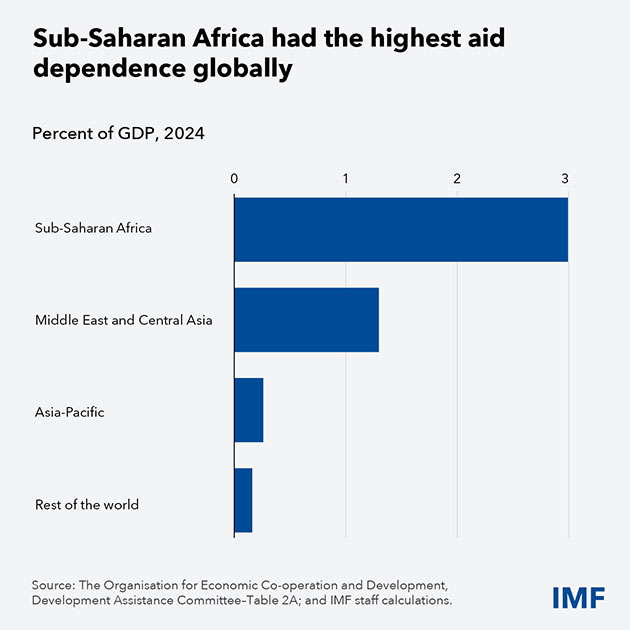
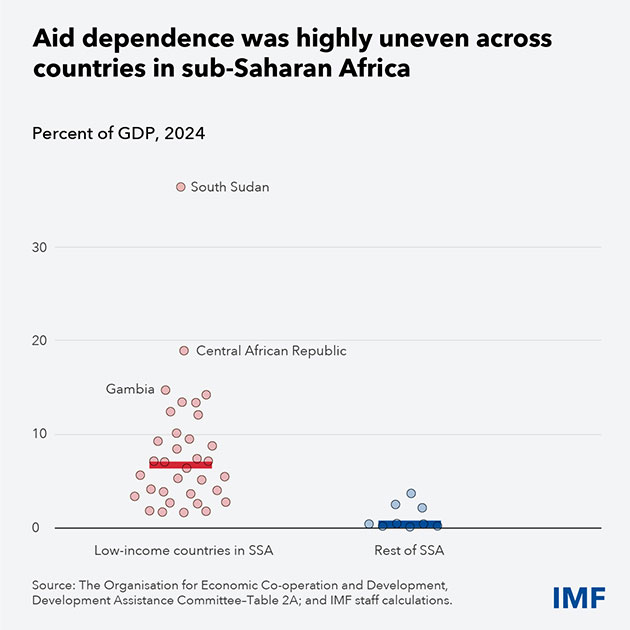
Sub-Saharan Africa had the highest aid dependency globally in 2024. On average, aid accounted for 3 percent of GDP at the regional level. But that average hid sharp differences. In low-income countries and fragile states, aid often reached the equivalent of 6 percent of GDP or more, and in some cases far higher.

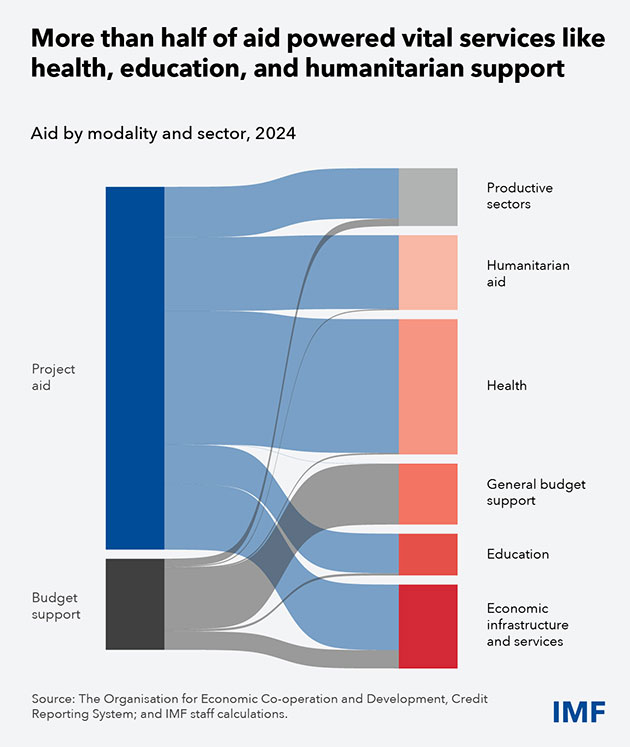
Over half of that aid was used to finance essential services such as health, education, and humanitarian assistance. And because development partners and non-governmental organizations (NGOs) often deliver services directly to people in need, aid cuts can also curtail the very systems that people rely on. Effective responses to crises such as the Ebola emergency in the Democratic Republic of the Congo and Uganda, the high and rising needs of people forcibly displaced by conflict, and the ongoing drought in the Horn of Africa rely heavily on the health and humanitarian infrastructure that aid has consistently helped to build.

A different reality

Aid flows have always fluctuated. But this episode stands apart.

The recent cuts are large and broadly simultaneous across countries. They are driven by donor decisions rather than changes in recipient economies. And they come at a time when traditional buffers are weaker: multilateral institutions and NGOs, which have often cushioned past declines, are themselves facing funding constraints. While non-traditional donors, such as China and the Gulf States, have grown their aid presence in the region, the magnitudes are not able to cover the reduction in traditional donors.

The cuts are also difficult to manage because they follow six years of successive shocks—including the pandemic, tighter global financial conditions, and food and energy crises—that have already eroded fiscal space.

Tough trade-offs

Governments now face difficult choices. Many have limited fiscal space, rising debt, and low reserves.

IMF-administered surveys covering 28 African countries suggest four broad policy responses:

    o Some governments are not replacing lost aid, allowing programs to lapse. This limits immediate fiscal strain but carries high social costs.
    o Many are reprioritizing spending, often cutting public investment—easier politically, but damaging to future growth.
    o Others are borrowing more, including domestically, increasing debt risks.
    o Some are stepping up revenue mobilization, though results take time.

Each option comes with trade-offs. Replacing lost aid can protect services and growth, but at the cost of wider deficits and external imbalances. Not replacing it stabilizes budgets and protects debt sustainability, but risks lasting damage to human capital and development.

There are no easy choices.

How to respond

The policy challenge is to manage the adjustment while preserving core development gains. Three priorities stand out.

First, protect and target high-impact aid.
With resources scarce, allocation matters more. Aid should be directed toward the countries and sectors where it has the greatest effect—especially low-income countries and fragile states, and essential humanitarian needs. Stronger coordination can reduce fragmentation and avoid duplication.

Second, broaden the financing toolkit.
Grant financing will remain essential, particularly in humanitarian contexts. But other instruments can play a larger role. Blended finance—using public funds to mobilize private investment—can help expand financing for infrastructure, energy, and agriculture. It is not a substitute for aid: it is harder to scale, more complex, and can add to debt if poorly designed. Managing these trade-offs will be critical.

Third, strengthen domestic capacity.
With aid less predictable, resilience increasingly depends on domestic institutions. This means mobilizing more revenue, improving spending efficiency, and strengthening policy design and service delivery. Aid has often provided both funding and implementation; replacing that capacity will take time and sustained investment.

A turning point

The shift that began in 2025 is unlikely to be temporary. It reflects a broader reconfiguration of development finance, shaped by tighter donor budgets and changing priorities.

The implications will vary by country, depending on exposure, initial buffers, and policy choices. But the direction is clear: reliance on external aid will become more uncertain, and domestic policy will matter more.

The immediate task is to manage the decline in aid without backsliding on the significant human development achievements of the past decades. The longer-term challenge is to adapt to a world where aid is less abundant and less predictable. How countries navigate both will shape growth and development outcomes for years to come.

Chie Aoyagi, Maurizio Leonardi, and Athene Laws are economists in the IMF’s African Department, where Hamza Mighri is a research analyst.

IPS UN Bureau


!function(d,s,id){var js,fjs=d.getElementsByTagName(s)[0],p=/^http:/.test(d.location)?’http’:’https’;if(!d.getElementById(id)){js=d.createElement(s);js.id=id;js.src=p+’://platform.twitter.com/widgets.js’;fjs.parentNode.insertBefore(js,fjs);}}(document, ‘script’, ‘twitter-wjs’);  


From Nets to Numbers: How Kenya’s Small-Scale Fishers Use Data to Save Their Ocean

As the afternoon sun casts a golden glow over Mukwiro village on Wasini Island on Kenya’s Indian Ocean South Coast, Mwanasiti Mwalola, 26 and Mzungu Mohammed Dhossa, 45, stand at the community fish landing site, carefully receiving baskets of freshly caught fish from returning fishers. A weighing scale hangs before them, with a pen and […]

In a Post-Aid World, Investing in Sustainable Livestock Farming Is an Investment in Global Stability

By Appolinaire Djikeng
NAIROBI, Kenya, Jun 26 2026 – Smallholder farmers in Africa and Asia are likely to still be reeling from the fuel and fertilizer crisis caused by conflict in the Middle East when what forecasters expect to be a “super” El Niño arrives later this year.

Appolinaire Djikeng

When climate extremes and conflict converge to cause crop harvests to fail, livestock will once again offer a resilient source of nutrition, organic fertilizer and incomes. But the confluence of shocks will nevertheless reverberate worldwide in everything from global food supply chains to increased migration and social tensions.

Consensus is increasingly clear that tackling climate change to avert such crises is a legal duty under international law. Bringing down emissions requires both short-term and long-term action. And yet one of the most effective levers available — sustainable livestock farming — receives just 1 to 2 per cent of climate finance dedicated to agriculture. That is a vanishingly small share for a sector that, in many low- and middle-income countries, accounts for as much as 80 per cent of agricultural GDP.

This funding gap matters because livestock offer something relatively rare in climate policy: the chance to cut emissions fast while also building resilience. Methane is a more potent greenhouse gas than carbon dioxide over the short term, which means reducing it delivers quicker climate benefits.

Cattle and other livestock are among the primary sources of methane emissions. But crucially, both direct and indirect methane emissions from livestock production are often higher than necessary because of the same factors that hold back productivity. Poor animal health, low quality feed and nutrition, and climate stress all undermine production and increase both direct emissions and emission intensity. Tackling these fundamental factors solves both challenges.

In Ethiopia, for example, poor animal health has been found to increase livestock emissions by 50 per cent while also resulting in lower meat, milk and egg yields. Parasites and other vector-borne diseases increase the methane produced in animals’ guts while stunting growth and development.

Simply by applying existing tools to improve animal health, such as vaccines, drugs that kill parasites and good nutrition, research suggests that emissions could be conservatively reduced by at least 15 per cent per unit of output. The same interventions also increase productivity and improve livelihoods.

New research is also uncovering new opportunities to reduce methane from livestock while also boosting productivity and resilience.

Scientists from CGIAR research centres and partners have analysed nearly 300 forage samples and found that varieties of African clover, cowpea and lablab could reduce methane emissions by up to 90 per cent. These plants contain compounds that alter the microbes in cows’ stomachs and block the process that generates methane.

Testing is now under way to identify varieties that could be grown as low-methane feed, which not only helps reduce emissions but also supports local seed systems.

Restoring rangelands adds another layer: it helps improve forage availability to support better animal nutrition, lower methane emissions and build stronger ecosystems. Last year, for example, participatory rangeland management (PRM) was strengthened across 340,000 hectares in Ethiopia and 50,000 hectares in Tanzania, improving rangeland health and supporting livestock production.

Many more solutions exist to improve livestock sustainability for short-term and long-term gains, including those developed by the Livestock and Climate Solutions Hub. But despite growing evidence of impact from livestock interventions, climate finance continues to flow elsewhere, away from the agricultural systems that hundreds of millions of people depend on most directly.

In a post-aid world, directing more climate finance towards sustainable livestock farming in low- and middle-income countries is an investment in global stability.

Investing in more sustainable livestock production has a ripple effect that improves food security, livelihoods, and economic growth and contributes to greater stability and resilience in the face of shocks like the “super” El Niño.

Climate vulnerability is costly. Building resilience through the primary sectors of low- and middle-income countries is an insurance against future crises.

Prof. Appolinaire Djikeng is Director General of the International Livestock Research Institute

IPS UN Bureau


!function(d,s,id){var js,fjs=d.getElementsByTagName(s)[0],p=/^http:/.test(d.location)?’http’:’https’;if(!d.getElementById(id)){js=d.createElement(s);js.id=id;js.src=p+’://platform.twitter.com/widgets.js’;fjs.parentNode.insertBefore(js,fjs);}}(document, ‘script’, ‘twitter-wjs’);