Zoom Recognizes the Rise of AI-Powered Businesses of One with Inaugural Solopreneur 50

SAN JOSE, Calif., May 04, 2026 (GLOBE NEWSWIRE) — Zoom (NASDAQ: ZM) today announced the inaugural Zoom Solopreneur 50, a recognition and grant program honoring AI-powered businesses of one across the United States, and released new data from its “Rise of the Solopreneur” report. Together, the program and research highlight how independent professionals are using artificial intelligence to build and scale sustainable businesses without traditional teams, reflecting a broader shift in how work is structured and executed.

For decades, small business growth has been defined by increasing overhead and scaling operations through headcount. The emergence of AI-powered solopreneurs represents a different model: individuals using artificial intelligence and integrated platforms to replace functions historically handled by full teams. Instead of managing people and tools, these operators are assembling capabilities and automating communication, production, and workflows to run efficient, revenue-generating businesses independently.

This shift toward AI-powered businesses of one is enabled by a new class of platforms designed to reduce operational overhead and automate execution. Zoom’s platform, built as a system of action for modern work, helps solopreneurs turn conversations into completed work by embedding artificial intelligence directly into communication, workflows, and customer interactions.

“Headcount used to be the measure of scale,” said Kimberly Storin, Chief Marketing Officer at Zoom. “But AI is decoupling growth from hiring. We’re seeing a new generation of solopreneurs operate with the capabilities of full teams without the overhead. The Zoom Solopreneur 50 is an early signal of where entrepreneurship is going: smaller, faster, and fundamentally more efficient.”

About the Zoom Solopreneur 50 
Selected from nearly 3,000 U.S.-based applicants, the Zoom Solopreneur 50 recognizes individuals who leverage AI and digital tools to turn creative ideas into outcomes. Unlike traditional entrepreneurship awards, the program evaluated applicants based on originality, performance, impact, authenticity, and influence, focusing on how businesses are built rather than just how big they get.

Key details:

  • 50 honorees selected from ~3,000 U.S. applicants
  • 5 grant recipients awarded $30,000 each
  • 12 industries represented, including technology, wellness, education, and professional services

The following five honorees will each receive $30,000 grants to support continued growth:

  • Cierra Gross, Worklution: Connects face‑to‑face with clients through video meetings, enabling strong relationship building, critical to her deeply engaged clientele.
  • Derek McCracken, The Owl’s Nest: Uses AI note capturing tools to collaborate with Ambassador Teachers nationwide and gather real‑time classroom feedback while staying fully present during conversations.
  • Angela Morrison, Cakes by Angela: Runs her business entirely from a home office through digital tools, enabling her to build a global supply chain and an international audience and customer base.
  • Michael Odokara-Okigbo, NKENNE: Collaborates with teams, partners, and customers across five countries through integrated technologies and AI tools, enabling global product development, sales, and training as a single connected, distributed organization.
  • Dana Snyder, Positive Equation: Hosts virtual meetings, workshops, and intensives using AI-first collaboration tools, enabling her to deliver high‑touch education and scale impact globally without a large team.

Honorees were selected by a jury composed of leaders from business and academia:

  • Patrick Hendren, VP of Legal & Policy at Upwork
  • Lisa Scheiring, Global SMB Advisor at Zoom
  • Kim Storin, Chief Marketing Officer at Zoom
  • Selma Studer, COO of Capital Department
  • Anita Woolley, Professor at Carnegie Mellon University’s Tepper School of Business

The full list of honorees is available at: www.zoom.com/solo50

The Role of AI in Solopreneurship

There are more than 30 million small businesses in the U.S., and 82% operate without employees (US Chamber of Commerce). A growing share is being built with AI at the core. These businesses are not smaller versions of traditional companies—they are fundamentally different in how they operate, scale, and deliver value. Instead of hiring teams, solopreneurs are assembling capabilities—using AI to handle operations, communication, and production.

This shift is driven by platforms that integrate communication and execution into a single workflow. Zoom’s platform, including Zoom Workplace and Zoom AI Companion, is designed as a system of action that captures context from conversations and automatically generates next steps, follow-ups, and deliverables without requiring additional tools.

For solopreneurs, that means:

  • Client conversations that automatically generate next steps and follow-ups through Zoom AI Companion
  • Meetings that convert into deliverables and decisions within Zoom Workplace
  • AI embedded directly into communication workflows, eliminating the need for separate tools

As more professionals seek tools to run a business solo with AI, integrated platforms that combine communication, automation, and execution are emerging as a primary requirement. Instead of managing multiple tools, one person can run an entire business from a single workflow.

New Report: The Rise of the Solopreneur

To highlight the growth and preferences of this influential group, Zoom released the inaugural “Rise of the Solopreneur” report, based on insights from the nearly 3,000 applicants, offering a comprehensive look at this emerging segment of the workforce.

Most Solopreneurs Are Already Running Revenue-Generating Businesses:

  • 62% of applicants are operating active, revenue-generating businesses
  • Median founding year is 2022, indicating rapid, recent growth
  • Nearly half cite prior professional or industry experience

AI Is Replacing Core Business Functions

  • Client communication and meetings: 82%
  • Automation and operational efficiency: 78%
  • Collaboration with partners and contractors: 71%
  • Delivering services or products virtually: 46%
  • Content creation and audience building: 46%

Adoption Spans Industries and Geographies

  • California (13%) and New York (10%) lead by state, followed by Georgia (9%) and Texas (9%)
  • Atlanta leads all cities (8%), followed by New York (7%)
  • Representation spans 12 industries, led by Services & Consulting (20%), Health & Wellness (14%), and Social Impact (12%)

Together, the data indicate that solopreneurship is shifting from a side-hustle model to a primary, technology-enabled form of business creation.

Zoom’s Solopreneur 50 and accompanying report position this emerging segment within a broader shift toward AI-powered, independent work, where platforms that can turn interaction into execution define the next generation of business infrastructure. To explore these trends in full, access the “Rise of the Solopreneur” report at https://click.zoom.com/resources/rise-of-the-solopreneur.

About Zoom
Zoom (NASDAQ: ZM) is a system of action for modern work, turning live collaboration into completed results. From entrepreneurs to global enterprises, customers choose Zoom to seamlessly collaborate, communicate, and drive outcomes across meetings, phone, contact center, and more — all with the built-in assistance of Zoom AI Companion. Founded in 2011, Zoom is headquartered in San Jose, CA. For more information, visit zoom.com.

Media Contact
[email protected]
[email protected]


GLOBENEWSWIRE (Distribution ID 9711706)

EarthDaily Advancing Daily Global Measurement of Planetary Change with Six Satellites Launched

MAPLE GROVE, Minn., May 04, 2026 (GLOBE NEWSWIRE) — EarthDaily Analytics (EarthDaily) today announced the successful launch of six EarthDaily Constellation satellites aboard a SpaceX Falcon 9 rideshare mission, confirming initial contact with satellites EDC-02 through EDC-07. The milestone significantly advances the company’s goal of delivering daily, consistent measurement of planetary change at global scale.

The launch, executed on May 3, 2026, delivered all six satellites to low Earth orbit. Telemetry confirms successful deployment, stable performance, solar array deployment, and power-positive status. Each satellite has transitioned into its expected operational configuration, continuing EarthDaily’s disciplined approach to on-orbit validation first demonstrated with EDC-01.

This second launch builds on the successful commissioning of EarthDaily’s first satellite and reinforces the company’s ability to deploy and operate a calibrated, AI-ready Earth observation system. With additional satellites now in orbit, the EarthDaily Constellation will be entering commercial operations late this summer, further strengthening EarthDaily’s existing portfolio of data and analytics products already supporting governments and commercial customers across agriculture, mining, insurance, and defense.

As the constellation expands, these offerings will be enhanced by a consistent, daily stream of calibrated measurement, enabling greater scale, accuracy, and automation across customer workflows. This evolution is closely tied to EarthDaily’s investment in AI and foundation models, designed to transform continuous global measurement into predictive intelligence. Trained on a unified, high-quality time series dataset, these models will enable faster insights, improved confidence, and more precise decision-making across mission-critical applications.

This capability is made possible by the design of the EarthDaily Constellation itself, purpose-built for broad-area change detection. By combining high-frequency revisit, wide-area coverage, and consistent measurement, each satellite, equipped with 16 imaging systems across 22 spectral bands, operates as part of a single, coordinated measurement platform.

“Most Earth observation systems were built to capture images,” said Don Osborne, Chief Executive Officer of EarthDaily. “We built EarthDaily to measure change. With this second launch and successful contact across multiple satellites, we are moving quickly toward delivering a consistent, daily understanding of the planet that customers can rely on to act with confidence.”

Customers will move beyond fragmented datasets to a unified, AI-ready source of truth, where calibrated measurement powers predictive intelligence. Governments can maintain high-confidence situational awareness and continuously update critical datasets, while commercial users can model risk, forecast outcomes, and optimize operations with greater precision.

“The world doesn’t need more imagery. It needs trusted, consistent measurement,” Osborne added. “With each satellite we bring online, we are closing the gap between data collection and decision-making, delivering the foundation for AI-ready geospatial intelligence at scale.”

With an eighth satellite set to launch later this summer, EarthDaily is accelerating into its next phase: delivering a new standard for how the planet is measured.

About EarthDaily

EarthDaily is a global Earth observation company focused on delivering science-grade data and analytics designed for broad-area change detection and decision-centric intelligence. With the EarthDaily Constellation, the company is building a foundation for daily, globally consistent Earth intelligence to support governments and enterprises operating in complex, high-impact environments.

To learn more, visit earthdaily.com and follow EarthDaily on LinkedIn (@EarthDaily) and X (@EarthDailyA).

Contacts
Tanya Cross
Vice President, Global Marketing and Communications
EarthDaily
[email protected]

Alliance Advisors IR
[email protected]

A photo accompanying this announcement is available at:
https://www.globenewswire.com/NewsRoom/AttachmentNg/63895f31-922c-451d-894e-110f2f640ad9


GLOBENEWSWIRE (Distribution ID 9712244)

Pacific Ocean Under Pressure — Now a Region Finally Armed With Evidence

In the low tide, an i-Taukei fisherwoman gathers cockles along the Nasese sea wall in Fiji, a tradition weathered by time and tide. The assessment Climate Change Implications for Fisheries and Aquaculture in the Pacific Island Region looks at women’s contributions across fisheries and aquaculture systems, from harvesting to trade. Credit: Josh Kuilamu/SPC

In the low tide, an i-Taukei fisherwoman gathers cockles along the Nasese sea wall in Fiji, a tradition weathered by time and tide. The assessment Climate Change Implications for Fisheries and Aquaculture in the Pacific Island Region looks at women’s contributions across fisheries and aquaculture systems, from harvesting to trade. Credit: Josh Kuilamu/SPC

By Sera Sefeti
SUVA, Fiji, May 4 2026 – For generations, Pacific people have understood the ocean not as a resource but as identity, sustenance, and survival. Today, that relationship is being tested in ways science is only just beginning to fully capture.

For the first time in the region’s history, every Pacific Island country now has a clear, data-driven picture of what climate change will mean for its waters and its own Exclusive Economic Zone (EEZ).

This shift marks more than just a scientific milestone. It is a turning point in how the Pacific can understand, manage, and defend its ocean in a rapidly changing climate.

From Regional Averages to National realities

The updated assessment, “Climate Change Implications for Fisheries and Aquaculture in the Pacific Island Region”, builds on a 14-year-old vulnerability study. But unlike its predecessor, this version moves beyond broad regional trends.

It goes deeper into country-specific realities.

In a region where ocean territories dwarf landmass, this matters. The Pacific controls around 27 million square kilometres of ocean, yet only about 2 percent of that is land. Fisheries are not just an industry – they are the backbone of economies, cultures, and food systems.

“This is quite amazing,” says SPC Climate Change Project Development Specialist Marie Lecomte, referring to the ability to assess climate impacts at the EEZ level. “The ocean is so big, and land masses are so tiny… it has always been very difficult to downscale ocean models to something meaningful for countries.”

Now, that gap is beginning to close.

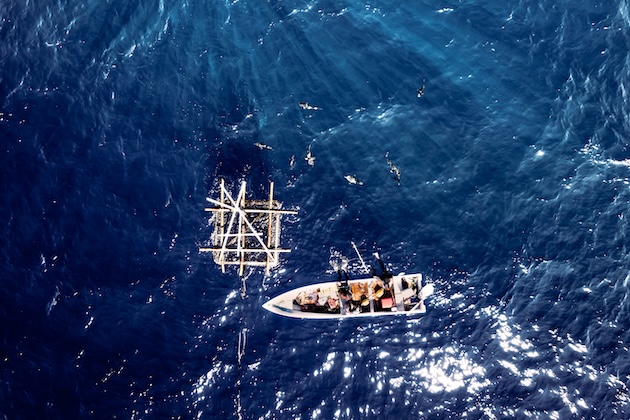
Rising ocean temperatures and changing chemistry are reshaping marine ecosystems, impacting people's livelihoods and national economies. Credit: Douglas Picacha/IPS

Rising ocean temperatures and changing chemistry are reshaping marine ecosystems, impacting people’s livelihoods and national economies. Credit: Douglas Picacha/IPS

Why This Science Matters Now

For Pacific leaders, the climate crisis is not abstract. It is negotiated in global forums, defended in policy rooms, and lived daily in coastal communities.

Yet one persistent challenge has been the lack of evidence.

This report begins to change that.

It provides:

  • Updated scientific data on ocean conditions
  • Country-level projections of fisheries decline
  • A clearer understanding of how climate change cascades from ocean systems into economies and livelihoods

In doing so, it transforms science into something actionable:

  • A diagnostic tool showing what lies ahead
  • A planning guide for adaptation
  • A negotiation tool for global advocacy

For a region often described as the moral voice of climate negotiations, this evidence adds weight to that voice.

The Pacific controls around 27 million square kilometres of ocean, yet only about 2 percent of that is land. Now each country in the region will have a data-driven picture of the effects of climate change in its waters. Credit: Francisco Blaha/SPC

The Pacific controls around 27 million square kilometres of ocean, yet only about 2 percent of that is land. Now each country in the region will have a data-driven picture of the effects of climate change in its waters. Credit: Francisco Blaha/SPC

What the Science Reveals

The findings are sobering.

Rising ocean temperatures and changing chemistry are already reshaping marine ecosystems. The report maps, with unprecedented clarity, a chain reaction: warming waters alter fish biology, leading to fish stocks’ decline, which will ultimately result in the impact on people’s livelihoods and national economies.

At the centre of this crisis are coastal ecosystems, i.e. coral reefs, mangroves, and seagrass beds, the ecological foundations of Pacific fisheries.

These systems are under intense pressure from both climate change and human activity.

“For mangroves, they are also constrained by infrastructure development,” Lecomte explains. “If you build a new hotel, then you get rid of the mangrove.”

For scientists, the assessment Climate Change Implications for Fisheries and Aquaculture in the Pacific Island Region offers the most comprehensive dataset for policymakers and communities. Credit: John Nihahuasi/SPC

For scientists, the assessment Climate Change Implications for Fisheries and Aquaculture in the Pacific Island Region offers the most comprehensive dataset for policymakers and communities. Credit: John Nihahuasi/SPC

Across the Pacific, the risks are not evenly distributed.

Low-lying island nations, already facing sea-level rise and extreme weather, are doubly exposed. Their dependence on fisheries for food and income leaves little buffer against decline.

The consequences are stark:

  • Reduced food security
  • Declining incomes
  • Increased vulnerability of coastal communities

Yet even in this “doom and gloom” narrative, the report resists fatalism. Instead, it offers a framework for adaptation and resilience.

However, in the Pacific, the situation is not starting from zero.

For centuries, communities have managed fisheries through customary practices like tabu areas, seasonal closures, and community governance.

The report reinforces these approaches while introducing new strategies:

  • Climate-smart aquaculture
  • Diversifying target species
  • Improving value chains (earning more from less catch)
  • Protecting and restoring coastal/blue ecosystems

It also highlights a critical but often overlooked dimension, which is women’s contributions across fisheries and aquaculture systems, from harvesting to trade work that remain under-recognised despite their central role.

Science, Power, and the Politics of Survival

Perhaps the most powerful implication of the report lies beyond science — in politics.

Despite being one of the most climate-impacted sectors, fisheries are largely absent from global climate negotiations.

This is where the findings become more than a report. It becomes leverage.

With pre-COP discussions and COP31 on the horizon, Pacific countries now have something they have long needed.

“If Pacific delegations can come to pre-COP saying we have the latest science… and we all agree on how we want to act with the regional climate change strategy for coastal fisheries being pre-endorsed,” Lecomte says, “it’s a unique chance to showcase fisheries as part of the ocean–climate nexus.”

Beyond the Data: A Call to Act

This report does not just document change but also demands a response.

It bridges worlds:

  • Between science and storytelling
  • Between policy and lived experience
  • Between global negotiations and village shorelines

For scientists, it offers the most comprehensive dataset yet when it comes to the Pacific and its EEZ; for policymakers, it is a roadmap; for communities, it is a validation of what they already know.

That the ocean is changing and so must we.

But in that change lies something powerful. For the first time, the Pacific is not just speaking from experience. It is speaking with scientific evidence.

IPS UN Bureau Report


!function(d,s,id){var js,fjs=d.getElementsByTagName(s)[0],p=/^http:/.test(d.location)?’http’:’https’;if(!d.getElementById(id)){js=d.createElement(s);js.id=id;js.src=p+’://platform.twitter.com/widgets.js’;fjs.parentNode.insertBefore(js,fjs);}}(document, ‘script’, ‘twitter-wjs’);


What is the best internet solution for business travel? Why Holafly for Business is becoming the preferred choice for global companies

DUBLIN, May 04, 2026 (GLOBE NEWSWIRE) — For IT teams, one of the biggest risks when an employee travels is not the flight itself, but what happens upon arrival: landing without reliable internet access. This goes far beyond lost time, as it often translates into lack of access to critical tools, reliance on unsecured public WiFi networks, and decisions being made without real-time information.

As global workforces become increasingly distributed, companies are rethinking how they support their teams abroad, moving away from fragmented solutions towards more integrated approaches. In this shift, solutions like Holafly for Business are emerging as a foundational layer that allows IT departments to regain control, visibility, and security, ensuring that employees can access mobile data the moment they land without dependency on external networks.

This transformation is closely tied to the evolution of business travel itself. According to the Global Business Travel Association (GBTA), global business travel spend is expected to reach $1.69 trillion in 2026, reflecting a structural shift towards more geographically distributed ways of working, where the ability to operate seamlessly from anywhere is a baseline expectation.

The operational impact of connectivity gaps is already measurable, with GBTA data indicating that business travelers lose an average of 5.2 productive hours per trip due to connectivity-related challenges. At the same time, security has moved to the center of the conversation. With the average cost of a corporate data breach reaching $4.88 million, according to IBM Security, relying on public WiFi networks is no longer a viable option for many organizations.

Alongside these challenges, the way companies manage data services internally is also a challenge itself. Platforms like Holafly Business Center allow IT teams to centralize eSIM management, monitor usage in real time, and automate billing processes, reducing operational complexity while providing the level of visibility required to manage distributed teams effectively. According to Gartner, organizations that adopt automation in IT operations can reduce management costs by up to 30%, reinforcing the value of more scalable solutions.

Cost predictability when it comes to roaming fees is another factor driving this shift, as traditional roaming models continue to generate unexpected and difficult-to-forecast expenses, solutions like Holafly for Business can reduce these costs by up to 85%, offering both savings and the financial stability that global operations increasingly demand.

“Companies are no longer asking whether their teams will be online when they travel, but how reliably and securely they can operate from anywhere,” said Ricardo Rodriguez, Head of Sales at Holafly for Business.

About Holafly
Holafly is the global leader in eSIMs for travelers, offering coverage in over 200 destinations. With an outstanding 4.6/5 rating on Trustpilot and more than 15 million satisfied users, it has become the preferred eSIM choice for international travelers. Its unlimited data offering ensures peace of mind anywhere in the world.

Contact: [email protected] 

A photo accompanying this announcement is available at https://www.globenewswire.com/NewsRoom/AttachmentNg/ff9372ad-41f6-4acc-8266-5578d80cc425


GLOBENEWSWIRE (Distribution ID 1001179705)

African Countries Up Efforts to Tax High-Income Individuals

African countries are exploring ways to tax high-earning individuals as the continent seeks to expand its revenue collection amid what experts say is a growing gulf between rich and poor. The numbers are staggering. According to Oxfam, “the richest 5 percent in Africa now hold nearly USD 4 trillion in wealth, more than double the […]

Migration a Toxic and Divisive Issue in Many Parts of the West

The second quadrennial International Migration Review Forum (IMRF) 2026 will be held at the UN Headquarters in New York from 5-8 May 2026, preceded by a multi-stakeholder hearing on 4 May. This forum reviews progress on the Global Compact for Safe, Orderly and Regular Migration (GCM) and aims to produce an inter-governmentally agreed Progress Declaration to set future migration policy goals.

 
https://migrationnetwork.un.org/international-migration-review-forum-2026

By Simone Galimberti
KATHMANDU, Nepal, May 4 2026 – Migration is a strange thing, hard to pin down. It is a complex phenomenon that transforms communities while shaping people’s identities and it is so multifaceted that individuals perceive it and live it in different ways.

It can turn to be a vehicle to security and prosperity for some but, on other hand, it can be also experienced with anguish and fear.

In short, migration is something personal that intimately affects both those settling into a new land and those communities that are supposed to co-exist with them.

A German’s state, Baden-Württembergwill soon will have its first state premier from Turkish origin, Cem Özdemir, a veteran green politician. In the past, Mr. Özdemir, according to DW report, has rejected the idea that he should be considered a “successful model of integration” because he always felt at home.

Özdemir’s unwillingness to be boxed into a fixed category of migrant contrasts those narratives that simplify and demean migration.

As we know, migration has been a toxic and divisive issue in many parts of the West, a dangerous problem that must be stopped at any cost. It is being portrayed through the lens of illegality as an open door that only invites violations of the law, including dangerous criminal activities.

While it is undeniable that security concerns can arise especially when there are massive flows of foreigners enter without papers into a new country, much less discussions are about the positive impact of migrants in the local economy.

But the level of politicization is so high that it ended up defining the whole issue. Migration has become something to be fixed, controlled in many parts of the Global North.

Such a framing ignores the fact that migration also occurs in large quantities also between developing nations and is not only about hordes of people from the Global South pushing their way into richer North.

It is unsurprising that the same logic also disregards the multiple and diverse “push factors” that bring individuals to migrate.

Poverty, discrimination and climate change are forcing millions of individuals to search for better places to live. This view has become so pervasive that it has delegitimized a different conversation, one based on exploring legal pathways to migration.

A different way of talking, discussing and regulating migration is possible.

The United Nations, over the last decades, have been trying to offer a venue to promote an approach leading to safe migration based on human rights, conducive, at least on paper, to a multilateralism centered governance of migration.

While far from being perfect, these mechanisms underpinning it, address migration in a way that goes past the deafening rhetoric that generally characterizes the debate on migration.

Because, as we know, migration if managed properly, taking into account the rights of migrants and bringing on board local communities in the destination countries with investment in social integration, instead offers a potent instrument to fight poverty while contributing to the economies of the Global North.

The International Migration Review Forum 2026 is one of these tools at the disposal of the UN to reframe the conversation about migration.

The United Nations in New York will host, from 5-8 May an essential conversation aimed at reviewing the Global Compact on Migration, GCM adopted on 19 December 2018.

Instead of being seen as an opportunity to reboot the conversation about immigration, this non-binding global blueprint, intended to offer a 360 degree approach to foster international cooperation to effectively and inclusively manage migration, ended up being instrumentalised by cunny politicians.

Since then, unfortunately the GCM has been overshadowed by the relentless politics of immigration based on the logic of “control” that has become more and more mainstream in the European Union and in the United States.

Making things more complicated is the fact that it is fitting for demagogues to conflate the issues of migrants with those of refugees. While these two categories often overlap, legally, they remain different concepts, a fact conveniently ignored by politicians.

It has not always been like this.

The international community, thanks also to a more favorable politics in the USA, on September 19, 2016, had successfully managed to create a united policy framework that would bring together both migration and the refugee’s related policies.

The New York Declaration for Refugees and Migrants led the foundations not only to the Global Compact on Migration but also to another tool, the Global Compact on Refugees approved just two days before the GCM.

These are two examples of soft law designed to ignite international support and cooperation even if they were criticized as attempts by the Global North of watering down the international human rights framework.

Yet in order for them to remain useful without diluting the international obligations of nations, they must remain as close as possible in terms of implementation.

The central question is if they revitalize and re-balance the conversation on immigration and refugee protection with practical cooperation and synergies among nations.

I doubt that IMRF 2026 can do much to elevate a new discussion about migration and challenge the status quo. After all, GCM has been designed to be structurally weak in terms of its governance.

For example, there is no mandatory reporting for its signatories.

A silver lining in the GCM’s framework is the existence of the United Nations Network on Migration that “coordinates system-wide, timely and practical support to Member States implementing the GCM.

Yet this is the only mechanism where the international community can holistically discuss immigration. No matter how battered the United Nations are amid drastic funding cuts and ongoing discussions about its re-organization and restructuring, multilateralism is needed more than ever in the areas of migration and refugees.

Yet it appears that the UN is not fighting the fight at political levels.

Reading the Report of the Secretary General on the Global Compact on Migration, you do not find a strong, vigorous push back against the politics that tackle immigration as a problem to be controlled.

There is only a small section on Dispelling Misleading Narratives and you could have expected a more punchy style and more space to counterattack this mainstream narrative on migration based on fear.

Perhaps the “immigration as a problem” approach has already metastasized and, inevitably, it adversely influences and restrains the United Nations. The International Migration Organization, the guardian of the GCM, remains a marginal institution within the UN system.

The Office of the High Commissioner on Refugees faced substantial funding cuts and underwent in 2025 a profound restructuring despite its essential role in many humanitarian situations.

At least the former Higher Commissioner, Fillippo Grandi who stepped down at the end of 2025, did not mince his words in criticizing the ways many governments in the West have been dealing with immigration.

“Building walls, sending boats back, offloading refugees and migrants on to other countries –, populists assure voters that controlling everything from borders and immigration numbers to job markets and national security will make their lives better” he wrote for The Guardian in 2024

“Few political tactics succeed like fear. But I can also tell you such claims of control are illusory”. he continued. It is not only the USA which has embraced this tactics.

Civil society organizations across Europe have been recently criticizing the European Union for the way it is drafting its Return Directive that, once approved, would streamline the return of non-EU nationals staying irregularly, including those whose asylum requests have been denied.

Yet amid this gloom, there are some best practices emerging.

Local governments have an important role to play.

The Local Coalition for Migrants and Refugees is showing an interest model to promote a bottom approach to migration. Moreover, some countries are stepping up.

For example, in 2025, Brazil approved a National Plan on Refugees, Migrants and Stateless while Kenya also brought in a new policy that would positively impact the more than 830,000 refugees and asylum-seekers that are hosted in the country.

At the same time, Ecuador reached an important milestone in 2025 with its National Implementation Plan (NIP) of GCM. Similarly, Malawi has finalized its first National Implementation Plan on Migration.

It is too early to see if these plans will be enforced and a lot will depend on the availability of international funding. Despite the constraints, the IOM remains steadfast in its mission of protecting the rights of migrants.

In 2024 a new Strategic Plan that aims at saving lives and protecting people on the move, driving solutions to displacement and facilitating pathways for regular migration, was introduced.

In a world in which 8,000 migrants were officially reported dead or missing worldwide in 2025, bringing the total since 2014 to more than 82,000 and with 117.3 million people worldwide are forcibly displaced, the international communities cannot stay indifferent.

Let’s remind ourselves of the real power of the GCM.

This Global Compact does not only recognize that safe, orderly and regular migration works for all when it takes place in a well-informed, planned and consensual manner. It is also a tool that highlights the role of the international community in helping create conducive policies for individuals to be able to lead peaceful and productive lives in their home nations.

In short, migration should never be an act of desperation.

While there are individuals of migrant origins like Cem Özdemir who offer a glaring example of successful achievements that allow himself to openly reject a stereotyped categorization, there is a sea of vulnerabilities and deaths affecting millions of others who voluntarily or forcibly left their homes.

This is the reason why legal tools like the International Refugees Convention, this year in its 75th anniversary and more limited but potentially useful mechanisms like IMRF this coming week and next Global Refugee Forum (GRF) 2027, do matter and we should all pay attention to them.

Simone Galimberti writes about the SDGs, youth-centered policy-making and a stronger and better United Nations.

IPS UN Bureau


!function(d,s,id){var js,fjs=d.getElementsByTagName(s)[0],p=/^http:/.test(d.location)?’http’:’https’;if(!d.getElementById(id)){js=d.createElement(s);js.id=id;js.src=p+’://platform.twitter.com/widgets.js’;fjs.parentNode.insertBefore(js,fjs);}}(document, ‘script’, ‘twitter-wjs’);  


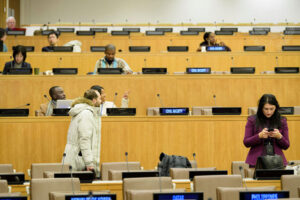
The UN NGO Committee: Civil Society’s Gatekeeper in Hostile Hands

The UN NGO Committee: Civil Society’s Gatekeeper in Hostile Hands

Credit: UN Photo/Manuel Elías

By Samuel King
BRUSSELS, Belgium, May 4 2026 – In January, the government of Algeria succeeded in locking two civil society groups out of access to the United Nations (UN). It raised questions at the UN Committee on Non-Governmental Organizations, known as the NGO Committee, about two civil society groups with accreditation. It alleged that Italian organisation Il Cenacolo was making politically motivated statements at the UN Human Rights Council and the Geneva-based International Committee for the Respect and Implementation of the African Charter on Human and Peoples’ Rights (CIRAC) was selling UN grounds passes. Four days later, it called a vote to revoke their status. Other states urged delay, but the no-action motion failed, and 11 of the body’s 19 members voted to recommend that the UN’s Economic and Social Council (ECOSOC) revoke Il Cenacolo’s accreditation and suspend CIRAC’s for a year.

As the primary gatekeeper for civil society participation at the UN, the NGO Committee controls ECOSOC consultative status, which allows organisations to attend UN meetings, submit written statements, make oral interventions, organise side events and access UN premises. Its mandate, set out in ECOSOC Resolution 1996/31, is straightforward: to facilitate civil society access to the UN system.

Such access is particularly valuable for organisations working in repressive contexts, where domestic advocacy is suppressed. It can mean the difference between a community’s concerns being silenced or becoming a matter of international record. In practice, however, the Committee has so consistently worked to obstruct rather than enable access that it is widely known as the ‘anti-NGO Committee’.

On 8 April, in an almost entirely uncompetitive vote, ECOSOC members elected 19 states to serve on the NGO Committee for four-year terms. Only 20 candidates ran for the 19 seats. UN states are organised into five regional blocs, and four of them presented closed slates, putting forward only as many candidates as the number of seats available.

As a result, the Asia-Pacific group selected China, India, Saudi Arabia and the United Arab Emirates (UAE), states with consistent track records of silencing civil society. Latin America and the Caribbean is represented by the likes of Cuba and Nicaragua, which suppress dissent and routinely detain critics. Four of the five African states elected have repressed or closed civic space. Two states elected from the Western European and Other States group, Israel and Turkey, have also recently intensified their repression of civic space.

The one exception was the Eastern European group, where Estonia and Ukraine won seats in a three-way contest, keeping out authoritarian Belarus, which received only 23 votes against Estonia’s 44 and Ukraine’s 38. As in 2022, when Russia lost a similar race, the result showed that competitive elections open up scrutiny and produce better outcomes. The problem is they rarely happen.

Overall, 13 of 19 newly elected states are rated as having closed or repressed civic space by the CIVICUS Monitor, our research initiative that tracks the conditions for civil society around the world. Only one, Estonia, has open civic space. Fourteen of the 20 candidates had been named as carrying out reprisals against people engaging with the UN.

In the run-up to the election, the International Service for Human Rights published scorecards assessing all 20 candidates against eight criteria; 12 of the 20 met none. Over 80 civil society organisations called on ECOSOC member states to hold competitive elections and vote for candidates committed to civil society access. Forty independent UN human rights experts, including special rapporteurs on human rights defenders and on countries including Afghanistan, Iran and Russia, issued a statement warning that Committee members were abusing the accreditation process to block access for human rights organisations. All these warnings went unheeded.

The withdrawal of accreditation from Il Cenacolo and CIRAC, which awaits ECOSOC confirmation, was unprecedented, but it sits within a long pattern of obstruction. At the Committee’s latest regular session in January, 618 applications were under consideration, 381 of which had been deferred from previous sessions.

The backlog is no accident. States ask repetitive questions about minor details and make short-notice requests for complex documentation to repeatedly delay applications until future sessions. States that repress civil society at home do the same in the international arena, targeting organisations that work on issues they deem controversial or opposed to their interests. Three states – China, India and Pakistan– stand out as the worst abusers of this mechanism, having asked almost half of the 647 questions posed to applicants during the January session. Repeated deferrals raise the costs for civil society organisations, draining financial resources and time.

The UN’s current financial crisis is compounding the problem. The consequences of funding cuts were visible at the latest session, when the question-and-answer session was cancelled following an early adjournment. The loss of the only opportunity for organisations seeking accreditation to engage directly with the Committee fell hardest on smaller organisations that had travelled to New York to take part.

The UN’s current cost-cutting drive could at least be used as an opportunity to push for online participation and other efficiency reforms to reduce the bureaucratic burden of repeated requests for information. Beyond this, there’s a need to reassert that the Committee’s function is supposed to be that of an enabler rather than an obstructor.

The NGO Committee determines whether the voices of communities facing repression and violence can be heard in the UN system, and it’s been hijacked by states with every interest in ensuring that they cannot. The floor can’t be left clear for states that repress civil society to act as gatekeepers. States that claim to support civil society must be willing to put themselves forward.

Samuel King is a researcher with the Horizon Europe-funded research project ENSURED: Shaping Cooperation for a World in Transition at CIVICUS: World Alliance for Citizen Participation.

For interviews or more information, please contact [email protected]


!function(d,s,id){var js,fjs=d.getElementsByTagName(s)[0],p=/^http:/.test(d.location)?’http’:’https’;if(!d.getElementById(id)){js=d.createElement(s);js.id=id;js.src=p+’://platform.twitter.com/widgets.js’;fjs.parentNode.insertBefore(js,fjs);}}(document, ‘script’, ‘twitter-wjs’);