EarthDaily Selected by National Reconnaissance Office (NRO) for Commercial Optical Earth Observation Contract

MAPLE GROVE, Minn., May 05, 2026 (GLOBE NEWSWIRE) — EarthDaily Analytics (EarthDaily) today announced it has been selected by the U.S. National Reconnaissance Office (NRO) to support the use of commercial multispectral Earth observation imagery under the Strategic Commercial Enhancements (SCE) Commercial Solutions Opening (CSO). The contract, valued at $1.2 million, underscores the growing role of commercial providers in supporting U.S. government mission needs.

EarthDaily will provide scientifically calibrated multispectral imagery and remote sensing capabilities via modeling, simulation, and data evaluation, leveraging the EarthDaily Constellation currently on orbit as well as additional satellites launching throughout 2026, EarthDaily will demonstrate its capabilities through end-to-end tasking, collection, and product dissemination, and respond to product ordering and delivery requests from the NRO and its partners.

“This selection reflects a broader shift toward integrating commercially available, high-quality Earth observation data into operational decision-making,” said Eric von Eckartsberg, Chief Revenue Officer, EarthDaily. “Our focus is on delivering consistent, trusted measurement that enables faster, more confident decisions in complex environments.”

The award represents an important step in establishing a scalable contracting framework for future U.S. government demand, positioning EarthDaily to support a wider range of mission applications as commercial Earth observation becomes increasingly embedded in national security workflows.

The selection aligns with the EarthDaily Constellation, a next-generation optical Earth observation system designed to deliver daily global coverage across 22 spectral bands, with full operational capability expected later this year. The constellation is purpose-built for broad-area change detection, enabling repeatable, consistent measurement at scale and supporting AI-ready analytics for both government and commercial users.

Through this award, EarthDaily continues to expand its role as a trusted commercial provider of Earth observation data and analytics, supporting national security and other high-impact applications.

About EarthDaily

EarthDaily is a global Earth observation company focused on delivering science-grade data and analytics designed for broad-area change detection and decision-centric intelligence. With the EarthDaily Constellation, the company is building a foundation for daily, globally consistent Earth intelligence to support governments and enterprises operating in complex, high-impact environments.

To learn more, visit earthdaily.com and follow EarthDaily on LinkedIn (@EarthDaily) and X (@EarthDailyA).

Contacts
Tanya Cross
Vice President, Global Marketing and Communications
EarthDaily
[email protected]

Alliance Advisors IR
[email protected]


GLOBENEWSWIRE (Distribution ID 9713119)

Bullish to acquire Equiniti from Siris in $4.2 billion transaction, creating the global transfer agent for tokenized securities

  • Bullish (NYSE: BLSH) has entered into a definitive agreement to acquire Equiniti, a leading global transfer agent serving nearly 3,000 issuer clients, 15,000 total corporate clients, 20 million shareholders, and processing $500 billion in annual payments.
  • The combination creates the first fully integrated blockchain-enabled, blue-chip issuer services provider — unifying a regulated transfer agent with end-to-end tokenization infrastructure.
  • The $4.2 billion transaction comprises $1.85 billion of assumed Equiniti debt and approximately $2.35 billion in Bullish stock consideration, subject to customary purchase price adjustments.
  • The pro forma combined company is expected to generate approximately $1.3 billion in adjusted total revenue and ~$500+ million in adjusted EBITDA less Capex for 2026E, and to thereafter achieve 6-8% combined 2027E-2029E revenue growth, including 20% revenue growth from tokenization and blockchain services.
  • The transaction is expected to close in January of 2027, subject to regulatory approvals and customary closing conditions.

GEORGE TOWN, Cayman Islands, May 05, 2026 (GLOBE NEWSWIRE) — Bullish (NYSE: BLSH), the institutional-grade digital asset platform, today announced it has entered into a definitive agreement to acquire Equiniti, a leading global transfer agent and provider of mission-critical shareholder services, in a transaction valued at $4.2 billion. The combination creates the global transfer agent for tokenized securities and aims to position Bullish to lead the shift toward blockchain-native capital markets infrastructure.

The acquisition brings together Bullish’s blockchain-native offering: token design, issuance, operation and compliance; distribution through regulated markets globally; liquidity provisioning; and visibility through CoinDesk’s media, data, and research. Equiniti brings what every listed company in most major markets is required to have: a regulated transfer agent. As the system of record for nearly 3,000 blue-chip public companies, Equiniti processes approximately $500 billion in annual payments and supports over 20 million verified shareholders. The combined platform, built to work alongside existing market infrastructure, supports the complete tokenized asset lifecycle.

A Generational Shift in Capital Markets

As capital markets move into a blockchain era with tokenized securities, the combination will address a foundational gap in market infrastructure: the absence of a transfer agent built for the blockchain. The shift underway is profound: stablecoins (the tokenized U.S. dollar) have grown to over $300 billion in reported market capitalization and an estimated $10 trillion in annual payments volume in just a decade. This is one of the most significant structural transformations in capital markets since the advent of electronic trading, and the combined entity will be well positioned to be the operating system that powers it.

“Tokenization is a once-in-a-generation shift in how capital markets operate, the defining infrastructure trend of the next 25 years,” said Tom Farley, CEO of Bullish. “Broad adoption at institutional scale requires three things: end-to-end tokenization services, a single, unified ledger, and a broad base of blue-chip issuer relationships, at scale. This combination delivers all three and I believe it uniquely positions us to lead the transition to tokenized securities.”

Benefits Across the Ecosystem

The combination is expected to deliver concrete benefits across the ecosystem. As blockchain technology and tokenized real-world assets gain broader adoption, this combination will enable issuers to gain real-time cap table visibility — a significant upgrade from the days or weeks of lag in traditional registries — automated corporate actions, broader investor access, and lower costs. Investors will gain the ability to engage in 24/7 transactions, instant settlement, and frictionless asset movement. Bullish will provide secondary trading infrastructure for eligible tokenized equities outside the U.S., serving non-U.S. investors seeking liquidity in tokenized shares and bridging certificated and tokenized markets.

“Equiniti sits at the heart of global capital markets, supporting clients who rely on resilient and trusted infrastructure. When I joined, the mission was clear: support our clients as they modernize by combining deep operational expertise with modern technology in a responsible way,” said Dan Kramer, CEO of Equiniti. “This transaction reflects that intent. It strengthens our ability to support clients as markets evolve, while maintaining the stability, service, and trust they expect from Equiniti. Working closely with Tom over the last few months, it’s clear we share a common view: market infrastructure should modernize thoughtfully, securely, and with clients leading the way.”

The combined platform will be designed to interoperate with existing capital markets infrastructure — including CSDs such as DTCC, Euroclear, and Clearstream, custodians, and broker-dealers — complementing existing books and records. It will operate within established regulatory frameworks, drawing on Equiniti's SEC-registered transfer agent status and FCA-regulated UK operations alongside Bullish's licensed digital asset infrastructure, and is built to align with emerging regimes such as the EU DLT Pilot — giving institutional issuers and investors the regulatory clarity needed for adoption at scale.

About the Transaction

Siris acquired Equiniti in 2021 and has played a central role in the company’s strategic development.

“When Siris invested in Equiniti, we identified a scaled, high quality infrastructure platform with deep client relationships, and partnered closely with Dan and his team to strengthen the business and prepare it for its next phase of growth. This outcome reflects our strategy of backing tech enabled services businesses at the center of market transformation, and we are confident that Bullish is exceptionally well positioned to build on Equiniti’s strength in an evolving capital markets ecosystem,” said Frank Baker, Co-Founder and Managing Partner of Siris.

Equiniti will operate under the Bullish umbrella alongside Bullish Exchange and CoinDesk. CEO Dan Kramer and the Equiniti leadership team will retain responsibility for day-to-day operations, regulatory obligations and client relationships. Bullish will provide strategic infrastructure and support to accelerate the companies’ shared tokenization roadmap. Siris will receive two board seats as part of the transaction. Closing is expected in January of 2027, subject to customary closing conditions and required regulatory approvals.

Key Financial Metrics

  • The $4.2 billion transaction comprises $1.85 billion of assumed Equiniti debt and approximately $2.35 billion in Bullish stock consideration, subject to customary purchase price adjustments.
    • Bullish stock consideration is priced at $38.48 per share, based on Bullish’s 30-day VWAP as of close on May 4, 2026.
  • Transaction includes a call option for Siris to acquire non-core Equiniti business lines, the financials of which have been excluded from all transaction disclosures.
  • On a pro forma combined basis, the companies are expected to generate approximately $1.3 billion in adjusted total revenue and ~$500+ million in adjusted EBITDA less Capex for 2026E, reflecting a highly profitable and scaled platform prior to the realization of synergies.
  • Bullish expects to realize 6-8% annual revenue growth from 2027E to 2029E and greater than $100 million in annual EBITDA less Capex growth.
    • 2029E exit run-rate EBITDA less Capex margin target of ~50%+

Webcast

Bullish will host a conference call and webcast to discuss this transaction at 8:30 AM ET today, May 5th. The live webcast and accompanying presentation materials will be accessible via the Investor Relations section of Bullish's website at investors.bullish.com

Advisors

Goldman Sachs & Co. LLC served as exclusive financial advisor to Bullish. Morgan, Lewis & Bockius LLP served as legal counsel. Alvarez & Marsal also advised Bullish.

Evercore and FT Partners served as lead financial advisors to Siris, as well as Wells Fargo and LionTree Advisors. Sidley Austin LLP served as legal counsel to Siris.

Media Contacts

Bullish: [email protected]

Equiniti: [email protected]

About Bullish:
Bullish (NYSE: BLSH) is an institutionally focused global digital asset platform that provides regulated market infrastructure and information services. This includes Bullish Exchange – an institutionally focused digital assets spot and derivatives exchange, integrating a high-performance central limit order book matching engine with automated market making to provide deep and predictable liquidity. Bullish Europe is regulated under MiCAR as a crypto asset service provider offering spot trading and custody services for digital assets.

Bullish is the parent company of CoinDesk, a leading provider of digital asset media and information services. CoinDesk's offerings include: CoinDesk Indices – a collection of tradable proprietary and single-asset benchmarks and indices that track the performance of digital assets for global institutions in the digital assets and traditional finance industries; CoinDesk Data – a broad suite of digital asset market data and analytics, providing real-time insights into prices, trends and market dynamics; and CoinDesk Insights – a digital asset media and events provider and operator of coindesk.com, a digital media platform that covers news and insights about digital assets, the underlying markets, policy and blockchain technology. For more information, please visit bullish.com and follow LinkedIn and X.

About Equiniti:
Equiniti delivers trusted data, intelligent insight, and seamless administration across the full equity ownership lifecycle. We help issuers, investors, and employees navigate complexity, strengthen market engagement, and achieve better outcomes through technology-powered solutions backed by expert service. Our 5,000+ global associates support more than 12,000 organizations and over 20 million shareholders worldwide.

Use of Websites to Distribute Material Company Information
We use the Bullish Investor Relations website (investors.bullish.com) and our X account (x.com/bullish) to publicize information relevant to investors, including information that may be deemed material, in addition to filings we make with the U.S. Securities and Exchange Commission (SEC) and press releases. We encourage investors to regularly review the information posted on our website and X account in addition to our SEC filings and press releases to be informed of the latest developments.‍

‍Forward-Looking Statements
This press release contains “forward-looking statements” within the meaning of the Private Securities Litigation Reform Act of 1995. Sentences containing words such as “believe,” “intend,” “plan,” “may,” “will,” “expect,” “should,” “could,” “anticipate,” “estimate,” “predict,” “project,” or their negatives, or other similar expressions of a future or forward-looking nature generally should be considered forward-looking statements and include, without limitation, statements and information relating to the acquisition of Equiniti, the future financial or operating performance, business strategy, and potential market opportunity of Bullish, Equiniti or the combined companies, and expectations related to the growth and adoption of tokenized securities and blockchain technology. Such forward-looking statements are based upon estimates and assumptions that, while considered reasonable by Bullish, are inherently uncertain and are subject to risks, uncertainties, and other factors which could cause actual results to differ materially from those expressed or implied by such forward-looking statements. Factors that may cause results to differ from those expressed in our forward-looking statements include, but are not limited, to the satisfaction of the conditions to closing the acquisition and combination in the anticipated timeframe or at all, the failure to obtain necessary regulatory approvals, the ability to realize the anticipated benefits of the combination, the ability to successfully integrate the business, litigation or regulatory actions related to the acquisition and combination, disruption from the acquisition and combination and its impact on our ability to grow our business and operations, including in new geographic locations, the costs or expenditures associated therewith, competition in our industry, and the evolving rules and regulations applicable to digital assets, tokenization and our industry. You should not place undue reliance on any such forward-looking statements, which speak only as of the date they are made, and Bullish undertakes no duty to update these forward-looking statements.


GLOBENEWSWIRE (Distribution ID 9713193)

Quelle est la meilleure solution internet pour les voyages d’affaires ? Pourquoi Holafly for Business s’impose comme le choix privilégié des entreprises internationales

DUBLIN, 05 mai 2026 (GLOBE NEWSWIRE) — Pour les équipes informatiques, l’un des principaux risques lors des déplacements professionnels n’est pas le vol lui-même, mais ce qui se passe à l’arrivée : atterrir sans accès internet fiable. Au-delà de la perte de temps, cela se traduit souvent par une inaccessibilité aux outils essentiels, une dépendance à des réseaux Wi-Fi publics non sécurisés et des décisions prises sans informations en temps réel.

Face à la dispersion croissante de leurs effectifs à l’international, les entreprises repensent l’accompagnement de leurs équipes à l’étranger, en délaissant les solutions fragmentées au profit d’approches plus intégrées. Dans ce contexte, des solutions comme Holafly for Business émergent comme une infrastructure fondamentale permettant aux services informatiques de reprendre le contrôle, d’avoir une meilleure visibilité et de garantir la sécurité, tout en assurant aux employés un accès aux données mobiles dès leur arrivée, sans dépendre des réseaux externes.

Cette transformation est étroitement liée à l’évolution même des voyages d’affaires. Selon la Global Business Travel Association (GBTA), les dépenses mondiales liées aux voyages d’affaires devraient atteindre 1 690 milliards de dollars en 2026, traduisant une évolution structurelle vers des modes de travail mieux répartis géographiquement, où la capacité à travailler efficacement n’importe où est devenue une exigence fondamentale.

L’impact opérationnel des problèmes de connectivité est déjà mesurable : selon la GBTA, les voyageurs d’affaires perdent en moyenne 5,2 heures de productivité par déplacement en raison de ces difficultés. Parallèlement, la sécurité est devenue un enjeu central. Selon IBM Security, le coût moyen d’une violation de données d’entreprise s’élève à 4,88 millions de dollars. Le recours aux réseaux Wi-Fi publics n’est donc plus une option viable pour de nombreuses organisations.

Outre ces défis, la gestion interne des services de données constitue également un enjeu majeur. Des plateformes comme Holafly Business Center permettent aux équipes informatiques de centraliser la gestion des eSIM, de suivre l’utilisation en temps réel et d’automatiser la facturation, réduisant ainsi la complexité opérationnelle tout en offrant la visibilité nécessaire à une gestion efficace des équipes distribuées. Selon Gartner, les entreprises qui automatisent leurs opérations informatiques peuvent réduire leurs coûts de gestion jusqu’à 30 %, ce qui confirme l’intérêt de solutions plus évolutives.

La prévisibilité des coûts liés à l’itinérance est un autre facteur clé de cette évolution. Alors que les modèles d’itinérance traditionnels continuent de générer des dépenses imprévues et difficiles à prévoir, des solutions comme Holafly for Business permettent de les réduire jusqu’à 85 %, offrant ainsi des économies et une stabilité financière de plus en plus indispensables aux opérations internationales.

« Les entreprises ne se demandent plus si leurs équipes seront connectées lorsqu’elles voyagent, mais plutôt avec quel niveau de fiabilité et de sécurité elles pourront travailler n’importe où », explique Ricardo Rodriguez, directeur des ventes chez Holafly for Business.

À propos de Holafly
Holafly est le leader mondial des eSIM pour les voyageurs et offre une couverture dans plus de 200 destinations. Fort d’une note exceptionnelle de 4,6/5 sur Trustpilot et de plus de 15 millions d’utilisateurs satisfaits, Holafly s’est imposé comme le choix privilégié des voyageurs internationaux. Son offre de données illimitées garantit une tranquillité d’esprit partout dans le monde.

Contact : [email protected] 

Une photo annexée au présent communiqué est disponible à l’adresse suivante : http://www.globenewswire.com/NewsRoom/AttachmentNg/ff9372ad-41f6-4acc-8266-5578d80cc425


GLOBENEWSWIRE (Distribution ID 1001180001)

Welche Internetlösung empfiehlt sich für Geschäftsreisen? Darum ist Holafly for Business die erste Wahl für globale Unternehmen

DUBLIN, May 05, 2026 (GLOBE NEWSWIRE) — Für IT-Teams ist eines der größten Risiken bei Geschäftsreisen nicht der Flug selbst, sondern ohne zuverlässigen Internetzugang am Zielort anzukommen. Dabei geht es um weit mehr als nur um Zeitverlust: Häufig fehlt der Zugriff auf wichtige Tools, Mitarbeiter sind auf ungesicherte öffentliche WLAN-Netzwerke angewiesen, und Entscheidungen müssen ohne aktuelle Informationen getroffen werden.

Da weltweit immer mehr Mitarbeiter an verschiedenen Standorten tätig sind, suchen Unternehmen nach neuen Möglichkeiten, ihre Teams im Ausland zu unterstützen – weg von fragmentierten Einzellösungen, hin zu stärker integrierten Ansätzen. Im Zuge dieses Wandels entwickeln sich Lösungen wie Holafly for Business zu einer zentralen Infrastrukturschicht. Sie helfen IT-Abteilungen, Kontrolle, Transparenz und Sicherheit zurückzugewinnen und stellen sicher, dass Mitarbeitende unmittelbar nach der Landung mobilen Datenzugang haben, ohne auf externe Netzwerke angewiesen zu sein.

Diese Entwicklung geht Hand in Hand mit den Veränderungen im geschäftlichen Reiseverkehr selbst. Laut der Global Business Travel Association (GBTA) werden die weltweiten Ausgaben für Geschäftsreisen 2026 voraussichtlich 1,69 Billionen US-Dollar erreichen. Dies spiegelt den strukturellen Wandel hin zu geografisch stärker verteilten Arbeitsmodellen wider, bei denen die Fähigkeit, von überall nahtlos zu arbeiten, zur Grundvoraussetzung geworden ist.

Die betrieblichen Auswirkungen von Verbindungslücken sind bereits messbar: Laut Daten der GBTA verlieren Geschäftsreisende aufgrund von Verbindungsproblemen durchschnittlich 5,2 produktive Stunden pro Reise. Gleichzeitig ist das Thema Sicherheit in den Mittelpunkt der Debatte gerückt. Angesichts der Tatsache, dass die durchschnittlichen Kosten einer Datenpanne in Unternehmen laut IBM Security 4,88 Millionen US-Dollar betragen, ist die Nutzung öffentlicher WLAN-Netzwerke für viele Organisationen keine tragfähige Option mehr.

Neben diesen Herausforderungen stellt auch das interne Management von Datendiensten Unternehmen vor erhebliche Schwierigkeiten. Plattformen wie das Holafly Business Center ermöglichen es IT-Teams, das eSIM-Management zu zentralisieren, die Nutzung in Echtzeit zu überwachen und Abrechnungsprozesse zu automatisieren. Dadurch wird die betriebliche Komplexität reduziert und die für eine effektive Verwaltung verteilter Teams erforderliche Transparenz gewährleistet. Laut Gartner können Unternehmen, die Automatisierung in ihren IT-Betrieb integrieren, ihre Verwaltungskosten um bis zu 30 % senken, was den Wert skalierbarer Lösungen zusätzlich unterstreicht.

Ein weiterer Treiber dieses Wandels ist die Planbarkeit von Roaming-Kosten: Während traditionelle Roaming-Modelle weiterhin unerwartete und schwer vorhersehbare Kosten verursachen, können Lösungen wie Holafly for Business diese Ausgaben um bis zu 85 % senken und damit sowohl Einsparungen als auch die zunehmend erforderliche finanzielle Stabilität für globale Aktivitäten bieten.

„Unternehmen fragen sich heute nicht mehr, ob ihre Teams auf Reisen online sein werden, sondern wie zuverlässig und sicher sie von überall aus arbeiten können“, so Ricardo Rodriguez, Head of Sales bei Holafly for Business.

Über Holafly
Holafly ist der weltweit führende Anbieter von eSIMs für Reisende und deckt über 200 Destinationen ab. Mit einer Trustpilot-Bewertung von 4,6/5 und mehr als 15 Millionen zufriedenen Kunden ist Holafly die erste Wahl für internationale Konnektivität. Das Angebot an unbegrenzten Daten garantiert sorgenfreies Reisen weltweit.

Kontakt: [email protected] 

Ein Foto zu dieser Mitteilung finden Sie unter http://www.globenewswire.com/NewsRoom/AttachmentNg/ff9372ad-41f6-4acc-8266-5578d80cc425


GLOBENEWSWIRE (Distribution ID 1001180001)

Qual é a melhor solução de internet para viagens de negócios? Por que a Holafly for Business está se tornando a escolha preferida das empresas globais

DUBLIN, May 05, 2026 (GLOBE NEWSWIRE) — Para as equipes de TI, um dos maiores riscos quando um funcionário viaja não é o voo em si, e sim o que acontece na chegada: o pouso sem acesso confiável à Internet. Isso vai muito além do tempo perdido, pois muitas vezes se traduz na falta de acesso a ferramentas críticas, dependência de redes WiFi públicas não seguras e decisões sendo tomadas sem informações em tempo real.

Com a força de trabalho global cada vez mais distribuída, as empresas estão repensando em como apoiar suas equipes no exterior, evitando soluções fragmentadas para abordagens mais integradas. Diante dessa mudança, as soluções como a Holafly for Business estão emergindo como uma camada fundamental que viabiliza que os departamentos de TI recuperem o controle, a visibilidade e a segurança, garantindo que os funcionários possam acessar os dados móveis no momento em que chegam, sem depender de redes externas.

Essa transformação está intimamente ligada à evolução das próprias viagens de negócios. De acordo com a Global Business Travel Association (GBTA), os gastos globais com viagens de negócios devem chegar a US$ 1,69 trilhão em 2026, refletindo uma mudança estrutural em direção a formas de trabalho mais distribuídas geograficamente, onde a capacidade de operar sem problemas de qualquer lugar é uma expectativa básica.

O impacto operacional das lacunas de conectividade já é mensurável, com dados da GBTA indicando que os viajantes de negócios perdem uma média de 5,2 horas produtivas por viagem devido a problemas relacionados à conectividade. Por outro lado, a segurança passou a ser central. Com o custo médio de uma violação de dados corporativos chegando a US$ 4,88 milhões, de acordo com a IBM Security, o uso de redes WiFi públicas não é mais uma opção viável para muitas organizações.

Além disso, a maneira como as empresas gerenciam os serviços de dados internamente também já é uma dificuldade. Plataformas como o Holafly Business Center possibilitam que as equipes de TI centralizem o gerenciamento de eSIM, monitorem o uso em tempo real e automatizem os processos de faturamento, reduzindo a complexidade operacional e, ao mesmo tempo, fornecendo o nível de visibilidade necessário para o gerenciamento eficiente de equipes distribuídas. De acordo com a Gartner, as organizações que adotam a automação nas operações de TI podem reduzir os custos de gestão em até 30%, confirmando o valor das soluções mais escaláveis.

A previsibilidade dos custos quando se trata de taxas de roaming é outro fator que impulsiona essa mudança, já que os modelos tradicionais de roaming continuam a gerar despesas inesperadas e difíceis de prever. Soluções como a Holafly for Business podem reduzir esses custos em até 85% e oferecer a economia e a estabilidade financeira que as operações globais exigem cada vez mais.

“As empresas não estão mais preocupadas se suas equipes estão online quando viajam, e sim com a confiabilidade e a segurança do local”, disse Ricardo Rodriguez, Dirigente de Vendas da Holafly for Business.

Sobre a Holafly
A Holafly é líder global em eSIMs para quem viaja, oferecendo cobertura em mais de 200 destinos. Com uma excelente classificação de 4.6/5 na Trustpilot e mais de 15 milhões de usuários satisfeitos, ela é a opção preferida de eSIM para quem viaja em todo o mundo. Sua oferta ilimitada de dados garante tranquilidade em qualquer lugar do mundo.

Contato: [email protected] 

Foto deste comunicado disponível em http://www.globenewswire.com/NewsRoom/AttachmentNg/ff9372ad-41f6-4acc-8266-5578d80cc425


GLOBENEWSWIRE (Distribution ID 1001180001)

100 Days, No Outcry – The Cost of Speaking Out

Hadi Ali Chatha (left) and Imaan Hazir Mazari (right) in the front seat, taking Asad Toor (at the back on the left) home after his release from Rawalpindi’s Adiala Jail, on March 17, 2024. Credit: Asad Toor

Hadi Ali Chatha (left) and Imaan Hazir Mazari (right) in the front seat, taking Asad Toor (at the back on the left) home after his release from Rawalpindi’s Adiala Jail, on March 17, 2024. Credit: Asad Toor

By Zofeen Ebrahim
KARACHI, Pakistan, May 5 2026 – “We’ve abandoned this couple completely; we have not done even 1% of what they did for us all these years!” said journalist Asad Ali Toor.

Arrested on January 23, 2026, two lawyers, also husband and wife – Imaan Mazari and Hadi Ali Chatha – were sentenced the next day to 17 years under the Prevention of Electronic Crimes Act (PECA), 2016 (amended in 2025) – a law Mazari had described as even more ‘draconian’ than its original version. Fines of Rs36 million (USD129,261) each were also imposed on the two under Sections 9 (glorification of an offence), 10 (cyber terrorism), and 26-A (false and fake information) under the same law.

“They have not violated PECA, and in my opinion the prosecution failed to prove any of the ingredients of any offence under the law,” said human rights activist and lawyer Jibran Nasir. He added that “the military elite and the new chief justice in the Islamabad High Court have taken a personal dislike to Imaan and Hadi.  He noted that “The laws may be inherently flawed, even draconian, but more dangerous is their malicious application by the state.”

The amendments on PECA were pushed through parliament within a week, without debate, and signed into law by President Asif Ali Zardari. The move triggered nationwide protests by journalists and rights groups, who warned that the law lacked safeguards. The government, however, defended it as necessary to regulate social media, arguing that similar frameworks exist globally.

Charges, Judgment and Allegations

The judgment stated that Mazari was accused of “disseminating and propagating narratives that align with hostile terrorist groups and proscribed organisations”, while Chatha was charged with reposting her content. The police report also alleged her social media content portrayed the armed forces as ineffective against groups such as the Balochistan Liberation Army (BLA) and Tehreek-i-Taliban Pakistan.

Protestors gather outside the Islamabad Press Club to mark 100 days of the two lawyers’ continued detention. Credit: Rana Shahbaz

Protestors gather outside the Islamabad Press Club to mark 100 days of the two lawyers’ continued detention. Credit: Rana Shahbaz


For Toor, who runs the YouTube channel Asad Toor Uncensored, the case is deeply personal. In 2024, he spent 20 days in Federal Investigation Agency custody and 12 in solitary confinement at Rawalpindi’s Adiala Jail, the same prison where the couple is now held.

Arrested on February 26, 2024, on “digital terrorism” charges linked to his coverage, among other things, of a Supreme Court ruling stripping the Pakistan Tehreek-e-Insaf of its election symbol, he was granted bail on March 17, 2024.

He credits Mazari and Chatha with securing his release. “They argued that journalists should not face criminal charges for “honest criticism” of court judgments, citing then Chief Justice of Pakistan Qazi Faez Isa and Attor­ney General for Pakistan Mansoor Usman Awan.”

But journalists like Toor are not alone in feeling what he describes as “a certain vacuum.”

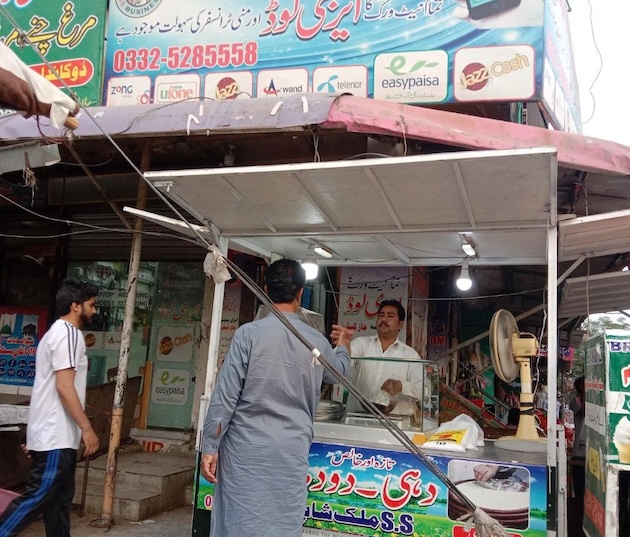
Rana Shahbaz’s milk stall was demolished by the city administration. Credit: Rana Shahbaz

Rana Shahbaz’s milk stall was demolished by the city administration. Credit: Rana Shahbaz

‘It Feels Like I’ve Lost My Right Arm’

The two lawyers had built a reputation for taking on cases few lawyers would touch.

“Imaan and Hadi have always taken up cases most lawyers shy away from due to their controversial or dangerous nature — including blasphemy accusations, enforced disappearances, and press freedom cases — often representing the most marginalised people, without charging anything,” said rights activist Usama Khilji, director of Bolo Bhi, an advocacy forum for digital rights.

“It feels like I’ve lost my right arm,” said a woman, who requested anonymity, as she struggles to secure the release of her brother and more than 400 others accused of blasphemy, languishing in jail across Pakistan.

“In the past three years, I have met countless lawyers and even judges, but no one fought like Imaan. She missed nothing – every detail mattered; she was relentless,” said the woman, talking to IPS.

Leading the campaign, she said most of the accused came from poor backgrounds. “She didn’t even charge for the photocopying of documents submitted to the court – she paid out of her own pocket.”

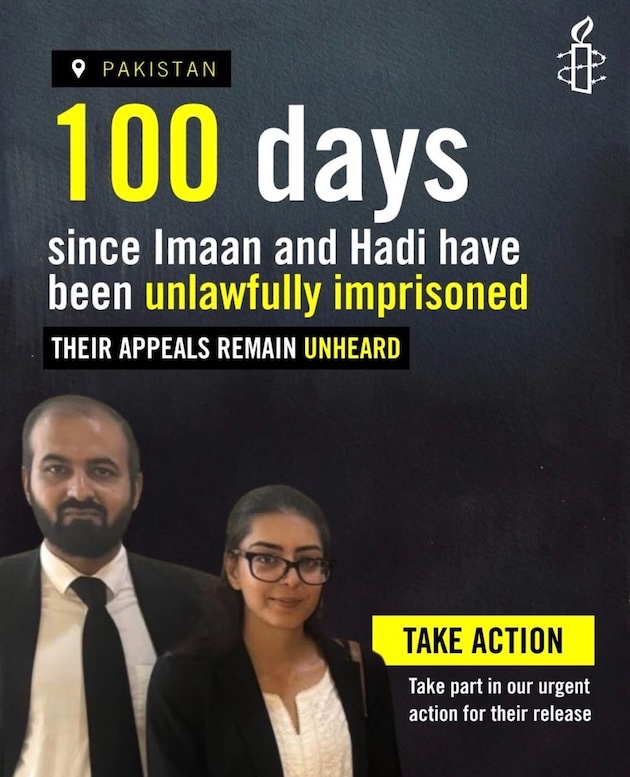
An Amnesty International poster protesting the 100 days since Hadi Ali Chatha and Imaan Hazir Mazari were jailed. Credit: Amnesty International

An Amnesty International poster protesting the 100 days since Hadi Ali Chatha and Imaan Hazir Mazari were jailed. Credit: Amnesty International

The sense of loss extends well beyond individual cases.

Rahat Mehmood, mother of missing poet and writer Mudassir Naru, who disappeared in 2018 described the couple’s arrest as devastating.

“It’s like my support system has collapsed,” she said over the phone from Faisalabad. “Not just for me—these two were a ray of hope, an anchor for hundreds of mothers, especially Baloch mothers.”

Mazari’s work, she said, was not limited to legal representation.

Her grandson, Sachal, was just six months old when his father was taken and later lost his mother in 2021. Court hearings, Mehmood recalled, became rare moments of relief. “They played hide-and-seek, raced around, and she would bring him toys and candy. Tell me—who does that?”

Although her son’s case has not been heard in over a year, Mehmood said that, with Mazari by their side, they had always had hope. “But now,” she added, “it’s all darkness.”

At the wedding of Imaan Mazari and Hadi Ali Chatha, Sachal (son of Mudassir Naru) sits between the two, on the far right; in black, Rahat Mehmood, Naru’s mother, sits. Credit: Rahat Mehmood

At the wedding of Imaan Mazari and Hadi Ali Chatha, Sachal (son of Mudassir Naru) sits between the two, on the far right; in black, Rahat Mehmood, Naru’s mother, sits. Credit: Rahat Mehmood

Mazari’s advocacy extended beyond the courtroom. She appeared in two of the three press conferences held by families of the blasphemy accused, which drew “huge crowds and media attention”. Today, more than 120 people are out on bail. “It’s because of the efforts of these two,” said the sister of the accused.

Their absence is being felt acutely among many others with the least protection.

A week after the lawyers’ arrest, Rana Shahbaz, a street vendor, went to visit Mazari in jail but was turned away. “I was told by jail authorities no one was allowed to meet her.” He had brought dry fruits, juices and clothes, which authorities refused to accept.

Shahbaz, president of the Anjuman Rehri Baan, Islamabad (association of street vendors), which represents over 20,000 street vendors, said Mazari had been instrumental in securing relief for them. Despite holding licences from the Metropolitan Corporation Islamabad, they routinely face raids and eviction by city administrations.

“Last year because of Madam Imaan, the Islamabad High Court stopped authorities from removing our stalls. She presented video evidence showing stalls being dismantled despite having permits,” Shahbaz said.

Since their arrest, he added, the pressure has returned.

“The day they were arrested, an official told us, ‘Call your lawyers now — I’ll see who stops me.’ She was right — only Madam Imaan had the courage to stand up for us,” said Shahbaz, whose stall has been destroyed thrice in the past two years.

“It costs Rs150,000 (USD 538) to set up these makeshift stalls – financed through a bank loan with a monthly instalment of Rs7,000 ($25). Each time authorities dismantle them, repairs cost up to Rs40,000 (US$144), making it impossible to keep up with repayments and pushing me toward default,” he said. Last week, despite having a valid licence, his lassi (yoghurt drink) and fresh milk stall were demolished.

The pretext for crackdowns can be anything—from late-night vending to fines for not displaying price lists or even refusing to offer “freebies” to the police. “Madam Imaan knew well that vendors are exempt from the curfew time for regular shops or that we can only display the price list once it comes from the city authorities and it doesn’t until midday,” he pointed out.

Like many others, Shahbaz said, the two lawyers worked for vendors for free. “We didn’t even know what the basic legal processes cost,” he said.

Muted Response

Despite the breadth of their work, support beyond affected communities has been limited.

“I hold both the journalist and legal fraternities responsible for doing virtually nothing,” said Toor. “Individual voices may struggle, but unions and bar councils have the power to pressure the government.”

Toor’s assessment is shared by lawyer Nasir. He acknowledged that the legal fraternity, with “many lawyers, like judges, appear to be motivated by self-preservation as opposed to the preservation of the constitutional and fundamental freedoms” and which has “blunted its effectiveness” and left it “equally vulnerable” in the long run.

Yet, even as this institutional weakness is laid bare, others frame the duo’s actions less as miscalculation and more as conscious defiance. Media development expert Adnan Rehmat argued that while some may see them as having paid a heavy price for their stance, the two have a long history of public-interest resistance. “They consciously chose to risk themselves to highlight state abuses, and their courage should be lauded—and we must continue raising our voices in their favour.”

As a result, sporadic protests have failed to shift the situation. With public pressure waning, the battle has moved to the courts.

An Uncertain Path

But even there, justice has remained elusive.

The Islamabad High Court refused interim relief. “Everyone knows the 17-year sentence is the product of a sham trial. No superior court in any modern judicial system would uphold it,” said senior advocate Faisal Siddiqi, the lawyer representing them.

Undeterred, the defence has moved the Supreme Court of Pakistan after the IHC failed to fix an early hearing for nearly two months – a delay which Siddiqui called “unheard of” and a ploy to “deny Imaan and Hadi their deserved liberty”.

The bail petition has since been accepted by the Supreme Court, offering a glimmer of hope. “It is our only and last hope,” said Siddiqi.

One hundred days on, that hope remains uncertain.

What is clearer, however, is the void left behind – felt in courtrooms, in protest spaces, and in the lives of those who had come to rely on the two lawyers willing to take risks few others would.

For many, it is not just their absence that is being measured in days but also the growing silence it has left behind.

“I cannot fathom why people like Imaan and Hadi are being punished—and for what,” said Mehmood. “They deserve to be saluted, not jailed!”

IPS UN Bureau Report


!function(d,s,id){var js,fjs=d.getElementsByTagName(s)[0],p=/^http:/.test(d.location)?’http’:’https’;if(!d.getElementById(id)){js=d.createElement(s);js.id=id;js.src=p+’://platform.twitter.com/widgets.js’;fjs.parentNode.insertBefore(js,fjs);}}(document, ‘script’, ‘twitter-wjs’);


2026 Sun Life Hong Kong International Dragon Boat Races Marks Dragon Boat Championship’s 50th Anniversary with the City’s Largest Day‑and‑night Hong Kong Dragon Boat Festival Across 13 Days This June

HONG KONG, May 05, 2026 (GLOBE NEWSWIRE) — One of Hong Kong’s most iconic summer traditions is set to make waves once again as the Sun Life Hong Kong International Dragon Boat Races, organised by Hong Kong Tourism Board, return to Victoria Harbour this June, celebrating a landmark 50th anniversary with a spectacular edition.

Running from 19 June to 1 July, the Hong Kong Dragon Boat Festival will bring a festive programme to the Tsim Sha Tsui Promenade, spanning 13 days through the Dragon Boat Festival and featuring traditional culture, interactive workshops and performances. Set against Hong Kong’s world-famous skyline, the Sun Life Hong Kong International Dragon Boat Races will bring together teams from around the globe on 27-28 June, transforming the Tsim Sha Tsui waterfront into a vibrant hub of culture, sport and entertainment.


From Local Ritual to World Stage: Hong Kong's Dragon Boat Legacy

The grand scale of the event belies its humble beginnings. What started five decades ago as a competitive extension of a local cultural ritual has evolved into a dynamic, citywide celebration that blends heritage with sports. Dragon boat racing in Hong Kong traces its roots to traditional rituals performed by fishing communities, where vessels were once used to dispel bad luck and pray for peace and safety. In 1976, the city hosted its first international race in Shau Kei Wan Typhoon Shelter, welcoming just 10 teams and marking the birth of modern international dragon boat racing.

Fast forward to today, and the event has grown into a truly global phenomenon and a competitive sport in Asian Games. This year’s races will welcome over 220 elite teams from 16 countries and regions over the two-day race schedule on 27-28 June, reinforcing Hong Kong’s position as the Events Capital of Asia.

Beyond the Finish Line: A Harbourfront Party for All

What sets the Hong Kong International Dragon Boat Races apart is the way the celebration brings together culture, sports and entertainment on water and land. In addition to the exhilarating racing action, the event extends into the 13-day Hong Kong Dragon Boat Festival on Fridays to Wednesdays from 19 June to 1 July, with immersive experiences designed to appeal to visitors of all ages and interests.

From daytime discoveries to after-dark energy, the Avenue of Stars and Salisbury Garden in Tsim Sha Tsui are set to come alive with an all-day, diverse activity line-up. The programme spans intangible cultural heritage workshops alongside contemporary highlights including VR dragon boat paddling game, live music and stage performances. The hands-on sessions in particular spotlight time-honoured crafts passed down for centuries while adding a modern harbourfront buzz to the carnival experience.

A dedicated food-and-beverage offering will showcase festive favourites alongside Hong Kong street-food classics at the Dragon Boat Food Lane, while the harbourfront Beer Garden will add to the celebratory atmosphere. Tourists can enjoy complimentary beer and iced rice dumplings while soaking up the festive summer breeze. Also, the display of a 22-meter dragon boat and themed photo spots will further transform the precinct into a colourful, festival-like playground.

Together, these elements reimagine the dragon boat tradition for a new generation, turning a sporting event into a multi-sensory cultural experience. The combination of thrilling racing and immersive programming reflects Hong Kong’s signature “east-meets-west” identity, where centuries-old traditions sit comfortably alongside modern city energy. 

Experience the Dragon Boat Festival Across Hong Kong

Beyond Victoria Harbour, the spirit of the Dragon Boat Festival can be felt across the city. In Tai O, the centuries-old Dragon Boat Water Parade continues a unique ritual tradition, where sacred sampans carrying deity statues are towed through the village waterways—a practice recognised as part of China’s national intangible cultural heritage in 2011.

Meanwhile, local dragon boat races will take place in neighbourhoods across Hong Kong, from the scenic seaside of Stanley and the bustling fishing village of Aberdeen to the verdant landscapes of Sai Kung and the serene Shing Mun River in Sha Tin. Each offers its own distinct character and community atmosphere, welcoming visitors from near and far to discover Hong Kong’s diverse charm.

For more information about the Sun Life Hong Kong International Dragon Boat Races, please visit the event website: https://www.discoverhongkong.com/eng/events/dragon-boat-festival.html

Media can download photos at the following link:
https://assetlibrary.hktb.com/assetbank-hktb/action/browseItems?categoryId=2415&categoryTypeId=2&cachedCriteria=1

For media enquiries, please contact:

Mr Cameron Tong Tel: 2807 6367                      Email: [email protected]
Ms Elisa Luk Tel: 2807 6236                      Email: [email protected]
   

Photos accompanying this announcement are available at:

https://www.globenewswire.com/NewsRoom/AttachmentNg/f80fbd6f-450b-4c92-a09e-b3386b925629

https://www.globenewswire.com/NewsRoom/AttachmentNg/b19234da-b436-4624-9f15-ed4ce1dd8d41

https://www.globenewswire.com/NewsRoom/AttachmentNg/e5e52911-43db-4729-a652-d193dcedc4c7


GLOBENEWSWIRE (Distribution ID 9713159)

neurocare group AG announces MDMA approval of TMS Devices in Saudi Arabia

Munich, Germany and Riyadh, Saudi Arabia – neurocare group AG (“neurocare” or the “Company”), a best practice platform for mental health and performance, is pleased to announce the Saudi Food & Drug Authority (SFDA) has granted the Company Medical Device Marketing Authorization (MDMA) approval to sell its TMS Devices in the Kingdom of Saudi Arabia.

A core part of neurocare’s best practice platform is TMS technology which offers a safe, non-invasive, and drug-free alternative for mental health indications such as depression, yet with no black box warning and no medication-related side effects. As part of the neurocare platform, TMS is embedded into structured clinical workflows and supported by digital tools and measurement-based care, enabling clinicians to deliver more consistent, personalized and sustainable outcomes.

Clinical studies show that approximately 60% of patients achieve remission with TMS, making it a promising new treatment option for adolescents who have not found success with other treatments for depression. 

This milestone marks a significant step forward in neurocare’s efforts to expand access to its advanced best practice platform across the Middle East. With this approval, neurocare becomes one of the first TMS manufacturers authorized to operate in Saudi Arabia, positioning the Company at the forefront of a rapidly developing mental healthcare landscape.

Saudi Arabia is investing heavily in evidence-based, technology-enabled care through its Health Sector Transformation Program, creating strong momentum for the adoption of innovative treatments such as TMS. Across the wider Gulf region, neurocare has seen growing interest specifically in its integrated platform approach, uniting neuromodulation, digital processes and standardized protocols, which is well aligned with the needs of clinicians and health systems seeking reliable alternatives.

With MDMA approval now secured, neurocare is uniquely positioned to bring its proven, state-of-the-art platform led by TMS technology to providers in the Kingdom. This enables clinics to expand their service offerings, improve treatment outcomes, and deliver personalized, nonpharmacological care to patients who need it most.

“We see tremendous potential across the region for adopting innovative, evidence-based methods such as TMS,” said Tariq El-Titi, Senior Vice President for neurocare in MENA. “Healthcare leaders in Saudi Arabia are increasingly looking for advanced, nonpharmacological solutions to support patients. We look forward to forming new partnerships across the Kingdom and supporting clinicians as they integrate best-practice TMS therapies powered by German-engineered technology.”

“This approval reflects our broader mission to empower clinicians through our best practice platform with our TMS technology first,” said Thomas Mechtersheimer, Founder and CEO of neurocare group AG. “By combining advanced neuromodulation, digital tools, and integrated processes, we enable providers to deliver more personalized care and achieve better outcomes for patients across the region.”

“With SFDA approval in place, the priority now is execution—embedding TMS within clinical pathways and expanding access beyond traditional hospital settings,“ added Dr. Helmut Schuehsler, CEO and Chairman of TVM Capital Healthcare. “We look forward to continuing to work closely with partners and regulators to adapt and scale proven platforms such as neurocare’s to the Kingdom’s needs and support growing mental health demand.”

neurocare has been active in the MENA region since 2024 through strategic partnerships that support the expansion of best-practice mental healthcare, complementing the company’s established clinical footprint across Europe, the US, the UK, the Netherlands and Australia. Following TVM Capital Healthcare’s investment, the Company has accelerated its regional expansion, working closely with local partners and regulators to establish and scale its integrated platform that provides neuromodulation and neurofeedback technologies and clinical care in Saudi Arabia. In parallel, neurocare continues to advance access to evidence-based neuromodulation by supporting global efforts to secure reimbursement pathways for TMS and related technologies.

At a time when regional dynamics underscore the importance of resilient healthcare systems that are inclusive of mental well-being, neurocare’s platform can support patients and providers during periods of heightened need with reliable, locally accessible, and personalised care solutions.

About neurocare group AG

neurocare group AG has developed a best practice mental health platform, empowering clinicians to offer their patients, through personalized therapy, the best care for a variety of psychological or neurological conditions with more sustainable clinical outcomes. These therapy plans integrate innovative methods and tools, such as psychotherapy, neuromodulation, and sleep hygiene, as well as medication. Following a detailed assessment of the patient's condition, neurocare supports clinicians in developing personalized therapy plans that improve self-regulation, resilience and social skills, while being cost-effective for the healthcare system.

The key technology elements of neurocare’s platform are developed in-house, including leading TMS and EEG devices, a cloud-based software platform, as well as an online academy to give professionals the tools and neuroscientific understanding to properly apply these approaches in clinical practice.

neurocare’s platform is currently applied throughout the company’s own clinics across the US, the UK, the Netherlands and Australia, as well as in a growing number of third-party clinics.

neurocaregroup.com

Contact:

Sally Remington
neurocare group AG
[email protected]

About TVM Capital Healthcare

TVM Capital Healthcare is a global private equity investor and operator focused on specialty care and healthcare growth capital across emerging markets. With nearly 40 years of global investment and operational experience and 15 years in emerging markets, the firm builds and scales companies in Southeast Asia and the Middle East while also investing in healthcare innovators from the US and Europe and guiding their expansion into these markets. TVM Capital Healthcare’s portfolio companies advance access to care, improve patient outcomes, and align with national healthcare transformation agendas.

tvmcapitalhealthcare.com

Contact:

Holly Radel
TVM Capital Healthcare
[email protected]

Attachment


GLOBENEWSWIRE (Distribution ID 1001179814)

تعلن مجموعة neurocare AG عن ترخيص تسويق الأجهزة الطبية (MDMA) لبيع أجهزة التحفيز المغناطيسي عبر الجمجمة (TMS) في المملكة العربية السعودية

ميونخ، ألمانيا والرياض، المملكة العربية السعودية: تعلن بكل سرور شركة neurocare Group AG (المنوه عنها فيمل يلي بـــ «neurocare» أو «الشركة»)، وهي منصة رائدة تعتمد أفضل الممارسات في مجال الصحة النفسية وتعزيز الأداء، أن الهيئة العامة للغذاء والدواء (SFDA) قد منحت الشركة ترخيص تسويق الأجهزة الطبية (MDMA) لبيع أجهزة التحفيز المغناطيسي عبر الجمجمة (TMS) الخاصة بها في المملكة العربية السعودية.

تُعدّ تكنولوجيا التحفيز المغناطيسي عبر الجمجمة (TMS) جزءًا أساسيًا من منصة «neurocare» القائمة على أفضل الممارسات، حيث توفّر بديلاً آمنًا وغير تدخلي وخاليًا من الأدوية لعلاج اضطرابات الصحة النفسية مثل الاكتئاب، دون تحذيرات من الصندوق الأسود ودون آثار جانبية مرتبطة بالأدوية. وكجزء من منصة «neurocare»، يتم دمج تقنية التحفيز المغناطيسي عبر الجمجمة (TMS) ضمن مسارات علاجية سريرية منظمة، ومدعومة بأدوات رقمية ونهج رعاية قائم على القياس، مما يمكّن الأطباء من تقديم نتائج أكثر اتساقًا وتخصيصًا واستدامة.
وتشير الدراسات السريرية إلى أن نحو 60% من المرضى يحققون حالة من التعافي باستخدام تقنية التحفيز المغناطيسي عبر الجمجمة (TMS) ، مما يجعلها خيارًا علاجيًا جديداً وواعدًا للمراهقين الذين لم يحققوا نتائج ناجحة مع العلاجات الأخرى للاكتئاب.

تمثّل هذه المحطة خطوة مهمة في جهود «neurocare» لتوسيع نطاق الوصول إلى منصتها المتقدمة القائمة على أفضل الممارسات في مختلف أنحاء الشرق الأوسط. ومع هذا الترخيص، تصبح «neurocare» من أوائل الشركات المصنعة لأجهزة التحفيز المغناطيسي عبر الجمجمة (TMS) المرخّص لها بالعمل في المملكة العربية السعودية، مما يضع الشركة في موقع ريادي ضمن مشهد سريع التطور لقطاع الرعاية الصحية النفسية.

تستثمر المملكة العربية السعودية بشكل مكثّف في نماذج الرعاية القائمة على الأدلة والمدعومة بالتكنولوجيا من خلال برنامج تحوّل القطاع الصحي، مما يخلق زخمًا قويًا لاعتماد العلاجات المبتكرة مثل التحفيز المغناطيسي عبر الجمجمة (TMS) وعلى مستوى منطقة الخليج الأوسع، تشهد «neurocare» اهتمامًا متزايدًا بنهجها القائم على المنصة المتكاملة، والذي يجمع بين تعديل النشاط العصبي، والعمليات الرقمية، والبروتوكولات المعيارية التي تتماشى بشكل وثيق مع احتياجات الأطباء وأنظمة الرعاية الصحية الساعية إلى بدائل موثوقة.

ومع الحصول على ترخيص تسويق الأجهزة الطبية (MDMA)، أصبحت «neurocare» في موقع متميز لتقديم منصتها المتطورة والمثبتة، والمدعومة بتقنية التحفيز المغناطيسي عبر الجمجمة (TMS)، إلى مقدمي الرعاية الصحية في المملكة. فيتيح ذلك للعيادات توسيع نطاق خدماتها، وتحسين نتائج العلاج، وتقديم رعاية مخصصة غير دوائية للمرضى الأكثر حاجة إليها.

وأفاد طارق التيتي، النائب الأول للرئيس لشركة «neurocare» في منطقة الشرق الأوسط وشمال أفريقيا: «نرى إمكانات كبيرة في مختلف أنحاء المنطقة لاعتماد أساليب مبتكرة قائمة على الأدلة، مثل التحفيز المغناطيسي عبر الجمجمة (TMS) ويبحث قادة قطاع الرعاية الصحية في المملكة العربية السعودية بشكل متزايد عن حلول متقدمة غير دوائية لدعم المرضى. ونتطلع إلى إقامة شراكات جديدة في مختلف أنحاء المملكة، ودعم الأطباء أثناء دمج علاجات التحفيز المغناطيسي عبر الجمجمة (TMS) القائمة على أفضل الممارسات، والمدعومة بتكنولوجيا مصممة وفق أعلى المعايير الهندسية الألمانية.»

 كما صرّح Thomas Mechtersheimer (توماس مخترشايمر)، المؤسس والرئيس التنفيذي لــــ «مجموعة  neurocare AG»: «يعكس هذا الترخيص مهمتنا الأوسع في تمكين الأطباء من خلال منصتنا القائمة على أفضل الممارسات، مع تركيز أساسي على تقنية التحفيز المغناطيسي عبر الجمجمة (TMS) . ومن خلال الجمع بين تقنيات التعديل العصبي المتقدمة، والأدوات الرقمية، والعمليات المتكاملة، نُمكّن مقدمي الرعاية الصحية من تقديم رعاية أكثر تخصيصًا وتحقيق نتائج أفضل للمرضى في مختلف أنحاء المنطقة.»

وأضاف الدكتور Helmut Schuehsler (هيلموت شوسلر)، الرئيس التنفيذي ورئيس مجلس إدارة شركة
 «TVM Capital Healthcare»: »مع الحصول على موافقة الهيئة العامة للغذاء والدواء (SFDA)، أصبحت الأولوية الآن للتنفيذ – من خلال دمج تقنية التحفيز المغناطيسي عبر الجمجمة (TMS) ضمن المسارات العلاجية السريرية، وتوسيع نطاق الوصول إليها خارج الإعدادات التقليدية للمستشفيات. ونتطلع إلى مواصلة العمل عن كثب مع الشركاء والجهات التنظيمية لتكييف وتوسيع نطاق المنصات المثبتة، مثل منصة “neurocare”، بما يتماشى مع احتياجات المملكة، ودعم الطلب المتزايد على خدمات الصحة النفسية. «

تنشط « neurocare » في منطقة الشرق الأوسط وشمال أفريقيا منذ عام 2024 من خلال شراكات استراتيجية تدعم توسيع نطاق خدمات الصحة النفسية القائمة على أفضل الممارسات، بما يُكمل حضورها السريري الراسخ في أوروبا والولايات المتحدة والمملكة المتحدة وهولندا وأستراليا. وعقب استثمار شركة «TVM Capital Healthcare»، سارعت الشركة وتيرة توسعها الإقليمي، من خلال العمل عن كثب مع الشركاء المحليين والجهات التنظيمية لتأسيس وتوسيع نطاق منصتها المتكاملة التي توفر تقنيات التعديل العصبي والتغذية الراجعة العصبية، إلى جانب خدمات الرعاية السريرية في المملكة العربية السعودية. وبالتوازي مع ذلك، تواصل « neurocare » تعزيز إتاحة تقنيات التعديل العصبي القائمة على الأدلة، من خلال دعم الجهود العالمية لتأمين مسارات التعويضات التأمينية لتقنية التحفيز المغناطيسي عبر الجمجمة (TMS) والتقنيات ذات الصلة.

في وقت تُبرز فيه الديناميكيات الإقليمية أهمية وجود أنظمة رعاية صحية مرِنة وشاملة للصحة النفسية، يمكن لمنصة « neurocare» دعم المرضى ومقدّمي الرعاية الصحية خلال فترات تزايد الحاجة، من خلال تقديم حلول رعاية موثوقة ومُخصّصة ومتاحة محليًا.

نبذة عن neurocare Group AG

طوّرت شركة « neurocare Group AG» منصة متكاملة للصحة النفسية قائمة على أفضل الممارسات، تمكّن الأطباء من تقديم أفضل مستويات الرعاية لمرضاهم عبر خطط علاجية مخصّصة، وذلك لمجموعة متنوعة من الحالات النفسية أو العصبية، مع تحقيق نتائج سريرية أكثر استدامة.
وتجمع هذه الخطط العلاجية بين أساليب وأدوات مبتكرة، مثل العلاج النفسي، وتعديل النشاط العصبي، وتحسين جودة النوم، إلى جانب العلاج الدوائي. وبعد إجراء تقييم شامل لحالة المريض، تدعم « neurocare» الأطباء في تطوير خطط علاجية مخصّصة تعزّز القدرة على التنظيم الذاتي، والمرونة النفسية، والمهارات الاجتماعية، مع الحفاظ على الكفاءة من حيث التكلفة ضمن أنظمة الرعاية الصحية.

يتم تطوير العناصر التكنولوجية الأساسية لمنصة « neurocare» داخليًا، وتشمل أجهزة متقدمة للتحفيز المغناطيسي عبر الجمجمة (TMS)   وتخطيط كهربائية الدماغ (EEG)، بالإضافة إلى منصة برمجية قائمة على الحوسبة السحابية، وأكاديمية إلكترونية تزوّد المتخصصين بالأدوات والمعرفة في علوم الأعصاب اللازمة لتطبيق هذه الأساليب بشكل صحيح في الممارسة السريرية.

تُطبَّق منصة « neurocare» حاليًا في عيادات الشركة الخاصة في كلٍّ من الولايات المتحدة والمملكة المتحدة وهولندا وأستراليا، بالإضافة إلى عدد متزايد من العيادات التابعة لجهات خارجية.

neurocaregroup.com

بيانات الاتصال:

Sally Remington (سالي ريمينغتون)
neurocare group AG
[email protected]

نبذة عن   TVM Capital Healthcare

تُعد ««TVM Capital Healthcare مستثمرًا عالميًا في مجال الملكية الخاصة ومشغّلًا يركّز على الرعاية التخصصية ورأس المال الموجّه لنمو قطاع الرعاية الصحية في الأسواق الناشئة. وبخبرة عالمية تمتد لنحو 40 عامًا في الاستثمار والتشغيل، منها 15 عامًا في الأسواق الناشئة، تعمل الشركة على بناء وتوسيع نطاق الشركات في جنوب شرق آسيا والشرق الأوسط، إلى جانب الاستثمار في شركات الابتكار في مجال الرعاية الصحية في الولايات المتحدة وأوروبا، وتوجيه توسّعها إلى هذه الأسواق.
وتُساهم الشركات التابعة لمحفظة «TVM Capital Healthcare» في تعزيز إتاحة خدمات الرعاية الصحية، وتحسين نتائج المرضى، بما يتماشى مع أجندات التحوّل الوطني لقطاع الرعاية الصحية.

tvmcapitalhealthcare.com

بيانات الاتصال:

Holly Radel (هولي رادل)
TVM Capital Healthcare

[email protected]

المرفق


GLOBENEWSWIRE (Distribution ID 1001179814)

Africa’s Youth are Shaping the Continent’s Climate Future

Africa’s Youth are Shaping the Continent’s Climate Future

On the sidelines of the UN Youth Forum, four climate leaders from across the continent and diaspora unite to call for stronger protection of Africa’s environment and vital resources.

 
Sibusiso Mazomba (far left), member of the UN Secretary-General’s Youth Advisory Group on Climate Change; Eugenia Boateng (second from left), Founder and Executive Director of the African Diaspora Youth Hub, FABA Institute; Jabri Ibrahim, also of the UN Secretary-General’s Youth Advisory Group on Climate Change; and Damon Hamman, Graduate Student, New York University, Centre for Global Affairs. Credit: UN Photo

By Alexandra del Castello
UNITED NATIONS, May 5 2026 – Africa is on the frontlines of the climate crisis, warming faster than the global average and facing disproportionate climate impacts, despite contributing the least to global greenhouse gas emissions.

This is particularly evident in the growing pressures that climate change is placing on water resources and systems across the continent. As water underpins agriculture, livelihoods, ecosystems, and energy production, water-related climate impacts are deepening inequalities and threatening sustainable development across Africa.

At the forefront of this year’s ECOSOC Youth Forum – the largest annual UN gathering of young people – four African climate youth leaders led a dynamic discussion spotlighting the key role that African youth play in driving climate solutions across the continent, building community resilience, strengthening water security, and advancing locally led adaptation efforts.

Their insights highlighted how young people are not only responding to the climate crisis but reshaping the development agenda through innovation, advocacy, and community rooted action.

African youth are charting bold new pathways for climate leadership and proving that the future of climate action is being shaped by their vision and determination.

Learn more about the speakers:

Eugenia Boateng is an African diaspora strategist and founder of the African Diaspora Youth Hub (ADYH) and FABA, a production strategy lab building systems to make African economies more visible, structured, and investable.

Her work focuses on translating informal economies into institutional intelligence, connecting diaspora resources to African production, and designing systems that enable value retention on the continent.

Jabri Ibrahim is a climate and energy policy expert with an extensive network across Africa, connecting youth movements, policymakers, and private sector leaders. Jabri has played a central role in mobilizing African youth for climate action, particularly through the African Youth Initiative on Climate Change (AYICC).

Sibusiso Mazomba is a climate justice activist, advocate, and researcher. He leads youth advocacy at the African Climate Alliance, driving initiatives to ensure meaningful youth participation in decision-making.

A junior negotiator for South Africa’s UNFCCC delegation since COP26, he has contributed to negotiations on adaptation, oceans, and loss and damage, representing youth and national interests on the global stage.

Damon Hamman is a Master of Science candidate in Global Affairs at New York University, concentrating in transnational security, intelligence, and conflict analysis. His work centers on the intersection of human security, diplomacy, and data-driven policy research.

He has served with the United Nations Office of the Special Adviser on Africa, where he built an AI-assisted thematic analysis pipeline for Voluntary National Reviews, contributed to policy briefs aligned with Agenda 2030 and AU Agenda 2063, and supported diplomatic engagement with African missions.

Source: Africa Renewal, United Nations

IPS UN Bureau


!function(d,s,id){var js,fjs=d.getElementsByTagName(s)[0],p=/^http:/.test(d.location)?’http’:’https’;if(!d.getElementById(id)){js=d.createElement(s);js.id=id;js.src=p+’://platform.twitter.com/widgets.js’;fjs.parentNode.insertBefore(js,fjs);}}(document, ‘script’, ‘twitter-wjs’);