Installation of Acrow Bridges Throughout Angola is Underway

PARSIPPANY, N.J., May 21, 2026 (GLOBE NEWSWIRE) — Acrow, a leading international bridge design and engineering firm, today announced that the first of 186 bridges it is providing to the Republic of Angola through a financed Bridge Development Program was officially inaugurated at a ceremony in Luanda on 8 May. The large-scale initiative will support the Government of Angola’s efforts to modernize the country’s road and transportation infrastructure, improving mobility, expanding rural connectivity and accelerating economic development.

The initial bridge installation is a two-lane structure with a total length of 134.11 meters (440’) and featuring an external footwalk. Installed in partnership with Conduril – Engenharia, S.A., the bridge spans the Mulenvos River and will serve to connect the densely populated municipalities of Cacuaco and Mulenvos in Luanda. Further structures to be delivered through the project duration include single- and multi-span configurations of varying lengths in one- and two-lane widths. The bridges will be installed by Angolan engineers, technicians and contractors who will be trained by Acrow in the assembly, installation and maintenance of the bridges.

Since its founding in 1951, Acrow has delivered sustainable infrastructure solutions into more than 150 countries worldwide. Since the 1990s, the company has supplied over 2,000 bridges to more than 40 nations across Africa, including large-scale Bridge Development Programs in Ghana, Cameroon and Zambia. Through this model, Acrow leverages a global network of financial institutions and capital providers to help arrange funding for qualified bridge projects, including export credit guarantees and other development finance solutions.

Designed for long-term performance in demanding environments, Acrow’s durable modular bridges are particularly effective for secondary and rural road networks, in addition to heavily-trafficked urban areas. Manufactured to rigorous international quality standards, the structures can be customized to meet specific site conditions, transported efficiently to even the most remote locations, and assembled in a matter of days or weeks using local labor and limited heavy equipment.

“We are proud to partner with the government of Angola as part of this major investment in Angola’s road and transportation infrastructure. Acrow’s financed bridge development programs help African leaders and policymakers address critical infrastructure and funding gaps that impede long-term economic growth,” said Paul Sullivan, President – International Business at Acrow Bridge. “With decades of experience in Africa, we remain committed to delivering reliable, sustainable infrastructure solutions that improve connectivity, strengthen transportation networks, and contribute to economic opportunity.”

Added Bill Killeen, CEO of The Acrow Group, “At Acrow, we believe in the transformative power of a bridge to bring people and communities together. Our vision is that this project will leave a lasting legacy of connectivity which will positively impact the lives of the people of Angola for generations to come.”

The project in Angola is being financed through the support of loan guarantees issued by the Export-Import Bank of the United States (EXIM), the nation’s official export credit agency. This project has also received international recognition as the recipient of EXIM’s inaugural Partnership for Global Infrastructure and Investment Deal of the Year Award. The Partnership for Global Infrastructure and Investment is a shared G7 commitment to advance public and private investments in sustainable, inclusive, resilient and quality infrastructure in partner countries.

About Acrow

Acrow has been serving the transportation and construction industries for more than 75 years with a wide range of modular steel bridging solutions for permanent, temporary, military and emergency use. Acrow’s extensive international presence includes leadership in the development and implementation of bridge infrastructure projects in over 150 countries across Africa, Asia, the Americas, Europe and the Middle East. For more information, please visit www.acrow.com.

Media contact:
Tracy Van Buskirk
Marketcom PR
Main: (212) 537-5177, ext. 8; Mobile: (203) 246-6165
[email protected]

A photo accompanying this announcement is available at https://www.globenewswire.com/NewsRoom/AttachmentNg/c62ea89c-11d8-4b4b-aff6-6f86a82696e1


GLOBENEWSWIRE (Distribution ID 9724738)

Hanmi Pharmaceutical تتعاون مع Organon لتصدير علاجات مركبة إلى جنوب شرق آسيا

Shin Hae-gon (إلى اليمين)، مدير المبيعات الدولية في شركة Hanmi Pharmaceutical، وAndreas Daugaard Jørgensen (إلى اليسار)، المدير الإداري لمجموعة Organon في آسيا والمحيط الهادئ، التقيا في مكتب Organon في ماليزيا لبحث توسيع انتشار العلاجات المركبة التي تنتجها Hanmi في أسواق منطقة جنوب شرق آسيا.

سيول، كوريا الجنوبية،, May 21, 2026 (GLOBE NEWSWIRE) —  أعلنت شركة Hanmi Pharmaceutical عن توقيع اتفاقية توريد مع شركة الرعاية الصحية العالمية Organon لتصدير ثلاثة أدوية مركّبة إلى أسواق ماليزيا والفلبين، في إطار الجهود الرامية إلى توسيع من نطاق الشراكة بين الشركتين في منطقة جنوب شرق آسيا.

وبموجب الاتفاقية، ستقوم Hanmi بتوريد ثلاثة أدوية مركّبة جاهزة مخصّصة لعلاج أمراض القلب والجهاز التنفسي، على أن تتولى Organon مسؤولية عمليات التسويق والتوزيع والمبيعات في الأسواق المحلية. كما تخطط الشركتان للمضي قدماً في الحصول على الموافقات التنظيمية وإطلاق المنتجات بشكل تدريجي في ماليزيا والفلبين، مع إمكانية توسيع نطاق تعاونهما على المدى المتوسط والطويل.

هذا وتُعد Organon، التي تأسست عام 2021، شركة عالمية متخصصة في الرعاية الصحية، وتمتلك محفظة تضم أكثر من 70 منتجاً تغطي مجموعة واسعة من المجالات العلاجية. وبفضل قدراتها التجارية المتقدمة وشبكة التصنيع الموثوقة التي تملكها، تتيح الشركة وصول هذه الأدوية والأجهزة الطبية الحيوية إلى المرضى في أكثر من 140 سوقاً حول العالم، بما في ذلك أسواق جنوب شرق آسيا.

وقد سبق لشركة Hanmi Pharmaceutical أن عززت حضورها العالمي من خلال إبرام شراكات مع شركات دوائية متعددة الجنسيات. ويستند الاتفاق الحالي مع Organon إلى خبرةHanmi في التعاونات الدولية، ومن المتوقع أن يدعم خطط الشركة للتوسع التجاري في أسواق جنوب شرق آسيا.

تُعد منطقة جنوب شرق آسيا واحدة من أسرع أسواق الأدوية نمواً في العالم، مدفوعة بزيادة عدد السكان وارتفاع وتيرة انتشار الأمراض المزمنة. وعلى وجه الخصوص، يشهد الطلب على العلاجات المركبة ارتفاعاً ملحوظاً، مع تزايد أعداد المرضى المصابين بحالات مرضية مزمنة مثل ارتفاع ضغط الدم.

وفي هذا السياق، قال Mazen Altaruti، رئيس قسم الأسواق الناشئة في شركة Organon: “تلتزم Organon بتوفير الأدوية التي تلبي أبرز الاحتياجات الصحية في المجتمعات التي نخدمها. إن هذه الشراكة معHanmi تعكس تركيزنا المشترك على توسيع نطاق وصول المرضى إلى الخيارات العلاجية في ماليزيا والفلبين، وتعزيز فرص الوصول العادل إلى الرعاية الصحية في مختلف أنحاء المنطقة“.

من جانبه، قال Sean Hwang، الرئيس التنفيذي لشركة Hanmi Pharmaceutical: ستواصلHanmi تسريع وتيرة توسّعها العالمي من خلال محفظتها المتنوعة من العلاجات المركّبة، التي تُعد إحدى نقاط القوة الأساسية للشركة. ومن خلال تعاوننا مع Organon، نهدف إلى تحسين الوصول إلى العلاج لخدمة المرضى في منطقة جنوب شرق آسيا”.

  • جهات الاتصال:

المواقع الرسمية : www.hanmipharm.com، www.linkedin.com/company/hanmipharm،  [email protected]، +82024100467

الصورة المرفقة بهذا البيان الصحفي متاحة عبر الرابط الالكتروني التالي: https://www.globenewswire.com/NewsRoom/AttachmentNg/b62e29c9-0e09-4dad-9cb8-6e47fb8415db


GLOBENEWSWIRE (Distribution ID 9724703)

UN General Assembly Votes for Resolution on ICJ Advisory Ruling on Climate Obligations

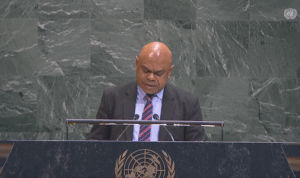
Odo Tevi, Permanent Representative of Vanuatu to the UN, speaks at the General Assembly. Credit : UN WEB TV

Odo Tevi, Permanent Representative of Vanuatu to the UN, speaks at the General Assembly. Credit : UN WEB TV

By Naureen Hossain
UNITED NATIONS, May 21 2026 – Member states this week (May 20) deliberated over a draft resolution on states’ obligations in respect of climate change following the advisory opinion from the International Court of Justice (ICJ). The General Assembly agreed to take measures to uphold the ICJ’s advisory opinion for member states to meet their existing obligations to climate justice under international law and multilateral frameworks.

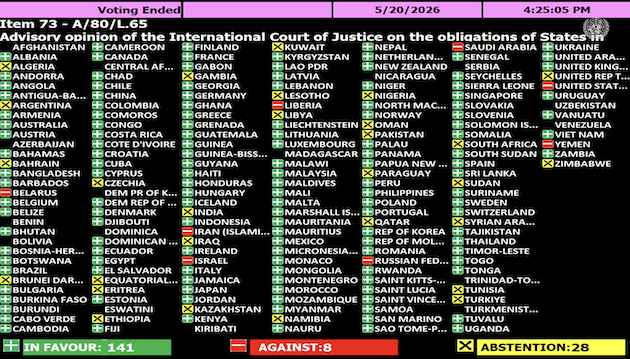
The draft resolution (A/80/L.65) passed with 141 votes in favor, 8 votes against, and 28 abstentions. It was brought forward by the Republic of Vanuatu, along with the Core Group of States leading the UN General Assembly resolution responding to the ICJ advisory opinion. The resolution was introduced after a long period of consultations between member states. It outlines member states’ obligations to ensure the protection of the climate system by calling for multilateral cooperation to address what the ICJ has called an “existential problem of planetary proportions that imperils all forms of life and the very health of our planet.”

“This day will be remembered. It will be remembered as the moment the United Nations received the considered judgment of its highest court of its defining challenge of our time and decided what to do with it. Vanuatu and the Core Group believe this Assembly should meet that moment with unity, with seriousness, and with respect for the law and one another,” said Odo Tevi, Permanent Representative of Vanuatu to the UN.

Voting Record of Resolution A-80-L.65. Credit: UN TV

Voting Record of Resolution A-80-L.65. Credit: UN TV

When introducing the draft resolution to the Assembly, Tevi remarked that the ICJ opinion “confirms that the protection of the climate system is a matter of legal obligation, not political discretion.” It would not replace or challenge existing agreements such as the UN Framework Convention on Climate Change (UNFCCC), the Kyoto Protocol or the Paris Agreement, but rather reinforce them as the primary legislations and forums for the world’s response to climate change.

Amendments to the resolution were brought forward by a small group of member states, which included Saudi Arabia, Kuwait and Algeria. Those that argued for the amendments posited that the current resolution required further legal clarity, particularly as it related to the measures required to support developing countries in mitigation and adaptation. At the same time, there were concerns that the amendments weakened the language around the actions and responsibilities of member states, and tabling them so late into the provision would risk undermining the careful negotiations. Ultimately though, the amendments did not pass and the resolution was adopted without them.

In their remarks following the vote, member states welcomed the adoption of the resolution in light of recognizing climate change as a defining existential issue of the modern age, commending Vanuatu for its leadership in pushing for the resolution.

Speaking on behalf of the Pacific Small-Island Developing States (SIDS), Filipo Tarakinikini, Permanent Representative of Fiji to the UN, welcomed the resolution, remarking that it was an “affirmation of survival” for island nations that have been uniquely threatened by climate change, experiencing lasting damages to their homes and their connection to heritage.

“We do not come to this hall asking for mercy. We come demanding justice. Justice that is today grounded in the authoritative voice of the world’s highest court. The Pacific will not disappear, and neither will our resolve,” said Tarakinikini.

Jérôme Bonnafont, Permanent Representative of France, said that this General Assembly decision was welcome in light of an “international context marred by many crises.”

“[France] will continue to defend ambitious climate action, multilateralism, respect for international law, and a science-based approach for sustainable development and for future generations,” Bonnafont said.

James Larsen, Permanent Representative of Australia, hoped that this resolution would “galvanize practical efforts” to protect the climate system and that the case for multilateralism has “never been stronger.” With Australia set to host COP31 later this year, Larsen remarked his country would continue working together with member states to accelerate climate action.

Among those that abstained from voting or were against the resolution are states accused of being major carbon emitters, including G77 members like India and Saudi Arabia. Both the United States of America and the Russian Federation voted against the resolution.

Prior to the vote, the United States expressed that their opposition was based on their “serious legal and policy concerns” about the resolution. The U.S. delegate noted that the resolution called for states to fulfill alleged obligations based on a non-binding ruling from the ICJ, and opposed the resolution’s “inappropriate political demands” to address climate issues.

The Russian Federation’s delegate argued after that member states’ climate obligations, such as the 1.5 degree Celsius threshold, were more of a political obligation rather than normative and that the resolution was an effort to circumvent existing climate agreements.

UN Secretary-General António Guterres welcomed the adoption of the resolution, commending the leadership of Pacific Island countries, SIDs and the students and activists whose “moral clarity helped bring the world to this moment.”

“The world’s highest court has spoken. Today, the General Assembly has answered,” said Guterres. “This is a powerful affirmation of international law, climate justice, science, and the responsibility of states to protect people from the escalating climate crisis… Those least responsible for climate change are paying the highest price. That injustice must end.”

Reacting to the debate, Yamide Dagnet, NRDC’s Senior Vice President, International, said, “Climate justice prevails! The world sent a loud signal that multilateralism and science matter and can deliver for the people and the planet.”

While congratulating the Small Island States, the youths and frontline communities who refused to stand down for their energy, tenacity and leadership, she noted,  “There will be a lot of noise about the difficulty in enforcing this resolution, but the reality is that it represents a watershed moment for polluter accountability. Moving forward, regulators and courts have an additional tool in their arsenal to force nations and companies to look at how they can put people over pollution and better protect the world’s most impacted communities and countries with dignity.”

The Prime Minister of the Republic of Vanuatu, Jotham Napat, said the country expressed profound gratitude to 141 Member States that voted in favor of the UNGA resolution welcoming the Advisory Opinion of the ICJ on climate change and to the 90 States that stood together as co-sponsors of this historic initiative.

“This outcome is a powerful affirmation that the international community remains committed to the rule of law, multilateral cooperation, and climate justice at a time when these principles are being tested,” Napat said while acknowledging that the resolution was the first step in a new journey. 

IPS UN Bureau Report


!function(d,s,id){var js,fjs=d.getElementsByTagName(s)[0],p=/^http:/.test(d.location)?’http’:’https’;if(!d.getElementById(id)){js=d.createElement(s);js.id=id;js.src=p+’://platform.twitter.com/widgets.js’;fjs.parentNode.insertBefore(js,fjs);}}(document, ‘script’, ‘twitter-wjs’);


Bitget Kicks Off Second Year Supporting UNICEF's Game Changers Coalition, Backing Expansion into Financial Literacy and AI

VICTORIA, Seychelles, May 21, 2026 (GLOBE NEWSWIRE) — Bitget, the world’s largest Universal Exchange (UEX), announced today the start of its second-year partnership in support of the UNICEF Game Changers Coalition (GCC). The coalition, which has reached over 642,000 young people, parents, and teachers across eight countries since launch, is entering a new phase of growth — introducing financial literacy and AI modules into its curriculum, with blockchain content planned for 2026.

GCC is a global initiative led by UNICEF’s Office of Innovation, bringing together public and private sector partners to broaden access to technology education for young people in emerging economies, with a particular focus on girls, who make up 52% of participants to date. Operating across Armenia, Brazil, Cambodia, India, Kazakhstan, Malaysia, Morocco, and South Africa, the coalition supports young people to build practical digital skills through an innovative curriculum, community-based learning programmes, and in-person and online game hackathons.

Bitget joined the coalition in June 2025 through its partnership with UNICEF Luxembourg, contributing to the coalition’s broader mission of improving digital literacy and technology access for underserved communities. In its second year, Bitget will contribute to GCC’s curriculum growth and geographic expansion.

In the first year of the partnership, Bitget supported UNICEF through several activations aimed at expanding awareness and participation in technology education. One of the key milestones included a visit to Cambodia, where Bitget CMO, Ignacio Aguirre, met students, educators, and local partners involved in digital skills training programs. The visit highlighted how access to foundational digital education can create new pathways for employment, entrepreneurship, and participation in the digital economy, particularly for young women and students in underserved regions.

The partnership also supported broader youth engagement initiatives through events and interactive learning experiences. In late 2025, Bitget CEO Gracy Chen supported GCC's inaugural global UNICEF Game Jam, a 40-day initiative through which young creators in emerging economies built original video games with mentorship sessions and a self-paced online course.

“Technology is becoming part of everyday life faster than education systems can adapt,” said Gracy Chen, CEO at Bitget. “What stood out during our work with UNICEF this year was how quickly young people engage once they are given access and opportunity. Our eventual goal is not only to introduce blockchain or digital tools, but to help build confidence and long-term digital and financial literacy that can create opportunities far beyond crypto.”

The update comes as demand for digital skills continues to rise globally, particularly in markets where younger populations are increasingly mobile-first but remain underserved by traditional technology education pathways. Bitget has continued to expand its education-focused initiatives alongside institutional and ecosystem growth, positioning digital literacy as a key pillar of long-term industry development.

“Too many young people are still locked out from the skills driving the digital transformation shaping today’s economy,” said Thomas Davin, Global Director at UNICEF Office of Innovation. “GCC is a clear response to this need. The initiative brings industry, governments, and communities together so the next generation has the skills, confidence, and opportunity to lead in a technology-driven economy. Alongside Bitget we expand to reach even more young people with the skills they need.”

In its second year, the partnership will support GCC's expansion into three additional countries and the rollout of new financial literacy and AI modules within the coalition's curriculum. Bitget will continue to engage through field visits, executive participation, and support for coalition-led learning experiences. 

About Bitget

Founded in 2018, Bitget is the world’s largest Universal Exchange (UEX), serving over 120 million users with access to crypto, tokenized assets, and AI-powered trading tools across major blockchains. Its ecosystem includes Bitget Wallet, an everyday finance app used by over 80 million people. Bitget advances global crypto adoption through partnerships with LALIGA, MotoGP™, and UNICEF.

About UNICEF

UNICEF works in over 190 countries and territories to reach the most disadvantaged children and build a better world for every child.

UNICEF Luxembourg supports this global mission by mobilizing private sector partnerships and voluntary contributions. It also advocates nationally to uphold children’s rights—focusing on reducing inequalities, promoting gender equality, tackling child poverty, supporting mental well-being, and improving access to justice for every child.

For media inquiries, please contact: [email protected]

A photo accompanying this announcement is available at https://www.globenewswire.com/NewsRoom/AttachmentNg/8f1e55c4-fec7-4aa5-84ef-b5fb5a7a4c2c


GLOBENEWSWIRE (Distribution ID 1001183254)

Hanmi Pharmaceutical Partners with Organon to Export Combination Therapies to Southeast Asia

Shin Hae-gon (right), Head of Overseas Sales at Hanmi Pharmaceutical, and Andreas Daugaard Jørgensen (left), Managing Director, Organon Asia Pacific Cluster, met at Organon’s Malaysia office to discuss the expansion of Hanmi’s combination therapies into the Southeast Asian market.

SEOUL, South Korea, May 21, 2026 (GLOBE NEWSWIRE) — Hanmi Pharmaceutical announced that it has signed a supply agreement with global healthcare company Organon to export three combination medicines for the Malaysian and Philippine markets, expanding the companies’ partnership in Southeast Asia.

Under the agreement, Hanmi will supply three finished combination products in the cardiovascular and respiratory therapeutic areas, while Organon will be responsible for marketing, distribution, and sales in the local markets. The two companies plan to pursue phased regulatory approvals and product launches in Malaysia and the Philippines, with the potential to expand their collaboration over the mid to long term.

Organon, established in 2021 is a global healthcare company with a portfolio of over 70 products across a range of therapeutic areas. Through a deep commercial ability and trusted manufacturing network, Organon brings these important medicines and devices to patients when and where they need them in over 140 markets, including Southeast Asia.

Hanmi Pharmaceutical has previously expanded its global presence through partnerships with multinational pharmaceutical companies. The current agreement with Organon builds on Hanmi’s experience in global collaborations and is expected to support the company’s commercial expansion in the Southeast Asian market.

Southeast Asia is widely regarded as a rapidly growing pharmaceutical market driven by population growth and the increasing prevalence of chronic diseases. In particular, demand for combination therapies is rising as the number of patients with chronic conditions such as hypertension continues to increase.

“At Organon, we are committed to improving access to medicines that address the greatest health needs in the communities we serve,” said Mazen Altaruti, President, Organon Emerging Markets. “This partnership with Hanmi reflects our shared focus on expanding treatment options for patients in Malaysia and the Philippines and advancing more equitable access to care across the region.”

Sean Hwang, CEO of Hanmi Pharmaceutical, said, “Hanmi will continue accelerating its global expansion with our diverse portfolio of combination therapies, which represent one of the company’s core strengths. Through our collaboration with Organon, we aim to improve treatment accessibility for patients in Southeast Asia.”

■ Contact info:

Official Websites: www.hanmipharm.com, www.linkedin.com/company/hanmipharm
[email protected], +82-02-410-0467

A photo accompanying this announcement is available at https://www.globenewswire.com/NewsRoom/AttachmentNg/b62e29c9-0e09-4dad-9cb8-6e47fb8415db


GLOBENEWSWIRE (Distribution ID 9724569)

Bitget lance le « Gold Fast or Go Home Challenge » pour le trading de CFD sur l’or

VICTORIA, Seychelles, 21 mai 2026 (GLOBE NEWSWIRE) — Bitget, la plus grande bourse universelle (UEX) au monde, lance le « Gold Fast or Go Home Challenge », une campagne mondiale visant à accélérer l’accès au trading de CFD sur l’or via l’application Bitget. Cette campagne fait suite à la récente mise à jour produit de Bitget qui a déplacé les produits TradFi (or, forex, matières premières et indices) directement dans un onglet principal de la page d’accueil, réduisant ainsi le nombre d’étapes nécessaires pour accéder directement à ces marchés depuis la page d’accueil.

Le défi proposé invite les utilisateurs à se filmer en train d’ouvrir l’application Bitget, d’accéder à la section TradFi et de réaliser une transaction CFD sur l’or XAUUSD le plus rapidement possible. Les participants publieront leurs performances sur les réseaux sociaux dans le cadre d’un défi mondial de trading basé sur la rapidité et conçu autour de l’accessibilité, de la fluidité d’exécution et de la participation aux marchés en temps réel. La campagne allie la culture du trading à des contenus courts et percutants pour les réseaux sociaux, transformant ainsi la rapidité d’exécution du produit en une expérience utilisateur concrète.

Cette campagne s’inscrit dans la stratégie globale de Bitget visant à rapprocher les actifs financiers traditionnels des environnements de trading natifs de la crypto grâce à une interface unifiée. Les utilisateurs peuvent ainsi naviguer entre les crypto-actifs, les produits tokenisés, les paires de devises, les matières premières et les CFD sur l’or depuis un compte unique sans avoir à jongler entre plusieurs plateformes, portefeuilles ou systèmes de trading.

« Les utilisateurs diversifient de plus en plus leurs activités entre les marchés crypto et les marchés financiers traditionnels au cours d’un même cycle de trading, notamment lors des périodes de forte volatilité macroéconomique », a déclaré Gracy Chen, PDG de Bitget. « Nous avons conçu la plateforme de manière à rendre ces marchés plus directement accessibles depuis l’application. En transformant ce flux de trading en une expérience publique et communautaire, ce défi vient illustrer l’évolution des comportements de trading multi-actifs. »

L’activité de trading sur l’or continue de progresser à l’échelle mondiale, les investisseurs suivant de près les anticipations de taux d’intérêt, les tendances de la politique monétaire des banques centrales, les risques d’inflation ainsi que les incertitudes géopolitiques. Sur les plateformes d’actifs numériques, les CFD sur l’or figurent parmi les produits TradFi les plus suivis en période de forte volatilité, notamment parce que les utilisateurs recherchent un accès plus rapide aux actifs sensibles aux fluctuations macroéconomiques sans avoir à quitter l’environnement de trading natif de la crypto.

L’intégration de la section TradFi à notre page d’accueil s’inscrit dans la stratégie globale de bourse universelle de Bitget qui vise à réduire la fragmentation entre actifs numériques et marchés financiers traditionnels. Face à l’augmentation du nombre d’utilisateurs qui adoptent des stratégies multi-actifs, les plateformes de trading sont de plus en plus tenues de prendre en charge les cryptomonnaies, les matières premières, les actions, le forex et les actifs tokenisés au sein d’une interface et d’un système de garanties uniques. Le développement de l’offre TradFi de Bitget témoigne de la demande croissante du marché pour un accès unifié à plusieurs classes d’actifs et une circulation plus rapide des capitaux entre les différentes catégories de trading.

Ce lancement intervient également dans le prolongement du déploiement continu de l’offre TradFi de Bitget sur les marchés mondiaux. Actuellement, la plateforme offre un accès aux marchés des cryptomonnaies ainsi qu’aux actions tokenisées, aux ETF, aux matières premières, aux paires de devises et aux métaux précieux comme l’or, le tout au sein d’un écosystème de trading unique. En 2026, Bitget a repositionné sa section TradFi sur la page d’accueil de l’application dans le cadre d’une initiative plus large visant à simplifier l’accès aux marchés et à améliorer l’efficacité d’exécution des transactions multi-actifs.

Pour tout complément d’information, rendez-vous ici.

À propos de Bitget

Bitget est la première bourse universelle (UEX) du monde. Au service de plus de 125 millions d’utilisateurs, elle donne accès à plus de 2 millions de jetons crypto et à plus de 100 actions tokenisées, ETF, matières premières, devises et métaux précieux comme l’or. L’écosystème s’engage à aider les utilisateurs à trader plus intelligemment grâce à son agent IA qui copilote l’exécution des transactions. Bitget entend promouvoir l’adoption des cryptomonnaies grâce à des partenariats stratégiques conclus avec LALIGA et MotoGP™. Dans le cadre de sa stratégie d’impact mondial, Bitget s’est associé à l’UNICEF pour soutenir l’éducation à la blockchain auprès de 1,1 million de personnes d’ici 2027. Actuellement leader du marché de la finance traditionnelle tokenisée, Bitget propose les frais les plus bas du secteur et la liquidité la plus élevée dans plus de 150 régions à travers le monde.

Pour en savoir plus, veuillez consulter : Site Internet | Twitter | Telegram | LinkedIn | Discord

Pour les demandes médias, veuillez contacter : [email protected]

Mise en garde sur les risques : les cours des actifs numériques peuvent fluctuer et connaître une forte volatilité. Il est conseillé aux investisseurs de n’engager que les fonds qu’ils peuvent se permettre de perdre. La valeur de votre investissement peut être affectée et il est possible que vous n’atteigniez pas vos objectifs financiers ou que vous ne parveniez pas à récupérer votre investissement principal. Nous vous encourageons à toujours solliciter les conseils d’un spécialiste financier indépendant et à tenir compte de votre expérience et de votre situation financière personnelles. Les performances passées ne constituent pas un indicateur fiable des résultats futurs. Bitget décline toute responsabilité en cas de pertes potentielles encourues. Les informations figurant dans le présent communiqué ne constituent en aucun cas un conseil financier. Pour tout complément d’information, veuillez consulter nos Conditions d’utilisation.

Une photo annexée au présent communiqué est disponible à l’adresse suivante :
http://www.globenewswire.com/NewsRoom/AttachmentNg/3484ccd0-5df8-4c93-91cb-c0bdf7495349


GLOBENEWSWIRE (Distribution ID 1001183217)

Bitget lance le « Gold Fast or Go Home Challenge » pour le trading de CFD sur l’or

VICTORIA, Seychelles, 21 mai 2026 (GLOBE NEWSWIRE) — Bitget, la plus grande bourse universelle (UEX) au monde, lance le « Gold Fast or Go Home Challenge », une campagne mondiale visant à accélérer l’accès au trading de CFD sur l’or via l’application Bitget. Cette campagne fait suite à la récente mise à jour produit de Bitget qui a déplacé les produits TradFi (or, forex, matières premières et indices) directement dans un onglet principal de la page d’accueil, réduisant ainsi le nombre d’étapes nécessaires pour accéder directement à ces marchés depuis la page d’accueil.

Le défi proposé invite les utilisateurs à se filmer en train d’ouvrir l’application Bitget, d’accéder à la section TradFi et de réaliser une transaction CFD sur l’or XAUUSD le plus rapidement possible. Les participants publieront leurs performances sur les réseaux sociaux dans le cadre d’un défi mondial de trading basé sur la rapidité et conçu autour de l’accessibilité, de la fluidité d’exécution et de la participation aux marchés en temps réel. La campagne allie la culture du trading à des contenus courts et percutants pour les réseaux sociaux, transformant ainsi la rapidité d’exécution du produit en une expérience utilisateur concrète.

Cette campagne s’inscrit dans la stratégie globale de Bitget visant à rapprocher les actifs financiers traditionnels des environnements de trading natifs de la crypto grâce à une interface unifiée. Les utilisateurs peuvent ainsi naviguer entre les crypto-actifs, les produits tokenisés, les paires de devises, les matières premières et les CFD sur l’or depuis un compte unique sans avoir à jongler entre plusieurs plateformes, portefeuilles ou systèmes de trading.

« Les utilisateurs diversifient de plus en plus leurs activités entre les marchés crypto et les marchés financiers traditionnels au cours d’un même cycle de trading, notamment lors des périodes de forte volatilité macroéconomique », a déclaré Gracy Chen, PDG de Bitget. « Nous avons conçu la plateforme de manière à rendre ces marchés plus directement accessibles depuis l’application. En transformant ce flux de trading en une expérience publique et communautaire, ce défi vient illustrer l’évolution des comportements de trading multi-actifs. »

L’activité de trading sur l’or continue de progresser à l’échelle mondiale, les investisseurs suivant de près les anticipations de taux d’intérêt, les tendances de la politique monétaire des banques centrales, les risques d’inflation ainsi que les incertitudes géopolitiques. Sur les plateformes d’actifs numériques, les CFD sur l’or figurent parmi les produits TradFi les plus suivis en période de forte volatilité, notamment parce que les utilisateurs recherchent un accès plus rapide aux actifs sensibles aux fluctuations macroéconomiques sans avoir à quitter l’environnement de trading natif de la crypto.

L’intégration de la section TradFi à notre page d’accueil s’inscrit dans la stratégie globale de bourse universelle de Bitget qui vise à réduire la fragmentation entre actifs numériques et marchés financiers traditionnels. Face à l’augmentation du nombre d’utilisateurs qui adoptent des stratégies multi-actifs, les plateformes de trading sont de plus en plus tenues de prendre en charge les cryptomonnaies, les matières premières, les actions, le forex et les actifs tokenisés au sein d’une interface et d’un système de garanties uniques. Le développement de l’offre TradFi de Bitget témoigne de la demande croissante du marché pour un accès unifié à plusieurs classes d’actifs et une circulation plus rapide des capitaux entre les différentes catégories de trading.

Ce lancement intervient également dans le prolongement du déploiement continu de l’offre TradFi de Bitget sur les marchés mondiaux. Actuellement, la plateforme offre un accès aux marchés des cryptomonnaies ainsi qu’aux actions tokenisées, aux ETF, aux matières premières, aux paires de devises et aux métaux précieux comme l’or, le tout au sein d’un écosystème de trading unique. En 2026, Bitget a repositionné sa section TradFi sur la page d’accueil de l’application dans le cadre d’une initiative plus large visant à simplifier l’accès aux marchés et à améliorer l’efficacité d’exécution des transactions multi-actifs.

Pour tout complément d’information, rendez-vous ici.

À propos de Bitget

Bitget est la première bourse universelle (UEX) du monde. Au service de plus de 125 millions d’utilisateurs, elle donne accès à plus de 2 millions de jetons crypto et à plus de 100 actions tokenisées, ETF, matières premières, devises et métaux précieux comme l’or. L’écosystème s’engage à aider les utilisateurs à trader plus intelligemment grâce à son agent IA qui copilote l’exécution des transactions. Bitget entend promouvoir l’adoption des cryptomonnaies grâce à des partenariats stratégiques conclus avec LALIGA et MotoGP™. Dans le cadre de sa stratégie d’impact mondial, Bitget s’est associé à l’UNICEF pour soutenir l’éducation à la blockchain auprès de 1,1 million de personnes d’ici 2027. Actuellement leader du marché de la finance traditionnelle tokenisée, Bitget propose les frais les plus bas du secteur et la liquidité la plus élevée dans plus de 150 régions à travers le monde.

Pour en savoir plus, veuillez consulter : Site Internet | Twitter | Telegram | LinkedIn | Discord

Pour les demandes médias, veuillez contacter : [email protected]

Mise en garde sur les risques : les cours des actifs numériques peuvent fluctuer et connaître une forte volatilité. Il est conseillé aux investisseurs de n’engager que les fonds qu’ils peuvent se permettre de perdre. La valeur de votre investissement peut être affectée et il est possible que vous n’atteigniez pas vos objectifs financiers ou que vous ne parveniez pas à récupérer votre investissement principal. Nous vous encourageons à toujours solliciter les conseils d’un spécialiste financier indépendant et à tenir compte de votre expérience et de votre situation financière personnelles. Les performances passées ne constituent pas un indicateur fiable des résultats futurs. Bitget décline toute responsabilité en cas de pertes potentielles encourues. Les informations figurant dans le présent communiqué ne constituent en aucun cas un conseil financier. Pour tout complément d’information, veuillez consulter nos Conditions d’utilisation.

Une photo annexée au présent communiqué est disponible à l’adresse suivante :
http://www.globenewswire.com/NewsRoom/AttachmentNg/3484ccd0-5df8-4c93-91cb-c0bdf7495349


GLOBENEWSWIRE (Distribution ID 1001183217)

Bitget Lança “Gold Fast or Go Home Challenge” para Negociação de CFDs de Ouro

VICTORIA, Seychelles, May 21, 2026 (GLOBE NEWSWIRE) — Bitget, a maior Universal Exchange (UEX) do mundo, lançou o “Gold Fast or Go Home Challenge”, uma campanha global desenvolvida em torno do acesso mais rápido à negociação de CFDs de ouro no aplicativo Bitget. A campanha dá seguimento à recente atualização da Bitget que moveu os produtos TradFi, incluindo ouro, forex, commodities e índices, para uma aba de primeiro nível na página inicial, reduzindo o número de etapas necessárias para o acesso a esses mercados diretamente da página inicial.

O desafio convida os usuários a se registrarem abrindo o aplicativo Bitget, entrando na seção TradFi e realizando uma negociação de CFD de ouro XAUUSD o mais rápido possível. Os participantes publicarão suas tentativas nas redes sociais como parte de um desafio global de negociação baseado na velocidade, desenvolvido em torno da acessibilidade, do fluxo de execução e da participação no mercado em tempo real. A campanha une a cultura da negociação com conteúdo social curto, transformando a velocidade do produto em uma experiência visível para o usuário.

A campanha reflete a direção mais ampla da Bitget de aproximar os ativos financeiros tradicionais dos ambientes de negociação nativos de criptomoedas em uma interface unificada. Os usuários podem transitar entre criptoativos, produtos tokenizados, pares de forex, commodities e mercados de CFD de ouro em uma única estrutura de conta sem a necessidade de alternar entre várias plataformas, carteiras ou sistemas de negociação.

“Os usuários estão transitando cada vez mais entre os mercados financeiros de criptomoedas e tradicionais dentro do mesmo ciclo de negociação, especialmente durante períodos moldados pela volatilidade macroeconômica”, disse Gracy Chen, CEO da Bitget. “Desenvolvemos a plataforma para tornar esses mercados mais acessíveis diretamente dentro do aplicativo. O Challenge transforma esse fluxo de negociação em uma experiência pública e voltada para a comunidade, que mostra como o comportamento da negociação de múltiplos ativos está evoluindo.”

A atividade de negociação de ouro continua ganhando força globalmente, com os investidores monitorando as expectativas das taxas de juros, as tendências de acumulação dos bancos centrais, os riscos de inflação e a incerteza geopolítica. Em todas as plataformas de ativos digitais, os CFDs de ouro têm sido um dos produtos TradFi mais monitorados durante períodos de elevada volatilidade, principalmente com os usuários em busca de acesso mais rápido a ativos macrossensíveis sem sair dos ambientes de negociação nativos de criptomoedas.

A integração do TradFi na página inicial faz parte da estratégia da Universal Exchange mais ampla da Bitget, focada na redução da fragmentação entre ativos digitais e mercados financeiros tradicionais. Com mais usuários se diversificando entre as classes de ativos, as plataformas de negociação devem oferecer suporte a criptomoedas, commodities, ações, FX e ativos tokenizados em uma única interface e sistema de garantia. A expansão do TradFi da Bitget reflete a crescente demanda do mercado pelo acesso unificado a múltiplos ativos e movimento de capital mais rápido entre as categorias de negociação.

O lançamento também dá seguimento à expansão contínua da Bitget da sua oferta TradFi nos mercados globais. Atualmente a plataforma fornece acesso a mercados de criptomoedas com ações tokenizadas, ETFs, commodities, pares de forex e metais preciosos como ouro, em um ecossistema de negociação. Em 2026, a Bitget reposicionou sua seção TradFi na página inicial do aplicativo como parte de um esforço mais amplo para simplificar o acesso ao mercado e aumentar a eficiência da execução em toda a atividade de negociação de vários ativos.

Para mais informações, clique aqui.

Sobre a Bitget

Bitget é a maior Universal Exchange (UEX) do mundo, atendendo a mais de 125 milhões de usuários com acesso a mais de 2 milhões de tokens de criptomoedas, mais de 100 ações tokenizadas, ETFs, commodities, FX e metais preciosos como ouro. O ecossistema está comprometido em ajudar os usuários a negociar de forma mais inteligente com seu agente de IA sendo o copiloto para executar ordens de trade. A Bitget está impulsionando a adoção de criptomoedas por meio de parcerias estratégicas com a LALIGA e MotoGP™. Alinhada com sua estratégia de impacto global, a Bitget se uniu à UNICEF em apoio ao ensino de blockchain para 1,1 milhão de pessoas até 2027. A Bitget atualmente lidera o mercado de TradFi tokenizado, fornecendo as taxas mais baixas do setor e a maior liquidez em 150 regiões em todo o mundo.

Para mais informação, visite: Website | Twitter | Telegram | LinkedIn | Discord

Para perguntas da mídia, contate: [email protected]

Aviso de Risco: Os preços dos ativos digitais estão sujeitos a flutuações e podem ser significantemente voláteis. Os investidores são aconselhados a alocar apenas os fundos que podem perder. O valor de qualquer investimento pode ser afetado, e existe a possibilidade de que os objetivos financeiros não sejam atingidos, nem que o investimento principal recuperado. Aconselhamento financeiro independente deve sempre ser obtido, e a experiência financeira pessoal e a posição devem ser cuidadosamente consideradas. O desempenho passado não é um indicador confiável de resultados futuros. A Bitget não se responsabiliza por quaisquer perdas potenciais incorridas. Nada contido neste documento deve ser interpretado como aconselhamento financeiro. Para mais informações, consulte nossos Termos de Uso.

Foto deste comunicado disponível em:
http://www.globenewswire.com/NewsRoom/AttachmentNg/3484ccd0-5df8-4c93-91cb-c0bdf7495349


GLOBENEWSWIRE (Distribution ID 1001183217)

Brazil’s Indigenous Communities Receive $9M in GEF Funding to Protect Lands, Traditions Under Threat

The community works to preserve its identity amid pressure from real estate development and non-Indigenous settlers. Credit: Samuel Tremembé

The community works to preserve its identity amid pressure from real estate development and non-Indigenous settlers. Credit: Samuel Tremembé

By Carla Ruas
BELÉM, Brazil, May 21 2026 – On Brazil’s northeastern coast, the Indigenous community, Tremembé da Barra do Mundaú, lives on a preserved stretch of land shaped by mangroves, dunes, and deserted beaches. The group of around 160 families is led by women and depends on the 3,500-hectare territory for fishing and subsistence farming.

In 2023, the Tremembé won federal recognition of their ancestral land in the state of Ceará – giving them formal control over the territory.

But their home remains under threat. As tourism has expanded, they have faced growing pressure from real estate developments and around 100 non-Indigenous settlers. A push for renewable energy has also brought nearby wind projects that the community says damage the environment and disrupt their way of life.

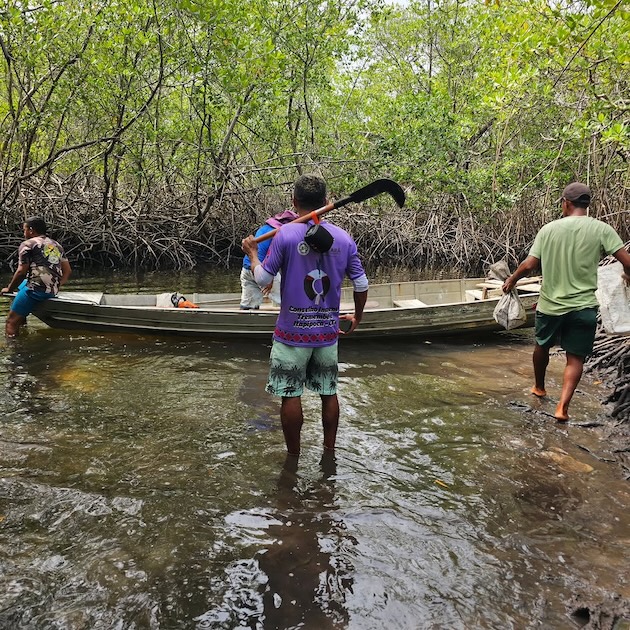
“We have many problems here, including trash in our rivers, cars scaring away animals, and people damaging the dunes,” said Cleidiane Tremembé, a local Indigenous teacher. “With the installation of wind farms, many fish species have also disappeared from our river, and we’re catching fewer fish.”

The Tremembé da Barra do Mundaú Indigenous Land protects 27 km of mangrove forest and 8 km of coastline. Credit: Samuel Tremembé

The Tremembé da Barra do Mundaú Indigenous Land protects 27 km of mangrove forest and 8 km of coastline. Credit: Samuel Tremembé

This May, the group will begin investing roughly US$300,000 in efforts to protect their territory. The funds come from the Ywy Ipuranguete (‘beautiful land’) project – an ambitious initiative that aims to distribute a total of US$9 million to 15 Indigenous Lands across Brazil by 2030.

The project is coordinated by Brazil’s Ministry of Indigenous Peoples (MPI), implemented by the Brazilian Biodiversity Fund (FUNBIO), and financed through the Global Biodiversity Framework Fund (GBFF). The GBFF, whose donors include the governments of Canada, Norway and the United Kingdom, is managed by the Global Environment Facility (GEF) – the world’s largest multilateral environmental fund.

According to the GEF, the goal is to support the protection of Indigenous territories as a strategy to conserve biodiversity and strengthen climate resilience.

“A growing body of evidence shows that territories managed by Indigenous Peoples — particularly where land tenure is formally recognised — consistently rank among the most effective settings for maintaining biodiversity, retaining carbon stocks, and preserving ecological integrity, often outperforming both unprotected lands and formally designated conservation areas,” said Adriana Moreira, Lead of the Partnerships Division at the GEF.

If fully implemented, the project would help protect 6.4 million hectares and reach around 61,000 Indigenous people.

Following the project’s launch in March 2025, the Tremembé will be among the first communities to put the funds into action.

Tremembé community member Mateus Castro says their goal is to preserve their land and culture for future generations. Credit: Julia Holanda

Tremembé community member Mateus Castro says their goal is to preserve their land and culture for future generations. Credit: Julia Holanda

Mateus Castro, a community member coordinating the work locally, said the money will be used primarily to acquire drones, radio transmitters, vehicles and a boat to help secure the territory’s boundaries.

“We want to monitor and record the presence of outsiders,” he said in an interview. “This project will allow us to have the tools that give our territory security and autonomy.”

The same equipment would help the community inventory local ecosystems and animal species. Their coastal stretch is home to a wide range of species – from fish and crabs to endangered sea turtles.

“We want to record the species along our coastline so we can use that information as a defence against the licensing of new offshore wind farms,” he said.

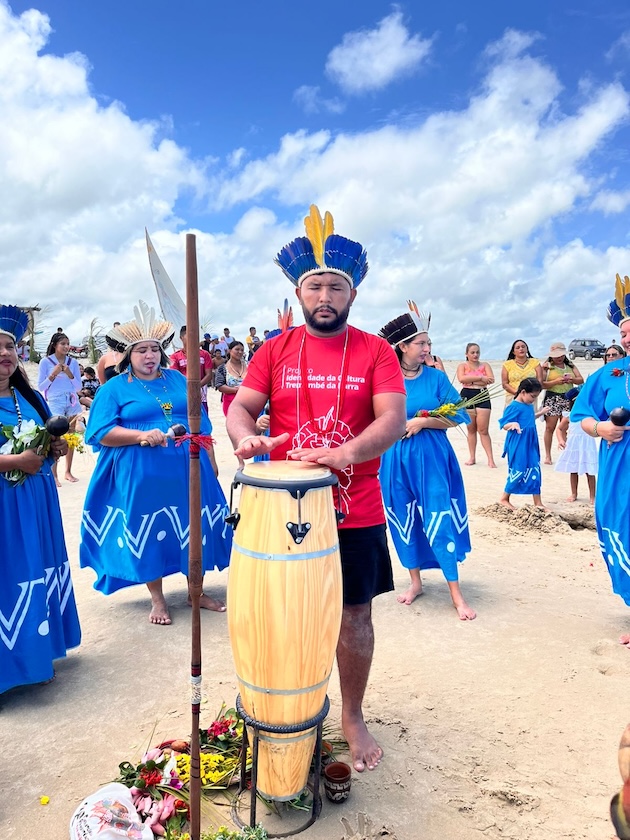
With the funding, they also plan to reforest degraded areas, train local environmental brigades, and fund traditional festivals. The first will be the Farinhada Festival that takes place in July. During the festivities, families celebrate cassava as a sacred food and prepare traditional dishes for younger generations.

“In Indigenous culture, everything is connected,” Castro said. “Our goal is to preserve our land, culture, and identity for the children who are yet to be born. We are thinking 100, 200 years from now.”

Future Plans

The Indigenous communities selected to participate in the Ywy Ipuranguete project were chosen by FUNAI, Brazil’s federal Indigenous affairs agency, with input from Indigenous organisations.

The priority was given to groups outside the Amazon, including the Tremembé in Ceará, as part of an effort to decentralise environmental funding. Nearly half of Brazil’s 1.69 million Indigenous people live outside the Legal Amazon, according to the legal census.

“If we look at environmental projects in general, funding, implementation, and resources are usually focused on the Amazon,” said Francisco Itamar Gonçalves Melgueiro, FUNAI’s general coordinator for environmental policies. “That is why we distributed the project across five biomes in Brazil – the Amazon, Pantanal, Cerrado, Caatinga and Atlantic Forest.”

FUNAI also selected communities that had recently removed invaders from their lands, including the Kayapó and Munduruku, who have been in conflict with illegal miners in the Amazon for decades. “After that removal, we see an opportunity for Indigenous peoples to fully retake possession of their territories,” Melgueiro said.

Communities did not need their territories to be fully recognised by the federal government to qualify for the funding. However, they had to submit detailed plans, known as PGTAs, which are part of a broader set of Indigenous territorial and environmental management documents.

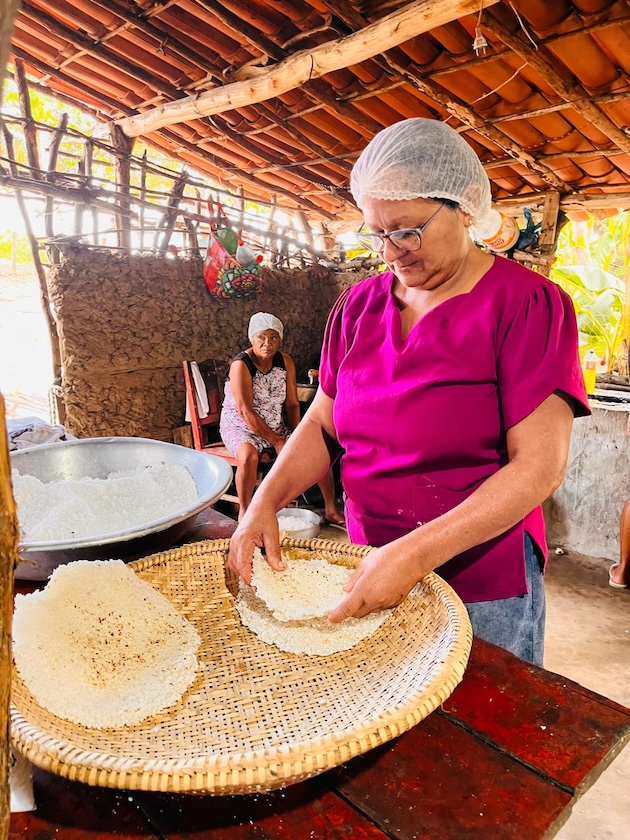
During the Farinhada Festival, families celebrate cassava and prepare traditional dishes such as tapioca crepes. Credit: Julia Holanda

During the Farinhada Festival, families celebrate cassava and prepare traditional dishes such as tapioca crepes. Credit: Julia Holanda

“These plans serve as blueprints for their future and cover a wide range of themes and actions,” Melgueiro said. “They are an instrument of the peoples, built by the peoples.”

But many are still working on their PGTAs. More than a decade after Brazil created the framework for these plans, a 2023 civil-society report found that Indigenous communities have received little support for their development, especially during the administration of Brazilian right-wing President Jair Bolsonaro. To date, FUNAI has mapped just 148 PGTAs in a country with more than 800 Indigenous Lands.

The first year of the Ywy Ipuranguete project has been largely dedicated to helping participating communities finalise and detail their PGTAs. The Brazilian Biodiversity Fund (FUNBIO), GEF’s implementing agency, told IPS that this “is a massive and meticulous undertaking”, as they work with Indigenous communities to “determine which PGTA activities are to be undertaken, the best methods for executing them, and the specific implementation arrangements for each Indigenous Land”.

According to Brazil’s Ministry of Indigenous Peoples (MPI), only about 8% of the total budget has been spent so far, mostly on planning, coordination and initial activities. Eventually, MPI said, 75% of the budget will go directly to the communities, with much of the funding transferred to Indigenous organisations. “Investing in Indigenous peoples to maintain their own ways of existing is investing in the survival of humanity itself,” the ministry said in a statement.

Community members say fish species have disappeared from their river following the installation of nearby wind farms. Credit: Samuel Tremembé

Community members say fish species have disappeared from their river following the installation of nearby wind farms. Credit: Samuel Tremembé

In an email, Brazil’s Ministry of Indigenous Peoples (MPI) said only about 8% of the total budget has been spent so far, mostly on planning, coordination and initial activities. Eventually, MPI said, 75% of the budget will go directly to the communities, with much of the funding transferred to Indigenous organisations.

“Investing in Indigenous peoples to maintain their own ways of existing is investing in the survival of humanity itself,” the ministry said in a statement.

In Tremembé da Barra do Mundaú, where plans are underway, the community feels ready. The funding will build on years of work, from training young environmental agents to documenting food traditions.

“This is one of the largest resources the territory has ever received,” Castro said. “For us, it’s a huge opportunity to consolidate and strengthen our mission of caring for the land.”

Note: The Eighth Global Environment Facility Assembly will be held from May 30 to June 6, 2026, in Samarkand, Uzbekistan.
This feature is published with the support of the GEF. IPS is solely responsible for the editorial content, and it does not necessarily reflect the views of the GEF.

IPS UN Bureau Report


!function(d,s,id){var js,fjs=d.getElementsByTagName(s)[0],p=/^http:/.test(d.location)?’http’:’https’;if(!d.getElementById(id)){js=d.createElement(s);js.id=id;js.src=p+’://platform.twitter.com/widgets.js’;fjs.parentNode.insertBefore(js,fjs);}}(document, ‘script’, ‘twitter-wjs’);


TRANSNATIONAL REPRESSION: ‘China Feels Emboldened to Globalise Its Political Red Lines’

By CIVICUS
May 21 2026 –  
CIVICUS discusses the cancellation of RightsCon 2026 with Barbora Bukovská, Senior Director for Law and Policy at ARTICLE 19, a human rights organisation that works on freedom of expression and information around the world.

Barbora Bukovská

On 29 April – days before RightsCon, the key global gathering of digital rights advocates, was due to open in Lusaka – the Zambian government announced a postponement that effectively cancelled the event. The government stands accused of giving in to China’s pressure over the participation of people from Taiwan. The event had been set to bring over 2,600 participants to sub-Saharan Africa for the first time, with another 1,100 joining online. Instead, it became the latest casualty of growing authoritarian pressure on the spaces where civil society convenes.

Why does the cancellation of RightsCon matter?

This cancellation is significant on three levels. First, it means the loss of community. The human rights movement depends on relationships built across borders and over time. RightsCon was one of the few global spaces where civil society organisations, funders, governments, journalists, researchers and technology professionals could meet without political interference. Losing it means losing opportunities to build solidarity and strengthen the networks the movement runs on.

Second, it was a symbolic blow. RightsCon represented the idea that at least one global space existed where civil society could convene freely, protected from political pressure. That illusion is now shattered. The space proved vulnerable. It is yet more evidence of shrinking civic space globally, and the message it sends is chilling: no space is truly protected from state interference any more.

Third, it caused financial damage. Following funding cuts from the USA in early 2025 and reduced funding from other major donor governments, civil society is struggling to secure resources. Organisations had invested precious funding to attend RightsCon, covering travel, organising side events and preparing advocacy materials. These are resources vulnerable civil society organisations cannot afford to waste.

What does this episode reveal about transnational repression?

The cancellation lays bare how emboldened China feels to globalise its political red lines and exercise transnational repression. For years, it has applied pressure on governments to sideline Taiwanese participation in multilateral forums. Taiwan’s leading role in digital rights and technology has long irritated China. What’s new is other governments’ willingness to yield.

China’s tactics have grown more sophisticated. Rather than open confrontation, it leverages threats of diplomatic fallout or lost investment. The pressure now extends into spaces once thought beyond its reach, such as cultural institutions, rights conferences and universities. China has shown it can coerce governments across sectors and at multiple levels.

The wider context matters too. The USA, once a leading global supporter of internet freedom, has retreated from diplomatic and financial backing for digital rights. China’s influence on the African continent has expanded in the absence of rights-based alternatives. When democratic states withdraw support for civil society, authoritarian influence fills the void.

How do China’s leverage and Zambia’s democratic decline combine?

China’s leverage across Africa has grown substantially in recent years. Chinese funding has built major infrastructure in Zambia, including Mulungushi International Conference Centre, the venue where RightsCon was due to take place. Only days before the cancellation, China signed a new agreement to fund further development projects. Zambia carries roughly US$5 billion in debt to China, and that dependency comes with strings attached.

Domestically, the picture is similarly bleak. Despite President Hakainde Hichilema being elected in 2021 on a promise of democratic renewal, civic space has shrunk steadily since. In 2025, parliament passed cybersecurity laws now used to curtail freedom of expression online and detain political opponents. Ahead of the August 2026 general election, the government is enacting further laws designed to entrench its power. Political control is winning out over democratic commitments.

Yielding to Chinese pressure while restricting civic space at home calls Zambia’s commitment to the rule of law and human rights into serious doubt. The debt creates a channel through which China can extract political cooperation. Together, these dynamics create a dangerous precedent for other global south nations facing similar pressure.

What does this mean globally?

The danger extends well beyond Zambia. If a government can cancel a major international civil society gathering without serious diplomatic or institutional consequences, it sends the wrong signals. States must show that interference carries costs. Democratic states, multilateral organisations and regional institutions must impose costs through sustained pressure and exclusion from future convenings.

International human rights mechanisms, including the United Nations Special Rapporteur on the Rights to Freedom of Peaceful Assembly and of Association, have already condemned Zambia’s decision. But statements alone are not enough. Zambia shouldn’t be considered a reliable host for rights-based global dialogue in future.

If governments can yield to authoritarian pressure at the expense of civil society protections without paying a price, the pattern will spread.

What steps should be taken to protect global civil society forums?

Civil society can adapt but cannot insulate its gatherings from state pressure on its own. Real responsibility lies with states that claim to support human rights. They must send a diplomatic and political signal that interference in global forums is costly and prevent other governments from following Zambia’s example. They must reaffirm their commitment to multi-stakeholder forums and invest in civil society’s ability to convene and participate.

That includes member states of international coalitions such as the Freedom Online Coalition and the Media Freedom Coalition. They must act against restrictions on civic space and freedom of expression, using these platforms to impose costs on governments that interfere with civil society. The behaviour Zambia has just normalised must be made costly.

The UN, other intergovernmental organisations and states must work to guarantee the safety and openness of global gatherings. As democratic states withdraw support and authoritarian states expand their reach, the spaces where global civil society can gather, build relationships and advance human rights will continue to shrink. What’s at stake is the infrastructure of global civil society coordination and solidarity.

CIVICUS interviews a wide range of civil society activists, experts and leaders to gather diverse perspectives on civil society action and current issues for publication on its CIVICUS Lens platform. The views expressed in interviews are the interviewees’ and do not necessarily reflect those of CIVICUS. Publication does not imply endorsement of interviewees or the organisations they represent.

GET IN TOUCH
Website
BlueSky
Facebook
Instagram
LinkedIn
Twitter
YouTube
Barbora Bukovská/LinkedIn

SEE ALSO
Democracy: an enduring aspiration CIVICUS | State of Civil Society Report 2026
Zambia: ‘Constitutional changes in an election period tend to be driven by political expediency rather than the public interest’ CIVICUS Lens | Interview with Gideon Musonda 24.Dec.2025
Zambia: ‘The NGO Bill strengthens legal mechanisms designed to discredit or silence critical civil society voices’ CIVICUS Lens | Interview with Josiah Kalala 03.Jun.2025


!function(d,s,id){var js,fjs=d.getElementsByTagName(s)[0],p=/^http:/.test(d.location)?’http’:’https’;if(!d.getElementById(id)){js=d.createElement(s);js.id=id;js.src=p+’://platform.twitter.com/widgets.js’;fjs.parentNode.insertBefore(js,fjs);}}(document, ‘script’, ‘twitter-wjs’);