Bitget Launches New Pre-IPO Product With SpaceX as First Listing

VICTORIA, Seychelles, April 13, 2026 (GLOBE NEWSWIRE) — Bitget, the world’s largest Universal Exchange (UEX), has launched IPO Prime, introducing a new market structure that enables users to access and trade pre-IPO exposure to global unicorn companies such as SpaceX.

Powered by Republic, the launch marks an expansion beyond traditional secondary market trading, enabling participation in value creation before companies enter public markets, a phase historically limited to institutional investors and private capital networks. Through IPO Prime, Bitget extends its Universal Exchange framework into primary market access, bridging a long-standing gap between private and public market participation.

IPO Prime operates through a subscription-based model, where eligible users can apply for allocations in tokenized offerings tied to specific companies. Allocation limits are determined based on user tier, with higher participation thresholds available to elevated VIP levels. Following the subscription phase, these digital assets transition into an over-the-counter market on Bitget, enabling continuous pricing, trading and circulation within a structured environment.

The first offering under IPO Prime is preSPAX, a digital asset designed to mirror the economic performance of SpaceX following its potential public listing. As one of the most closely watched private companies globally, SpaceX represents the type of high-growth opportunity that has traditionally remained inaccessible to retail investors.

“Since the beginning of financial markets, access to pre-IPO opportunities has been defined by exclusivity,” said Gracy Chen, CEO of Bitget. “IPO Prime allows users to participate earlier in a company’s growth cycle, with the flexibility of continuous trading. This shifts how and when investors can engage with emerging companies, which gives retailers and new investors a chance to buy-in early. This is part of our greater shift towards building an UEX, democratizing access to financial equality.”

To mark the launch, Bitget will introduce two rounds of preSPAX token airdrops for eligible VIP users, on April 13, 2026 at 10:00 (UTC), providing early participants with additional exposure as the platform begins onboarding its first offering. The official preSPAX token launches on April 21, 2026 at 12:00 (UTC), with the commitment period starting April 18, 2026, 18:00 and ending April 21, 2026, 18:00 (UTC). Distribution period runs from April 21, 2026 18:00 till April 21, 2026, 22:00 (UTC).

The introduction of IPO Prime is a new route to traditional financial opportunities being structured and accessed. As boundaries between asset classes continue to blur, platforms are expanding beyond traditional and crypto trading to include early-stage market participation. Within Bitget’s Universal Exchange model, IPO Prime moves towards integrating diverse financial opportunities into a single, unified environment.

To find out more about IPO Prime and further details on preSPAX, visit here.

Disclaimer: This content is for reference only and does not constitute investment advice or an offer or solicitation to buy or sell any assets. This product may not be suitable for your jurisdiction. This product represents only a mirrored economic interest in the potential upside of SpaceX upon a qualifying event, and does not constitute a direct investment in SpaceX. SpaceX has not endorsed, approved, or authorized this Product in any capacity. Digital asset trading involves significant risks and price fluctuations, and you may lose all investment principal without any guarantee of return. Please ensure compliance with local laws and regulations and seek independent professional advice before investing.

About Bitget

Bitget is the world’s largest Universal Exchange (UEX), serving over 125 million users and offering access to over 2M crypto tokens, 100+ tokenized stocks, ETFs, commodities, FX, and precious metals such as gold. The ecosystem is committed to helping users trade smarter with its AI agent, which co-pilots trade execution. Bitget is driving crypto adoption through strategic partnerships with LALIGA and MotoGP™. Aligned with its global impact strategy, Bitget has joined hands with UNICEF to support blockchain education for 1.1 million people by 2027. Bitget currently leads in the tokenized TradFi market, providing the industry’s lowest fees and highest liquidity across 150 regions worldwide.

For more information, visit: Website | Twitter | Telegram | LinkedIn | Discord

For media inquiries, please contact: [email protected]

Risk Warning: Digital asset prices are subject to fluctuation and may experience significant volatility. Investors are advised to only allocate funds they can afford to lose. The value of any investment may be impacted, and there is a possibility that financial objectives may not be met, nor the principal investment recovered. Independent financial advice should always be sought, and personal financial experience and standing carefully considered. Past performance is not a reliable indicator of future results. Bitget accepts no liability for any potential losses incurred. Nothing contained herein should be construed as financial advice. For further information, please refer to our Terms of Use.

A photo accompanying this announcement is available at:
https://www.globenewswire.com/NewsRoom/AttachmentNg/fe5569d2-32ba-4335-aa3b-ee2d9cdac48b


GLOBENEWSWIRE (Distribution ID 1001175425)

Riyadh Hosts the Third Edition of the Saudi WoodShow from 1–3 September 2026

RIYADH, Saudi Arabia, April 13, 2026 (GLOBE NEWSWIRE) — Riyadh is set to host the third edition of the Saudi WoodShow, taking place from 1 to 3 September 2026, with broad international participation from leading manufacturers, suppliers, and specialized companies from across the global wood and woodworking machinery industries.

Held under the patronage of Saudi Arabia’s Ministry of Industry and Mineral Resources, the exhibition continues to reinforce its position as one of the most prominent global platforms across the wood value chain. The event will showcase a comprehensive range of products and solutions spanning raw materials, industrial equipment, cutting and processing machinery, as well as finishing and treatment technologies, creating a fully integrated business environment designed to drive trade expansion and unlock new partnership opportunities across regional and global markets.

The upcoming edition comes amid continued momentum in Saudi Arabia’s industrial transformation and rapid growth by large-scale infrastructure and development projects under the Kingdom’s Vision 2030. With a strategic focus on strengthening local manufacturing capabilities and advancing supply chain localization, the exhibition aligns with national strategies to diversify the economy and enhance the competitiveness of industries, particularly in sectors linked to construction materials and industrial production.

Saudi WoodShow 2026 serves as a reflection of the Kingdom’s evolving industrial landscape, highlighting the growing importance of advanced manufacturing technologies, engineered wood products, and digital production systems that are reshaping global industry standards.

Mr. Saud Al Sheikh, Chairman of Strategic Exhibitions and Conferences Company, said:

“Saudi Arabia is undergoing a significant transformation across its construction and manufacturing sectors, driven by a forward-looking vision that prioritizes economic diversification and local value creation. In this context, Saudi WoodShow represents a strategic gateway that brings together global expertise and innovation with one of the region’s fastest-growing markets. It connects investors and manufacturers to accelerate this transformation by strengthening supply chain integration and unlocking high-quality investment opportunities in a market experiencing exceptional momentum across the Middle East.”

Mr. Saud Al Sheikh, Chairman of Strategic Exhibitions and Conferences Company

Meanwhile, Mr. Walid Farghal, Exhibition Director, highlighted the event’s growing influence, stating:

“Saudi WoodShow has firmly established itself as a leading industry platform in the Kingdom and the wider region, serving as a key platform that reflects the dynamism and rapid evolution of the Saudi market. While bringing together top-tier international and regional leaders to showcase cutting-edge solutions and technologies shaping the future of the wood industry. As the growing international participation underscores the Kingdom’s position as a strategic destination for industrial expansion and investment, particularly as major development projects continue to redefine the construction and manufacturing landscape. While this edition will further enhance collaboration, knowledge exchange, and contribute to the sustainable growth and competitiveness of the industry.”

Mr. Walid Farghal, Exhibition Director

The three-day exhibition will feature a comprehensive program of conferences and knowledge-sharing sessions, including panel discussions and expert-led presentations focused on sustainability, innovation, and the future of wood manufacturing. Key themes will include the future of the wood industry, sustainability, and the role of advanced technologies such as artificial intelligence, digital manufacturing, and 3D printing across sectors, including hospitality, retail, furniture, and fashion.

The event is expected to attract thousands of industry professionals, decision makers, and buyers, alongside a strong international exhibitor base showcasing a diverse portfolio of products, including natural and engineered wood, composite materials, and advanced manufacturing technologies.

Building on the success of previous editions, Saudi WoodShow 2026 continues to expand its regional and international footprint, further cementing its role as a leading platform driving growth, innovation, and collaboration within the global wood and woodworking machinery industry.

Contact:
Marina Mounir
[email protected]

Photos accompanying this announcement are available at:
https://www.globenewswire.com/NewsRoom/AttachmentNg/b0ee31d9-b045-40eb-8427-38e9e1a0a08c/en

https://www.globenewswire.com/NewsRoom/AttachmentNg/b0531aa8-e60e-4258-831f-29a7b1d1a4ff/en 


GLOBENEWSWIRE (Distribution ID 1001175525)

الرياض تستعد لتنظيم الدورة الثالثة من المعرض السعودي الدولي للأخشاب ومكائن الأخشاب (Saudi WoodShow) من 1 الي 3 سبتمبر المقبل

الرياض، المملكة العربية السعودية, April 13, 2026 (GLOBE NEWSWIRE) — تستعد العاصمة الرياض لتنظيم فعاليات الدورة الثالثة من المعرض السعودي الدولي للأخشاب ومكائن الأخشاب خلال الفترة من 1 إلى 3 سبتمبر 2026 بمشاركة دولية واسعة من كبار المصنعين والموردين والشركات العالمية المتخصصة في قطاع الأخشاب ومكائن تصنيع الأخشاب ومستلزمات صناعة الأثاث من مختلف أنحاء العالم.

ويأتي تنظيم المعرض الذي يقام تحت رعاية وزارة الصناعة والثروة المعدنية بالمملكة العربية السعودية ليواصل ترسيخ مكانته كأكبر وأبرز المنصات العالمية الرائدة المتخصصة في قطاع الأخشاب، بما يشمل المواد الخام و التجهيزات الصناعية و مكائن القطع و التصنيع ومستلزمات التشطيب والمعالجة و جميع أنواع الأخشاب وذلك في إطار منصة أعمال متكاملة تدعم التوسع التجاري وتفتح آفاقًا جديدة للموردين و المصدرين والشراكات المحلية و العالمية في المملكة والمنطقة.

و يأتي تنظيم هذا الحدث للنمو المتسارع الذي يشهده قطاع البناء والتشييد والصناعات التحويلية في المملكة العربية السعودية، مدفوعًا بمشاريع التنمية الكبرى ورؤية المملكة السعودية 2030 التي تضع تعزيز التصنيع المحلي وتوطين سلاسل الإمداد ضمن أولوياتها و توجهتها الاستراتيجية والتي تهدف الي تعزيز التنويع الاقتصادي وتمكين الصناعات المرتبطة بمواد البناء والتصنيع ورفع كفاءة الإنتاج الصناعي.

بالإضافة إلى ذلك، يسلط المعرض السعودي الدولي للأخشاب ومكائن الأخشاب 2026 الضوء على أحدث الابتكارات في صناعة الأخشاب بما في ذلك الأخشاب الصلبة والألواح متعددة الاستخدامات إلى جانب الجيل الجديد و أحدث الابتكارات من الأخشاب وتقنيات التصنيع الرقمي.

وفي هذا السياق، قال الأستاذ سعود آل الشيخ رئيس شركة الاستراتيجي لتنظيم المعارض والمؤتمرات:

” تشهد المملكة العربية السعودية اليوم مرحلة إعادة تشكيل شاملة لقطاعي البناء والتصنيع، مدفوعة برؤية طموحة ترتكز على التنويع الاقتصادي وتعظيم القيمة المحلية. وفي هذا السياق، يمثل المعرض السعودي الدولي للأخشاب ومكائن الأخشاب منصة استراتيجية تجمع بين الابتكار والخبرة العالمية لدعم تطور قطاع الأخشاب في المملكة العربية السعودية والذي يجمع المستثمرين والمصنعين لقيادة هذا التحول من خلال تعزيز التكامل بين سلاسل الإمداد، وفتح آفاق جديدة أمام الاستثمارات النوعية في قطاع الأخشاب بالإضافة إلى تعزيز حضورهم في سوق يشهد توسعاً غير مسبوق على مستوى منطقة الشرق الأوسط.”

الأستاذ سعود آل الشيخ رئيس شركة الاستراتيجي لتنظيم المعارض والمؤتمرات

من جانبه، أكد الأستاذ وليد فرغل رئيس المعرض أن المعرض يواصل تعزيز حضوره كمنصة رئيسية تجمع قادة صناعة الأخشاب و يعكس ديناميكية السوق السعودي وتطوره، قائلاً:

” أصبح المعرض السعودي الدولي للأخشاب ومكائن الأخشاب أحد أهم المعارض المتخصصة في المملكة العربية السعودية والمنطقة و الذي يمثل منصة محورية تواكب النمو المتسارع الذي يشهده قطاع الأخشاب في المنطقة، حيث يجمع نخبة من الشركات العالمية والإقليمية لاستعراض أحدث الحلول والتقنيات في المجال. و يعكس الإقبال المتزايد على المشاركة في المعرض أهمية السوق السعودي كوجهة استراتيجية للاستثمار والتوسع، في ظل المشاريع الكبرى التي تعيد تشكيل ملامح قطاع البناء والتشييد. ونسعى من خلال هذه الدورة إلى تعزيز فرص التعاون وتبادل الخبرات، بما يسهم في دعم نمو الصناعة ورفع مستوى تنافسيتها على المدى الطويل.”

الأستاذ وليد فرغل رئيس المعرض

على مدار ثلاثة أيام، ينظم المعرض برنامجًا متكاملاً من الفعاليات المصاحبة، تشمل مؤتمرًا متخصصًا يضم جلسات نقاش و ندوات وعروض تقديمية بمشاركة أبرز الخبراء في المجال. كما يركز المؤتمرعلى مستقبل صناعة الأخشاب والاستدامة بما يسهم في تعزيز الابتكار ودعم سلاسل الإمداد في قطاع الأخشاب على مستوى المنطقة. إضافة إلى دور التقنيات الحديثة مثل الذكاء الاصطناعي و التصنيع الرقمي والطباعة ثلاثية الأبعاد في قطاعات الضيافة و التجزئة و الأثاث والموضة.

ومن المتوقع أن يستقطب المعرض آلاف الزوار من المتخصصين وصناع القرار، إلى جانب عشرات العارضين الدوليين، مع عرض مجموعة واسعة من المنتجات تشمل الأخشاب الطبيعية والصناعية والمواد المركبة وتقنيات التصنيع.

وفي إطار التوسع الإقليمي و استكمالًا للنجاحات التي حققها المعرض في دوراته السابقة، يواصل المعرض السعودي الدولي للأخشاب ومكائن الأخشاب هذا العام مسيرته في ترسيخ مكانته كمنصة إقليمية رائدة تجمع صناعة الأخشاب ومكائنها، مع توسيع نطاق تأثيره وتعزيز حضوره في السوق الإقليمي والدولي.

بيانات التواصل
Marina Mounir
[email protected]

الصور المصاحبة لهذا الإعلان متاحة على 

https://www.globenewswire.com/NewsRoom/AttachmentNg/b0ee31d9-b045-40eb-8427-38e9e1a0a08c/ar

https://www.globenewswire.com/NewsRoom/AttachmentNg/b0531aa8-e60e-4258-831f-29a7b1d1a4ff/ar


GLOBENEWSWIRE (Distribution ID 1001175525)

Dive Into the Beat of Songkran: Where Music, Water, and Global Culture Collide

BANGKOK, April 13, 2026 (GLOBE NEWSWIRE) — There is a moment each April when Bangkok comes alive in a way that nowhere else on earth can match. Streets flood with colour and water. Music thunders through open-air stages. Strangers become friends in seconds. That moment is Songkran and this year, EBC Financial Group (“EBC”) is proud to celebrate it as an official sponsor of the S2O Songkran Music Festival 2026.

The sponsorship reflects EBC’s long-standing commitment to supporting vibrant cultural traditions in the communities where it operates. One of Asia’s most celebrated water-and-music festivals, S2O has grown into a global symbol of Thai cultural identity – a fusion of centuries-old tradition and world-class contemporary entertainment that draws thousands of international and local attendees each year.

A Broker That Shows Up Where Its Community Lives

As the Official Foreign Exchange Partner of FC Barcelona, EBC stands alongside one of the world’s most iconic sporting institutions. It connects with millions of football fans across Asia, Latin America, the Middle East, and Africa through a shared belief in teamwork, ambition, and excellence. Through its ongoing collaboration with the University of Oxford’s Department of Economics, this World’s Best Brokerage, according to World Finance in 2023-2025, helps bring world-class economic thinking to a global audience, making financial and economic literacy more accessible and inclusive. And as a partner of the United Nations Foundation’s United to Beat Malaria campaign, now in its second year, EBC invests in the health and equity of the communities it serves – because a broker’s responsibility does not end at the trading screen.

Supporting S2O is the natural next chapter in that story. Where FC Barcelona channels the thrill of competition, Oxford sharpens the mind, and the UN Foundation protects the most vulnerable, S2O celebrates culture, joy, and the spirit of coming together. For a broker that has always believed in showing up meaningfully in the communities it serves, Songkran is the perfect stage.

Celebrating Thai Culture on a Global Stage

Songkran is more than a holiday. It is a living expression of Thai generosity, renewal, and togetherness: values that resonate far beyond Thailand’s borders. The S2O Songkran Music Festival has become a powerful ambassador for that spirit, introducing the world to a celebration that is joyful, inclusive, and unmistakably Thai.

For EBC, the opportunity to be part of that story is significant. Thailand’s cultural richness and creative energy have long made it one of Southeast Asia’s most dynamic societies. By supporting a festival that amplifies Thai traditions for a global audience, EBC honours the culture of a country that holds an important place in its regional presence – and reinforces its belief that the communities it operates in deserve to be celebrated, not just served.

Beyond the Screen, Into the Moment

At its core, this sponsorship reflects what kind of broker EBC chooses to be – one that deeply connects with the people in every region it serves, shares their passions, supports what they love, and encourages them to live fully. Songkran, with its energy, its warmth, and its tradition of bringing people together, is the perfect expression of that ambition.

As the countdown to Songkran begins, EBC looks forward to standing alongside the thousands of festival-goers who will gather at S2O Land Bangkok this April, not as a brand on a billboard, but as part of the celebration itself. Some of the best partnerships, after all, are built not in boardrooms but in the moments people remember.

For more analysis from EBC, visit: www.ebc.com.

Disclaimer: This material is for information only and does not constitute a recommendation or advice from EBC Financial Group and all its entities (“EBC”). Trading Forex and Contracts for Difference (CFDs) on margin carries a high level of risk and may not be suitable for all investors. Losses can exceed your deposits. Before trading, you should carefully consider your trading objectives, level of experience, and risk appetite, and consult an independent financial advisor if necessary. Statistics or past investment performance are not a guarantee of future performance. EBC is not liable for any damages arising from reliance on this information.

About EBC Financial Group 

Founded in London, EBC Financial Group (“EBC”) is a global brand known for its expertise in financial brokerage and asset management. Through its regulated entities operating across major financial jurisdictions—including the UK, Australia, the Cayman Islands, Mauritius, South Africa and others—EBC enables retail, professional, and institutional investors to access global markets and trading opportunities, including currencies, commodities, CFDs and more.

Trusted by investors in over 100 countries and honoured with global awards including multiple year recognition from World Finance, EBC is widely regarded as one of the world’s best brokers with titles including Best Trading Platform and Most Trusted Broker. With its strong regulatory standing and commitment to transparency, EBC has also been consistently ranked among the top brokers—trusted for its ability to deliver secure, innovative, and client-first trading solutions across competitive international markets.

EBC’s subsidiaries are licensed and regulated within their respective jurisdictions. EBC Financial Group (UK) Limited is regulated by the UK's Financial Conduct Authority (FCA); EBC Financial Group (Cayman) Limited is regulated by the Cayman Islands Monetary Authority (CIMA); EBC Financial Group (Australia) Pty Ltd, and EBC Asset Management Pty Ltd are regulated by Australia's Securities and Investments Commission (ASIC); EBC Financial (MU) Ltd is authorised and regulated by the Financial Services Commission Mauritius (FSC); EBC Financial Group SA (Pty) Ltd is authorised and regulated by the Financial Sector Conduct Authority (FSCA).

At the core of EBC are a team of industry veterans with over 40 years of experience in major financial institutions. Having navigated key economic cycles from the Plaza Accord and 2015 Swiss franc crisis to the market upheavals of the COVID-19 pandemic. We foster a culture where integrity, respect, and client asset security are paramount, ensuring that every investor relationship is handled with the utmost seriousness it deserves.

EBC is a proud official foreign exchange partner of FC Barcelona and continues to drive impactful partnerships to empower communities – namely through the UN Foundation’s United to Beat Malaria initiative, Department of Economics at the University of Oxford, and a diverse range of partners to champion initiatives in global health, economics, education, and sustainability.

https://www.ebc.com/

Media Contact: 

Ginny Dang
Public Relations Executive
[email protected]

Aldric Tinker
Global Public Relations Lead
[email protected]


GLOBENEWSWIRE (Distribution ID 9688451)

From Flooded to Future Ready: Why Asia Pacific Cities must Become ‘Sponges’

A motorcycle rider riding through flood in Kolkata, India. Cities should transform into sponges to absorb flood as part of climate adaptation. Credit: Pexels/Dibakar Roy

By Temily Baker, Leila Salarpour Goodarzi and Elisa Belaz
BANGKOK, Thailand, Apr 13 2026 – As the Pacific recovers from a severe cyclone season and Asia braces for the monsoon, flood readiness has become a defining test of sustainable urban development.

The Asia and the Pacific 2026 SDG Progress Report signals a hard truth: while poverty reduction, health and basic infrastructure have advanced, the region is regressing on climate action, disaster resilience and biodiversity—areas now decisive for long-term development.

The widespread flooding across the region in November 2025 was not merely a weather event; it was a warning and a new baseline. From Hat Yai to Colombo, dense urban districts were underwater for days, exposing millions of people and billions in assets to cascading disruption.

Across the Asia-Pacific region, climate extremes are intensifying, increasing water inflow to drainage systems by over 53%. In coastal areas, flooding can halt transport, isolate communities, delay emergency response and lead to saltwater intrusion that damages agriculture and freshwater supplies.

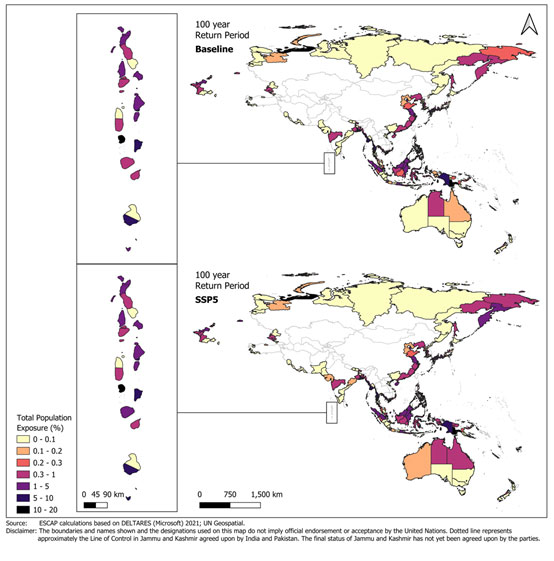
ESCAP’s analysis (Figure 1) examines how these threats are expected to continue to increase in the region’s low-lying river deltas, small island nations and rapidly growing coastal cities. For example, Seenu Atoll in the Maldives is expected to face a six-fold jump in population exposure to coastal flooding by 2050.

Looking across the region, Jiangsu Province in China, West Bengal in India, Khula and Marisal Divisions of Bangladesh, and Bến Tre and Bạc Liêu Provinces of Viet Nam are all expected to see hundreds of thousands of people exposed along their respective coastlines in the next 25 years.

Figure 1 – Percentage of People Exposed to Coastal Flooding of 0.5 Meters and Above in States/Provinces Across the Asia-Pacific Region and in Atolls of the Maldives (2018 Baseline vs. 2050 RCP8.5).

In the face of these risks, cities become engines of growth only when they are resilient. So, why do many cities across the Asia-Pacific region find themselves underwater while others weathered the storm with far less disruption? The answer lies in whether cities treat rain as a resource or as waste

Traditional “grey” systems, such as pipes, pumps and channels, aim to move water out fast. In a nonstationary climate and denser urban fabric, this is no longer sufficient. Sponge city design blends green-blue-grey systems (permeable surfaces, parks, wetlands, bioswales, green corridors) with modernized drainage to capture, store, and safely release rainfall at the source.

China’s national Sponge City Initiative (launched in 2015) built on international practice and showed how integrated planning can retrofit districts and guide new growth to manage water where it falls. The logic is simple: expand infiltration and storage, reduce peak runoff and use engineered conveyance when and where needed.

Results from early adopters are tangible

In Wuhan, sponge city measures contributed to a 50% reduction in locations experiencing overflow and pipe overloading during high flow years. Over the life of assets, green-blue systems can cost significantly less than like-for-like grey expansions, while delivering co-benefits that traditional drains cannot: cooler neighborhoods, improved air quality, biodiversity and accessible public space.

For cities facing rising loss and damage under SDG 11.5 (deaths, affected people and economic losses), sponge city programmes generate a resilience dividend—not just a flood fix.

Sponge city thinking is also evolving toward smart hybrid infrastructure

Nature-based systems are being coupled with engineered assets and digital tools, such as digital twins, to model urban hydrology and optimize performance in real time, enabling city planners to simulate rainfall scenarios, forecast flood hotspots and manage infrastructure adaptively, thereby improving the effectiveness of sponge-city interventions.

This pairing turns static drainage into adaptive urban water management, essential as rainfall intensity and patterns shift, reducing and managing risk through early warning, community preparedness and basin scale controls.

Urban resilience is also ecological

The Asia-Pacific region is home to an estimated 30–40% of the world’s wetlands, yet only around 22% are formally protected. As wetland buffers are drained or reclaimed, cities lose natural absorption, filtration and surge moderation, just as extremes intensify. Protecting and restoring urban and peri-urban wetlands is therefore core infrastructure policy, reinforcing SDG 15 while directly advancing SDGs 11.5 and 13.1.

Sponge city approaches are not a panacea. Their effectiveness can be constrained by governance capacity, implementation scale and maintenance requirements, land availability and high-density development. They must therefore be complemented by robust end-to-end early warning systems and coordinated disaster risk management frameworks.

To this end, ESCAP supports countries across the region by providing regional and national risk analytics through its Risk and Resilience Portal, enabling policymakers to integrate climate and disaster information directly into development planning.

These analyses and tools are tailored to regional and country needs, such as ClimaCoast, which focuses on coastal multi-hazard and socio-economic exposures. These initiatives are complemented by targeted financing from the Trust Fund for Tsunami, Disaster and Climate Preparedness, through programmes that strengthen coastal resilience in Asia and the Pacific. Together, these initiatives aim to reverse the current regression in resilience related SDG targets and help safeguard sustainable development in the region’s high risk hotspots.

Asia and the Pacific region can no longer rely on drainage systems built for a different climate and century. By adopting sponge city principles, Asia Pacific cities can embed resilience into everyday urban life—a development imperative, not just a technical shift.

Strengthening urban resilience is essential to advancing SDG 11 and SDG 13 and protecting hard won development gains that too often wash away when floods strike.

Temily Baker is Programme Management Officer, ESCAP; Leila Salarpour Goodarzi is Associate Economic Affairs Officer, ESCAP and Elisa Belaz is Consultant, ESCAP

IPS UN Bureau


!function(d,s,id){var js,fjs=d.getElementsByTagName(s)[0],p=/^http:/.test(d.location)?’http’:’https’;if(!d.getElementById(id)){js=d.createElement(s);js.id=id;js.src=p+’://platform.twitter.com/widgets.js’;fjs.parentNode.insertBefore(js,fjs);}}(document, ‘script’, ‘twitter-wjs’);  

Informal Settlements Grapple With Climate Extremes in Pacific Islands

A rising cycle of poverty and extreme weather threatens many towns and cities, especially those situated on coastlines, in the Pacific Islands. Urban centres in the Pacific have grown at an unprecedented rate this century, rapidly straining national resources for urban planning. But governments are now making progress on improving people’s lives in the informal […]

ARGENTINA: ‘Under the New Law, Workers Have No Real Scope to Defend Their Rights’

By CIVICUS
Apr 13 2026 –  
CIVICUS discusses recent regressive changes to Argentina’s labour laws with Facundo Merlán Rey, an activist with the Coordination Against Police and Institutional Repression (CORREPI), an organisation that defends workers’ rights and resists state repression.

Facundo Merlán Rey

Argentina has just passed the most significant changes to labour legislation in half a century. Driven by President Javier Milei following his victory in the October 2025 parliamentary election, the law profoundly changes the conditions for hiring and dismissing workers, extends the working day, restricts the right to strike and removes protections for workers in some occupations. The government says the measures will boost formal employment and investment, but trade unions and social organisations warn they erode decades of hard-won rights. The law has triggered four general strikes and numerous protests.

What does the new law change and why did the government decide to push it through?

Capitalising on its victory in last year’s legislative election, which gave it a majority in both parliamentary chambers, the government pushed through a labour law that introduced changes on several fronts simultaneously.

It increases the daily maximum of working hours from eight to 12, with a weekly cap of 48. Hours worked beyond this limit no longer need to be paid separately, but can be accumulated and exchanged for days off at a later date.

It also introduces the concept of ‘dynamic wage’, allowing part of an employee’s pay to be determined based on merit or individual productivity. The employer can decide this unilaterally with no need for a collective agreement. This would allow two people to be paid differently for doing the same work.

The law creates the Labour Assistance Fund, an account to which the employer contributes three per cent of a worker’s salary, of which between one and 2.5 percentage points come from the worker’s pay. If dismissed, the worker receives the amount accumulated in that fund. This is deeply humiliating. It makes the worker contribute to the financing of their dismissal. Given that these contributions previously went into the pension system, the effect will also be to weaken pensions.

The law restricts the right to strike by expanding the list of occupations deemed essential, which means they are required to maintain at least 75 per cent of their operations during a strike. Previously, this category included air traffic control, electricity, gas, healthcare and water. Now it also includes customs, education at all levels except university, immigration, ports and telecommunications. In practice, this means that in these fields a strike will have a much more limited impact.

Finally, the law repeals the special regimes that regulated working conditions in some trades and professions. Over the next six months, hairdressers, private drivers, radio and telegraph operators and travelling salespeople will lose these protections. The Journalists’ Statute will be abolished from 2027 onwards.

At CORREPI, we believe all these measures are unconstitutional, as they directly contravene article 14 of the constitution, which guarantees the right to work and the right to decent living conditions. The changes put employers in a position of almost absolute dominance in an employment relationship, leaving workers with no real scope to defend their rights.

How have trade unions and social organisations reacted?

The most militant groups highlighted the problems with the new law clearly, but the response from the organised labour movement has been insufficient.

Union leaders responded with a belated and low-profile campaign plan. They have long been criticised for preferring discreet agreements to open confrontation, and this time was no different. They negotiated behind the scenes and secured concessions to protect themselves. The law maintains employers’ contributions to trade union health schemes and the union dues paid by workers for two years. The rights of workers as a whole were sidelined.

What impact are the changes having?

Although the law is already in force, its full implementation faces obstacles, partly because it has internal consistency issues that hinder its practical application. When the government attempts to apply it in employment areas that still retain rights, it will likely face legal challenges, which will increase social unrest.

Even so, some of its effects are already being felt. Unemployment is rising slowly but steadily. Factory closures, driven by the opening up of imports and the greater ease of dismissal, are pushing more workers into informal employment and multiple jobs. The result is a fall in consumption and a level of strain with outcomes that are difficult to predict.

The consequences extend beyond the economic sphere. Increasingly demanding working conditions, combined with high inflation and rising household debt, are taking a toll on workers’ mental health. Regrettably, there is already a worrying rise in the suicide rate.

There’s also a consequence that is harder to measure: this reform erodes the collective identity of workers. When work is informal, individuals tend to solve their problems on their own, making it much harder to organise to demand better conditions. In working-class neighbourhoods, drug trafficking is becoming established as an alternative source of employment, generating situations of violence that largely go unnoticed. Unfortunately, everything points to an ever-deepening social breakdown.

What lessons does this experience hold for the rest of the region?

Regional experience shows it is very difficult to reverse this kind of change. In Brazil, President Lula da Silva came to power in 2022 promising to repeal the labour law passed in 2017 under Michel Temer’s government, similarly opposed by social organisations and trade unions. However, he failed to do so, and the framework Temer left remains in force. Once passed, these laws tend to remain in place regardless of who governs next.

That’s why what’s happening in Argentina should not be viewed as an isolated phenomenon. The reform appears to be part of a broader direction that regional politics is taking under the influence of the USA, one of the main drivers of these changes and a supporter of the governments implementing them.

The weakening of labour rights and collective organising is not a side effect; it is the objective being pursued. Dismantling workers’ ability to organise collectively facilitates the advance of extractive and financial interests and guarantees access to cheap labour. In that sense, Argentina offers a warning to the rest of the region.

CIVICUS interviews a wide range of civil society activists, experts and leaders to gather diverse perspectives on civil society action and current issues for publication on its CIVICUS Lens platform. The views expressed in interviews are the interviewees’ and do not necessarily reflect those of CIVICUS. Publication does not imply endorsement of interviewees or the organisations they represent.

GET IN TOUCH
Website
Facebook
Instagram
Twitter
YouTube

SEE ALSO
‘Milei managed to capture social unrest and channel it through a disruptive political proposal’ CIVICUS Lens | Interview with Carlos Gervasoni 13.Dec.2025
‘Society must prepare to act collectively to defend rights and democracy’ CIVICUS Lens | Interview with Natalia Gherardi 27.Feb.2025
‘The state is abandoning its role as guarantor of access to rights’ CIVICUS Lens | Interview with Vanina Escales and Manuel Tufró 22.Jul.2024


!function(d,s,id){var js,fjs=d.getElementsByTagName(s)[0],p=/^http:/.test(d.location)?’http’:’https’;if(!d.getElementById(id)){js=d.createElement(s);js.id=id;js.src=p+’://platform.twitter.com/widgets.js’;fjs.parentNode.insertBefore(js,fjs);}}(document, ‘script’, ‘twitter-wjs’);