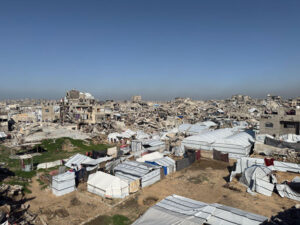
UNICEF and partners established the first Primary Health Care (PHC) Centre and Child-Friendly Space/Learning Space in Jabalia, North Gaza on 12 January, 2026. Credit: UNICEF/Rawan Eleyan
By Oritro Karim
UNITED NATIONS, May 8 2026 – Despite the implementation of a ceasefire between Hamas and Israel last October, Israeli forces continue to launch airstrikes into the Occupied Palestinian Territory. This has resulted in extensive destruction of infrastructure, loss of human life and exacerbating immense health needs amid an increasingly strained health system in Gaza.
Recent months have marked a significant escalation in hostilities, with routine bombardment pushing communities that have been displaced multiple times to the brink, while continued blockages of humanitarian aid hinder relief efforts and deprive thousands of life-saving services.
“Gaza’s crisis is far from over. For millions of civilians, the emergency is ongoing, relentless, and life-threatening. Food insecurity remains widespread and severe,” said Faten, the International Rescue Committee’s (IRC) Senior Protection Manager in Gaza. “Gaza’s healthcare system has all but collapsed with 94% of Gaza’s hospitals destroyed or damaged.”
Findings from the UN Office for the Coordination of Humanitarian Affairs (OCHA) underscore the urgent state of crisis in the Gaza Strip. OCHA experts leading a safety report recorded a significant number of security incidents over the past week, noting that the figures are among the highest reported since the declaration of the ceasefire last year. Experts from the United Nations Relief and Works Agency for Palestine Refugees in the Near East (UNRWA) note that Israeli forces continue to maintain a high level of activity across the Gaza Strip, most notably in the northern region, where the scale of needs is most pronounced.
According to figures from OCHA, between October 7, 2023, and April 29, 2026, a total of 72,599 Palestinians have been killed in the Gaza Strip and another 172,411 injured. UNRWA has also reported that over 391 UN personnel have been killed since the start of the war through May 7. Hostilities from Israeli forces remain a routine part of daily life for Palestinians across Gaza, with UN experts recording airstrikes, shelling, and gunfire across all areas, particularly densely populated ones.
In May, a UNRWA school in Jabalia was struck by gunfire, injuring two displaced civilians residing within the school for shelter. OCHA also recorded two separate incidents in which humanitarian facilities came under fire in May, alongside an airstrike landing near a UN warehouse and a stone-throwing incident that damaged humanitarian relief vehicles. The UN continues to underscore the urgency of all actors complying with international humanitarian law, including all parties’ obligations to facilitate humanitarian operations and protect civilians and civilian infrastructure in all contexts.
Displacement also remains widespread, with over 90 percent of the population having been internally displaced. Many communities have been displaced multiple times, with more than half of the displaced population being children. Thousands of families currently reside in poor-quality makeshift shelters, such as damaged residential buildings and schools, where they face increasingly limited access to basic essential services, such as food, water, fuel and sanitation.
It is estimated that UNRWA currently hosts over 65,000 displaced Palestinians across 82 collective emergency shelters throughout the enclave. Approximately 126 UNRWA displacement sites are located with the Yellow Line, as well as areas within the Orange Line, where humanitarian aid remains subject to Israeli monitoring and intervention.
Many of these displacement sites face severe security concerns, overcrowding, and unsanitary conditions, while health responses fail to keep pace and mitigate the rapid spread of infectious disease and illnesses.
Gaza’s health system has borne the brunt of the crisis, being on the brink of collapse as the immense scale of needs continues to grow every day. Compounded by Israeli blockades on humanitarian aid deliveries, relief efforts have been severely hindered by a lack of supplies, such as batteries, lubricants, and spare parts.
“51 percent of essential medicines are currently at zero stock in Gaza, which is severely limiting the ability to treat patients with life-threatening conditions, including those requiring intensive care and cancer treatment,” said Faten. “Hospitals are overwhelmed, under-resourced, and increasingly unable to provide adequate care.”
Additionally, humanitarian movement remains severely constricted as armored vehicles break down, posing significant security risks to aid personnel as they attempt to assist vulnerable populations. Furthermore, continued restrictions on generators, engine oil, and other key supplies hinder sanitation efforts, debris clearance, food distribution, water trucking, ambulance services, and the delivery of educational and medical supplies.
Over the past several months, UNRWA teams on the frontlines have recorded a significant uptick in rodent infestations across multiple overcrowded displacement shelters across the enclave, being most pronounced in Khan Younis, as well as areas with large amounts of rubble, including northern Gaza.
Heath facilities have also reported a significant increase in the frequency of rat bites, which are linked to the transmission of rodent-borne diseases such as leptospirosis. Efforts to contain the spread of infection are hindered by a severe shortage of pesticides, anti-lice shampoos, and scabicidal medications. As a result, UNRWA has recorded a significant increase in cases of chickenpox, as well as ectoparasitic skin diseases, such as scabies, over the past few months.
“With designated landfills becoming inaccessible during hostilities, the market has been used as a major solid waste dump, with trash now covering an entire city block and exceeding four flights in height,” said Stéphane Dujarric, UN Spokesperson for the Secretary-General during a press briefing on May 7.
“Our sanitation partners report that Gaza’s two sanitary landfills are near the perimeter fence surrounding the Strip, where access needs to be enabled by Israeli authorities. They also stress the need for permissions to bring into Gaza the machinery to remove the waste, the rubble and explosive ordnance, as well as the spare parts required to operate that equipment. These permissions are also critical to address health risks linked to pests and rodents,” Dujarric continued.
Despite immense challenges, UNRWA remains on the frontlines of this crisis, providing lifesaving services to vulnerable, displaced communities. Since October 2023, the agency has conducted over 17.2 million health consultations, including over 71,800 consultations between April 20 and 26 of this year alone. UNRWA continues to support six health centers, four temporary centers, and 28 medical points across the enclave, and have provided psychosocial support services to over 730,000 displaced Palestinians, including 520,000 children. The agency also continues to provide protection services, which have proved to be instrumental as security concerns reach new highs, particularly around displacement sites.
IPS UN Bureau Report
!function(d,s,id){var js,fjs=d.getElementsByTagName(s)[0],p=/^http:/.test(d.location)?’http’:’https’;if(!d.getElementById(id)){js=d.createElement(s);js.id=id;js.src=p+’://platform.twitter.com/widgets.js’;fjs.parentNode.insertBefore(js,fjs);}}(document, ‘script’, ‘twitter-wjs’);