ALIT FINAL DEADLINE: ROSEN, A HIGHLY RECOGNIZED LAW FIRM, Encourages Alight, Inc. Investors to Secure Counsel Before Important May 15 Deadline in Securities Class Action – ALIT

NEW YORK, May 08, 2026 (GLOBE NEWSWIRE) —

WHY: Rosen Law Firm, a global investor rights law firm, reminds purchasers of common stock of Alight, Inc. (NYSE: ALIT) between November 12, 2024 and February 18, 2026, both dates inclusive (the “Class Period”), of the important May 15, 2026 lead plaintiff deadline.

SO WHAT: If you purchased Alight common stock during the Class Period you may be entitled to compensation without payment of any out of pocket fees or costs through a contingency fee arrangement.

WHAT TO DO NEXT: To join the Alight class action, go to https://rosenlegal.com/submit-form/?case_id=54542 or call Phillip Kim, Esq. toll-free at 866-767-3653 or email [email protected] for information on the class action. A class action lawsuit has already been filed. If you wish to serve as lead plaintiff, you must move the Court no later than May 15, 2026. A lead plaintiff is a representative party acting on behalf of other class members in directing the litigation.

WHY ROSEN LAW: We encourage investors to select qualified counsel with a track record of success in leadership roles. Often, firms issuing notices do not have comparable experience, resources, or any meaningful peer recognition. Many of these firms do not actually handle securities class actions, but are merely middlemen that refer clients or partner with law firms that actually litigate the cases. Be wise in selecting counsel. The Rosen Law Firm represents investors throughout the globe, concentrating its practice in securities class actions and shareholder derivative litigation. Rosen Law Firm has achieved, at that time, the largest ever securities class action settlement against a Chinese Company. Rosen Law Firm was Ranked No. 1 by ISS Securities Class Action Services for number of securities class action settlements in 2017. The firm has been ranked in the top 4 each year since 2013 and has recovered hundreds of millions of dollars for investors. In 2019 alone the firm secured over $438 million for investors. In 2020, founding partner Laurence Rosen was named by law360 as a Titan of Plaintiffs’ Bar. Many of the firm’s attorneys have been recognized by Lawdragon and Super Lawyers.

DETAILS OF THE CASE: According to the lawsuit, defendants made false and/or misleading statements and/or failed to disclose facts concerning the true state of Alight’s growth potential and financial stability; notably, that Alight was not truly equipped to execute on its claimed potential and could not maintain its promised dividend as a result. Rather, Alight would require significantly higher compensation and incentive expenses to achieve the projections put forth by management. Throughout the class period, defendants announced disappointing results, reduced projections, and multiple goodwill impairments all while remaining confident in their ability to execute, drive growth, and continue to provide a dividend to their shareholders. When the true details entered the market, the lawsuit claims that investors suffered damages.

To join the Alight class action, go to https://rosenlegal.com/submit-form/?case_id=54542 or call Phillip Kim, Esq. toll-free at 866-767-3653 or email [email protected] for information on the class action.

No Class Has Been Certified. Until a class is certified, you are not represented by counsel unless you retain one. You may select counsel of your choice. You may also remain an absent class member and do nothing at this point. An investor’s ability to share in any potential future recovery is not dependent upon serving as lead plaintiff.

Follow us for updates on LinkedIn: https://www.linkedin.com/company/the-rosen-law-firm, on Twitter: https://twitter.com/rosen_firm or on Facebook: https://www.facebook.com/rosenlawfirm/.

Attorney Advertising. Prior results do not guarantee a similar outcome.

Contact Information:

        Laurence Rosen, Esq.
        Phillip Kim, Esq.
        The Rosen Law Firm, P.A.
        275 Madison Avenue, 40th Floor
        New York, NY 10016
        Tel: (212) 686-1060
        Toll Free: (866) 767-3653
        Fax: (212) 202-3827
        [email protected]
        www.rosenlegal.com


GLOBENEWSWIRE (Distribution ID 9716653)

AirX تطرح طائرة Challenger 604 في السوق لإحداث تحوّل جذري في قطاع الطائرات فائقة المتوسطة

لندن, May 08, 2026 (GLOBE NEWSWIRE) —

أعلنت AirX، ثاني أكبر مزوّد لخدمات تأجير الطائرات الخاصة في أوروبا، عن انضمام الطائرة 9H-ATGT، وهي أول طائرة من طراز Bombardier Challenger 604، إلى أسطول طائراتها المخصصّة للتأجير. تأتي هذه الخطوة ضمن استراتيجية توسّع طموحة، تهدف إلى ترسيخ حضور الشركة عبر مختلف شرائح المقصورات الجوية.

يمثّل إدخال طائرة Challenger 604 أكثر من مجرد إضافة تشغيلية تقليدية، إذ يعكس توجّه AirX نحو إعادة تعريف توزيع القدرات داخل سوق الطائرات الخاصة، من خلال إدخال إمكانيات الطيران بعيد المدى إلى فئة الطائرات الخاصة فائقة المتوسطة. من شأن ذلك أن يتيح لشركة AirX تحقيق كفاءة أعلى في اقتصاديات التشغيل عبر شراح التشغيل المتجاورة ضمن نموذج أكثر مرونة وتكاملاً.

تمثّل إضافة هذه الطائرة المحطة الأولى في مسيرة النمو الطموحة للشركة، التي يصفها المؤسس John Mathews بـ”الانطلاق نحو أسطول من 50 طائرة“، وهي رؤية استراتيجية تهدف إلى مضاعفة حجم الأسطول بشكل مستمر، وتعزيز النطاق التشغيلي للشركة في الأسواق.

خضعت طائرة 9H-ATGT لعملية تجديد شاملة وإعادة طلاء في أبريل 2026، لتدخل الخدمة بمظهر حديث وحالة تشغيلية أقرب إلى الطائرات الجديدة بالكامل. تتميز الطائرة بمقصورة ذات فسحة واسعة وسقف مرتفع يسمح بالوقوف المريح، مع قدرة استيعاب تتسع لما بين 8 إلى 10 ركاب. كما تضمّ الطائرة نظام Airshow مُحدّث، إلى جانب شاشتين ترفيهيتين بقياس 18 بوصة، ما يمنح المسافرين تجربة سفر مريحة وفاخرة خلال الرحلات.

وفي هذا السياق، قال John Matthews: “تساهم إضافة طائرة Challenger 604 إلى أسطولنا بمنح الشركة قدرة أكبر على توسيع مدى الطيران ضمن فئة المقصورات الأصغر، مع الالتزام بانضباط صارم في كيفية إدارة وتشغيل الأصول.” وأضاف: “تضطلع كل طائرة بدور محدد، يحمل بُعداً اقتصاديًا أساسياً ضمن منظومة متكاملة. يتمثّل هدفنا في خلق ضغط تسعيري تنافسي عبر عدة شرائح سوقية، بدلاً من الاكتفاء بالعمل ضمن شريحة واحدة فقط، ما يسهم في تعزيز كفاءة النمو والتوسع.”

ويأتي هذا التطور بعد نجاح AirX في جمع تمويل بقيمة 115 مليون يورو عبر إصدار سندات مضمونة، في خطوة تعزز قوة المركز الرأسمالي للشركة، ويوفر دعماً إضافياً لخططها التوسّعية المستقبلية.

وأضاف Matthews: “للمرحلة المقبلة، يتمثّل هدفنا في تقليل التكاليف إلى أدنى مستوى، وتعظيم الأرباح التشغيلية قبل الفوائد والضرائب والإهلاك لكل طائرة، وبالتالي، تحويل هذا الأداء التشغيلي إلى تدفقات نقدية فعلية تدعم النمو طويل الأمد.

تدير AirX أسطولاً متنوعاً يشمل الطائرات الفاخرة المخصّصة لكبار الشخصيات، وصولاً إلى الطائرات الأصغر ذات المقصورة المدمجة، ما يتيح لها تلبية مجموعة واسعة من احتياجات التأجير، مع الحفاظ على نموذج تشغيلي موحّد ومتّسق، يضمن الكفاءة والموثوقية.

تستمر الشركة في اعتماد نهج يضع الوسطاء في قلب استراتيجيتها التشغيلية، وتعمل بشكل وثيق مع شبكة شركائها حول العالم، مع التركيز على عمليات تأجير قائمة على الشفافية ومبنية على الصفقات.

لمحة عن AirX

تعدّ AirX شركة أوروبية رائدة في مجال تأجير الطائرات الخاصة، تأسست عام 2011 وتقدم حلولاً فاخرة في مجال السفر الجوي. تدير الشركة أسطولاً متنوعاً يضمّ 20 طائرة، بينها الطائرات من الفئة الثقيلة وطائرات كبار الشخصيات. يتألف فريقها من أكثر من 450 خبيراً محترفاً، يقدمون خدمات تأجير عالمية بمعايير عالية من الاحترافية والمرونة، من خلال نموذج تشغيلي مرن متعدد القطاعات يعتمد على الوسطاء أولاً.

للمزيد من المعلومات، يُرجى التواصل مع:
Jack Roberts
رئيس قسم التسويق – AirX
البريد الالكتروني: [email protected]

يمكنكم الاطلاع على الصورة المرفقة بهذا البيان الصحفي عبر الرابط الالكتروني التالي:

http://www.globenewswire.com/NewsRoom/AttachmentNg/09f44308-a89c-4801-a653-11a82d52055b


GLOBENEWSWIRE (Distribution ID 1001180875)

AirX met en service le Challenger 604, un avion destiné à bousculer le segment super-midsize

LONDRES, 08 mai 2026 (GLOBE NEWSWIRE) — AirX, deuxième opérateur européen de jets privés, a mis en service son premier Bombardier Challenger 604, immatriculé 9H-ATGT, dans le cadre d’une stratégie plus large visant à développer sa flotte et à renforcer sa position sur plusieurs segments de marché.

Au lieu d’accroître la capacité au sens traditionnel du terme, le Challenger 604 est déployé en vue d’introduire une capacité long-courrier sur le marché super-midsize, permettant ainsi à AirX de proposer une rentabilité unitaire plus efficace dans les catégories voisines.

Cet appareil marque la première étape d’une stratégie que le fondateur John Matthews décrit comme la « Course vers les 50 » appareils, stratégie qui vise à soutenir l’expansion continue de la flotte et l’échelle opérationnelle de l’entreprise.

Récemment rénové et repeint en avril 2026, le 9H-ATGT entre en service dans un état flambant neuf, doté d’une cabine spacieuse permettant de se tenir debout, parfaitement adaptée à 8 à 10 passagers, d’un système Airshow amélioré et de deux écrans de 18 pouces (45 cm).

« Le Challenger 604 nous permet d’élargir notre gamme à une catégorie de cabines plus petites tout en maintenant une gestion rigoureuse de l’exploitation de cet appareil », a déclaré M. Matthews. « Chaque appareil a un rôle bien défini, et ce rôle est d’ordre économique. Il s’agit d’exercer une pression sur les prix sur plusieurs segments, et non de se limiter à un seul. »

L’introduction de cet appareil fait suite à une levée de fonds réussie de 115 millions d’euros sous forme d’obligations garanties, ce qui renforce la situation financière d’AirX dans un contexte de croissance continue de la société.

« Au niveau de chaque appareil, l’objectif est simple : minimiser les dépenses, optimiser l’EBITDA par appareil et convertir le tout en liquidités réelles », a ajouté M. Matthews.

AirX exploite une flotte diversifiée couvrant aussi bien les avions VIP de grande taille que les appareils aux cabines plus petites, ce qui lui permet de répondre à un large éventail de demandes de vols charter tout en conservant un modèle d’exploitation cohérent.

La société continue de privilégier une approche axée sur les courtiers. Elle travaille en étroite collaboration avec son réseau mondial de partenaires et se concentre sur des opérations de charter transparentes et axées sur les transactions.

À propos d’AirX

Fondée en 2011, AirX est un opérateur européen de jets privés, avec une flotte composée de 20 avions long-courriers et appareils VIP. Avec plus de 450 professionnels, l’entreprise répond aux besoins mondiaux en matière de charters grâce à un modèle opérationnel multi-segment axé sur les courtiers.

Pour de plus amples informations, veuillez contacter :
Jack Roberts
Responsable du marketing – AirX
[email protected]

Une photo annexée au présent communiqué est disponible à l’adresse suivante : http://www.globenewswire.com/NewsRoom/AttachmentNg/09f44308-a89c-4801-a653-11a82d52055b


GLOBENEWSWIRE (Distribution ID 1001180875)

Bitget lance sa campagne « Fan Story: UEX Through Your Eyes » dotée d’une cagnotte de 100 000 USDT

VICTORIA, Seychelles, 08 mai 2026 (GLOBE NEWSWIRE) — Bitget, la plus grande bourse universelle (UEX) au monde, a lancé aujourd’hui sa nouvelle campagne communautaire intitulée « Bitget Fan Story: UEX Through Your Eyes ». Elle invite les utilisateurs éligibles du monde entier à partager leur parcours avec Bitget sur les réseaux sociaux afin de tenter de remporter une part de la cagnotte d’une valeur maximale de 100 000 USDT, ainsi que des produits dérivés exclusifs du Bitget Fan Club.

La campagne, qui se déroule du 7 au 20 mai 2026, vise à mettre en lumière les témoignages des utilisateurs de Bitget, des premiers utilisateurs et traders de longue date jusqu’aux contributeurs de la communauté en passant par les testeurs de fonctionnalités, dont les expériences reflètent l’évolution et l’expansion mondiale de la plateforme. Les participants sont invités à partager leurs expériences concrètes avec l’écosystème tout-en-un de la bourse universelle (UEX) de Bitget, en décrivant la manière dont elle leur permet d’accéder à un plus grand nombre de produits, de types d’actifs et d’opportunités de trading, le tout depuis une interface unique. Le montant de la cagnotte augmentera avec la participation de la communauté, grâce à un système de paliers qui alimente le fonds pour chaque tranche de 500 nouveaux participants, jusqu’à un total de 100 000 USDT.

« La communauté Bitget rassemble des utilisateurs de tous horizons, non seulement des traders chevronnés, mais aussi toutes les personnes qui s’engagent, contribuent et évoluent avec nous », a déclaré Gracy Chen, PDG de Bitget. « Avec cette campagne, nous souhaitons mettre en lumière les témoignages de celles et ceux qui rendent notre bourse universelle possible. Ce sont leurs histoires qui définissent notre communauté et qui inspirent l’avenir de Bitget. »

« Chaque transaction, chaque actif détenu, chaque histoire compte », a déclaré Bitget dans l’annonce de sa campagne. « Nous voulons savoir comment nos utilisateurs ont découvert de nouvelles opportunités, comment ils ont élargi leurs horizons de trading et évolué avec Bitget dans chaque cycle de marché. »

Pour participer, les utilisateurs sont invités à :

  1. Partager l’histoire de leur utilisation de Bitget sur une plateforme sociale comme X, Telegram, Reddit, LinkedIn ou Discord, au format texte + image/vidéo.
  2. Inclure le hashtag #BitgetFanStory dans leur publication.
  3. Soumettre leur contribution via ce formulaire.

Bitget précise que des outils d’IA peuvent être utilisés pour améliorer les visuels, comme la génération d’images ou le montage vidéo, mais que le récit lui-même doit être basé sur l’expérience réelle de l’utilisateur. Les contributions écrites entièrement générées par IA ne seront pas acceptées.

La campagne propose plusieurs niveaux de récompenses :

  • Pour les 3 premiers gagnants : de 1 000 à 3 000 USDT chacun
  • Pour les 20 premiers gagnants : un minimum de 100 USDT chacun
  • Pour les mentions honorables illimitées : 50 USDT chacun
  • Pour tous les gagnants : des produits dérivés exclusifs du Bitget Fan Club

Pour consulter l’intégralité des conditions générales et les modalités de participation, veuillez vous référer à l’annonce officielle de Bitget ici.

À propos de Bitget

Bitget est la première bourse universelle (UEX) du monde. Au service de plus de 125 millions d’utilisateurs, elle donne accès à plus de 2 millions de jetons crypto et à plus de 100 actions tokenisées, ETF, matières premières, devises et métaux précieux comme l’or. L’écosystème vise à aider les utilisateurs à faire du trading de manière plus avisée grâce à son agent IA qui accompagne l’exécution des ordres. Bitget entend promouvoir l’adoption des cryptomonnaies grâce à des partenariats stratégiques conclus avec LALIGA et MotoGP™. En accord avec sa stratégie d’impact mondial, Bitget s’est associée à l’UNICEF pour soutenir la formation à la blockchain auprès de 1,1 million de personnes d’ici à 2027. Actuellement leader sur le marché de la finance traditionnelle tokenisée, Bitget offre les frais les plus bas du secteur et la liquidité la plus élevée dans plus de 150 régions à travers le monde.

Pour en savoir plus, veuillez consulter : Site Internet | X | Telegram LinkedIn | Discord

Pour les demandes médias, veuillez contacter : [email protected]

Mise en garde sur les risques : les cours des actifs numériques peuvent fluctuer et connaître une forte volatilité. Il est conseillé aux investisseurs de n’engager que les fonds qu’ils peuvent se permettre de perdre. La valeur de votre investissement peut être affectée et il est possible que vous n’atteigniez pas vos objectifs financiers ou que vous ne parveniez pas à récupérer votre investissement principal. Nous vous encourageons à toujours solliciter les conseils d’un spécialiste financier indépendant et à tenir compte de votre expérience et de votre situation financière personnelles. Les performances passées ne constituent pas un indicateur fiable des résultats futurs. Bitget décline toute responsabilité en cas de pertes potentielles encourues. Les informations contenues dans le présent communiqué ne constituent en aucun cas un conseil financier. Pour tout complément d’information, veuillez consulter nos Conditions d’utilisation.


GLOBENEWSWIRE (Distribution ID 1001180856)

Bitget Lança “Fan Story: UEX Through Your Eyes” uma Campanha com Premiação de 100.000 USDT

VICTORIA, Seychelles, May 08, 2026 (GLOBE NEWSWIRE) — Bitget, a maior Universal Exchange (UEX) do mundo, lançou hoje sua nova campanha comunitária, “Bitget Fan Story: UEX Through Your Eyes,” convidando usuários elegíveis em todo o mundo a compartilhar a jornada nas redes sociais com a Bitget para a chance de ganhar parte de um prêmio de até 100.000 USDT, juntamente com produtos exclusivos do Bitget Fan Club.

A campanha, que vai de 7 de maio de 2026 a 20 de maio de 2026, visa destacar a opinião dos usuários da Bitget, desde os primeiros usuários e traders de longo prazo até os colaboradores da comunidade e testadores de recursos, cujas experiências mostram a evolução e a expansão global da plataforma. Os participantes são incentivados a compartilhar suas experiências reais com o ecossistema Universal Exchange (UEX) da Bitget – como isso ajuda o acesso a mais produtos, tipos de ativos e oportunidades de negociação, tudo em um só lugar. A premiação irá aumentar com o aumento da participação, com um mecanismo de marcos da comunidade que aumenta com cada 500 novos participantes, até um total de 100.000 USDT.

“A comunidade da Bitget é criada pelos usuários de todas as esferas da vida e não apenas pelos principais traders. E sim por qualquer pessoa que se envolva, contribua e cresça conosco”, disse Gracy Chen, CEO da Bitget. “Com esta campanha, queremos destacar a opinião das pessoas que viabilizam a nossa Universal Exchange. Suas histórias moldam a nossa comunidade e inspiram o futuro da Bitget.”

“Cada negociação, cada participação, cada história é importante”, disse a Bitget no anúncio da sua campanha. “Queremos saber como nossos usuários descobriram novas oportunidades, expandiram seus limites de trade e cresceram com a Bitget em todos os ciclos do mercado.”

Para participar, os usuários devem:

  1. Compartilhar sua história na Bitget em uma plataforma social como X, Telegram, Reddit, LinkedIn ou Discord em formato de texto + imagem/vídeo
  2. Incluir a hashtag # BitgetFanStory no post
  3. Fazer a inscrição aqui neste formulário.

De acordo com a Bitget, ferramentas de IA podem ser usadas para aprimorar recursos visuais, como geração de imagens ou edição de vídeo, mas a história em si deve ser baseada na experiência real do usuário. E que material totalmente gerado por IA não será aceito.

A campanha oferece vários níveis de prêmios:

  • Os 3 principais vencedores: 1.000 a 3.000 USDT cada
  • Top 20 vencedores: mínimo de 100 USDT cada
  • Menções Honrosas Ilimitadas: 50 USDT cada
  • Todos os vencedores: produtos exclusivos do Bitget Fan Club

Para detalhes dos termos e condições, e sobre como participar, consulte o anúncio oficial da Bitget aqui.

Sobre a Bitget

Bitget é a maior Universal Exchange (UEX) do mundo, atendendo a mais de 125 milhões de usuários com acesso a mais de 2 milhões de tokens de criptomoedas, mais de 100 ações tokenizadas, ETFs, commodities, FX e metais preciosos como ouro. O ecossistema está comprometido em ajudar os usuários a negociar de forma mais inteligente com seu agente de IA sendo o copiloto para executar ordens de trade. A Bitget está impulsionando a adoção de criptomoedas por meio de parcerias estratégicas com a LALIGA e MotoGP™. Alinhada com sua estratégia de impacto global, a Bitget se uniu à UNICEF em apoio ao ensino de blockchain para 1,1 milhão de pessoas até 2027. A Bitget atualmente lidera o mercado de TradFi tokenizado, fornecendo as taxas mais baixas do setor e a maior liquidez em 150 regiões em todo o mundo.

Para mais informação, visite: Website | X | Telegram | LinkedIn | Discord

Para perguntas da mídia, contate: [email protected]

Aviso de Risco: Os preços dos ativos digitais estão sujeitos a flutuações e podem ser significantemente voláteis. Os investidores são aconselhados a alocar apenas os fundos que podem perder. O valor de qualquer investimento pode ser afetado, e existe a possibilidade de que os objetivos financeiros não sejam atingidos, nem que o investimento principal recuperado. Aconselhamento financeiro independente deve sempre ser obtido, e a experiência financeira pessoal e a posição devem ser cuidadosamente consideradas. O desempenho passado não é um indicador confiável de resultados futuros. A Bitget não se responsabiliza por quaisquer perdas potenciais incorridas. Nada contido neste documento deve ser interpretado como aconselhamento financeiro. Para mais informações, consulte nossos Termos de Uso.


GLOBENEWSWIRE (Distribution ID 1001180856)

Dmitry Shubov Consulting: Navigating the “Digital Border” as AI Fragmentation Begins to Shape Southeast Asian Tech Expansion

FREMONT, Calif., May 08, 2026 (GLOBE NEWSWIRE) — Dmitry Shubov Consulting is releasing a strategic briefing to help Southeast Asian (SEA) startups navigate the emerging “Digital Border” created by a global shift toward sovereignty-focused AI deployments. Per Gartner’s 2026 outlook, which projects that 35% of nations will be locked into region-specific AI platforms by 2027, the briefing provides a roadmap for SEA founders to adapt their product and governance practices to meet the evolving trust and compliance expectations of U.S. buyers and investors.

“We are starting to see a world where AI essentially needs its own passport,” says Dmitry Shubov, founder of Dmitry Shubov Consulting. “When a country builds a sovereign stack, they aren't just protecting data—they’re often building a wall for outside vendors. Our goal is to give founders the 'legal passport' their tech needs so it doesn't get geographically stranded while trying to anchor in the United States.”

Key Briefing Takeaways for SEA Founders:

  • Bridging the Procurement “Trust Gap”: Institutional buyers in the U.S. are moving away from “black box” models. They want to see the receipts. Founders will need to implement transparent architectures that satisfy strict expectations for data residency and auditability.
  • Engineering for Global Portability: Local context is a huge win in Asia, but it shouldn’t become a cage. There are technical and legal requirements for keeping a model portable so it can cross into new jurisdictions without a total rebuild.
  • The Diligence Dividend: Mapping out data flows isn't just a chore anymore; it’s a competitive advantage. The firms that are going to flourish are those that are actively treating “Regulatory Readiness” as a core product feature, as it can stabilize a startup's valuation and actually speed up the path to investment.

For startups that need assistance or complete direction, a consulting firm can be the best way to start. Dmitry Shubov Consulting focuses on market entry and regulatory readiness for Southeast Asian legal-tech startups. The firm can help founders prepare the governance, data-flow maps, and procurement materials needed to meet the high bar of U.S. institutional buyers. For more information, visit Dmitry Shubov Consulting directly.

About Dmitry Shubov Consulting

At Dmitry Shubov Consulting, our mission is to connect accredited investors with groundbreaking legal technology startups, fostering innovation and growth across Southeast Asia and helping Asian businesses enter the U.S. market. For more information, please visit our website or contact us directly.

Media Contact:

[email protected]


GLOBENEWSWIRE (Distribution ID 9716246)

Nuclear ‘Close-Calls’ Prove Deterrence No Guarantee for Peace

Attendees at the NPT Review Conference side event titled 'Preventing Nuclear Use and Escalation: Lessons from Nuclear Close Calls.' Credit: Naureen Hossain/IPS

Attendees at the NPT Review Conference side event titled ‘Preventing Nuclear Use and Escalation: Lessons from Nuclear Close Calls. ‘ Credit: Naureen Hossain/IPS

By Naureen Hossain
UNITED NATIONS, May 8 2026 – The consequences of nuclear warfare would transcend borders and the impact would be felt across generations. Yet knowing this, member states, including nuclear-armed states, are increasingly flouting the nuclear taboo, while also relying heavily on deterrence to prevent fallout.

Throughout the Cold War period, there were stories of nuclear “close calls”—moments where the world could have been plunged into nuclear warfare were it not for human intervention or sheer luck. The Cuban Missile Crisis of 1962 and the Petrov incident of 1983 may be more well-known examples from history, but others may also reveal what lessons should be taken from these ‘close calls.’

At the sidelines of the 2026 NPT Review Conference, academics, government and civil society convened to discuss just that. On May 1, at an event convened by Soka Gakkai International (SGI) and the James Martin Center for Nonproliferation Studies (CNS), people came together to deliberate over past and present efforts to prevent nuclear escalation. The panelists argued that these stories demonstrate how nuclear deterrence may not be an effective security strategy towards disarmament or even nonproliferation.

Chie Sunada, Director of Disarmament and Human Rights, SGI Peace Center speaks in a panel on nuclear escalation risks. Credit: Naureen Hossain/IPS

Chie Sunada, Director of Disarmament and Human Rights, SGI Peace Center, speaks in a panel on nuclear escalation risks. Credit: Naureen Hossain/IPS

“The history of close calls—Cuba, Petrov, Black Brant—and many other less well-known events does not tell us that deterrence works. It tells us that deterrence has, on a number of documented occasions, almost failed,” said George-Wilhelm Gallhofer, Director for Disarmament, Arms Control and Non-Proliferation in Austria’s Federal Ministry for European and International Affairs. “Luck is not a security strategy. And yet, the global security order, 60 years on, still rests on it.”

Gallhoffer went on to suggest that the nuclear taboo needs to be reinforced once more by promoting honest dialogue between nuclear powers and non-nuclear states, where the non-nuclear states remind all parties of the stakes at play. Doctrines like the NPT and the Treaty for the Prohibition of Nuclear Weapons (TPNW) should be regarded as security treaties, not only moral or ethical frameworks.

Elayne Whyte, a professor at Johns Hopkins and former UN Ambassador of Costa Rica, also echoed this sentiment, adding that the issue of nuclear danger is just as rooted at the societal level as it is through legal frameworks. The shared understanding of nuclear danger is not only produced through weapons systems or treaties but also through decision-makers and the values of society.

“It is [the] 21st century; we also have to acknowledge that the erosion of the nuclear taboo cannot be separated from the wider nationalist trends that rank human lives unequally and make it easier to imagine that mass destruction inflicted on others is […] tolerated,” said Whyte.

Emerging technologies such as artificial intelligence threaten to further complicate nuclear escalation, wherein nuclear states, in an effort to stay ahead of the curve, adopt these technologies for their perceived potential to reduce the human margin of error. The automation of decision-making in nuclear weapons use is not entirely new, as was seen in 1979 and 1980, when the North American Aerospace Defense Command (NORAD) received several false alarms through errors in their missile warning system.

Yanliang Pan, a research associate at CNS, remarked that these cases proved that automated systems would still be susceptible to automation bias and compressed decision-making time, thus increasing the likelihood of accidents. Although humans should still have ‘meaningful’ control over decisions of nuclear use, Pan noted that these close calls occurred while humans were in control. “We should be talking about the effect of automation on the reliability of human control, rather than simply human control as an antidote to automation,” said Pan.

At present, academic research can uncover recurring patterns in how nuclear close calls were handled and what that can tell decision-makers about risk reduction in this space. According to Sarah Bidgood, a postdoctoral fellow at the UC Institute on Global Conflict and Cooperation, recent studies have looked into how there might not be a singular framework for crisis management that could apply across nuclear close calls. When it comes to crisis management and risk reduction, the dynamics of previous nuclear close calls do not exist in a monolith, but there are variations in the outcomes instead. The lessons that leaders take from such situations may not lead to a shift away from nuclear weapons. Instead, these events may reinforce what leaders already think about the risks and benefits of nuclear weapons. If a leader regards nuclear weapons for a perceived strategic value, then after a close call, they may be just as likely to embrace new capabilities that would allow them to threaten the use of weapons across multiple levels of conflict. Bidgood raised the question of what this scenario would mean for the future of risk reduction in the present geopolitical environment.

“We need to be quite skeptical of this conventional wisdom that we often hear in our community… which is that to get arms control and risk reduction back on track, maybe we need another event like the Cuban Missile Crisis. Because if my theory is right, what this tells us is that the next crisis could just as easily lead us farther down a very, very different path. And that’s something that I don’t think we as scholars or practitioners have really accounted for,” said Bidgood.

Such near-misses may often be thanks to individual human judgement calls rather than the positions of nuclear states. Chie Sunada, Director of Disarmament and Human Rights at the SGI Peace Center, recalled the example of an incident during the height of the Cuban Missile Crisis in 1962, where a near-miss also brewed in the Pacific, which would have targeted an uninvolved third party. During this time, U.S. military bases hosted nuclear missiles in Japan that were powerful enough to level cities. The base in Okinawa received what seemed like authenticated launch orders. However, the most senior field officer on site, Captain William Bassett, found discrepancies with the launch orders and the missiles’ readiness level, including that the missiles at this base were primarily targeted at China. So he ordered subordinates to stand down.

Sunada warned that the sense of urgency that informed decisions on nuclear de-escalation was missing from the current discourse and that the reality of nuclear fallout and the aftermath of Hiroshima and Nagasaki would be “fading into abstract history.” She urged that nuclear disarmament education would be a “vital mechanism” for maintaining “strategic restraint” by recognizing that a key element for its success is empathy for the pain of others, which is itself a form of deterrence.

“We cannot continue to outsource our survival to luck,” said Sunada. “We urge all state parties to recognize that risk reduction requires more than just adjusting military doctrines. It requires a fundamental shift in how we understand these weapons, driven by education. By cutting the chain of hatred and nurturing the heart that cherishes and is respectful to others, we achieve the ultimate disarmament and pure, proper peace education.”

Note: This article is brought to you by IPS Noram in collaboration with INPS Japan and Soka Gakkai International in consultative status with ECOSOC.

IPS UN Bureau Report


!function(d,s,id){var js,fjs=d.getElementsByTagName(s)[0],p=/^http:/.test(d.location)?’http’:’https’;if(!d.getElementById(id)){js=d.createElement(s);js.id=id;js.src=p+’://platform.twitter.com/widgets.js’;fjs.parentNode.insertBefore(js,fjs);}}(document, ‘script’, ‘twitter-wjs’);


Empowering Youth Is the Fastest Path to Transforming Least Developed Countries

Empowering Youth Is the Fastest Path to Transforming Least Developed Countries

LDC Future Forum Banner. Credit: OHRLLS

By Rabab Fatima
UNITED NATIONS, May 8 2026 – The future of the world’s least developed countries (LDCs) will be shaped by a critical choice they make today- strategic investment in their youth. Rich in human potential, the young people in LDCs embody ingenuity, resilience and ambition. With the right opportunities, they can transform challenges into opportunities and put their countries strongly on track to sustainable development.

In the 44 LDCs, more than 60 per cent of the population is under 25. That is more than 315 million young people – innovators, entrepreneurs and problem-solvers – in a world being reshaped by technology, climate pressures and shifting economic realities. Their energy, creativity and ambition represent an extraordinary opportunity not only for national development, but for global prosperity and stability.

The question is simple: will we act with the urgency this moment demands? In May 2026, governments, development partners, private sector leaders, researchers and young changemakers will convene in Helsinki for the Fourth LDC Future Forum, under the theme “Transforming LDCs by Empowering the Youth Population through Education, Innovation, and Inclusive Growth.

Rabab Fatima, USG and High Representative, OHRLLS. Credit: OHRLLS

This Forum is more than a ceremonial gathering. It is a strategic moment—one that calls for decisive action to translate youthful potential into concrete progress.

Opportunity is expanding—but unevenly

The global economy is evolving at speed. Artificial intelligence, digital platforms, green technologies and geopolitical shifts are reshaping how we live and work. By 2030, an estimated 170 million new jobs will be created worldwide, even as 40 per cent of core workplace skills are transformed.

Youth in LDCs are ready to be part of this future. Already, they demonstrate remarkable entrepreneurial initiative: nearly 70 per cent are engaged in self employment, compared to about 50 per cent in other developing countries.

Yet opportunity remains deeply uneven. Tertiary enrolment in LDCs stands at just 11 per cent. Fewer than a quarter of graduates specialize in science, technology, engineering and mathematics.

Millions of young people—especially girls and rural youth—remain excluded from quality education, digital connectivity and formal employment. Without urgent and targeted investment, demographic strength risks becoming a demographic strain.

The DPOA: Investing in youth as a development imperative

The Doha Programme of Action (DPoA) is unequivocal: investing in people – especially youth – is central to sustainable development and smooth graduation from the LDC category.

It places strong emphasis on education, skills and science, technology and innovation (STI) as engines of structural transformation. Critically, it advances concrete deliverables, including the establishment of an Online University for LDCs, designed to expand access to quality, affordable higher education – particularly in STEM fields. It also promotes digital learning, innovation ecosystems, and stronger linkages between education systems and labour market needs.

The Fourth LDC Future Forum will focus squarely on these priorities. It will advance practical solutions to close skills gaps, expand digital learning, strengthen innovation hubs and promote inclusive growth models that leave no young person behind.

Inclusion must be intentional

True transformation cannot happen if opportunity is accessible only to a few.

Gender gaps in education, skills acquisition and labour force participation continue to hold back progress. The digital divide—between countries, communities and genders—threatens to widen existing inequalities unless deliberately addressed. Inclusive growth requires inclusive design: policies and investments that actively reach girls, marginalized youth and those in rural and underserved areas.

By placing equity at the centre of youth empowerment, LDCs can ensure that growth is not only faster, but fairer—and therefore more sustainable.

A shared responsibility

No country can undertake this transformation alone. Governments must lead by prioritizing youth in national development strategies and aligning education with future economic needs. Development partners must scale up predictable, high quality financing for education, skills and digital infrastructure. Academia must help generate evidence based solutions. And the private sector must play a central role—by investing, mentoring, innovating and creating decent jobs.

The LDC Future Forum exists to forge these partnerships. Through rigorous research, policy dialogue and multi stakeholder collaboration, it aims to deliver actionable recommendations that will inform both national action and the 2027 Midterm Review of the Doha Programme of Action.

The choice before us

History will judge this generation not by the challenges we faced, but by the choices we made. We can allow structural barriers and underinvestment to hold back millions of young people—or we can unlock the dynamism that resides within them.

Empowering youth is not a long term aspiration. It is the fastest, most reliable path to sustainable growth, resilience and global stability.

The message from Helsinki must be clear: invest in young people now – and they will transform their countries, and our shared future.

IPS UN Bureau


!function(d,s,id){var js,fjs=d.getElementsByTagName(s)[0],p=/^http:/.test(d.location)?’http’:’https’;if(!d.getElementById(id)){js=d.createElement(s);js.id=id;js.src=p+’://platform.twitter.com/widgets.js’;fjs.parentNode.insertBefore(js,fjs);}}(document, ‘script’, ‘twitter-wjs’);  


Excerpt:

Rabab Fatima is United Nations Under Secretary General and High Representative for LDCs, LLDCs and SIDS

Hungary’s Long Road Back

Hungary’s Long Road Back

Credit: Attila Kisbenedek/AFP

By Inés M. Pousadela
MONTEVIDEO, Uruguay, May 8 2026 – When Péter Magyar took the stage in Budapest on the night of 12 April, he told the crowd they had ‘liberated Hungary’. The hyperbole seemed justified. His party, Tisza, had won a parliamentary supermajority on the highest turnout since Hungary’s first free election in 1990, ending 16 years of increasingly autocratic rule.

An autocracy built in plain sight

Ousted Prime Minister Viktor Orbán boasted of turning Hungary into a model of what he called ‘illiberal democracy’. When he returned to power in 2010, he set about dismantling every institution capable of constraining him. His party, Fidesz, rewrote the constitution, restructured the Constitutional Court and gerrymandered electoral districts so thoroughly that in 2014 and 2018, it won two-thirds of parliamentary seats on under half of the vote.

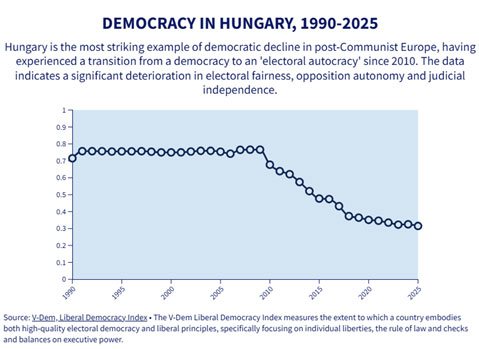
Public broadcasting became a party mouthpiece, and Orbán-connected oligarchs took over private media. Fidesz captured universities and arts bodies. The government used Pegasus spyware against opponents, demonised migrants and LGBTQI+ people as threats to the nation and passed a law criminalising attendance at Budapest Pride. Civil society organisations faced escalating restrictions on their funding, and the government created a Sovereignty Protection Office to investigate and harass them further. The Varieties of Democracy (V-Dem) index eventually downgraded Hungary to ‘electoral autocracy’ status — the first European Union (EU) member state to receive that designation.

The EU’s blind spot

The EU’s response was inadequate. In 2018, the European Parliament triggered Article 7(1) of the Treaty on European Union, the first step in a procedure that could, in theory, suspend a state’s voting rights. In practice, Article 7 was never fully applied, because doing so requires unanimous agreement among all other member states, and there are always states unwilling to go that far. The Rule of Law Conditionality Regulation, in force since 2022, allowed the EU to freeze up to US$32 billion in funds for Hungary, but this mechanism too was compromised by political calculation. In December 2023, the Commission released around US$12 billion in cohesion funds seemingly in exchange for Hungary lifting its veto on Ukraine aid, effectively trading rule-of-law conditionality for foreign policy compliance.

Ultimately, the EU did not solve its Orbán problem; Hungarian voters did. This suggests structural reforms are still needed to prevent another autocrat from playing the same blocking game Hungary did.

After Orbán

Previous opposition coalitions in Hungary failed partly because Orbán’s machine had a reliable weapon against them: the accusation that they served Brussels, Hungary-born funder George Soros and a cosmopolitan elite detached from Hungarian values. Magyar, a former Fidesz insider who broke with the party in February 2024 following a scandal over a presidential pardon granted to a man convicted of covering up child sexual abuse, was immune to that weapon. His campaign was deliberately post-ideological, focused on corruption, crumbling public services and economic stagnation, while Orbán ran a fear-based campaign centred on the EU and the war in Ukraine. Voters chose economic reality over a manufactured threat. In the end, the electoral architecture Orbán had built to reward the first-placed party converted Tisza’s win into a supermajority of 141 of 199 parliamentary seats.

But Magyar’s victory will not necessarily bring a progressive transformation. He is a conservative politician leading a centre-right party whose platform made no explicit commitment on LGBTQI+ rights. During the campaign, he criticised the Budapest Pride ban as a distraction rather than a rights violation, committing only to protecting freedom of assembly more broadly. His victory speech promised a Hungary where ‘no one is stigmatised for loving someone differently from the majority’, but this was a shift in tone rather than a policy commitment. LGBTQI+ rights are unlikely to regress further under Magyar, but recovery will depend on sustained pressure from civil society.

Orbán may be out of government, but Fidesz appointees remain embedded throughout the state apparatus. Magyar has pledged to invite the European Public Prosecutor’s Office to examine alleged misuses of EU funds, dismantle the Sovereignty Protection Office and drop proposed legislation that would have further extended powers to restrict civil society. Delivering on those pledges and unravelling 16 years of institutional capture will require sustained political will.

Hungarian civil society faces its first genuine opening in 16 years. To make the most of it, it will need to push hard and consistently for the restoration of civic space, the rule of law and LGBTQI+ rights, and not mistake a change of government for a change of direction.

For the EU, Magyar’s victory opens a window to change a decision-making structure that allows a single member state to hold the bloc’s foreign policy hostage. European Commission President Ursula von der Leyen’s call for qualified majority voting for foreign policy decisions may now gain traction. But the broader question of how the EU enforces its democratic standards against a member state determined to flout them remains open. The EU should resolve it before the next challenge arises.

Inés M. Pousadela is CIVICUS Head of Research and Analysis, co-director and writer for CIVICUS Lens and co-author of the State of Civil Society Report. She is also a Professor of Comparative Politics at Universidad ORT Uruguay.

For interviews or more information, please contact [email protected]


!function(d,s,id){var js,fjs=d.getElementsByTagName(s)[0],p=/^http:/.test(d.location)?’http’:’https’;if(!d.getElementById(id)){js=d.createElement(s);js.id=id;js.src=p+’://platform.twitter.com/widgets.js’;fjs.parentNode.insertBefore(js,fjs);}}(document, ‘script’, ‘twitter-wjs’);  


Before the Flood, Jannat Carried Books. After the Flood, She Carried Dirty Dishes

Before the Flood, Jannat Carried Books. After the Flood, She Carried Dirty Dishes

Credit: UKBET (UK Bangladesh Education Trust)

By Mohammed A. Sayem
SYLHET, Bangladesh, May 8 2026 – When catastrophic floods swept through the Haor wetlands of Sunamganj in 2022, they destroyed far more than homes and crops. They shattered childhoods.

Jannat was only nine years old when floodwater swallowed her family’s house, farmland, and livestock. Like thousands of displaced families in northeastern Bangladesh, they took shelter in a school building converted into an emergency flood centre. But when the water receded, there was nothing left to return to.

The family migrated to a slum in Sylhet city to survive. Her father, once a farmer in the fertile haor lands, began pulling a rented rickshaw. Her mother started working as a domestic worker. Jannat’s school life ended almost overnight. Instead of carrying books, she began washing dishes and cleaning clothes in another family’s home for food and a small income.

Her story reflects a growing reality across climate-vulnerable Bangladesh. The 2022 floods in Sylhet, Kanaighat, Companygonj and Sunamganj were among the worst in more than a century. United Nations agencies estimated that nearly 7.2 million people across northeastern Bangladesh were affected, including around 3.5 million children. Entire villages disappeared under water, electricity collapsed across districts, schools were turned into emergency shelters, and thousands of hectares of cropland were destroyed. UNICEF reported that 1.6 million children were stranded by the floods, while hundreds of educational institutions and community clinics were damaged or submerged.

Before the Flood, Jannat Carried Books. After the Flood, She Carried Dirty Dishes

Credit: UKBET (UK Bangladesh Education Trust)

The crisis did not end in 2022. In 2024, another devastating wave of flooding inundated nearly 75 per cent of Sylhet district, affecting more than two million people across northeastern Bangladesh and displacing thousands of families yet again. More than 800 schools were flooded and large areas of farmland went underwater, deepening poverty and food insecurity. This year again, heavy rainfall and upstream water flows submerged more than 46,000 hectares of standing Boro rice fields in the haor region during harvesting season, threatening livelihoods and increasing the risk of climate migration and child labour. Experts warn that repeated climate shocks are trapping vulnerable families in a cycle of disaster, displacement, and poverty.

Yet hope can still rise from disaster.

The Doorstep Learning Programme (DLP) of UKBET, a UK-based international NGO working in Bangladesh, was created to support children trapped in domestic labour and other vulnerable situations in urban slums. Rather than waiting for children to return to school on their own, the programme brings education, counselling, and rehabilitation support directly to their communities. Through flexible learning support and family livelihood assistance, it helps children return to education while reducing families’ dependence on child labour for survival.

Before the Flood, Jannat Carried Books. After the Flood, She Carried Dirty Dishes

Credit: UKBET (UK Bangladesh Education Trust)

DLP identified Jannat and supported her return to school alongside her younger brother. The programme also helped her father secure his own rickshaw, giving the family a more stable livelihood and a chance to rebuild their future.

As global leaders gather at the Eighth Assembly of the Global Environment Facility (GEF) in Samarkand, Uzbekistan in May–June 2026 to discuss climate financing and resilience, stories like Jannat’s must remain at the centre of international attention. (Global Environment Facility) Climate change is no longer only about rising temperatures or environmental loss. It is about children losing education, dignity, and hope.

Before the Flood, Jannat Carried Books. After the Flood, She Carried Dirty Dishes

Credit: UKBET (UK Bangladesh Education Trust)

Local community-led initiatives that protect vulnerable children and strengthen climate resilience deserve far greater global investment and support through mechanisms such as the GEF Trust Fund and international adaptation financing.

Because children like Jannat are not victims to be pitied. They are futures worth protecting.

Mohammed A Sayem is Executive Director, UKBET
Sylhet, Bangladesh
[email protected]

IPS UN Bureau


!function(d,s,id){var js,fjs=d.getElementsByTagName(s)[0],p=/^http:/.test(d.location)?’http’:’https’;if(!d.getElementById(id)){js=d.createElement(s);js.id=id;js.src=p+’://platform.twitter.com/widgets.js’;fjs.parentNode.insertBefore(js,fjs);}}(document, ‘script’, ‘twitter-wjs’);