Google Cloud Security s’appuie sur la plateforme Instruqt pour former plus de 150 professionnels à l’IA agentique à l’occasion du Google Cloud Next 2026

AMSTERDAM, 25 mai 2026 (GLOBE NEWSWIRE) — Instruqt, plateforme d’expérience produit pratique utilisée par MongoDB, Elastic, Google et SUSE, annonce ce jour que Google Cloud Security s’est appuyé sur sa technologie pour former plus de 150 professionnels aux capacités de l’IA agentique lors de la conférence Google Cloud Next 2026. Intitulée « Agentic SOC Experience », cette session figure parmi les plus importantes formations pratiques consacrées à l’IA agentique organisées cette année dans le cadre d’une grande conférence technologique.

Grâce à Instruqt, chaque participant a pu accéder à un environnement Google Cloud Vertex AI dédié, concevoir ses propres agents à partir de zéro et explorer les capacités agentiques de Google dans des environnements sandbox isolés. Cette approche immersive a permis d’aller au-delà des démonstrations traditionnelles sur diapositives.

« En matière d’IA, Instruqt est un outil remarquable, car il nous permet de déployer un environnement Vertex dédié pour chaque participant », déclare Keith Manville, ingénieur avant-vente au sein de l’équipe en contact avec la clientèle de Google Cloud Security, qui a animé la session. « Les participants sont repartis avec une compréhension claire de ce qu’est un agent, des fonctionnalités fondamentales que nous y intégrons et de la manière de les utiliser. Chacun apprend différemment. Face à une technologie complexe, lorsqu’on ne l’a jamais manipulée, il est difficile de savoir où cliquer ou quoi faire. Instruqt nous aide à guider les utilisateurs de façon fluide tout au long de leur parcours d’apprentissage et de prise en main du produit. »

Combler le fossé de l’adoption de l’IA

Cet atelier s’inscrit dans une évolution plus large des pratiques au sein du secteur des logiciels. Alors que l’IA accélère le rythme de lancement de nouvelles fonctionnalités, les clients peinent souvent à les adopter au même rythme. C’est dans cet écart entre la mise sur le marché d’un produit et son adoption effective que les entreprises risquent de perdre en pipeline commercial, en fidélisation client et en chiffre d’affaires. Selon le rapport « 2026 State of Developer Adoption Report » de SlashData, 92 % des professionnels déclarent être confrontés à au moins un défi majeur en matière d’adoption. Parmi les principaux freins cités figurent la complexité technologique (26 %), le manque de coordination entre les équipes (27 %) et l’obsolescence des contenus (25 %).

« À l’ère de l’IA, les entreprises qui s’imposeront ne seront pas seulement celles qui proposeront les meilleurs produits, mais celles qui aideront leurs clients à les utiliser concrètement », déclare Tyler Crumpler, vice-président du marketing chez Instruqt. « L’initiative menée par Google Cloud Security lors de Google Cloud Next constitue un modèle pour toute entreprise orientée IA : offrir aux clients un environnement réel, des outils concrets et la possibilité de créer quelque chose qu’ils pourront réutiliser dans leur activité. C’est ainsi que l’on renforce l’adoption, les compétences et le pipeline commercial. »

À propos d’Instruqt

Instruqt est une plateforme interactive d’expérience produit qui aide les plus grandes entreprises de logiciels au monde à transformer la complexité de leurs produits en expériences client engageantes. Les équipes marketing, commerciales et de formation de MongoDB, Elastic, Google, SUSE et d’autres leaders technologiques utilisent Instruqt pour proposer, directement depuis un navigateur, des expériences évolutives. Ces expériences favorisent l’adoption des produits, génèrent des opportunités commerciales qualifiées et accélèrent la montée en compétences des utilisateurs. Fondée à Amsterdam, Instruqt s’impose comme une plateforme de référence pour accompagner la croissance axée sur les développeurs à l’ère de l’IA. Pour en savoir plus, rendez-vous sur instruqt.com.

Interlocuteur auprès des médias

Tyler Crumpler, vice-président du marketing, Instruqt
[email protected]


GLOBENEWSWIRE (Distribution ID 1001183872)

Google Cloud Security Utiliza Plataforma Instruqt para Treinar mais de 150 Profissionais em IA Agentic no Google Next 2026

AMSTERDÃ, May 25, 2026 (GLOBE NEWSWIRE) — Instruqt, a plataforma de experiência de prática de produtos utilizada por MongoDB, Elastic, Google e SUSE, anunciou hoje que o Google Cloud Security utilizou a Instruqt para treinar mais de 150 profissionais em recursos de IA Agentic no Google Next 2026. A sessão, denominada Agentic SOC Experience, é uma das maiores sessões práticas de treinamento em IA da Agentic ministradas em uma grande conferência do setor este ano.

Utilizando a Instruqt, os participantes criaram um ambiente dedicado no Google Cloud Vertex AI, construindo seus próprios agentes a partir do zero e explorando os recursos agênticos do Google em ambientes isolados de sandbox, em vez de assistir a demonstrações baseadas em slides.

“No âmbito da IA, a Instruqt é fantástica porque permite a criação de um ambiente Vertex dedicado para cada participante”, disse Keith Manville, Engenheiro de Pré-vendas da equipe de atendimento ao cliente do Google Cloud Security, que liderou a sessão. “Os participantes entenderam o que é um agente, quais são as características primitivas que criamos em um agente e como utilizá-las. Todos aprendem de forma diferente. Como a tecnologia é complexa, quem não conhece não sabe onde clicar ou o que fazer. A Instruqt nos ajuda a conduzir o usuário nessa jornada sobre como operar o produto.”

Fechando a lacuna na adoção de IA

O workshop reflete uma mudança operacional mais ampla em toda a indústria de software. A IA está criando recursos com mais rapidez do que os clientes conseguem adotar, e a lacuna entre o produto lançado e o produto adotado é onde o pipeline, a retenção e a receita estão sendo perdidos. De acordo com o 2026 State of Developer Adoption Report do SlashData, 92% dos profissionais encontram pelo menos uma dificuldade na adoção do produto, com complexidade tecnológica (26%), desalinhamento da equipe (27%) e conteúdo desatualizado (25%) citado como as principais causas.

“As empresas que vencerem na era da IA não irão simplesmente lançar os melhores produtos. E sim as que que irão ajudar seus clientes a usar os produtos”, disse Tyler Crumpler, VP de Marketing da Instruqt. “O Google Cloud Security criou no Google Next um modelo que toda empresa liderada por IA deveria estar criando. Um modelo com clientes em um ambiente real, ferramentas reais, onde eles podem criar algo e voltar ao trabalho. É assim que a adoção, as habilidades e o pipeline funcionam.”

Sobre a Instruqt

A Instruqt é a plataforma de experiência de prática de produtos que ajuda as principais empresas de software do mundo a transformar produtos complexos em clientes confiantes. As equipes de marketing, vendas e educação da MongoDB, Elastic, Google, SUSE e outras, contam com a Instruqt para oferecer experiências escaláveis e baseadas em navegador que impulsionam a adoção de produtos, geram pipeline qualificado e aceleram o desenvolvimento de habilidades. Fundada em Amsterdã, a Instruqt é a plataforma de referência para o crescimento liderado por desenvolvedores na era da IA. Saiba mais em instruqt.com.

Contato com a Mídia

Tyler Crumpler, VP de Marketing, Instruqt
[email protected]


GLOBENEWSWIRE (Distribution ID 1001183872)

Google Cloud Security schult auf der Google Next 2026 mit Instruqt über 150 Fachkräfte in agentischer KI

AMSTERDAM, May 25, 2026 (GLOBE NEWSWIRE) — Instruqt, die praxisorientierte Plattform für Produkterlebnisse, die von MongoDB, Elastic, Google und SUSE genutzt wird, gab heute bekannt, dass Google Cloud Security Instruqt auf der Google Next 2026 eingesetzt hat, um mehr als 150 Fachkräfte in den Möglichkeiten agentischer KI zu schulen. Die unter dem Namen „Agentic SOC Experience“ angebotene Session zählt zu den größten praxisorientierten Schulungen zu agentischer KI, die in diesem Jahr auf einer großen Branchenkonferenz durchgeführt wurden.

Mithilfe von Instruqt richteten die Teilnehmer jeweils eine eigene Google-Cloud-Vertex-AI-Umgebung ein, entwickelten ihre eigenen Agenten von Grund auf und erkundeten Googles agentische Funktionen in isolierten Sandbox-Umgebungen, statt lediglich foliengestützte Präsentationen anzusehen.

„Gerade im KI-Bereich ist Instruqt hervorragend, weil wir damit für jeden Teilnehmer eine eigene Vertex-Umgebung aufsetzen können“, so Keith Manville, Pre-Sales Engineer im Kundenkommunikationsteam von Google Cloud Security und Leiter der Session. „Die Teilnehmer gingen mit einem klaren Verständnis dafür nach Hause, was ein Agent ist, welche grundlegenden Funktionen in einen Agenten eingebaut werden und wie man sie nutzt. Jeder lernt auf seine eigene Weise. Da die Technologie komplex ist, weiß man wirklich nicht, wo man klicken oder was man tun soll, wenn man sie noch nie gesehen hat. Instruqt hilft uns dabei, Nutzer nahtlos durch den Lernprozess zu führen und ihnen den Umgang mit dem Produkt Schritt für Schritt zu vermitteln.“

Die Lücke bei der KI-Nutzung schließen

Der Workshop spiegelt einen umfassenderen Wandel innerhalb der Softwarebranche wider. KI bringt neue Funktionen schneller auf den Markt, als Kunden sie tatsächlich nutzen können, und genau in der Lücke zwischen Produkteinführung und Produktnutzung gehen Pipeline, Kundenbindung und Umsatz verloren. Laut dem „2026 State of Developer Adoption Report“ von SlashData sehen sich 92 % der Fachkräfte mit mindestens einer erheblichen Hürde bei der Einführung konfrontiert, wobei technologische Komplexität (26 %), mangelnde Abstimmung im Team (27 %) und veraltete Inhalte (25 %) als wichtigste Ursachen genannt werden.

„Die Unternehmen, die im KI-Zeitalter erfolgreich sein werden, bringen nicht nur die besten Produkte auf den Markt. Sie werden ihren Kunden helfen, diese tatsächlich zu nutzen“, erklärt Tyler Crumpler, VP of Marketing bei Instruqt. „Was Google Cloud Security auf der Google Next gezeigt hat, sollte für jedes KI-basierte Unternehmen ein Vorbild sein. Geben Sie Kunden eine reale Umgebung mit echten Tools und lassen Sie sie etwas entwickeln, das sie direkt in ihren Arbeitsalltag mitnehmen können. So wächst die Nutzung, so wachsen die Fähigkeiten, und so wächst auch die Pipeline.“

Über Instruqt

Instruqt ist die praxisorientierte Plattform für Produkterlebnisse, mit der weltweit führende Softwareunternehmen komplexe Produkte in überzeugte Kundenbeziehungen übersetzen. Marketing-, Vertriebs- und Schulungsteams bei MongoDB, Elastic, Google, SUSE und anderen Unternehmen nutzen Instruqt, um skalierbare, browserbasierte Produkterlebnisse bereitzustellen, die die Produktnutzung fördern, qualifizierte Vertriebspipelines aufbauen und die Kompetenzentwicklung beschleunigen. Instruqt wurde in Amsterdam gegründet und ist die zentrale Plattform für entwicklergetriebenes Wachstum im KI-Zeitalter. Weitere Informationen unter instruqt.com.

Medienkontakt

Tyler Crumpler, VP of Marketing, Instruqt
[email protected]


GLOBENEWSWIRE (Distribution ID 1001183872)
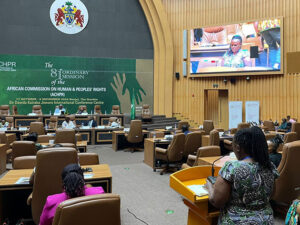
How the Global Anti-Rights Movement Is Targeting Women’s Rights in Africa Through Family Laws

Deborah Nyokabi speaking at the 81st African Commission on Human & Peoples’ Rights

By Deborah Nyokabi
NAIROBI, Kenya, May 25 2026 – The theme of Africa Day 2026, “63 years of unity, integration and development,” offers a stark reminder of the gap that often exists between rhetoric and reality. While commendable regional legal frameworks have advanced legal protections for millions of women and girls, injustice remains written into the fabric of national family laws in many African countries, entrenching gender inequality in the home.

Such is the reality for the young woman in Kampala whose marriage was never legally registered and who, in the eyes of the State, does not exist as a wife.

For the woman in Lagos whose husband took their children after a divorce she did not want, and the law backed him.

For the Muslim widow in Nairobi who cannot inherit the home she shared with her husband for thirty years because property passes to his male relatives.

How the global anti-rights movement is targeting women’s rights in Africa

African countries have made laudable advances in legal rights for women and girls, but many laws governing marriage, divorce, child custody, and inheritance remain stubbornly unequal.

Deborah Nyokabi

Equality Now’s report, Gender Inequality in Family Laws in Africa, documents how legal frameworks continue to subordinate women within the family. Women face intimate partner violence; some laws permit child marriage; customary and religious marriages frequently operate outside formal legal protections, leaving wives without legal safeguards; divorce settlements do not recognise women’s unpaid domestic work; and custody laws favour paternal authority over equal parental rights.

Reform remains slow, uneven, and increasingly obstructed by a coordinated anti-rights movement that includes transnational ultra-conservative Christian organisations, populist political actors from the Global North, billionaire-funded conservative foundations, and right-wing think tanks and legal advocacy groups. They have found fertile ground in Africa, forging alliances with conservative organisations, religious leaders, and politicians who promote illiberal agendas.

Operating in plain sight and dressed in the language of culture, tradition, and sovereignty, these groups target parliaments, constitutional drafting processes, and regional human rights bodies. They draft model legislation, deploy strategic litigation, lobby policymakers, and cultivate relationships with heads of state and cabinet ministers.

They infiltrate international and regional human rights spaces to weaken protections, and run expensive communications campaigns while channeling cross-border funding to local organisations to portray coordinated efforts as grassroots.

Anti-rights groups seeking to reshape African policy

At the second Pan-African Conference on Family Values, held in Nairobi in May 2025, a declaration was adopted calling the family “not a flexible or negotiable construct” and committing to translate their discriminative doctrine into enforceable laws and regional partnerships. High-ranking Kenyan government officials delivered the opening and closing addresses.

The conference was co-sponsored by Family Watch International, C-Fam, and the Alliance Defending Freedom, all of whom served on the advisory committee of Project 2025, an initiative by the US-based Heritage Foundation seeking to roll back reproductive rights, LGBTQ+ rights, and diversity initiatives. These are not fringe actors. They are well-funded, politically connected, and pushing into the mainstream.

These groups have also drafted a proposed African Charter on Family, Sovereignty, and Values, which undermines gender equality by rejecting universal definitions of gender, sexuality, and sexual and reproductive health rights. Tabled at an inter-parliamentary conference in Entebbe in 2025, it calls for withdrawal from international human rights instruments and seeks to shield states from obligations under the Maputo Protocol, the African Union’s legally-binding women’s rights treaty.

Applications for observer status at the African Commission on Human and Peoples’ Rights from organisations such as the Alliance Defending Freedom signal an intent to infiltrate the very bodies designed to hold States accountable to their obligation to ensure equality, including in the family.

Harmful bills pass fast while equality bills stall

One of the most devastating patterns is the speed at which homophobic ‘family protection’ legislation moves, while paralysis grips laws to advance gender equality. In Uganda, the Anti-Homosexuality Act was passed in under three months. In Ghana, lawmakers are promoting the Human Sexual Rights and Family Values Bill; in Kenya, political support for the Family Protection Bill is growing. Backed by far-right organisations in the US, these bills seek to criminalise sexual minorities and promote a rigid, exclusionary vision of the family centred on heterosexual marriage and conservative social structures.

Meanwhile, family law reform bills that would give women equal rights in marriage, divorce, and custody have stalled for decades in Uganda, Cameroon, and Ghana. The contrast is not coincidental. The same movement blocking equality for women and girls in family laws is the one pushing legislation against LGBTQI+ people. It uses the same language: family values, cultural integrity, sovereignty, national cohesion. But when you trace the money and the actors, the strategy becomes clear. The goal is not to protect the family. It is to protect the patriarchy within it.

How African civil society and coalitions are fighting back

None of this goes unanswered.

When the Pan-African Conference on Family Values convened in Nairobi, over twenty Kenyan human rights organisations petitioned for the venue to refuse to host it. Billboards celebrating diverse families lined the road from the airport. Activists disrupted the social media narrative and organised in the streets.

Strategic litigation has compelled the government to reinstate safe abortion guidelines in Kenya. International coalitions, including African women, have pushed back against anti-rights infiltration at the UN’s Commission on the Status of Women. Survivors, lawyers, activists, and advocates are refusing to cede ground.

Working in coalitions is one of the most powerful tools available to those defending gender equality. The anti-rights movement succeeds in part because it is coordinated across borders, sectors, and institutions. The response must be equally organised. Equality Now’s coalition work is grounded in this understanding. Through the Africa Family Law Network, we join with civil society organisations, legal networks, faith communities, survivor advocates, and parliamentarians to build and sustain a stronger common front.

What African governments must do to reform family laws

This year’s Africa Day should serve as a call to action to prioritise family law reform. We are at a perilous moment of global regression in women’s rights, where hard-won legal safeguards are being deliberately dismantled. Discriminatory family law sits at the heart of that regression. The ask is not complicated. The political will is what is missing. We stand ready to work with you to change that:

To the African Union: Advocate for the universal ratification and implementation of the Maputo Protocol, a floor, not a ceiling. Push for lifting of reservations on equality in marriage, family, and reproductive rights by member states. Resist attempts to water down its provisions through model reservations crafted by anti-rights legal networks.

To African parliaments and parliamentarians: Reform discriminatory laws on marriage registration, equal divorce rights, child custody, and inheritance that have been stalled for too long. Every year of inaction is a year of harm. Do not allow parliaments to be used as platforms for movements that entrench inequality in the family under the disguise of protecting it.

To African governments: Enforce the Maputo Protocol, and ratify if not already undertaken. Conduct awareness-raising campaigns on family law rights. Invest in legal aid that reaches women in rural communities and informal settlements. Allocate sufficient budgets to gender equality and family law reform. Recognise unpaid care work. National family protection policies must protect all family members, not only those who fit a narrow ideological template.

To civil society, lawyers, journalists, and advocates: Build and sustain coalitions across borders. Expose the funding and actors behind anti-rights campaigns. Tell the stories of the women these laws fail. Make the abstract concrete. Keep going.

“Until family laws are equal, there is no equality in African society.”

This Africa Day, let us be clear about what we are celebrating, and honest about what still needs to change.

Deborah Nyokabi is a Legal Advisor on Legal Equality at Equality Now, a global human rights organisation dedicated to ending discrimination against all women and girls. She is based in Nairobi, Kenya.

IPS UN Bureau


!function(d,s,id){var js,fjs=d.getElementsByTagName(s)[0],p=/^http:/.test(d.location)?’http’:’https’;if(!d.getElementById(id)){js=d.createElement(s);js.id=id;js.src=p+’://platform.twitter.com/widgets.js’;fjs.parentNode.insertBefore(js,fjs);}}(document, ‘script’, ‘twitter-wjs’);  


Excerpt:

Millions of African women live under laws that deny them equal rights at home. A well-funded global movement is working to make sure it stays that way.

Into the Wild: GWM Brings the World's Best to the Gobi

BAODING, China, May 25, 2026 (GLOBE NEWSWIRE) — This May, the Taklimakan Rally will host a milestone: for the first time, four international rally champions — Pau Navarro of Spain, Nicolas Cavigliasso of Argentina, Gerard Farres of Spain, and Rebecca Busi of Italy — will line up alongside China's fastest desert racers on the same course. On May 14, GWM confirmed a twelve-driver, four-factory-team roster assembled through a personal recruitment campaign launched by Chairman Jack Wey in March.

Founded in 2005, the Taklimakan — Asia's premier off-road event, known as the “Eastern Dakar” — earned FIA Grade A status in 2014. It runs more than 3,400 kilometers across thirteen stages in terrain that has broken some of the world's best drivers. For years, the world's elite competed primarily in North Africa and Europe while China's own rally culture grew largely unseen. GWM is attempting to change that.

By May 9, the international quartet had arrived at GWM's Baoding headquarters for a face-to-face meeting with Chairman Jack Wey — a level of personal engagement unusual at the top of a major automaker. Speaking directly to the drivers, Jack Wey offered what read less as ceremony than as commitment: “Motorsport requires no language. We hope to build deep, long-term cooperation — and we wish you excellent results in China Rally.”

Nicolas Cavigliasso of Argentina arrives as the 2025 Dakar Challenger champion, a distinction that earned him an FIA Gold license — one of the sport's rarest honors. He will be navigated by Valentina Pertegarini. Spain's Pau Navarro, the 2026 Dakar Challenger champion, joins with navigator Jan Rosa. Gerard Farres, a veteran of the Dakar Rally, will be paired with navigator Bruno Jacomy. Italy's Rebecca Busi — one of the world's most recognizable female rally drivers, with nearly 120,000 Instagram followers — completes the quartet.

Ma Hailong and two additional Chinese drivers, Zhang Jianfeng and Yao Weiqiang, complete the lineup. Yao Weiqiang is the 2025 China Rally T2.E champion in a TANK 300 Hi4-T. All three competed at the 2025 Taklimakan Rally.

“2016, we went to Dakar,” Jack Wey told the assembled drivers at Baoding. “We finished sixth — the highest any Chinese team has ever achieved.” The remark of someone who has raced at that level himself — and who is now investing personally to close the gap.

GWM's entry is built entirely around production-basis vehicles. The TANK 700 Hi4-T leads the lineup with a 3.0T V6 powertrain and Hi4-T intelligent four-wheel drive. The TANK 500 Hi4-Z carries a dedicated all-wheel drive architecture with a 201km electric range, optimized for the most demanding desert stages. The TANK 300 Hi4-T — proven across thousands of competitive kilometers — continues to demonstrate that durability and performance do not have to trade off. Three V6 Fire Bullet 3.0T pickups complete the production category entry.

The rally begins May 16 from Urumqi, runs through the Flaming Mountains near Shanshan and the Kumtag Desert, cuts south to the edge of the Taklimakan at Korla, and finishes in Aksu sixteen days later. Thirteen stages. One event.

The world's best are not here to pass judgment on Chinese motorsport. They are here to discover, alongside Chinese racing, what the sport looks like when the full picture finally comes together.

That answer waits at the finish line.

Contact: [email protected]


GLOBENEWSWIRE (Distribution ID 9725951)

The Search is On for the Next U.N. Secretary General in a Turbulent World

The headquarters of the United Nations with Trump World Tower looming in the foreground, in Manhattan, NY, on April 28, 2026. (SEBASTIAN CHRISTOPH GOLLNOW/PICTURE ALLIANCE VIA GETTY IMAGES) Source: Wahington Reports

By Ian Williams
NEW YORK, May 25 2026 – AS THE WORLD HURTLES TO HELL (albeit in a SpaceX rather than a hand basket), it might seem of only academic interest which cipher vegetates on the 38th floor of the U.N. Headquarters. However, the choice is due by the end of the year, unless, as has happened in the past, the Security Council is veto-bound and asks António Guterres to stay on as interim Secretary General.

Guterres certainly has experience for a seat-warming position, since he has performed like an interim Secretary General ever since he was first appointed. At times when his voice could and should have made a difference, he has followed the guidance of the three wise monkeys (see no evil, hear no evil, speak no evil). The Secretary General’s ability to put items on the council agenda and raise them publicly are his few effective powers in the face of the permanent members’ traditional lackadaisical stance.

His studied withdrawal from influence has infected other levels of the Secretariat and allowed the Security Council to reach new lows of subservience to power. So, if and when the council picks his successor, it’s unlikely that crowds will gather on U.N. Plaza to watch the white smoke rising to announce the anointment.

That is not only because Trump World Tower looms over the plaza like an escaped prop from “2001: A Space Odyssey,” but also because its eponymous owner has done so much to devalue the U.N. One could almost suspect that it is only allowed to hang on in New York because property values would plummet in the neighborhood if all the insouciant and complaisant diplomats who work in the U.N. complex had to leave.

The U.N.’s geopolitical absence certainly diminishes potential public interest in the race and is compounded by the increasing ineffectuality of the Security Council in the face of the erasure of the U.N. Charter. The guiding principle of the Secretariat often seems to be plucked from Arthur Hugh Clough’s old poem, “Thou shalt not kill/ But needs’t not strive, officiously to keep alive.”

However, the general membership is almost as complicit. Faced with the latest U.S. demand to reshape the organization before Washington even considers paying a part of its legally obligated payments, their response is to dicker about the depth of evisceration, not to challenge the assumptions. Of course, the U.N. needs reform—but not necessarily in the way the U.S. has been demanding for half a century.

Western signatories of the Rome Convention for the International Criminal Court have left their nationals, like Francesca Albanese and Karim Khan, to swing in the wind in the face of an entirely illegal U.S.–Israeli war on International Criminal Court staff. Even their home states’ declaration that they will provide government backed credit to the victims of U.S. sanctions would send a signal and some succor to the judges. A robust denunciation by the outgoing Secretary General (a lame duck and hence beyond significant U.S. payback) would have helped, but it was not forthcoming.

As the only figure who could coordinate (and heaven help us, lead) the defense, the forlorn position of the Secretary General is still essential despite the lackluster field. So, the choice is important—as well as boring.

So far, there is a growing consensus that the next leader needs to be a woman, which China has been very firm on, and should be from the Latin American and Caribbean region. So far, it’s a very uninspiring and, dare one say, “mature” field. Maybe there should be as much pressure for “youth’s” turn as there is for a woman, not least since both declared female candidates are of a certain age. The “most difficult job in the world” is not one for the elderly.

The April candidate forums at the U.N. featured four announced aspirants, but as the Book of Proverbs says, “Where there is no vision, the people perish: but he that keepeth the law, happy is he.” None of the candidates offered a vision: their presentations were more like an AI-generated resume for corporate human resources.

Even the candidates who showed some signs of integrity, like the “keeping the law” bit, seem to be missing the vision thing and, frankly, professed over-adherence to the law is a stretch for candidates who want to avoid a veto from the P5. Which is, of course, why there was conspicuous silence on the hustings about Israel and Iran. It also so far guaranteed candidates who will not rock the boat for Washington.

So in a field of lame horses, the three-legged one might limp home, and that could be former President of Senegal Macky Sall, who is not a woman, not Latin American and does not have the support of his own country or the African Union. His best qualification is the traditional U.N. promotion criterion: not being remembered for anything in particular. He could fall in the East River and not cause a ripple. But he is unlikely to be willing to undergo the gender transition necessary. China says it wants a woman and has historically been prepared to stand its ground with repeated vetoes.

Former Chilean President Michelle Bachelet has the required diplomatic and political credentials, and she has clearly been playing the long game. As U.N. Human Rights Commissioner she sat upon a report about the People’s Republic of China’s abuse of the Uighurs, which might fend off a Chinese veto but raises questions about her integrity and independence.

It does suggest that she had acute political antennae since at that time pandering to China could have cost her support with the U.S. and Europeans—but now, perhaps not so much. Under the MAGA Trump Republicans, human rights are a now and then thing. More important perhaps to Washington, Chile’s new right-wing government pulled its endorsement of her which could burnish her credentials with what’s left of the progressive world. And her gender and Latin American origins tick other boxes.

In contrast, right-wing Argentinian President Javier Milei backs Rafael Grossi’s candidacy, which detracts from Grossi’s globalist credentials to head the U.N. However, as head of the International Atomic Energy Agency (IAEA), his equivocation about Iranian nuclear activities might well be negotiable into active U.S. support. He has been a deft tightrope walker, trying not to give Iran a clean bill of health, but avoiding complicity in an over-explicit casus belli to Washington, which would upset Moscow and Beijing (and may yet). But he has defied best practice for candidates by staying active in his U.N. role, which suggests he knows his IAEA position gives him cards to play.

Costa Rica’s Rebeca Grynspan is an uninspiring apparatchik who has presided over the effectual dismantlement of U.N. Conference on Trade and Development, the development agency that had been in the sights of Washington for decades. While one cannot hold family connections against her, many countries might also worry about the optics of a secretary general whose sister is an Israeli settler in the West Bank. However, she is backed by her government, unlike some other candidates, and is a Latina, so ticks two of the boxes, and is likely to get support from the U.S. (and Israel, which does not have a direct seat on the Security Council, but nevertheless is reputedly a presence).

Looking at the heavily handicapped slate so far, it’s good that there are nominations waiting in the wings. Barbadian PM Mia Amor Mottley would be an ideal candidate, ticking both the vision and law boxes. A woman from the Latin American and Caribbean region whose otherwise disqualifying integrity might pass the Trump test by speaking English and being previously accoladed by no less than the American Enterprise Institute! However, she has just won re-election in Barbados and would probably prefer to stay where she is now.

Another person who announced her candidacy is Ecuador’s María Fernanda Espinosa, former General Assembly President, who is also missing support from her own government, but she has shown both vision and integrity and has other backers. And she is not of pensionable age.

In the end, sadly, the odds are against anyone who meets the needs of the world and organization. Their very qualifications would be unlikely to survive the whims and prejudices of this U.S. administration, let alone survive scrutiny by Moscow or Beijing. Even if Russia and China pay lip service to the international order and sacrifice their immediate prejudices for the greater good, Washington is unlikely to be so forbearing.

Overall, the question is whether the U.N. is redeemable while some countries have veto power. At one time the U.S. realized the advantages of maintaining the U.N. as a thin blue fig leaf for its actual hegemony, but it no longer sees the need to cover its rampant MAGA-hood.

U.N. correspondent Ian Williams is president of the Foreign Press Association of the U.S. He is the author of U.N.told: The Real Story of the United Nations in Peace and War (available from Middle East Books and More).

Source: Washington Report on Middle Eastern Affairs

IPS UN Bureau


!function(d,s,id){var js,fjs=d.getElementsByTagName(s)[0],p=/^http:/.test(d.location)?’http’:’https’;if(!d.getElementById(id)){js=d.createElement(s);js.id=id;js.src=p+’://platform.twitter.com/widgets.js’;fjs.parentNode.insertBefore(js,fjs);}}(document, ‘script’, ‘twitter-wjs’);  


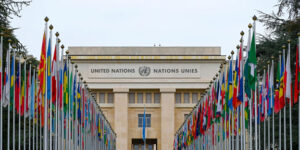
Trump’s Cuts are Pushing the UN out of Geneva. That may be a Win

Trump's Cuts are Pushing the UN out of Geneva. That may be a Win

Budget shortfalls could force the organization to move closer to the communities that it’s meant to serve.

By JB Bae
FORT COLLINS, Colorado USA, May 25 2026 – The $1.2 billion renovation of the Palais des Nations was intended to reaffirm Geneva’s centrality to the multilateral system. Instead, the city’s international quarter is emptying.

The World Health Organization (WHO) has cut hundreds of positions. The U.N. Children’s Fund (UNICEF) is relocating core administrative roles to Rome and Budapest. Other agencies are scaling back or relocating operations. The United States, which funds roughly a quarter of the U.N.’s regular budget, now owes approximately $2.2 billion, about 95% of all unpaid contributions to the organization.

Many will read this as a harbinger of the decline, or perhaps even the demise, of the U.N. system. Yet the crisis in Geneva may be creating the conditions for a more resilient multilateralism.

Critics claim that American taxpayers subsidized a U.N. bureaucracy hostile to their interests, one lacking accountability and captured by priorities divorced from its founding purposes. There is some truth to this. However, these arguments have marginalized those who wish to refound the U.N. system, rather than dismantling multilateralism wholesale.

The erosion of U.S. funding may be doing what decades of reform efforts could not: forcing a realignment of the U.N.’s structure with its mission. Numerous proposals, secretary-general initiatives, and expert panels have failed to produce meaningful change.

The U.N.’s own 2021 Integration Review, drawing on input from over 200 staff members across the organization, found that institutional insulation undermined impact, calling for more decentralized decision-making and reforms responsive to field realities. Member states had pressed for the same for decades.

Meanwhile, Geneva came to embody the distance between those running the institution and the constituencies they were meant to serve. The compensation structure tells part of the story. Bureaucrats enjoyed tax-free salaries, exceptionally generous pension arrangements, housing allowances pegged to one of the world’s most expensive cities, business-class travel, and education grants that cover most of the cost of elite international-school tuition in Geneva, where annual fees often reach $45,000 per child per year.

One study of United Nations High Commissioner for Refugees (UNHCR) operations found spending of roughly $600 per refugee annually (around $800-850 in today’s dollars). U.N. reimbursements for a single child’s school fees in Geneva, in other words, could support dozens of refugees for a year. These arrangements are not reserved for senior leadership. They define the terms of employment for the typical international civil servant.

These terms apply to a substantial workforce. Switzerland hosts roughly forty international organizations that employ more than 25,000 people, most concentrated in the Lake Geneva region. The World Health Organization, the largest, employs roughly 2,400 people at its Geneva headquarters and operated on a biennial budget of $5.3 billion for 2026-27 before recent cuts. The International Labour Organization (ILO), UNHCR, the World Trade Organization (WTO), and others maintain significant presences in Geneva.

Subscribe now to our weekly round-up and don’t miss a beat with your favorite RS contributors and reporters, as well as staff analysis, opinion, and news promoting a positive, non-partisan vision of U.S. foreign policy.

When the U.N. Secretary-General’s office issued a memo in April 2025 directing Geneva and New York to identify posts for relocation to lower-cost duty stations, the Geneva staff union’s response was telling: its official statement declared the union “alarmed,” hundreds of staff demonstrated on International Workers’ Day to protect their Geneva postings, and unions defended housing subsidies, education grants, and tax exemptions as essential. These numbers and reactions reflect the insulation of much of Geneva from the realities the institution nominally exists to address.

Yet the crisis is strengthening the position of those within the system who have long called for change. The U.N. Children’s Fund (UNICEF)’s consolidation of regional functions to Bangkok, the expansion of U.N. agency operations in Nairobi, and shifting administrative functions to lower-cost duty stations all reflect a shift toward where the work actually is. Technology and the remote collaboration it enables make justifying the Geneva-centric model even more difficult. What once required flights to Geneva can now happen across multiple continents simultaneously.

Simply relocating institutions to less costly settings, however, risks reproducing Geneva’s pathologies — insulated professional communities, compensation structures detached from local conditions, and organizational cultures oriented more toward one another than toward the populations they serve. More than simply moving offices, structural reform requires confronting how these institutions are staffed, incentivized, and embedded in the political contexts in which they operate.

A more promising direction is aligning institutions with the political support and capacity of host nations. This goes beyond decentralization and proximity to need, toward placing authority where capacity and political will already exist. Former aid recipients that have become donors and regional powers in their own right — Poland, Chile, and South Korea among them — are natural candidates for anchoring this kind of multilateralism. Having navigated conflict, development, refugee flows, and political transition themselves, they bring the political legitimacy and operational credibility that Geneva-centered bureaucracies cannot replicate.

The substance of the changes also matters for the legitimacy of the international order. A multilateral system whose centers of decision-making remain in Geneva, New York, and a handful of donor capitals is vulnerable to the accusation that it represents a historical moment that has long passed. Institutions whose operational weight sits closer to the communities they serve, staffed by professionals embedded in supportive settings, are harder to displace. What survives will be better able to compete for relevance in a more contested world order.

Geneva will survive this crisis as a conference center for highest-stakes diplomacy and backroom dialogues that only physical proximity can enable. But what emerges beyond Geneva, in the field offices of agencies closer to the populations they serve and potentially in the hands of actors with the legitimacy and experience to carry multilateralism forward, may prove closer to what the system was always intended to be.

Many of the structural problems that have long plagued the U.N. will remain. The shifts now under way will not solve them. But they change where influence accumulates, and who shapes the decisions that matter. This new multilateralism may prove more resilient, more legitimate, and harder to hold captive to the politics of any single donor.

JB Bae is an assistant professor of political science at Colorado State University. His research addresses issues in international security and foreign policy, with a focus on East Asia. He received his PhD from UCLA.

The views expressed by authors on Responsible Statecraft do not necessarily reflect those of the Quincy Institute or its associates.

Source: Responsible Statecraft

IPS UN Bureau


!function(d,s,id){var js,fjs=d.getElementsByTagName(s)[0],p=/^http:/.test(d.location)?’http’:’https’;if(!d.getElementById(id)){js=d.createElement(s);js.id=id;js.src=p+’://platform.twitter.com/widgets.js’;fjs.parentNode.insertBefore(js,fjs);}}(document, ‘script’, ‘twitter-wjs’);  


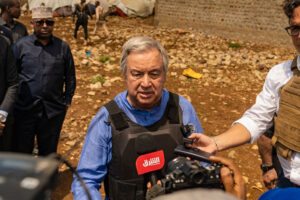
Faced with a Cash Crisis, UN is Urging Senior Staff to Forgo First Class & Business Class Travel

UN Secretary-General Antonio Guterres. Credit: UN Photo/Sourav Sarker

By Thalif Deen
UNITED NATIONS, May 25 2026 – The United Nations has had a longstanding tradition, described by some as a “privilege”, where most senior staffers are entitled to highly-expensive First Class or Business Class seats on trips worldwide.

But with the world body facing a severe cash crisis –and demands by the Trump administration calling for drastic cost-cutting—another privilege is likely to end up on the chopping block.

https://www.un.org/sg/en/content/senior-management-group

Speaking off-the-record, a former UN official told Inter Press Service: “On the rare occasion I travelled with the UN for work, I was always shocked by the enormous amounts paid for air tickets. I find it interesting to see that it took the UN a deep financial crisis to invite the staff to a ”voluntary” downgrade”

As part of the Organization’s ongoing efforts to reduce travel costs, and in response to the General Assembly’s call to strengthen measures to promote voluntary downgrades from business or first-class travel entitlements, the UN’s Human Resources Services Division (HRSD), in collaboration with the Travel and Transportation Section (TTS), in the Department of Operational Support (DOS), has launched the Voluntary Downgrade Pilot which introduced a set of new incentives to encourage voluntary downgrade for official air travels by United Nations travelers.

“The initiative is designed to encourage United Nations travelers to voluntarily downgrade from business class to premium economy, or equivalent cabins, by offering eligible travelers, a series of additional incentives aimed at maintaining comfort and convenience, while generating cost savings for the Organization,” says a circular released 18 May.

Meanwhile, in the latest figures released in one published report, the UN spent approximately $319 million on staff travel in one recent reporting year, covering roughly 98,000 trips.

Of those trips:

    • About 12,000 flights were business class
    • Only 51 flights were first class

The report also noted that the Secretary-General has recommended curbing first-class travel for senior officials.

Current UN travel rules state that:

    • Most staff up to D-2 level normally travel economy, though some long-haul exceptions permit a higher class.
    • Under-Secretaries-General (USGs) and Assistant Secretaries-General (ASGs) are entitled to “the class immediately below first class,” which in practice is generally business class on most airlines.

So, while the UN’s total annual travel spending has been in the range of hundreds of millions of dollars, the portion specifically attributable to senior officials flying business or first class is likely only a fraction of that total — probably in the tens of millions rather than hundreds of millions annually, based on the relatively small number of first-class tickets reported. The UN has steadily tightened rules on premium travel over the years, according to the report.

In addition to the existing entitlements for travelers, such as reimbursement for advance seat selection, in-flight meals and beverages, and one additional checked bag, the new incentives, according to the staff circular include:

Rest Periods (subject to supervisory approval)

    • One additional day of rest upon arrival at the duty station, with up to one day of additional Daily Subsistence Allowance (DSA), if arriving early.
    • The option to remain at the official business location for one extra day prior to return, with DSA, if this reduces overall ticket cost.
    • One additional calendar day of rest upon return to duty station (no DSA).

Reimbursement of costs for

    • Lounge access at departure and connection points for both outbound and inbound travel (where applicable).
    • Purchase of “extra space seating” including “couch style” in economy class, if offered by the airline.

The circular appeals to staffers to consider the above incentives when planning official travel, ”and should you opt for voluntary downgrade, you may select any combination, provided that the total cost is less than the entitled business class fare, keeping in mind, any additional rest periods selected under the pilot will remain subject to the approval of your first reporting officer.”

How to get started

“We encourage all staff to take advantage of these options and contribute to more cost-effective travel practices across the Organization”.

HRSD in the Office of Support Operations (OSO) and TTS in the Facilities and Commercial Acitivites Service (FCAS) within the Division of Administration (DOA), are part of the Department of Operationsl Support (DOS).

Read about DOS on iSeek or our website and follow us on LinkedIn and X.

IPS UN Bureau Report


!function(d,s,id){var js,fjs=d.getElementsByTagName(s)[0],p=/^http:/.test(d.location)?’http’:’https’;if(!d.getElementById(id)){js=d.createElement(s);js.id=id;js.src=p+’://platform.twitter.com/widgets.js’;fjs.parentNode.insertBefore(js,fjs);}}(document, ‘script’, ‘twitter-wjs’);  


Japan and Kazakhstan: A Partnership for an Age of Energy Insecurity and Nuclear Risk

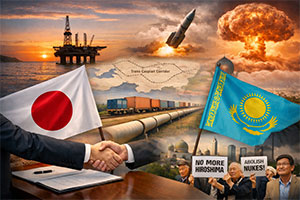
Astana’s futuristic skyline and Japan’s urban landscape converge with symbols of clean energy, connectivity and peace, reflecting a partnership shaped by smart-city cooperation, energy security, and shared memories of nuclear suffering. Credit: INPS Japan

By Katsuhiro Asagiri
TOKYO, Japan, May 25 2026 – The relationship between Japan and Kazakhstan is often described in terms of diplomacy, investment and regional cooperation. But at a time of growing geopolitical uncertainty, it deserves to be understood in broader terms: as a partnership linking cities, resources, technology and peace.

Kisho Kurokawa

Kazakhstan’s capital, Astana, offers a powerful symbol of that evolving relationship. Built on the vast steppes of Central Asia, the city is often described as a futuristic capital, with glass-and-steel towers, broad boulevards and monumental architecture reflecting the aspirations of a young state seeking to define its place in the 21st century.

For Japan, however, Astana is not simply a distant capital. Its master plan was shaped in part by the late Kisho Kurokawa, one of Japan’s leading architects, who sought to combine Kazakhstan’s nomadic heritage, harsh natural environment and state-building ambitions with forward-looking urban design. That historical connection is now taking on new meaning as Japan and Kazakhstan expand cooperation in smart cities, green technologies, energy security and nuclear disarmament.

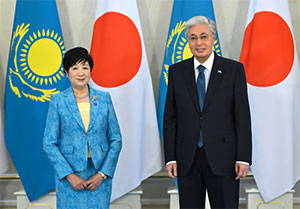
On May 22, Kazakhstan’s President Kassym-Jomart Tokayev met Tokyo Governor Yuriko Koike in Astana to discuss cooperation in smart city development, digital technologies, finance, education, emergency response and sustainable urban management. Tokyo, one of the world’s most densely populated metropolitan areas, has developed advanced systems in public safety, disaster preparedness, transportation and administrative services. For rapidly growing Astana, Tokyo’s experience provides a valuable reference point.

Akorda

This is not merely technical cooperation. It points to a new form of urban diplomacy, in which cities work directly together to address shared challenges such as climate change, disaster risk, energy efficiency, digital governance and sustainable growth. In an age when many of the world’s most urgent problems are experienced first and most directly in cities, such cooperation matters.

Yet the deepening Japan-Kazakhstan relationship cannot be explained by urban cooperation alone. Behind it lies a more urgent geopolitical reality: instability in the Middle East and the resulting anxiety over energy security.

Japan has long depended heavily on the Middle East for crude oil. Tensions around Iran and the Strait of Hormuz pose risks that directly affect Japan’s economy and daily life. For Tokyo, diversifying energy sources, critical mineral supplies and transport routes is no longer simply a matter of trade policy. It has become a central element of economic security.

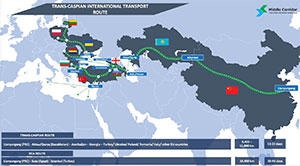
Middle Corridor. Photo credit: TITR

In this context, Kazakhstan has gained renewed importance. The country is rich in oil, natural gas, uranium and critical minerals, while also serving as a logistical hub linking Central Asia and Europe. At the “Central Asia plus Japan” summit held in Tokyo in December 2025, strengthening critical mineral supply chains and supporting the Trans-Caspian Corridor — a route connecting Central Asia and Europe without passing through Russia — were placed at the center of regional cooperation.

For Japan, rare earths, lithium and other critical minerals are essential to batteries, electronics, renewable energy systems and next-generation industries. Diversifying both sources of supply and transport routes is therefore an energy policy, an industrial policy and a security policy at once. Astana is increasingly becoming an important platform for Japan’s engagement with Central Asia.

Semipalatinsk Former Nuclear Weapon Test site. Credit: Katsuhiro Asagiri

The logic of this partnership is not limited to resources. It also extends to technology and sustainability. During Koike’s visit, a Kazakhstan-Japan business event brought together Japanese companies specializing in decarbonization, renewable energy, drone technologies and carbon credit solutions. On the Kazakh side, interest in Japanese expertise has been growing in renewable energy, artificial intelligence and digital transformation.

Urban development, environmental technologies, resource cooperation and logistics infrastructure are no longer separate policy fields. They are becoming part of a wider strategic framework in which Japan and Kazakhstan can complement each other: one with advanced technology and urban management experience, the other with resources, geography and a young capital still in the process of defining its future.

But there is a deeper layer to this relationship that should not be overlooked: the memory of nuclear suffering.

Japan is the only country to have suffered atomic bombings in war, in Hiroshima and Nagasaki. Kazakhstan endured severe radiation damage from repeated Soviet nuclear tests at the Semipalatinsk test site, where more than 450 nuclear tests were conducted between 1949 and 1989, leaving long-term consequences for local communities and public health.

In 1991, Kazakhstan closed the Semipalatinsk test site. After the collapse of the Soviet Union, it gave up one of the world’s largest nuclear arsenals remaining on its territory and chose the path of a non-nuclear-weapon state. That decision has become a defining feature of Kazakhstan’s foreign policy.

Japan and Kazakhstan both know, not as an abstract matter of security theory but through historical experience, what nuclear weapons can inflict on human beings, communities, the environment and future generations. This shared memory gives the bilateral relationship a distinct ethical foundation.

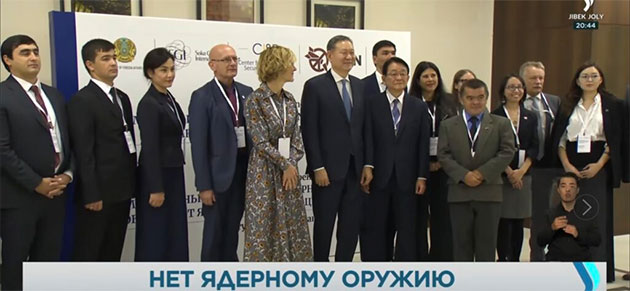
That memory has also shaped sustained cooperation among governments, civil society and international organizations. INPS Japan has reported on nuclear disarmament-related conferences and events involving Kazakhstan’s Ministry of Foreign Affairs, the International Committee of the Red Cross, the Center for International Security and Policy, the International Campaign to Abolish Nuclear Weapons and Soka Gakkai International.

A Group photo of participants of the regional conference on the humanitarian consequences of nuclear weapons and nuclear-free-zone in Central Asia held on August 29, 2023. Photo Credit: Jibek Joly TV Channel

One notable example was the anti-nuclear exhibition “Everything You Treasure — For a World Free From Nuclear Weapons,” jointly organized in Astana by SGI, ICAN and Kazakhstan’s Center for International Security and Policy. Held in September 2022 at Keruen Mall in central Astana, the exhibition used photographs, illustrations and graphics to educate young people about the dangers of nuclear weapons, from the atomic bombing of Hiroshima to the continuing humanitarian consequences of nuclear arms.

A documentary produced by CISP, a Kazakh NGO, with support from SGI.

Such initiatives are important because nuclear disarmament cannot be left to diplomats alone. If the memory of Hiroshima, Nagasaki and Semipalatinsk is to shape policy, it must also be passed to younger generations. Exhibitions, survivor testimony, documentaries and civil society campaigns help ensure that nuclear weapons are discussed not only as instruments of deterrence, but also as weapons with catastrophic human, environmental and intergenerational consequences.

In 2023, a regional conference in Astana addressed the humanitarian impact of nuclear weapons, the Central Asian Nuclear-Weapon-Free Zone, testimony from nuclear test victims, and victim assistance and environmental remediation under the Treaty on the Prohibition of Nuclear Weapons. Unlike debates that frame nuclear weapons mainly in terms of deterrence or national prestige, such forums place affected people, their families, communities and environment at the center.

A documentary on Kazakhstan’s nuclear test victims, I Want to Live On: The Untold Stories of the Polygon, produced by Kazakhstan’s CISP with support from SGI, has also helped bring the testimonies of second- and third-generation victims in the Semey region to international audiences. Together with workshops involving the United Nations Office for Disarmament Affairs and discussions on cooperation among nuclear-weapon-free zones, these efforts keep the humanitarian impact of nuclear weapons at the center of global disarmament debates.

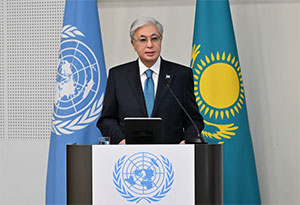
Akorda.kz

In 2025, President Tokayev delivered a lecture at the United Nations University in Tokyo, warning that nuclear risks were again on the rise. Referring to Hiroshima, Nagasaki and Semipalatinsk, he stressed that Japan and Kazakhstan are both countries that understand the catastrophic consequences of nuclear weapons.

That message should be taken seriously. Japan and Kazakhstan do not occupy identical security positions. Japan continues to rely on the United States’ nuclear deterrence as part of its security policy, while Kazakhstan, having renounced nuclear weapons, is a member of the Central Asian Nuclear-Weapon-Free Zone. Yet both countries share common ground in seeking to transform the memory of nuclear harm into action for international peace.

Japan and Kazakhstan Draw Closer as Iran Crisis Reshapes Energy and Security Priorities. Credit: INPS Japan

This is why practical cooperation in smart cities, green technologies, energy transition, critical minerals and the Trans-Caspian Corridor carries meaning beyond ordinary transactions. It rests on a wider foundation: mutual trust, shared vulnerability and a common responsibility to help build a safer and more sustainable future.

At a time when crises in the Middle East are shaking the global energy order and nuclear risks are again moving to the forefront of international politics, the Japan-Kazakhstan relationship is no longer merely a story of friendship. It reflects Japan’s own choices in an age of uncertainty: whether to approach Central Asia only as a source of resources, or as a region with which it can build a broader partnership linking cities, technology, energy security and peace.

Astana, the futuristic capital shaped in part by a Japanese architect, has become more than a symbol of Kazakhstan’s ambitions. It is also a reminder that the future of international cooperation will depend not only on markets and infrastructure, but on memory, responsibility and the courage to imagine security beyond fear.

This article is brought to you by INPS Japan in collaboration with Soka Gakkai International in consultative status with UN ECOSOC.

IPS UN Bureau


!function(d,s,id){var js,fjs=d.getElementsByTagName(s)[0],p=/^http:/.test(d.location)?’http’:’https’;if(!d.getElementById(id)){js=d.createElement(s);js.id=id;js.src=p+’://platform.twitter.com/widgets.js’;fjs.parentNode.insertBefore(js,fjs);}}(document, ‘script’, ‘twitter-wjs’);  


CGTN: Putting people first: A guiding principle in China's governance

BEIJING, May 25, 2026 (GLOBE NEWSWIRE) — Ahead of this year's Spring Festival, Chinese President Xi Jinping visited a community canteen at an apartment complex for seniors to learn about local efforts to improve public convenience services and elderly care. He also had a warm conversation with delivery workers taking a break at the canteen, asking about their work and daily lives.

Xi stressed that Party committees and governments at all levels must care for them and provide better services to support their lives, work and education.

The year 2026 marks the 105th anniversary of the founding of the Communist Party of China (CPC). Xi once pointed out that people represent the nation, and the nation is made up of people. He also said the survival of a party depends on the support of its people, adding that with people's confidence and support, the CPC is invincible in the face of any obstacles.

Since the 18th CPC National Congress in 2012, nearly 100 million people have been lifted out of poverty, China has completed the building of a moderately prosperous society in all respects, and the country has established the world's largest systems for education, social security, healthcare and urban housing support.

Access to education at all levels has reached or surpassed the average for middle- and high-income countries. Basic medical insurance coverage has remained above 95%, life expectancy has risen above 79 years, and the middle-income group now exceeds 400 million people.

The emphasis on putting people first is more evident as China is in the first year of the 15th Five-Year Plan period (2026-2030). More than one-third of the plan for national economic and social development is related to people's livelihoods, covering employment, income, education, healthcare, elderly care and childcare – issues that are of the greatest and most immediate concern to the public.

Regarding food delivery couriers, ride-hailing drivers and e-commerce workers, known as the “new forms of employment” and representing a fast-growing part of China's labor market that has emerged with the rise of the internet and digital economy, the plan stressed efforts to boost the sound development of flexible and new forms of employment and support people in flexible and new forms of employment to participate in insurance schemes for employees and further improve the policies for transferring social security accounts.

Zhang Linshan, a researcher at the Academy of Macroeconomic Research under China's National Development and Reform Commission, said the 15th Five-Year Plan sends a strong signal that China remains committed to a people-centered approach, with high-quality development focused on improving the quality of people's lives and ensuring that development outcomes benefit all people more broadly and more fairly.

Zhang said this also reflects China's shift in development from pursuing whether there is growth to pursuing whether growth is of higher quality.

The goal is to ensure that economic growth and improvements in people's livelihoods advance in tandem, creating a virtuous cycle and enabling people to feel more secure and more confident about the future, Zhang added.

https://news.cgtn.com/news/2026-05-24/Putting-people-first-A-guiding-principle-in-China-s-governance-1NpJlbWbCUM/p.html


GLOBENEWSWIRE (Distribution ID 9725899)