Africa’s Golden Future

Africa’s Golden Future

Credit: The African Development Bank Group

 
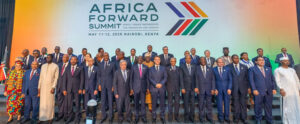
Excerpts from remarks by Kristalina Georgieva, Managing Director, International Monetary Fund (IMF), at the Africa Forward Summit, Nairobi, May 11-12.

By Kristalina Georgieva
NAIROBI, Kenya, May 18 2026 – It is very appropriate that this Africa Forward Summit is being held in Kenya. Two weeks ago, a Kenyan marathon runner, Sabastian Sawe, did what had been considered impossible: by running a marathon in under two hours! What we have set ourselves here is also a marathon—and we must show the same resilience and perseverance that Mr. Sawe did.

Because Africa is not just another region. It is the future; it is where the world will acquire its next growth engine.

And it must do so in a more complex and uncertain global environment, when imbalances are growing yet again. Export-led economies reduce the space for Africa to integrate into global supply chains. At the other end, countries with large deficits absorb a disproportionately large share of financial resources, limiting the availability of capital for the rest of the world.

But the most dramatic imbalance is in demographics—between aging and youthful societies, with capital mostly in the first group and growth potential in the second.

What should the countries of Africa do to build resilience against a world of more frequent shocks and secure the bright future that this continent so richly deserves?

Kristalina Georgieva

First, make better use of their own savings for growth enhancing investments—today we heard President Ruto talk of $4 trillion in domestic assets that Africa is underutilizing. But even more important: African countries must become more attractive to the world’s savings—to the $126 trillion in global equities, $145 trillion in fixed income—which today flow mostly to advanced and more-established emerging market economies and are hesitant to go where the population growth is fastest.

This requires action at home and stepped-up support from Africa’s partners.

At home, building economic and social resilience must be grounded in strong institutions and sound policies, creating the conditions for private sector-led growth. From credible macroeconomic policy to decisive steps against corruption and reforms to slash red tape, countries need to work to win investors’ trust.

Africa also has to speed up trade and economic integration. Just eliminating tariff and non-tariff barriers in line with the continental free trade area can increase income per capita by more than 10 percent—with more purchasing power the continent becomes more competitive.

And Africa must deal decisively with the burden of debt. Restructure or reprofile when debt is unsustainable; avoid non-productive borrowing; and shift the balance from debt to equity as much and as quickly as possible. For this, it is paramount to develop deeper, more diversified capital markets.

Under France’s G7 presidency we have made the issue of global imbalances a priority for our work. Africa benefits when the Fund advocates for fair treatment. To reflect our firm belief in Africa’s growth potential, we have also pursued multiple reforms to expand our support for the continent.

First, we put our money where our mouth is. We have vastly expanded our concessional lending for Africa, from $8 billion pre-COVID to $36 billion today. Thanks to the SDR channeling of $109 billion, which President Macron and leaders from Africa championed, we can deploy substantially more concessional lending. To put it simply, thanks to the SDR channeling we can do more as ODA does less.

And we make sure our financing unlocks support from our development partners and helps attract private funding.

Second, we reformed how we do our programs—as a genuine partnership with our members. We don’t just talk the talk on country ownership; we walk the walk—we listen, we adapt, we show flexibility when warranted.

There are many good examples across Africa of homegrown reform programs that we support, of countries maturing in their policy choices—Benin, Côte d’Ivoire, Egypt, Ethiopia, Ghana, Morocco, Rwanda, Zambia, to name a few.

And yes, good policies pay off. Closing half the gap vis-à-vis emerging market economies in areas like regulation and governance can raise sub-Saharan Africa’s output by up to 20 percent within a decade.

Third, we pursue reforms of the international debt architecture, with our efforts extending to the Global Sovereign Debt Roundtable, our new debt playbook for country authorities, the London Alliance, and proactive use of our good offices to help forge consensus.

Lastly, at the IMF we are delivering more voice and representation for Africa in our governance and resource allocation. We have established a third African chair at our Board and a strong focus on the continent in our work.

Our members are committed to addressing underrepresentation in the 17th quota review. And we work with regional institutions—the African Union, the African Development Bank, the Economic Commission for Africa—to ensure their deep local knowledge helps us better serve our members.

In this world of rapid transformations and repetitive exogenous shocks, there is much that individual countries cannot control. But you can, as they say here in Kenya, keep your own house “spick and span.”

You control your policies, you define your future, and your value proposition—which we will help amplify to the relevant audiences, the rating agencies included.

With the people of Africa in the front seat and we, as partners, firmly with them, I am confident that this continent will achieve its golden destiny.

IPS UN Bureau


!function(d,s,id){var js,fjs=d.getElementsByTagName(s)[0],p=/^http:/.test(d.location)?’http’:’https’;if(!d.getElementById(id)){js=d.createElement(s);js.id=id;js.src=p+’://platform.twitter.com/widgets.js’;fjs.parentNode.insertBefore(js,fjs);}}(document, ‘script’, ‘twitter-wjs’);  



Civilian Casualties Grow Amid Russian and Ukrainian Drone Strikes

Civilian Casualties Grow Amid Russian and Ukrainian Drone Strikes

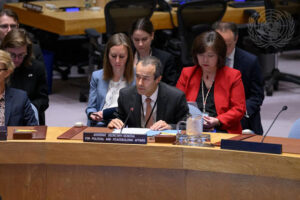
Khaled Khiari, UN Assistant Secretary-General for Middle East, Europe, the Americas, Asia and the Pacific, Department of Political and Peacebuilding Affairs and Peace Operations, addresses the Security Council meeting on maintenance of peace and security of Ukraine. Credit: UN Photo/Loey Felipe

By Oritro Karim
UNITED NATIONS, May 18 2026 – Four years after the start of the Russo-Ukrainian War, 2026 has marked a significant escalation in hostilities, with intensified bombardments from both sides causing immense destruction across the region, complicating humanitarian operations, and deepening an already severe humanitarian crisis. As exchanges of attacks have intensified in recent days, the United Nations (UN) warns that women and girls will be disproportionately impacted as violence disrupts access to basic, lifesaving services.

Last week on May 13, Russian forces launched a massive barrage of approximately 800 drones, targeting western regions of Ukraine, including areas that surround the Hungarian border. Local authorities informed the UN’s country office in Ukraine that the attacks resulted in multiple civilian casualties and extensive damage to critical infrastructure, including energy facilities and railway hubs. Significant destruction was reported in the Rivne, Volyn, and Ivano-Frankivsk regions, where several sites came under fire.

This attack triggered what UN Ukraine described as “one of the most intense and prolonged attacks of the war to date,” with continuous hostilities from Russian forces reported across the country for nearly 24 hours. Violence intensified the following day in Kyiv, where drone and missile strikes targeted major residential neighborhoods and key civilian infrastructure.

Ukrainian authorities reported that at least 140 Ukrainians were killed, including six children, with figures expected to rise as rescue operations continue. Officials also stated that a high-rise residential building in Kyiv’s Darnytskyi district sustained significant damage following a direct strike, leaving numerous residents trapped beneath the rubble.

Approximately 24 civilians were killed and 48 others were injured in the strike, including three children who were found dead. UN Ukraine reported that emergency teams carried out search-and-rescue operations and extinguished fires despite immense risks, as strikes continued to land. That same day, the Office for the Coordination of Humanitarian Affairs (OCHA) reported that a “clearly marked” UN vehicle was struck twice in Kherson City while delivering aid to vulnerable communities.

“Families should always feel safe,” said Bernadette Castel-Hollingsworth, the Office of the United Nations High Commissioner of Refugees’ (UNHCR) Representative in Ukraine. “Mothers should not be waiting to know if their children are alive under the rubble after these missile attacks,” she continued, stressing that attacks that target civilians are a violation of humanitarian law.

According to the UN Human Rights Monitoring Mission in Ukraine (HRMMU) , civilian casualties in Ukraine over the first four months of 2026 were higher than any four-month period recorded in any of the last three years. The Mission found that this is primarily due to a massive rise in the use of long-range weapons, which carry a far greater capacity for destruction and civilian harm, especially when used in densely populated urban areas.

HRMMU found that in April of this year, at least 84 civilians were killed and 628 others were injured as a direct result of long-range weapons use, accounting for approximately 43 percent of the total civilian casualties recorded during that period.

“I deplore the resumption of these large-scale attacks which have resulted in civilian casualties across the country,” said the UN High Commissioner for Human Rights Volker Türk on May 14. “Attacks by long-range weapons are one of the leading causes of civilian casualties in Ukraine. Their expanded use in populated areas will only increase the already mounting toll on civilians,” Turk added, urging for an immediate de-escalation of hostilities.

Ukrainian women and girls have been severely and disproportionately impacted by the war, with the first three months of 2026 marking the deadliest winter for women and girls since the full-scale Russian invasion in 2022. According to figures from UN Women, approximately 199 women and girls were killed between January and March of this year. This follows a 27 percent increase in casualties among women between 2025 and 2024.

More than four years into the Russian invasion, women and girls in Ukraine are facing immense stress under the threats of war and subsequent attacks on energy infrastructure. Credit: UN Women/Aurel Obreja

During a press briefing at the Palais des Nations in Geneva on May 12, UN Women’s Representative in Ukraine Sabine Friezer Gunes informed reporters that attacks on energy infrastructure have devastated mental and physical wellbeing for women across Ukraine, particularly those in caregiving roles. Gunes noted that many of these women are struggling to manage increasing household responsibilities, growing financial pressures, and shrinking access to essential resources, such as reliable electricity.

“Women are significantly more likely than men to report having no backup energy supply during disruptions – 73 per cent of women say that they have no alternative energy sources,” said Gunes. “Nearly eight in ten women’s organisations in Ukraine told UN Women that funding reductions are seriously affecting their work, including some organisations reporting having to reduce the number of women and girls supported by their services. Official donor assistance to support women has reduced, and inequalities in Ukraine are increasing.”

Over the weekend, on May 17, Ukraine launched one of its largest long-range drone offensives against Russia in over a year, mainly targeting Moscow. This attack, described by reporters as retaliation for the missile and drone strikes in Kyiv, killed at least three people and injured 12 others, while local authorities reported damage to several unspecified infrastructure and numerous high-rise buildings.

“Our responses to Russia’s prolongation of the war and attacks on our cities and communities are entirely justified,” said Ukrainian President Volodymyr Zelenskyy in a statement shared to X (formerly Twitter). “This time, Ukrainian long-distance sanctions have reached the Moscow region, and we are clearly telling the Russians: their state must end its war.”

Nigel Gould Davies, a senior fellow for Russia and Eurasia at the International Institute for Strategic Studies, warned that Ukraine’s retaliatory strikes against Russia will only work to exacerbate regional tensions going forward.

“There is no ongoing peace process to disrupt. What (the attack) is more likely to do is add to the darkening cloud of anxiety over Russia, which has developed palpably over the last three or four months,” said Davies. “The fact that Ukraine is reminding the Moscow population that it is vulnerable to these attacks is likely to intensify the mix of concerns now. I see no prospect, though, in the shorter term, that even these factors together will induce Russia to consider the compromises that will be necessary for peace negotiations.”

IPS UN Bureau Report


!function(d,s,id){var js,fjs=d.getElementsByTagName(s)[0],p=/^http:/.test(d.location)?’http’:’https’;if(!d.getElementById(id)){js=d.createElement(s);js.id=id;js.src=p+’://platform.twitter.com/widgets.js’;fjs.parentNode.insertBefore(js,fjs);}}(document, ‘script’, ‘twitter-wjs’);